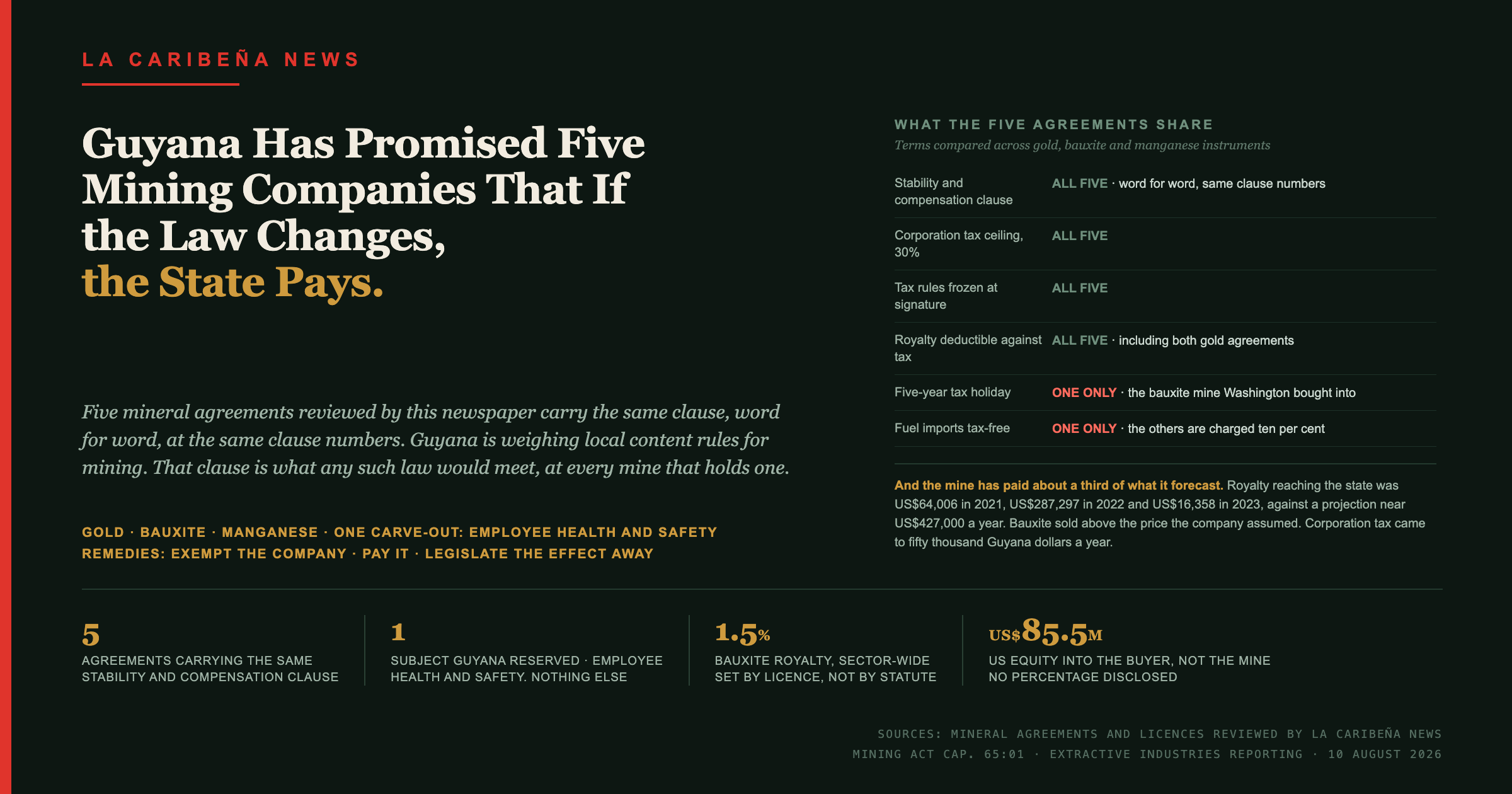
Quick summary: Five Guyanese mineral agreements reviewed by La Caribeña News carry the same clause, word for word: if a new law increases what a company must pay or do, the state restores it to the position it held. Guyana signalled in 2025 it may extend local content rules to mining. That clause is what any such law would meet.
BY LA CARIBEÑA NEWS · 10 AUGUST 2026
Guyana's government has spent the past year edging toward extending local content rules to mining. The governing party's manifesto raised it in August 2025. The Minister of Natural Resources told the Committee of Supply in February 2026 that a dedicated local content law for mining was "something that we are considering", before defending the arrangements already in place. In June the President spoke at Bartica about building a mining company owned by Guyanese.
Five mineral agreements reviewed by this newspaper, covering gold, bauxite and manganese, carry the same undertaking in the same words at the same clause numbers. If Guyana enacts, amends or repeals any law, and the effect is materially to increase the burden of what the company must do or pay, the state has agreed to restore that company to the position it would have held. The routes are listed: exempt it from the new law, pay it money to offset the effect, or pass further legislation to cancel the effect out.
One subject is carved out. Guyana kept a free hand on employee health and safety. Environmental rules, taxes, royalties, rents and local content all sit inside the promise.
What does the clause actually say?
That the law may change, and that the company will not feel it.
The undertaking comes in two parts. The first is a guarantee of legal stability over the agreement, the licences and the authorisations attached to them, which the documents describe as absolute. It provides that they cannot be altered by unilateral government action, whether by legislation, by other action of a government authority, or by a change in how an existing law is interpreted. Changes require the written agreement of both sides.
The second part is the machinery, and it is triggered by Guyana legislating. A clause that promises to exempt a company from a new law, and to pass further legislation cancelling that law's effect, is drafted by people who expect the new law to exist.
Two limits cut against the company. The increase must be material, and the burden of proving the effect lies on the company asserting it.
Is this mine's deal unusual?
Less than the transaction that brought it to attention would suggest.
The mine is the Bonasika bauxite operation, between the Essequibo and Demerara rivers, governed by an agreement made with the Government of Guyana and the Guyana Geology and Mines Commission in November 2011. It is the mine whose refractory bauxite drew a United States defence programme into Guyana, and the mine at the centre of an US$85.5 million United States government investment announced on 7 August.
Set its terms beside the other agreements and most of what looks exceptional is standard.
The royalty is 1.5 per cent. So is every other bauxite operator's, on the licences and agreements reviewed by this newspaper. It is also the rate the gold agreements apply to any valuable mineral other than gold, and the rate manganese carries. The royalty is deductible as an expense against taxable income, and so is every other one in the set, including in both gold agreements. The corporation tax ceiling of thirty per cent, the freezing of tax calculation rules at the date of signature, and the whole stability and compensation apparatus appear in all five.
Two terms are genuinely unusual. The first is a five-year holiday from income and corporation tax. The second is a total exemption from tax on imported fuel, where the other agreements charge ten per cent.
There is also a mechanism in the bauxite agreement that runs one way. If Guyana legislates a lower royalty or a lower rent of general application, this mine's obligation falls automatically to match it. There is no matching provision for an increase. General law reaches this mine when it reduces what the mine pays, and engages the compensation machinery when it does not.
Who sets the royalty in the first place?
Not Parliament, and not the regulations.
The Mining Act fixes no royalty rate for any mineral. It allocates the power to fix one. For a mining licence, which is what every large operator holds, royalty is payable at the rate fixed by the licence, and the rate set by regulation applies only where the licence is silent. For the smaller titles, only the prescribed rate applies.
So the rates that actually operate in Guyanese mining are negotiated, one instrument at a time. Bauxite sits at 1.5 per cent across the sector. Large-scale gold agreements carry 5 per cent up to a gold price of US$1,000 an ounce and 8 per cent above it, and other gold miners pay 5 per cent regardless of price, on the record of the country's extractive industries transparency reporting. Diamonds run at 3 per cent for claims and medium scale and 5 per cent for large-scale licences and permits. Petroleum sits outside this structure entirely: the Stabroek royalty is fixed by contract at 2 per cent, against the 6.25 per cent Suriname signed on the block next door, and it sits alongside a share of profit oil.
The published regulations still carry rates in pre-decimal terms, a dollar a carat for precious stones and a per-tonne figure for bauxite that predates independence. Changing what an existing holder pays is therefore a contractual question before it is a legislative one. The same is true offshore, where ExxonMobil's exploration has added further leads on the terms it already holds.
What does Guyana actually get?
About a third of what the company said it would.
There are two ways to measure what a government takes from a mine, and they produce very different-looking numbers for the same money. One measures the government's share of the mine's profit. The other measures it against everything the mine sells. A mine that looks like it hands over 42 cents in the dollar on the first measure can be handing over 14 cents on the second. Both are correct. They are counting the same money against different things.
Measured the second way, against everything sold, a standard bauxite mine gives its government about 14 cents in every dollar, on the World Bank's own model of a bauxite operation. The owners of Bonasika projected 12 cents in every dollar across the mine's fifteen-year life. Close to normal.
What reached the treasury was smaller. Royalty paid was US$64,006 in 2021, US$287,297 in 2022 and US$16,358 in 2023, against a projection of about US$427,000 a year. Across those three years the mine delivered under a third of the royalty it had forecast, and roughly a third of its total forecast contribution. In no year did it reach half. Those are the only years for which reconciled figures exist; the first production year is absent from the reconciliation.
Most of what did reach the state came out of workers' pay packets rather than the company's pocket. Income tax deducted from wages and from contractors made up 81 per cent of the total, where the projection had put it at 49. Corporation tax came to fifty thousand Guyana dollars a year, roughly two hundred and forty United States dollars.
The two sides do not agree on what was paid. For 2023 the company reported paying GYD 39.5 million in royalty. The government recorded receiving GYD 3.4 million. The gap is logged as unresolved, and it is not a matter of timing or exchange rates.
Guyana has charged far more than this before. In 1974 it put a levy on bauxite pegged to the world aluminium price, worth roughly eight cents in every dollar of the metal's value, matched deliberately to Jamaica's. Its largest foreign producer stopped shipping bauxite.
What happens if Parliament changes the law anyway?
It changes, and the state pays.
The undertaking does not bind Parliament and was not written on the assumption that it could. Under the Constitution, Parliament may make laws for the peace, order and good government of Guyana subject to the Constitution, and the Constitution is the only limit on that power. A commission entering an agreement with a minister's approval cannot add one. A law raising the royalty at any of these mines would be valid and enforceable on the day it commenced.
There is a further point that has not been tested. The Mining Act authorises a mineral agreement that is not inconsistent with the Act, and confines what such an agreement may cover to the grant of a licence, the conditions in it, and how the Commission exercises its own discretion. The Act itself defers to an agreement in only a handful of places, all of them concerning area, parcel counts, renewal geometry and surrender mechanics. None concerns royalty, fiscal terms, or the Commission's core powers.
What the clause creates, then, is not a barrier but a bill. Arbitration is by American Arbitration Association rules, seated in Port of Spain, under Guyanese law, with sovereign immunity from jurisdiction, enforcement and execution expressly waived and any award payable in United States dollars without set-off.
Guyana has no investment treaty with the United States. Negotiations began in 1993 and broke down in 1995. There is none with Canada either. But treaty cover is not the only route: Guyana's investment legislation of 2004 carries a standing consent to international arbitration, and it has already been used against the state in a claim brought in 2021. Arbitration is not hypothetical in the Guyanese resource sector: the International Monetary Fund has pressed the question of cost oil audits and the arbitration that could follow.
Has a Caribbean government done it anyway?
Jamaica did, in the same industry, and it is the closest thing the region has to a rehearsal.
Jamaican bauxite agreements carried undertakings that no further taxes would be imposed. In 1974 the government passed the Bauxite (Production Levy) Act, imposing a levy on all bauxite extracted from the first of January that year. Section 3(1) of that Act did three things at once: it applied notwithstanding anything in any law, enactment or agreement; it provided that no such agreement could be read as derogating from it; and it extinguished any cause of action in respect of anything done under it.
Three American companies went to arbitration at the World Bank's investment disputes centre: Alcoa, Kaiser and Reynolds, all registered on 21 June 1974. Jamaica had filed a notification six weeks earlier seeking to place mineral disputes beyond that centre's reach. It failed, on the ground that a consent already given cannot be unilaterally withdrawn. The claims were discontinued on settlement, two in February 1977 and one that October, so no tribunal ever ruled on the merits. Separately, the government had already agreed in November 1974 to take a 51 per cent share in Kaiser's bauxite mines for J$15 million payable over ten years.
The Act stood. The levy was collected. The money was settled by negotiation.
Guyana went further in the same year. In July 1974 it announced a levy on bauxite modelled on Jamaica's, possibly backdated to the start of the year, and the then President said publicly that the levy would not substitute for nationalisation. It nationalised the Demerara Bauxite Company in 1971 and Reynolds' Guyanese operation in the mid-1970s. Guyana filed the same kind of notification over mineral disputes in July 1974 and withdrew it in September 1987, so the manoeuvre Jamaica attempted is no longer available to it.
Arbitral tribunals have addressed what a clause of this kind does. In a 1979 award against Congo, one held that stabilisation undertakings do not affect a state's legislative and regulatory sovereignty, because the state keeps that sovereignty as against everyone it has not given such an undertaking to, and that their operation is limited to making the change unopposable to the other contracting party, with compensation as the consequence. A 2012 award against Ecuador held that general taxation is a permissible exercise of regulatory power and not an expropriation, that the state was nonetheless obliged to apply a correction factor restoring the contract's economics, and that failing to do so breached the clause. Its sharpest line was about asymmetry: both parties may invoke the clause, but only the state can raise taxes and disregard it.
Does mining already have local content obligations?
Yes, since 1991, and they are thirty years weaker than the petroleum regime.
The Mining Act, Chapter 65:01, as consolidated in 2012, was assented in December 1989 and commenced on 15 July 1991. It provides that a mining licence shall not be granted unless the Commission is satisfied that the applicant's proposals for the employment and training of citizens of Guyana are satisfactory, and that its proposals for the procurement of goods and services obtainable within Guyana are satisfactory. A comparable employment test applies to prospecting licences, with an express ministerial power to waive it where special circumstances exist.
The Act also restricts who may hold what. Prospecting permits are confined to Guyanese individuals, Guyanese partnerships, and companies whose entire issued share capital is beneficially owned by citizens. Large-scale licences granted to an individual require that individual to be a citizen of Guyana or a national of a Caribbean Community (CARICOM) member state, a widening made in 2006. Bodies corporate are treated separately, and the Act expressly contemplates prospecting licences to companies incorporated outside Guyana and mining licences to companies incorporated within it, which is how foreign-owned operators hold Guyanese licences.
What the Mining Act lacks is everything that makes the petroleum law operate. No percentages, no schedule, no annual plan, no filing, no offence. The Commission must be satisfied once, at the moment the licence is granted, and after that nothing is measured.
Set that beside the Local Content Act 2021, which reserves forty categories of service work, requires a qualifying company to be 51 per cent beneficially owned by Guyanese nationals with Guyanese in 75 per cent of senior positions and 90 per cent of the rest, and carries fines to G$50 million. Those obligations, and the categories running from 90 per cent of catering down to 5 per cent of engineering, apply to petroleum and nothing else, and suppliers have described what qualifying under that regime actually demands. Even inside petroleum the schedule has been found to have no category for some of what the operators actually buy.
The agreements carry their own version, and it is softer still. The bauxite agreement requires preference for Guyanese construction firms, for buildings that can be put up with local materials and skills, for Guyanese subcontractors on road construction and transport, and for buying household products and furniture locally. It requires an annual report to the Minister on the proportion sourced locally. There is no percentage, no reserved category and no dedicated penalty, and the obligation is qualified by reasonable efforts and by what is compatible with efficient operations.
Does the state own any of it?
Two of the three bauxite operations, and it earns nothing from either.
Through the National Industrial and Commercial Investments Limited (NICIL), the state holding company, the government holds 30 per cent of Bosai Minerals Group Guyana and 10 per cent of the Bauxite Company of Guyana, on the record of the country's extractive industries transparency reporting. That reporting states that NICIL contributes nothing to Bosai's US$115 million investment programme and received no dividends from Bosai in 2023. It also records that NICIL was asked for its audited financial statements for 2023 and declined to provide them, under a heading dealing with non-compliant reporting. Transparency reporting is itself a live question in the region, where Mexico's suspension from the same standard carried a warning Guyana was invited to read. The Bauxite Company of Guyana has not operated since the Russian aluminium producer RUSAL withdrew in 2020.
At Bonasika the state holds nothing, and on the documents reviewed by this newspaper the arrangement provides for none. That is not a gap in the law. The Mining Act allows a prospecting licence to carry an option for the state or a state agency to take an interest in any resulting mining venture, and requires any such option to be settled before a mining licence is granted. The framework contemplates it. In this case it was not taken.
What did Washington actually buy?
Equity in the buyer, not the mine.
Strategic Bauxite acquired the Bonasika operator on 17 July 2026, terms undisclosed. Three weeks later, on 7 August, the United States Department of Defense, which the current administration also styles the Department of War, announced an US$85.5 million equity investment agreement with Strategic Bauxite USA, LLC through its Industrial Base Analysis and Sustainment programme, alongside US$64.5 million of private co-investment. The stated uses are to acquire and expand the mine, to develop new calcination facilities for primary processing, and to contribute to a follow-on brown-fused alumina plant in the United States. No percentage was disclosed.
Bonasika produces refractory-grade bauxite, used in furnace linings, oil and gas equipment and abrasives, not the metallurgical grade that feeds aluminium smelters. It ships the ore raw, and the calcining that turns it into the finished refractory material is done abroad. Guyana applies one royalty rate to both classes.
The five-year tax holiday in the 2011 agreement runs from the start of commercial production at a sinter plant at Sand Hills. There is no sinter plant at Sand Hills. Calcination has been done outside Guyana, in Louisiana and in Spain, and the American announcement describes the new calcination facilities in the future tense. On the documents reviewed by this newspaper, the clock on that concession has not obviously started, and the money now being put in is money to build the plant that would start it.
What would extending local content to mining cost?
That depends on which mines hold one of these agreements, and the answer is at least five.
Elsewhere, resource economies have been moving in the other direction, and doing it by instrument rather than by intention. Zambia gazetted local content regulations for mining in October 2025, in force from 1 January 2026, reserving 20 per cent of procurement within six months, 25 per cent within a year, 35 per cent within two and not less than 40 per cent within five, with a fifteen per cent margin of preference at bid evaluation and certain non-core goods and services reserved exclusively for local companies. Tanzania has required non-indigenous suppliers to form joint ventures with local partners since 2018; an amendment in September 2025 tightened the requirement, so that the partner must now be wholly owned by Tanzanian citizens and operating in the same line of business, and the joint venture needs approval rather than notification.
Suriname's Minister of Oil, Gas and Environment warned last week that concentrating local content on one sector drains the others. Guyana's own consultations on amending the Local Content Act, running since late 2025, concern adding categories inside petroleum rather than reaching beyond it. And the same manifesto that raised mining local content also promised no increase in royalties, no value added tax on heavy equipment and no tributors' tax.
For any company holding one of these agreements, an obligation that increases what it must pay or do is the thing the clause was written to answer. The remedies run from exemption to payment to further legislation, the increase must be material, and the company carries the burden of proving the effect.
LCN has previously reported on the arrival of the United States Deputy Secretary of State in Georgetown, on what Guyana's gas sector discloses and what it does not, on the long arc of banking and foreign capital in Guyana since 1836, and on Colombian manufacturers looking at the same Guyanese supply gaps.
The data in this article
The title card carries the following.
- The finding. Five Guyanese mineral agreements, covering gold, bauxite and manganese, carry the same stability and compensation undertaking in the same words at the same clause numbers. Source: the agreements, reviewed by La Caribeña News.
- Common to all five. The stability and compensation clause; corporation tax capped at the lower of 30 per cent and the prevailing rate; tax calculation rules frozen at the date of signature; royalty deductible as an expense against taxable income.
- In one agreement only. A five-year holiday from income and corporation tax, and total exemption from tax on imported fuel, where the other agreements are charged ten per cent.
- The carve-out. Employee health and safety is the only subject Guyana reserved. The listed remedies are to exempt the company, to pay it, or to legislate the effect away.
- Bauxite royalty, 1.5 per cent, sector-wide. Fixed by the licence, not by statute: the Mining Act sets no bauxite rate. Source: the agreements and licences, and the Mining Act, Chapter 65:01, section 68(3)(a), as consolidated in 2012.
- A third. Royalty and total payments reaching the state across 2021 to 2023 ran at roughly a third of what the operator projected, while bauxite prices ran above its assumption. Source: Guyana's extractive industries reconciliation reports.
- US$85.5 million. United States equity into the buyer rather than the mine, with no percentage disclosed. Source: United States Department of Defense announcement, 7 August 2026.
Frequently Asked Questions
What does the stability clause in a Guyanese mineral agreement do?
It provides that the agreement and licences cannot be altered by unilateral government action, and that if a new, amended or repealed law materially increases what the company must pay or do, the state will restore it to the position it held. The state may do that by exempting the company, by paying it, or by legislating the effect away. Employee health and safety is the only subject Guyana reserved.
Can Guyana raise the royalty?
Parliament can. The Constitution subjects Parliament's law-making power to the Constitution and nothing else, and an agreement made by a commission with a minister's approval cannot add a limit. What the agreement does is commit the state to make the company whole, so a higher rate would be collected and then answered. Because the rate sits in the mining licence rather than in statute, changing it also takes an Act rather than a regulation.
Is this one mine's special deal?
No. The stability and compensation machinery, the thirty per cent corporation tax ceiling, the freezing of tax rules and the deductibility of royalty appear in all five agreements reviewed by this newspaper. What is unusual at Bonasika is a five-year tax holiday and a total exemption from tax on imported fuel.
Does mining have local content obligations in Guyana?
Yes, but weaker ones than petroleum. Since the Mining Act commenced in 1991 the Commission must be satisfied with an applicant's proposals for employing and training Guyanese and for procuring goods and services within Guyana before a mining licence is granted. There are no percentages, no reserved categories, no reporting duty and no penalty. The Local Content Act 2021, which carries all of those, applies to petroleum alone.
What did the United States government buy?
An US$85.5 million equity stake in Strategic Bauxite USA, LLC, the American company that acquired the mine's operator in July 2026, through a defence industrial base programme, alongside US$64.5 million of private co-investment. No percentage was disclosed. The stated uses include developing calcination facilities, which is the processing step whose commissioning would start the five-year tax holiday in the 2011 agreement.