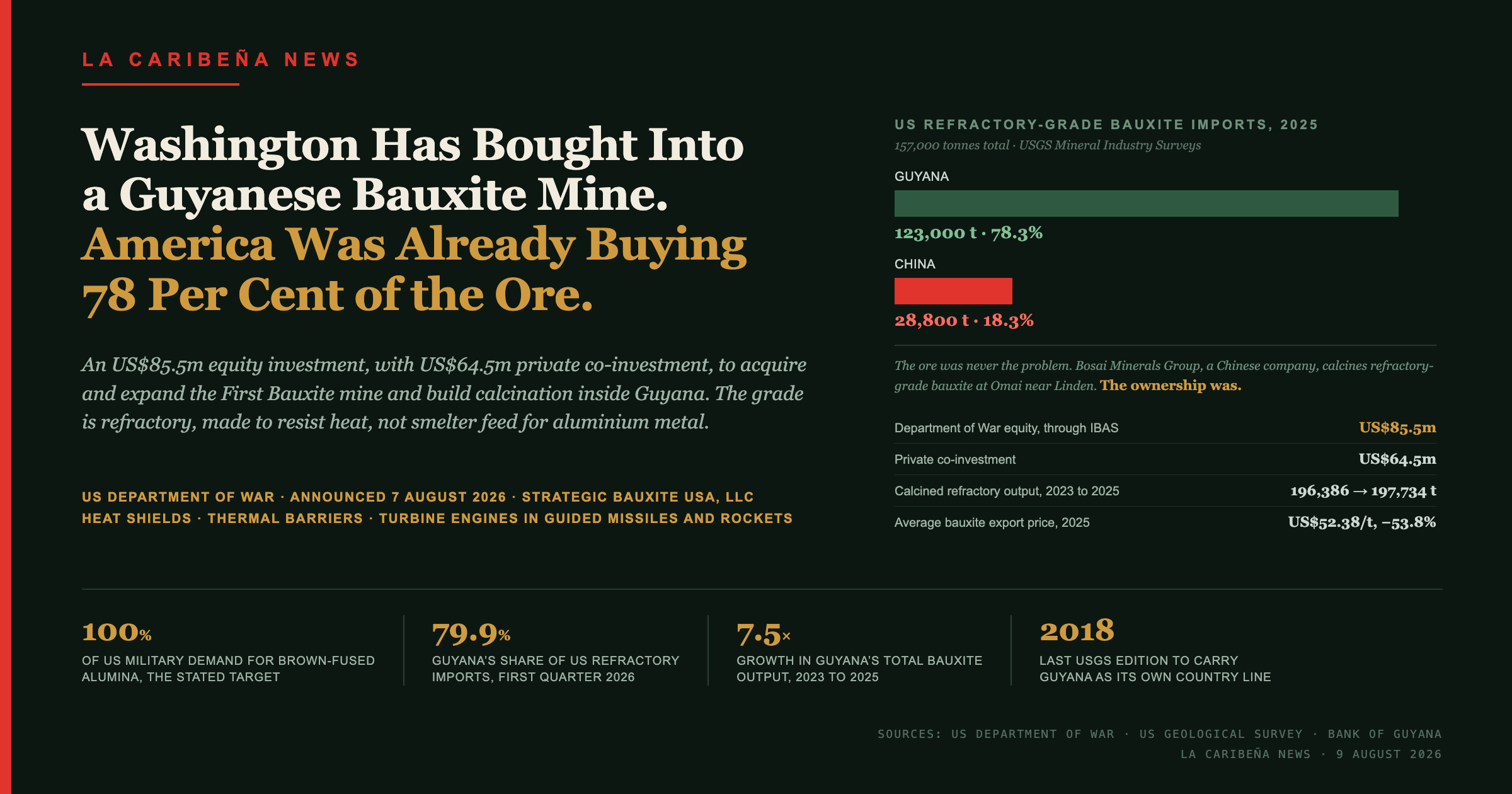
Quick summary: The US Department of War announced on 7 August 2026 an US$85.5 million equity investment in Strategic Bauxite USA, LLC, alongside US$64.5 million in private co-investment, to acquire and expand the First Bauxite mine in Guyana, build calcination capacity there, and contribute to a brown-fused alumina plant in the United States. The stated aim is to end US reliance on Chinese-controlled refractory bauxite.
BY LA CARIBEÑA NEWS · 9 AUGUST 2026
Governments usually describe this kind of transaction in the language of partnership and shared prosperity. The United States Department of War did not.
Its announcement of 7 August states the purpose in the title: to secure the critical refractory grade bauxite supply chain. The money is an equity investment. The mine is in Guyana. And the reason given for both is that the material currently comes, in the department's words, "directly from China or Chinese-owned entities."
What exactly has been agreed?
An US$85.5 million equity investment in Strategic Bauxite USA, LLC, made through the Industrial Base Analysis and Sustainment programme, by the Department of War's Economic Defense Unit working with the Office of the Assistant Secretary of War for Industrial Base Policy.
A further US$64.5 million comes from private co-investment, taking the package to US$150 million.
The department states the funds will be used to acquire and expand the First Bauxite mine in Guyana, to develop new calcination facilities for primary processing, and to contribute to a follow-on project to build a brown-fused alumina facility in the United States.
The Department of State separately funded infrastructure associated with the project, which the release presents as evidence of interagency coordination rather than as a Guyanese aid item.
Two officials are on the record. Michael Cadenazzi, Assistant Secretary of War for Industrial Base Policy, framed it as regional supply: "Our defense readiness relies on secure, regional access to critical minerals. This partnership with Strategic Bauxite through the equity funding and analysis provided by the IBAS program ensures that critical materials in the western hemisphere stay in supply chains that protect the United States and its allies."
George K. Kollitides II, Director of the Economic Defense Unit, put it more bluntly: "The Department of War is no longer waiting for supply chain dependencies to be exploited."
One inconsistency is worth noting for anyone tracking the company. The White House has referred to the counterparty as Standard Bauxite, while the Department of War release names it Strategic Bauxite USA, LLC, abbreviated SBX. The two have not been reconciled publicly.
Why refractory bauxite, and not the kind that makes aluminium?
Because they are different products with different buyers, and only one of them is a defence input.
Most bauxite in the world is metallurgical grade, refined into alumina and smelted into aluminium. Refractory-grade bauxite is calcined at high temperature and used to make materials that survive heat rather than conduct it.
The Department of War lists the applications directly: heat shields, thermal barriers, and turbine engines in guided missiles, rockets, military aircraft and space systems. Beyond defence it names steel and aluminium production, energy infrastructure and industrial furnaces.
The department expects the project, once fully operational, to meet 100 per cent of US military demand for brown-fused alumina and 100 per cent of US demand for refractory bauxite.
That is the whole logic of the investment. Refractory bauxite is a small market by tonnage and an unavoidable one by function, which is why the release describes IBAS equity as targeted at "critical supply chain bottlenecks, particularly where private venture capital has historically been hesitant to invest due to long developmental timelines."
Why Guyana?
Because Guyana is already where this material comes from.
United States imports of refractory-grade calcined bauxite in 2025 totalled 157,000 tonnes. Guyana supplied 123,000 tonnes of it, 78.3 per cent. China supplied 28,800 tonnes. In the first quarter of 2026 the pattern held, with Guyana at 29,400 tonnes of a 36,800 tonne total, or 79.9 per cent. The figures are from the United States Geological Survey's Mineral Industry Surveys.
The dependence has deepened rather than emerged. In 2022 Guyana supplied 68,000 tonnes of a 108,000 tonne US total, about 63 per cent, worth US$16.1 million.
So this is not a decision to start buying from Guyana. It is a decision to own the mine that America already buys from.
The Department of War's phrase carries the rest of the explanation. The dependence it describes is on China "or Chinese-owned entities", and one of the producers of calcined refractory bauxite in Guyana is Chinese-owned. USGS records Bosai Minerals Group (Guyana) Inc. investing US$20 million in a rotary kiln at Omai, near Linden, to produce 170,000 tonnes a year of refractory A-grade super calcined bauxite, alongside US$3 million in a rotary dryer for chemical-grade material.
Read against that, "regional access" in the Cadenazzi quote means something specific. The ore was never the problem. The ownership was.
What does Guyana get?
An operating mine acquired and expanded, calcination capacity built domestically rather than the ore leaving raw, and a foreign owner whose stated commercial future depends on the asset producing.
Calcination is the part worth watching. Processing bauxite into calcined product before export is value added inside Guyana, and it is the difference between shipping rock and shipping a specified industrial material. The release commits the money to building that capacity at the mine, with the brown-fused alumina step happening in the United States.
What it does not get is a local content obligation, because Guyana's does not reach mining. The agreement governing the mine, and four others reviewed by this newspaper, also commits the state to make the company whole if a future law raises what it must pay.
The Local Content Act 2021 states its scope in its own long title: obligations "on persons engaged in petroleum operations or related activities in the petroleum sector". The Act defines petroleum operations as those carried out for, or in connection with, the prospecting for or production of petroleum. Bauxite is outside it.
So the forty service categories reserved for Guyanese-owned companies, the 51 per cent ownership test and the requirement that Guyanese nationals hold 75 per cent of senior roles apply to an oil operator and not to a bauxite miner. A foreign-owned mine has no equivalent statutory floor for Guyanese suppliers or Guyanese managers.
That framework has already shown gaps where a category does not exist for the service being bought inside the sector it does cover. Mining sits outside the Act altogether.
Why does the law cover oil and not bauxite?
Guyana's newest extractive industry has a local content statute. Its oldest does not.
Bauxite has been mined in Guyana since 1917. Petroleum production began in December 2019, and the Local Content Act followed two years later, drafted around the sector that was arriving rather than the sector that was already there. The forty reserved categories read accordingly: rig chandlery, borehole testing, in-water activity permits, offshore catering.
The result is that the same Guyanese supplier, offering the same service, has a statutory floor when the customer is an oil operator and none when the customer is a mine. The same is true of the ownership and management thresholds. A foreign company acquiring a producing Guyanese mine takes on no obligation to source locally, to hold 51 per cent Guyanese ownership, or to fill three-quarters of its senior posts with Guyanese nationals.
The Act has been under review since 2025, with the Local Content Secretariat consulting on widening the reserved categories. Those consultations, on the public record this newspaper can find, concern categories inside the petroleum sector rather than the boundary of the Act itself.
So the boundary stands where it was drawn in 2021, and an American-owned mine is now expanding on the far side of it under a United States defence programme.
What the sector looks like underneath this
Guyana's bauxite industry has grown very fast and moved down the value scale while doing it.
Bank of Guyana figures for 2025 show total bauxite production of 3,908,625 tonnes, against 523,742 tonnes in 2023. That is more than sevenfold in two years.
Almost all of the growth is metallurgical grade, which rose from 30,757 tonnes in 2023 to 3,322,695 tonnes in 2025. Calcined refractory output, the grade this US investment concerns, was 197,734 tonnes in 2025 against 196,386 in 2023. Flat over two years, and down 9.1 per cent against 2024.
The prices confirm the mix. Bauxite export earnings rose 52 per cent to US$144.1 million in 2025, on volume up 1.9 million tonnes, because the average export price fell 53.8 per cent to US$52.38 a tonne from US$113.31.
Guyana more than tripled the tonnage it ships to raise the money it earns by half. Against that, an investment aimed squarely at expanding the high-value calcined grade points in the opposite direction to where the sector has been drifting.
One statistical note for anyone checking. Guyana has not appeared as a separate country line in the USGS Mineral Commodity Summaries since the 2018 edition, and is folded into "other countries". The most recent USGS country figure for Guyana is 706,000 tonnes, for 2022. Reserve figures of 850 million tonnes still in circulation date from 2018.
The data in this article
- Instrument: equity investment, US Department of War, through the Industrial Base Analysis and Sustainment (IBAS) programme.
- Department of War contribution: US$85.5 million. Private co-investment: US$64.5 million. Total US$150 million.
- Counterparty: Strategic Bauxite USA, LLC (SBX). The White House has referred to Standard Bauxite; the two names have not been reconciled publicly.
- Use of funds: acquire and expand the First Bauxite mine in Guyana; new calcination facilities for primary processing; contribution to a follow-on brown-fused alumina facility in the United States.
- Additional: the US Department of State funded associated infrastructure.
- Stated outcome: 100 per cent of US military demand for brown-fused alumina and 100 per cent of US demand for refractory bauxite.
- US refractory-grade calcined bauxite imports 2025: 157,000 tonnes total. Guyana 123,000 tonnes (78.3 per cent), China 28,800 tonnes. Source: USGS Mineral Industry Surveys.
- First quarter 2026: Guyana 29,400 tonnes of 36,800 tonnes, 79.9 per cent.
- 2022 comparison: Guyana 68,000 tonnes of 108,000 tonnes, about 63 per cent, US$16.1 million.
- Bosai Minerals Group (Guyana) Inc., Omai near Linden: US$20 million rotary kiln for 170,000 tonnes a year of refractory A-grade super calcined bauxite. Source: USGS Minerals Yearbook 2019, Guyana.
- Guyana bauxite production: 523,742 tonnes (2023) to 3,908,625 tonnes (2025). Source: Bank of Guyana Annual Report 2025.
- Calcined refractory grade: 196,386 tonnes (2023), 197,734 tonnes (2025).
- Metallurgical grade: 30,757 tonnes (2023), 3,322,695 tonnes (2025).
- Bauxite export earnings 2025: US$144.1 million, up 52 per cent. Average export price US$52.38 a tonne, down 53.8 per cent from US$113.31.
- Guyana has not been a separate line in the USGS Mineral Commodity Summaries since the 2018 edition.
- Local Content Act 2021 scope: petroleum operations and the petroleum sector only, per the Act's long title. Mining is not covered.
Frequently Asked Questions
What did the US Department of War actually announce?
An US$85.5 million equity investment in Strategic Bauxite USA, LLC, through the Industrial Base Analysis and Sustainment programme, announced on 7 August 2026. A further US$64.5 million comes from private co-investment. The funds are to acquire and expand the First Bauxite mine in Guyana, build calcination facilities there, and contribute to a brown-fused alumina plant in the United States.
Why is refractory bauxite treated as a defence material?
Because it is calcined into materials that resist very high temperatures. The Department of War names heat shields, thermal barriers and turbine engines in guided missiles, rockets, military aircraft and space systems, as well as civilian uses in steel and aluminium production, energy infrastructure and industrial furnaces. It is a different product from the metallurgical-grade bauxite used to make aluminium metal.
Was the United States already buying Guyanese bauxite?
Yes, and overwhelmingly. Guyana supplied 123,000 tonnes of the 157,000 tonnes of refractory-grade calcined bauxite the United States imported in 2025, or 78.3 per cent, against 28,800 tonnes from China. The share was 79.9 per cent in the first quarter of 2026.
What does the reference to Chinese-owned entities mean?
The Department of War describes US dependence as being on material sourced from China "or Chinese-owned entities". Bosai Minerals Group, a Chinese company, produces calcined refractory bauxite at Omai near Linden, where USGS records a US$20 million rotary kiln built for 170,000 tonnes a year of that grade.
Does Guyana's Local Content Act apply to a foreign-owned bauxite mine?
No. The Local Content Act 2021 states in its long title that it imposes obligations on persons engaged in petroleum operations or related activities in the petroleum sector, and it defines petroleum operations as those connected with prospecting for or producing petroleum. Mining falls outside it, so the forty reserved service categories and the Guyanese ownership and staffing thresholds do not apply to a bauxite operation.
How large is Guyana's bauxite sector now?
Bank of Guyana figures put 2025 production at 3,908,625 tonnes, up from 523,742 tonnes in 2023. Almost all the growth is metallurgical grade. Calcined refractory output was 197,734 tonnes in 2025, effectively unchanged from 2023. Export earnings were US$144.1 million at an average price of US$52.38 a tonne, down 53.8 per cent.