ANALYSIS
The First Schedule reserves 90 per cent of catering and 100 per cent of customs brokerage for Guyanese firms. It reserves nothing at all of the software that coordinates a 48-well offshore development, because the word does not appear in the Act.
BY LCN NEWSROOM · GEORGETOWN, GUYANA
Quick summary: ExxonMobil Global Projects awarded Viridien's Sercel a one-year contract in August 2026 to run simultaneous operations software at Whiptail, a US$12.7 billion Stabroek development. Guyana's Local Content Act lists 40 reserved categories. None covers operational software, and its targets were set for the end of 2022, so the spend cannot register as a shortfall in any compliance report.
What the title card shows
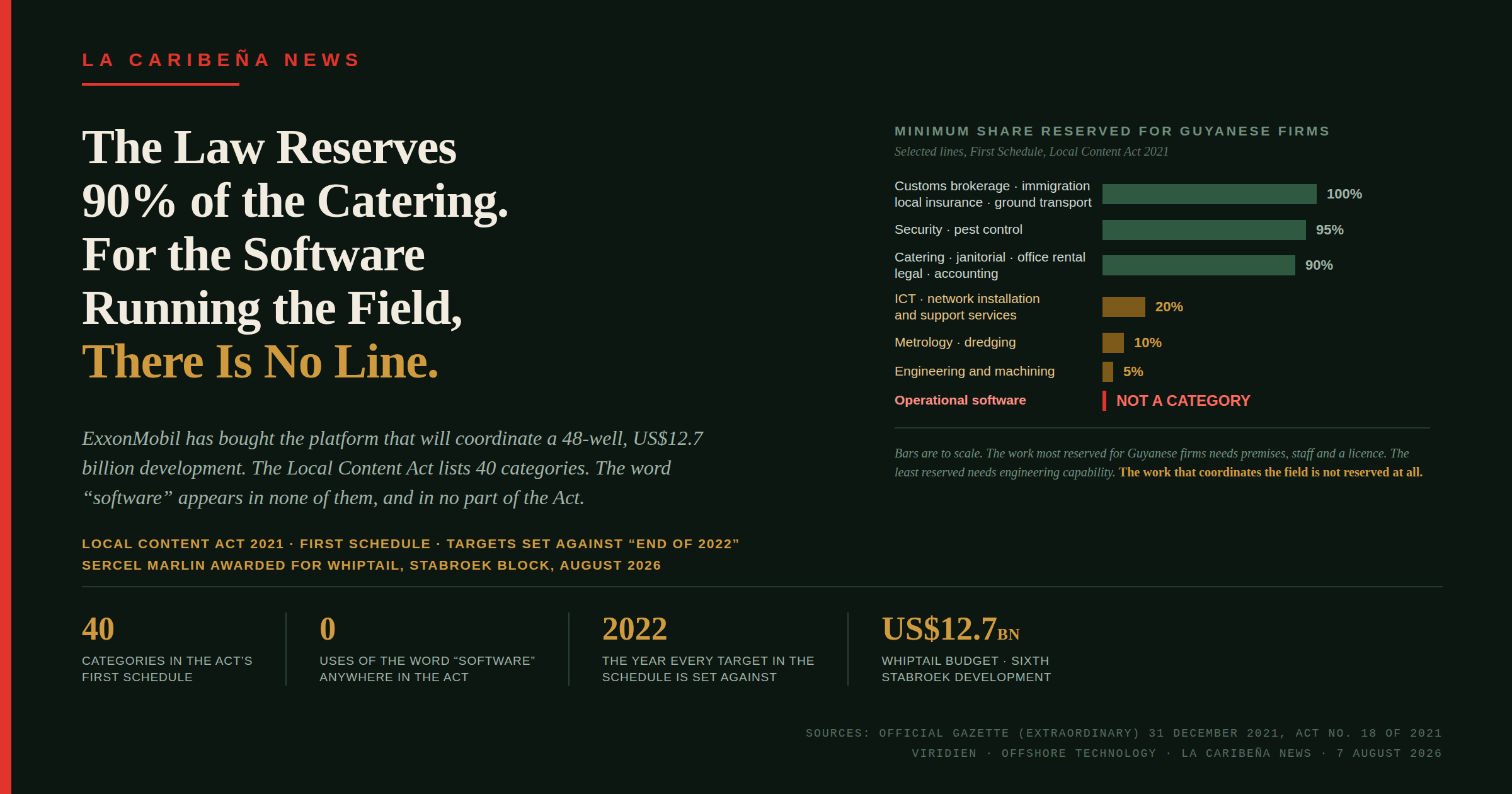
Every data point on the article's title card, in text.
- 40 categories. The number of sectors and sub-sectors in the First Schedule to the Local Content Act 2021. Source: Official Gazette (Extraordinary), 31 December 2021, Act No. 18 of 2021.
- Zero. Occurrences of the word "software" in the Local Content Act 2021. Source: Act No. 18 of 2021.
- 90 per cent. The reserved share for catering services, and for janitorial and laundry services. Source: First Schedule.
- 5 per cent. The reserved share for engineering and machining, the lowest in the schedule. Source: First Schedule.
- 20 per cent. The reserved share for ICT, scoped in the Act as "network installation, support services". Source: First Schedule.
- End of 2022. The date against which every target in the First Schedule is set. Source: First Schedule column heading.
- US$12.7 billion. The reported budget for the Whiptail development, the sixth on the Stabroek Block. Source: Offshore Technology.
What did ExxonMobil award, and to whom?
A one-year software contract, to a French group's monitoring division.
ExxonMobil Global Projects has awarded Sercel a one-year contract to deploy its Marlin platform on the Whiptail development in the Stabroek Block. Sercel is the sensing and monitoring business line of Viridien, the French group formerly known as CGG.
Marlin manages simultaneous operations, known in the industry as SIMOPS. It gives offshore teams a live, time-based geospatial view of concurrent activity, so that vessels and assets can be tracked while several jobs run at once. The deployment covers the pipelay and mooring installation campaigns.
Whiptail is the sixth development on the Stabroek Block. It is budgeted at about US$12.7 billion, designed for roughly 250,000 barrels per day by the end of 2027, and is expected to involve up to ten drilling centres and 48 production and injection wells.
This is not a story about a contract that should have gone elsewhere. No evidence has been presented, and none is asserted here, that a Guyanese firm bid for this work or could have performed it. The question is narrower and more durable: what does Guyanese law say about this class of work? The answer is nothing.
Why does a software contract raise a local content question?
Because the law that governs who supplies the sector does not contemplate it.
The Local Content Act 2021 requires a contractor, sub-contractor or licensee to meet minimum levels of Guyanese participation across a defined list of sectors. That list is the First Schedule, published in the Official Gazette on 31 December 2021.
The schedule contains 40 numbered categories. The word "software" does not appear in the Act. Neither does "digital", "geospatial" nor "simultaneous operations". The class of work ExxonMobil has just bought is not addressed by the statute.
That is not a loophole anyone exploited. It is an absence in the drafting.
What does the First Schedule actually reserve?
Presence, mostly. Less often, capability.
The highest reservations are for work that requires premises, staff or a licence in Guyana.
| Category | Reserved for Guyanese firms |
|---|---|
| Immigration support; work permits and visas; customs brokerage; local insurance; ground transportation of personnel | 100% |
| Pest control; security services | 95% |
| Office space rental; accommodation; janitorial and laundry; catering; lay down yard; accounting; legal services | 90% |
| Surveying; non-hazardous waste; food supply; administrative support; cargo management; trucking; industrial cleaning; marketing and advertising | 75% |
| Ventilation | 70% |
| Storage and warehousing | 60% |
| Equipment rental; onshore building construction; export packaging; manpower and crewing | 50% |
| Onshore structural fabrication; onshore pipe sand blasting and coating | 30% |
| Onshore pipe welding; hazardous waste; ship and rig chandlery; environmental services; medical services | 25% |
| Borehole testing; aviation support; ICT, network installation and support services | 20% |
| Metrology; dredging | 10% |
| Engineering and machining | 5% |
| Operational software | not a category |
Source: First Schedule to the Local Content Act 2021, Act No. 18 of 2021, Official Gazette (Extraordinary), 31 December 2021. Percentages are the minimum levels set against "End of 2022".
The pattern is legible from top to bottom. Catering is reserved at 90 per cent. Engineering and machining is reserved at 5 per cent. Between those two lines sits the difference between selling into the sector and building capability in it.
A schedule that reserves 90 per cent of the catering and 5 per cent of the engineering has decided which parts of the industry Guyanese firms are expected to grow into.
Is there any category that could capture this work?
Three come close, and none of them fits.
ICT, at 20 per cent, is the nearest by name. But the Act scopes it precisely: "ICT, network installation, support services". That is cabling, infrastructure and helpdesk. A geospatial operations platform licensed to an operator is not network installation, and reading it in would stretch the words past what they say.
Metrology, at 10 per cent, covers measurement services. Marlin consumes positional data; it is not a measurement service.
Engineering and machining, at 5 per cent, is the category most likely to be argued. Even if it applied, the reserved share would be the lowest number in the schedule.
So the strongest available reading puts a US$12.7 billion field's coordination software in the 5 per cent line, and the plain reading puts it outside the schedule altogether.
When were these targets set?
For the end of 2022, and they have not been replaced.
Every percentage in the First Schedule sits under a single column heading: "End of 2022". Those are the levels the Act required by that date. They remain the only local content levels fixed in Guyanese law.
The Local Content Secretariat began stakeholder consultations in late 2025 to increase the number of categories and adjust existing targets. On the public record this newspaper can find, no amended schedule has been gazetted.
Guyana has therefore sanctioned its sixth Stabroek development against a table of minimum participation levels written for the end of the year in which the Act commenced, when production was a fraction of what it is now.
What does this mean for a Guyanese firm?
That the ceiling is set somewhere other than the market.
A local content certificate lets a firm compete in a listed category. It does nothing in a category that does not exist. A Guyanese software business cannot be counted toward a target that was never written, cannot appear as a shortfall in a compliance report, and cannot be identified as a gap by a system that is not looking.
This is the same structure this newspaper reported in the case for a business cluster: the services the law most protects are those needing premises, staff and a licence, and the least protected are those needing engineering capability and certification. The software line extends the pattern past its edge, into work the law does not name at all.
It is also the argument made at Bartica this week in a different sector. Reservation on paper is not capability. A percentage protects a market share. It does not build a firm that can hold it.
What would change it?
Four things, and they are questions for the consultation now under way.
1. Should the First Schedule carry a category for operational and industrial software, distinct from ICT network installation and support?
2. Should the schedule's targets be re-dated, given every level in it is set against the end of 2022?
3. Where a category does not exist, is an operator required to report the spend at all, and if not, how would anyone know the size of the market?
4. Does the 5 per cent engineering and machining line reflect current Guyanese capability, or the capability that existed when the Act was drafted?
Frequently Asked Questions
What contract did ExxonMobil award to Sercel?
A one-year contract from ExxonMobil Global Projects to deploy the Marlin platform for simultaneous operations management on the Whiptail development in the Stabroek Block, covering pipelay and mooring installation campaigns.
Does the Local Content Act cover software?
No. The word "software" does not appear in the Act. The First Schedule's 40 categories include ICT scoped as "network installation, support services" at 20 per cent, but no category for operational or industrial software.
Was the Local Content Act breached?
No such claim is made. Where the schedule has no category, there is no minimum level to meet. The issue is what the law omits, not whether anyone complied with it.
What is the lowest reserved share in the schedule?
Engineering and machining, at 5 per cent. The highest are the 100 per cent lines: immigration support, work permits and visas, customs brokerage, local insurance, and ground transportation of personnel.
Are the local content targets being updated?
The Local Content Secretariat began consultations in late 2025 on increasing the categories and adjusting targets. On the public record this newspaper can find, no amended schedule has been gazetted.
---
Disclosure. La Caribeña News is owned by Theon Alleyne, who is a Director of the Guyana Manufacturing and Services Association and Chair of its Services Sub-Sector, and Vice President and Public Relations Officer of the Essequibo Islands-West Demerara Chamber of Commerce and Industry. Both bodies represent firms with an interest in the local content categories discussed above.