By La Caribeña News · 15 August 2026
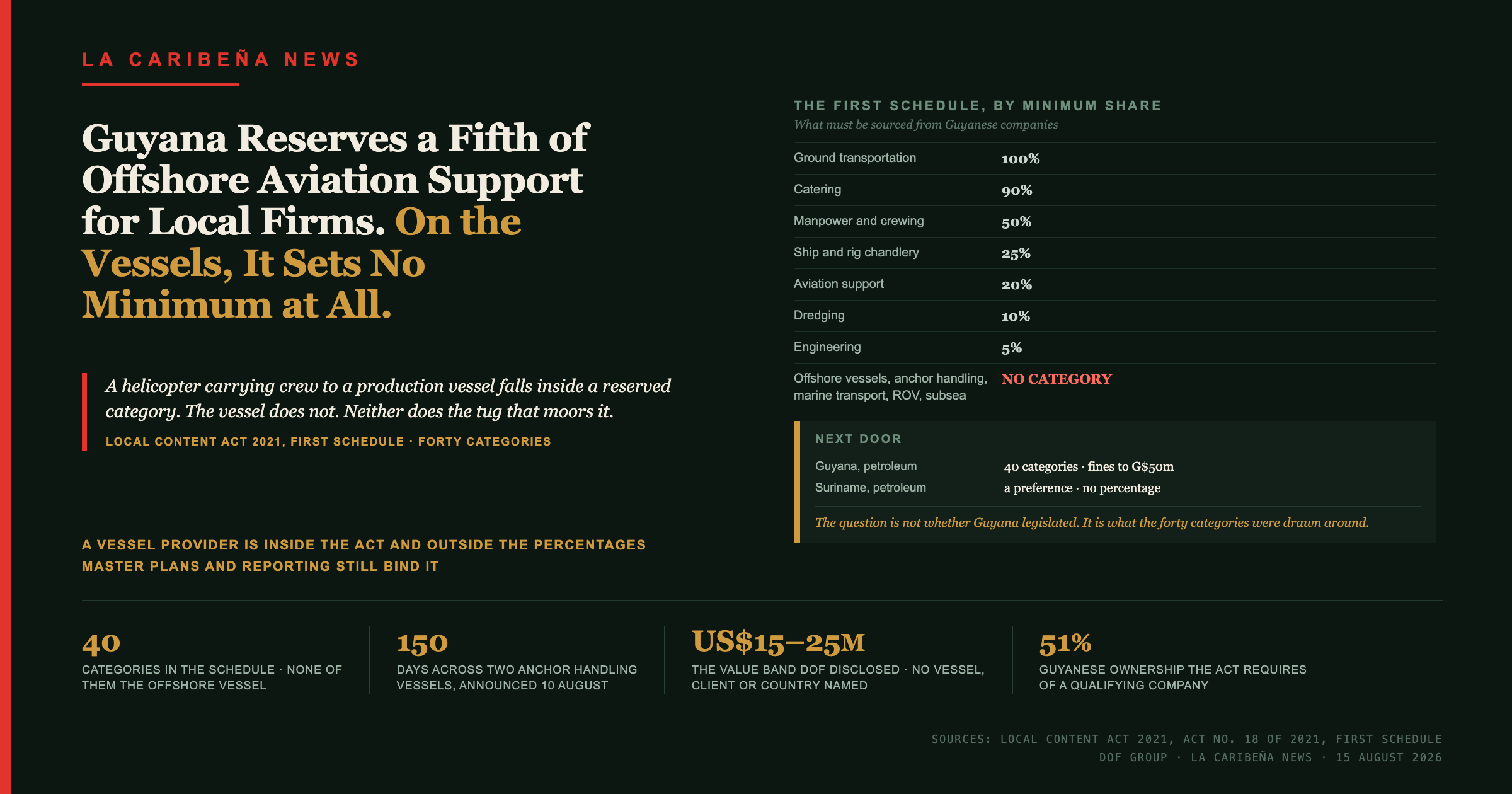
Guyana's Local Content Act reserves 20 per cent of offshore aviation support for Guyanese companies, and 100 per cent of ground transportation. It sets no percentage at all on the vessels.
The First Schedule to the Act lists forty categories of work and a minimum share of each that a contractor must source from Guyanese companies. Read in full, it has no category for offshore vessel provision, vessel charter, marine transportation, anchor handling, towing, offshore supply vessels, remotely operated vehicles or subsea services.
What does the schedule actually reach at sea?
Four items, and none of them is the vessel.
Ship and rig chandlery is reserved at 25 per cent. That is the business of supplying a vessel, not providing one.
Transportation services is reserved at 75 and 100 per cent, and the schedule defines it expressly and only as trucking and ground transportation. The Act's transport category is a land category.
Manpower and crewing is reserved at 50 per cent. That reaches the crew, not the hull, and is the one item that bites on an offshore vessel contract.
Dredging is reserved at 10 per cent, the only marine plant category in the schedule and among the lowest targets in it.
Aviation support is reserved at 20 per cent.
So a helicopter flying personnel to a floating production vessel falls inside a reserved category. The floating production vessel does not. Neither does the anchor handling tug that moors it.
Why does that matter now?
Because those contracts are being signed.
The Norwegian offshore group DOF announced on 10 August that it had secured 150 days of work across two anchor handling tug supply vessels, with remotely operated vehicle services included, in what the company itself described as the CARICOM region. It put the value in a band it defines as significant, being between US$15 million and US$25 million.
The company did not name the vessels, the client, the country or the start date. Its own words are the only geography on the record, and nothing published identifies where the work is. Reporting that has placed it in Guyana or Suriname is glossing what CARICOM means rather than repeating anything the company said.
What is on the record is that DOF already works in Guyana. It has supplied vessels to ExxonMobil's operations there, and it holds a five-year local content master plan, one of the plans the state approves and does not publish.
Is a vessel provider outside the Act?
No, and the distinction is the point.
The First Schedule sets percentage targets. It is not the whole of the Act. Master plans, annual plans, procurement rules and reporting duties bind operators and their subcontractors regardless of whether a particular service appears in the schedule.
A vessel provider is therefore inside the Act and outside the percentages. It must file, it must report, and it must show what it procures locally. What no instrument tells it is that any minimum share of the work has to go to a Guyanese company, because for that service no minimum exists.
That is a different gap from the one this newspaper reported when the schedule was found to have no category for software the operators actually buy. Software was an omission of a service nobody anticipated. Offshore vessels are the most visible equipment in the industry.
How does the schedule compare across the sector?
It reserves most heavily where the work is least capital-intensive.
Catering is reserved at 90 per cent and engineering at 5. Ground transportation is at 100. Aviation support is at 20. Dredging is at 10. The vessels are at nothing.
A Guyanese company can be required to hold nine tenths of the catering and none of the marine spread that installs a mooring system.
Guyana's law is still the most demanding local content statute in the region by a distance. It carries 51 per cent Guyanese beneficial ownership, Guyanese in 75 per cent of senior positions and 90 per cent of other roles, and fines to G$50 million. Suriname's petroleum statute, next door and eighteen months from first oil, carries a preference and no percentage at all.
The question the schedule raises is not whether Guyana legislated. It is what the forty categories were drawn around.
The data in this article
- Local Content Act 2021, Act No. 18 of 2021, First Schedule: forty categories of work with minimum percentages to be sourced from Guyanese companies.
- No category in the First Schedule covers offshore vessel provision, vessel charter, marine transportation, anchor handling, towing, offshore supply vessels, remotely operated vehicles or subsea services.
- Marine and transport-adjacent categories in the schedule: Ship and Rig Chandlery at 25 per cent; Transportation Services at 75 and 100 per cent, defined expressly as trucking and ground transportation; Manpower and Crewing at 50 per cent; Dredging at 10 per cent; Aviation Support at 20 per cent.
- Catering is reserved at 90 per cent and engineering at 5 per cent.
- The Act requires 51 per cent Guyanese beneficial ownership, Guyanese in 75 per cent of senior positions and 90 per cent of other roles, and carries fines to G$50 million.
- The First Schedule sets percentage targets only. Master plans, annual plans, procurement rules and reporting duties under the Act bind operators and subcontractors regardless of whether a service appears in the schedule.
- DOF announced on 10 August 2026 that it had secured 150 days of work across two anchor handling tug supply vessels, including remotely operated vehicle services, in what the company described as the CARICOM region, with a value in its "significant" band of US$15 million to US$25 million. The vessels, client, country and start date were not disclosed.
- DOF has supplied vessels to ExxonMobil's operations in Guyana and holds a five-year local content master plan there.
Frequently Asked Questions
Does Guyana's Local Content Act cover offshore vessels? Not in its First Schedule. None of the forty reserved categories covers offshore vessel provision, charter, anchor handling, marine transport, remotely operated vehicles or subsea services, so no minimum Guyanese share applies to them.
What marine work is reserved? Ship and rig chandlery at 25 per cent, manpower and crewing at 50 per cent, and dredging at 10 per cent. Transportation services, reserved at 75 and 100 per cent, is defined as trucking and ground transportation.
Is a vessel operator outside the law entirely? No. Master plans, annual plans, procurement rules and reporting duties apply regardless of the schedule. A vessel provider sits inside the Act and outside the percentages.
What did DOF actually announce? 150 days of work across two anchor handling tug supply vessels with remotely operated vehicle services, valued between US$15 million and US$25 million, in what the company called the CARICOM region. It did not name the vessels, the client, the country or the start date.
How does this compare with Suriname? Suriname's Petroleum Law 1990 requires preference for Surinamese labour and supply and sets no percentage, no reserved category and no penalty. Guyana's Act sets forty categories with percentages, and offshore vessels are not among them.