A Colombian electrical engineering delegation came to Georgetown to explain how twenty years of working as a cluster took their firms from suppliers to partners. Guyana's own law shows where the growth is, and how little of it local firms currently hold. ExxonMobil is in Leonora this afternoon.
BY LCN NEWSROOM
Quick summary: Guyana's Local Content Act 2021 sets minimum shares of 40 oil and gas service categories that must go to Guyanese companies. The shares are highest for services built on premises and labour, at 90 to 100 per cent, and lowest for technical work: Engineering and Machining sits at 5 per cent, the lowest figure in the schedule. Those low figures mark the technical, higher-value work that is still mostly supplied from abroad. A business cluster, run by a chamber of commerce, is how firms elsewhere built the capability to take a share of it.
What the title card shows
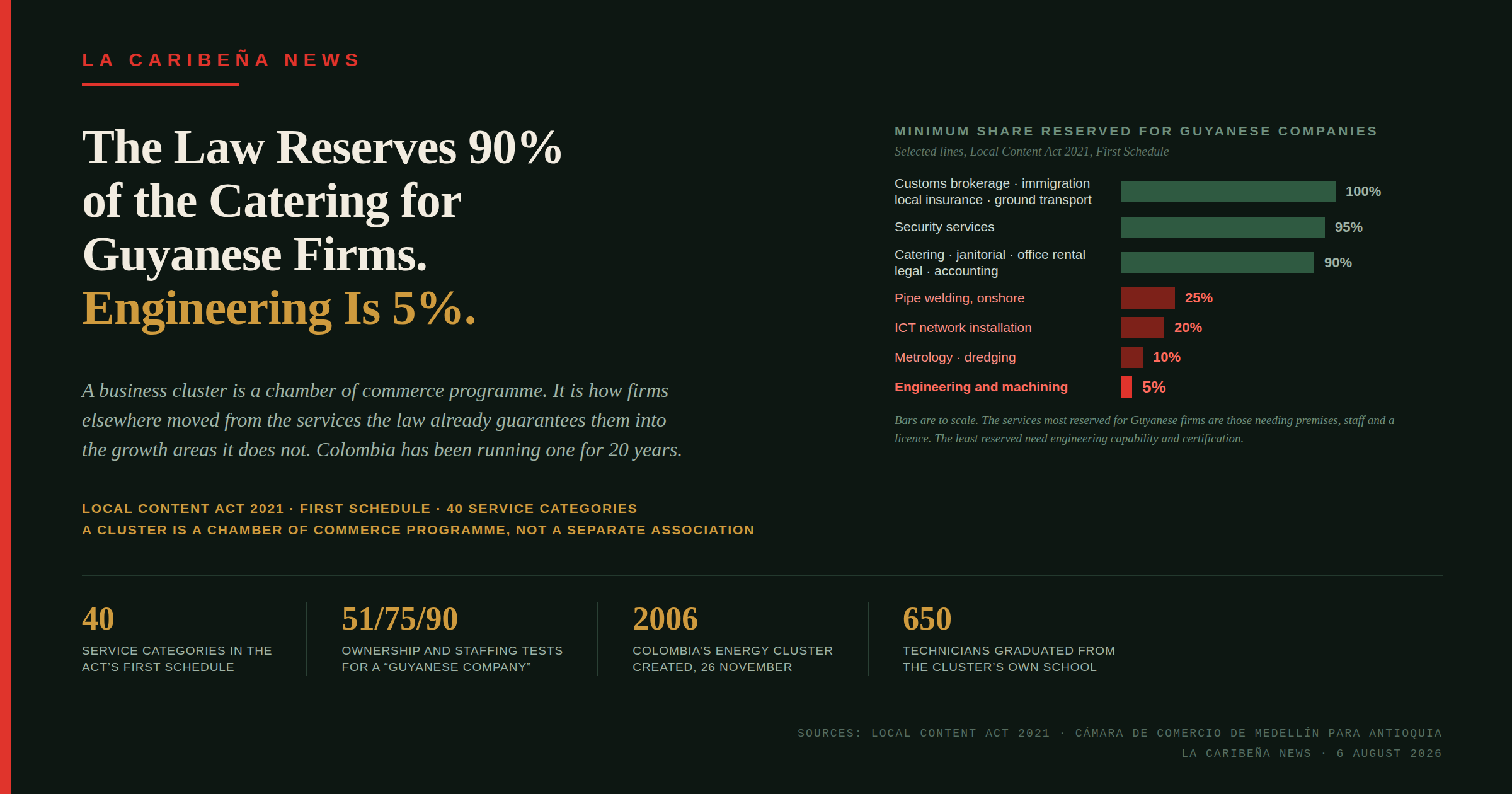
Every data point on the article's title card, in text.
- 5 per cent. The minimum local content level for Engineering and Machining, the lowest of the 40 categories. Source: Local Content Act 2021, First Schedule.
- 90 per cent. The level for Catering Services, and for Janitorial and Laundry Services, Rental of Office Space and Accommodation Services. Source: as above.
- 100 per cent. The level for Customs Brokerage, Immigration Support, Local Insurance and Ground Transportation of personnel. Source: as above.
- 40. Service categories listed in the First Schedule. Source: as above.
- 51, 75 and 90 per cent. The ownership and staffing thresholds a company must meet to count as a "Guyanese company" under the Act. Source: Local Content Act 2021, section 2.
- 26 November 2006. The date Colombia's Cluster Energía Eléctrica was created in Medellín. Source: Cámara de Comercio de Medellín para Antioquia.
- 650. Technicians in energy transmission networks graduated from the specialised school the Colombian cluster supports. Source: as above.
- The bar chart on the card, in full. Customs brokerage, immigration support, local insurance and ground transport 100%; security services 95%; catering, janitorial, office rental, legal and accounting 90%; pipe welding onshore 25%; ICT network installation 20%; metrology and dredging 10%; engineering and machining 5%. Bars are drawn to scale. Source: Local Content Act 2021, First Schedule.
- The line printed across the card. That a cluster is a chamber of commerce programme, not a separate association. Source: this article's reporting.
What is a business cluster?
A programme run by a chamber of commerce, in which firms from the same industry agree to compete less with each other and build capacity together.
That structural point comes first because it is the one most often missed. A cluster is not a separate association that firms go off and form. It is one of the chamber's own services, convened, staffed and governed by the chamber, with member firms inside it.
Members of a Colombian electrical engineering delegation, in Guyana on a trade mission, explained the idea to La Caribeña News in plain terms. It traces back to the work of Michael Porter, the Harvard economist who argued that firms in the same chain gain more by collaborating within it than by fighting over the same customers.
A cluster, one delegate said, rests on three things: networking, knowledge and collaboration. The distinction they drew is the important one. A cluster does not simply give firms a room to talk in. It teaches them how to work together, and it supplies the knowledge they cannot generate alone, through forums, conferences and technical training. All of that is organised by the chamber, which is what separates a cluster from a trade group that meets for lunch.
The commercial logic is that a customer rarely wants one component. They want a working system. A single small firm can sell a part. A group of firms that have learned each other's capabilities can sell the whole solution.
The delegation was blunt that this was not charity. They came to sell. But their stated goal went past the sale to technology transfer and training, so that Guyanese technicians learn the systems rather than simply install them.
Does the model actually work?
Colombia has twenty years of evidence, it started with the same industry, and it is run out of a chamber.
The Cámara de Comercio de Medellín para Antioquia records that the Cluster Energía Eléctrica strategy was created on 26 November 2006, with the purpose of increasing the competitiveness of the industry's firms and their participation in new markets. In 2017, as the sector shifted, it was renamed the Cluster Energía Sostenible.
Its working networks now cover energy efficiency and services, electronics, the circular economy, intelligent and sustainable mobility, a solar network and a rail hub.
The number worth holding on to is not a trade figure. The cluster supports a specialised school for the sector, and the chamber reports 650 technicians graduated in energy transmission networks. That is the knowledge leg of the model made concrete. A cluster that only produced meetings would have produced no technicians.
A cluster is not a networking group with a better name. Colombia's has a school attached, and 650 people have come out of it.
When does Guyana need one?
The answer is written into Guyana's own law, in a table most business owners have never opened.
The Local Content Act 2021, Act No. 18 of 2021, sets out in its First Schedule the minimum share of each service category that must be supplied by Guyanese companies. The schedule states its own purpose: maximum participation of Guyanese nationals and companies, and local capacity development.
Read the schedule as a whole and a pattern appears that no single line reveals.
| Service category | Minimum for Guyanese companies |
|---|---|
| Customs Brokerage Services | 100% |
| Immigration Support Services | 100% |
| Local Insurance Services | 100% |
| Ground Transportation, movement of personnel | 100% |
| Security Services | 95% |
| Janitorial and Laundry Services | 90% |
| Catering Services | 90% |
| Rental of Office Space | 90% |
| Local Legal Services | 90% |
| Pipe Welding, onshore | 25% |
| Environmental Services and Studies | 25% |
| ICT, network installation and support | 20% |
| Aviation Support Services | 20% |
| Metrology Services | 10% |
| Dredging Services | 10% |
| Engineering and Machining | 5% |
Selected lines from the First Schedule of the Local Content Act 2021, which lists 40 categories in total. The percentages are the minimum local content levels stated in the schedule against end of 2022.
The services where Guyanese firms are guaranteed almost everything are the services that need premises, staff and a licence. Cleaning. Catering. Office space. Brokerage. Security.
The services where the guarantee is smallest are the ones that need engineering capability, calibrated equipment and certification. Metrology at 10 per cent. Dredging at 10. Network installation at 20. And at the bottom of all forty lines, Engineering and Machining at 5 per cent.
That is not a criticism of the Act. A minimum level cannot be set above what an economy can actually supply, or the sector stops. It is a measurement of where Guyanese capability was judged to be in 2021, and it is the clearest published statement of the gap.
How does a small firm get into the growth areas?
By joining a group that can deliver what it cannot deliver alone.
Read that schedule again and notice what the low numbers actually mark. Engineering, machining, metrology, network installation, dredging and aviation support are not the leftovers of the oil and gas economy. They are the technical, higher-value end of it, and the low percentages mean most of that work is still supplied from outside Guyana. That is where the sector is growing, and it is where Guyanese firms currently hold the smallest share.
So the opportunity and the difficulty sit in the same place. No single Guyanese workshop moves into certified engineering and machining on its own. The capital, the certification, the technical staff and the track record all arrive together or not at all.
A cluster is the mechanism for assembling them jointly. Firms specialise instead of duplicating. They share the cost of the certification and the training school. They bid as a combination that can deliver a whole scope, because the customer, as the Colombians put it, wants a complete solution.
Note also who the Act says you must be. Under section 2, a "Guyanese company" is one where Guyanese nationals hold voting rights over at least 51 per cent of issued shares, at least 75 per cent of executive and senior management positions, and at least 90 per cent of non-managerial and other positions. A partnership between Guyanese nationals and such a company also qualifies.
That definition rewards exactly the structure a cluster produces. Guyanese firms can partner with foreign expertise and keep the local content status, provided ownership and staffing stay on the Guyanese side of those lines. Technology transfer is not a threat to the classification. It is the route through it.
Where does this get tested this week?
In Leonora, this afternoon.
ExxonMobil Guyana Limited, working with the ACE Consulting Group, is holding a Region 3 engagement at the TVET Building in Leonora, West Coast Demerara, on Thursday 6 August 2026 from 2:00 PM. That is today. Readers seeing this later should read the rest of this article as the argument rather than the invitation.
It puts the operator, government officials and Region 3 firms in one room to talk about what the local private sector can supply.
That is the room in which a cluster either forms or does not. Firms that arrive individually will leave with individual contacts. Firms that arrive knowing which of their neighbours complement them can leave with a combination.
What should a Region 3 business owner actually do?
Four things, none of which need a consultant.
Find your category in the schedule. The First Schedule has 40 lines. Work out which one your business sits in and what the minimum level is. A 90 or 100 per cent line means the law already protects your position, and the open question is whether you can deliver at the standard and scale the operator buys at. A 5, 10 or 20 per cent line means you are sitting in a growth area that is still largely served from abroad, with room to take more of it.
Work out what you cannot do alone. The gap between what a tender asks for and what you can deliver is the shape of the partner you need. That is a concrete question, not a networking one.
Ask who else is in the room. At an engagement like this afternoon's, the most valuable conversations may not be with the operator. They may be with the three other Region 3 firms whose capabilities, combined with yours, add up to a scope none of you could bid alone.
Ask your chamber to convene the cluster. This is the ask that follows from everything above. A cluster is a chamber programme, so it is not something a group of firms has to invent from nothing, and it is not something that forms by itself in a networking room. Colombia's was built and run by a chamber, which organised the forums, the training and the school. Guyana has chambers in every region. Asking one of them to stand up a cluster for your sector is a legitimate demand from a fee-paying member, and a more useful one than asking for another mixer.
Disclosure: Theon Alleyne, the founder and managing director of La Caribeña News, is Vice President and Public Relations Officer of the Essequibo Islands-West Demerara Chamber of Commerce and Industry, the chamber for Region 3, where the engagement described in this article takes place. This article argues that chambers of commerce should convene clusters, which is a service his own chamber could provide, and chambers were among the bodies invited to circulate the ExxonMobil event to their members. Readers should weigh both of those interests when reading this coverage. Neither ExxonMobil Guyana Limited nor the ACE Consulting Group is a client of La Caribeña News or of EICCIO Advisors.
Frequently Asked Questions
What is a business cluster?
A programme run by a chamber of commerce in which firms from the same industry collaborate rather than compete on capability, sharing networking, knowledge and joint delivery so they can offer a complete solution instead of individual parts. It sits inside the chamber rather than alongside it. The concept traces to the work of economist Michael Porter.
What is the lowest local content target in Guyana's law?
Engineering and Machining, at 5 per cent, is the lowest of the 40 categories in the First Schedule of the Local Content Act 2021.
Which services are most reserved for Guyanese companies?
Customs brokerage, immigration support, work permit and visa services, local insurance and ground transportation of personnel are all set at 100 per cent. Security and pest control are at 95 per cent, and catering, janitorial and laundry services, office rental, accommodation, accounting and legal services at 90 per cent.
What counts as a Guyanese company under the Act?
A company incorporated under the Companies Act in which Guyanese nationals hold voting rights over at least 51 per cent of issued shares, at least 75 per cent of executive and senior management positions and at least 90 per cent of non-managerial and other positions. A partnership between Guyanese nationals and such a company also qualifies.
How long has Colombia used the cluster model?
Its Cluster Energía Eléctrica was created on 26 November 2006 in Medellín and was renamed Cluster Energía Sostenible in 2017. The chamber that runs it reports 650 technicians graduated from the specialised school it supports.
When and where is the ExxonMobil Region 3 engagement?
Thursday 6 August 2026 from 2:00 PM at the TVET Building, Leonora, West Coast Demerara, hosted by ExxonMobil Guyana Limited with the ACE Consulting Group.