By La Caribeña News · 15 August 2026
Guyana's local content regime rests on a document that every significant company in the oil sector must file and that no member of the public can read.
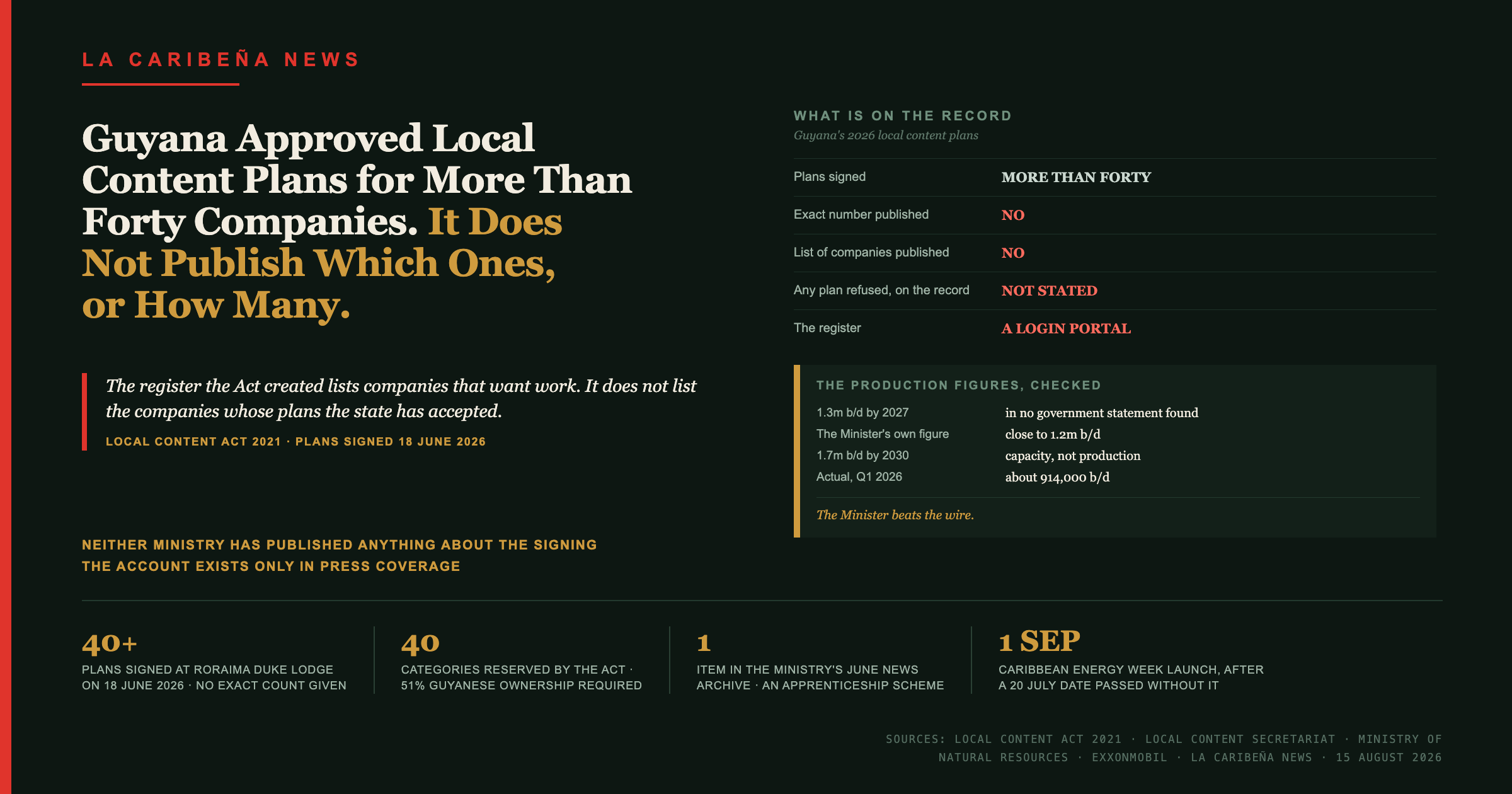
The Local Content Secretariat signed annual plans for the 2026 reporting year with more than forty operators, contractors and subcontractors at a ceremony on 18 June at the Roraima Duke Lodge in Kingston. ExxonMobil Guyana, CNOOC Petroleum Guyana, MODEC and SLB are among the companies confirmed as signatories, alongside Guyana Deep Water Operations, Halliburton, Saipem, Baker Hughes, Ramps Logistics, Technip, Airswift and G-Port.
More than forty is as precise as the public record gets.
Is there a published list of approved plans?
No, and the register that exists does not contain one.
The Local Content Act 2021 established a register, and it exists at a government address. It is a registration portal for Guyanese suppliers and jobseekers, not a public record of who has been approved. An unauthenticated visitor asking to view it is told they do not have permission.
So the register lists companies that want work. It does not list the companies whose plans the state has accepted, what those plans commit them to, or whether any of them were rejected.
The Ministry of Natural Resources has published nothing about the June ceremony. Its own news archive for June carries a single item, on an apprenticeship programme, and its July and August pages carry three more between them. The petroleum ministry's press release index has not been updated past 2025. The account of what happened in June exists in press coverage sourced to the Department of Public Information, and nowhere in the ministries' own published record.
The Act requires the plans, and it requires their publication. Section 11(5) provides that the Secretariat "shall cause to be published an approved extract of a Local Content Plan on the website of the Ministry responsible for petroleum or on any other media of wide circulation", excluding confidential or proprietary information. Section 6(9) requires the Local Content Registers to be published the same way.
No extract of any approved plan appears on the petroleum ministry's document library, which carries petroleum agreements, production licences, cost recovery audit reports, model production sharing agreements and crude assays. The Act permits publication in other media of wide circulation as an alternative, and none has been found.
What do the plans actually cover?
The forty categories, and the annual filing that follows them.
The Local Content Act 2021 reserves forty categories of service work for companies that are 51 per cent beneficially owned by Guyanese nationals, with Guyanese in 75 per cent of senior positions and 90 per cent of other roles. The reserved categories run from 90 per cent of catering down to 5 per cent of engineering, and the Act carries fines to G$50 million.
An operator or contractor files a plan each year setting out how it will meet those obligations. The plans signed in June are for the 2026 reporting year.
That regime applies to petroleum and to nothing else. The country's mining sector operates under a different and much older standard, and the terms of at least five mineral agreements commit the state to make a company whole if a future law raises what it must pay. Guyana has also found that the reserved schedule has no category for some of what the operators actually buy.
What is Guyana actually producing?
Less than the figure now circulating, on the Minister's own account.
A production target of 1.3 million barrels a day by 2027 has been attached to recent coverage of the local content plans. That number does not appear in any government statement this newspaper can find. The Minister of Natural Resources, Vickram Bharrat, said in February that Guyana expects to be producing close to 1.2 million barrels a day by the time of the 2027 conference.
The figure of 1.7 million barrels a day by 2030 is also being reported as a production target. ExxonMobil's own statement describes it as total production capacity from eight developments, and the eighth, Longtail, was still under regulatory review when that statement was made. Capacity and production are different numbers, and the difference is the eighth project.
Current output from the Stabroek Block averaged approximately 914,000 barrels a day in the first quarter of 2026, on figures attributed to the government: 82.2 million barrels across the quarter, with Liza One at 129,000, Liza Two at 265,000, Payara at 264,000 and Yellowtail at 257,000. The ministry's monthly returns behind that average are not published.
When is Caribbean Energy Week being launched?
On 1 September, after the July date passed without the event.
The organiser, Energy Capital and Power, announced in July that the in-country launch would take place on 20 July at the Guyana Marriott Hotel. Its August release gives the date as 1 September, and its own event site carries a live listing for 1 September at six in the evening at the Marriott in Georgetown, with registration open.
No notice explaining the change has been published.
Caribbean Energy Week 2027 itself runs 13 to 15 July 2027 in Georgetown, the second annual edition, under the patronage of President Irfaan Ali and with the endorsement of Minister Bharrat. Patronage and endorsement are not the same as government organisation, and the event is run by a commercial conference company. Announced speakers for the launch are Bharrat, Peter Ramsaroop of the Guyana Office for Investment, and Alistair Routledge of ExxonMobil Guyana.
What does the state hold and not release?
Four things, each of which the state holds and does not publish.
The exact number of plans approved for 2026. The identity of every company that signed, beyond those named in press coverage. Whether any plan was refused. And what the plans commit each company to, which is the only document that would show whether the forty categories are being met in practice rather than on paper.
Guyana's oil sector is now the largest in the English-speaking Caribbean, and its local content law is the most demanding in the region. The record of who has agreed to what under that law is held by the Secretariat and released to nobody.
The data in this article
- Local content plans for the 2026 reporting year were signed with more than forty operators, contractors and subcontractors at a ceremony on 18 June 2026 at the Roraima Duke Lodge, Duke Street, Kingston. No exact count has been published.
- Companies confirmed among the signatories: ExxonMobil Guyana, CNOOC Petroleum Guyana, MODEC, SLB, Guyana Deep Water Operations, Halliburton, Saipem, Baker Hughes, Ramps Logistics, Technip, Airswift and G-Port.
- The Local Content Register at the petroleum ministry's address is a registration portal for suppliers and jobseekers. An unauthenticated visitor is told they do not have permission to view it. No public list of approved plans exists.
- The Ministry of Natural Resources published nothing on the June ceremony. Its news archive carries one item in June 2026, two in July and one in August. The petroleum ministry's press release index is not current past 2025.
- Local Content Act 2021: forty reserved categories; 51 per cent Guyanese beneficial ownership; Guyanese in 75 per cent of senior positions and 90 per cent of other roles; fines to G$50 million. It applies to petroleum operations only.
- Production target of 1.3 million barrels a day by 2027: not found in any government statement. Minister of Natural Resources Vickram Bharrat said in February 2026 that Guyana expects production close to 1.2 million barrels a day by the time of the 2027 conference.
- 1.7 million barrels a day by 2030 is described by ExxonMobil as total production capacity from eight developments, the eighth being Longtail, which was under regulatory review at the time of that statement.
- Stabroek Block production averaged approximately 914,000 barrels a day in the first quarter of 2026, being 82.2 million barrels for the quarter, with Liza One at 129,000, Liza Two at 265,000, Payara at 264,000 and Yellowtail at 257,000 barrels a day. Attributed to government data. The underlying ministry returns are not published.
- Caribbean Energy Week 2027 in-country launch: announced for 20 July 2026 at the Guyana Marriott, then given as 1 September 2026. The organiser's event listing shows 1 September at 18:00 at the Marriott, Georgetown, with registration open. No notice explaining the change has been published.
- Caribbean Energy Week 2027 runs 13 to 15 July 2027 in Georgetown, the second annual edition, under the patronage of President Irfaan Ali and the endorsement of Minister Bharrat, organised by Energy Capital and Power. Announced launch speakers: Vickram Bharrat, Peter Ramsaroop, Alistair Routledge.
Frequently Asked Questions
How many local content plans did Guyana approve for 2026? More than forty, signed at a ceremony on 18 June 2026. No exact figure has been published by the Local Content Secretariat or either ministry.
Can the public see which companies have approved plans? No. The Local Content Register is a registration portal for Guyanese suppliers and jobseekers, and an unauthenticated visitor is told they do not have permission to view it. No list of approved plans is published anywhere.
What does the Local Content Act require? It reserves forty categories of service work for companies 51 per cent beneficially owned by Guyanese nationals, with Guyanese in 75 per cent of senior positions and 90 per cent of other roles, and carries fines to G$50 million. It applies to petroleum operations only.
What is Guyana producing now? Stabroek Block production averaged approximately 914,000 barrels a day in the first quarter of 2026. The Minister of Natural Resources said in February that Guyana expects close to 1.2 million barrels a day by the time of the 2027 conference. A figure of 1.7 million by 2030 refers to capacity from eight developments, not production.
When does Caribbean Energy Week 2027 launch in Guyana? On 1 September 2026 at the Marriott in Georgetown, after a launch announced for 20 July did not take place. The conference itself runs 13 to 15 July 2027.