By La Caribeña News · 15 August 2026
Suriname will produce oil offshore in 2028 under a statute that has required contractors to favour Surinamese workers and suppliers since 1990, and that says nothing about how much.
The GranMorgu development on Block 58 was more than thirty per cent complete and its production vessel sixty per cent built in April, on figures given at the Cabinet of the President by TotalEnergies' exploration and production director for the Americas, Javier Rielo, and its Suriname general manager, Artur Nunes-Da-Silva. Drilling begins at the end of 2026. First oil is expected in the first half of 2028.
The project holds nearly 760 million barrels of recoverable resources across the Sapakara and Krabdagu fields, 150 kilometres offshore in water between 100 and 1,000 metres deep. The floating production vessel is designed for 220,000 barrels a day. The capital cost is about US$10.5 billion.
What does Suriname own of it?
Twenty per cent, financed on borrowed money.
TotalEnergies operates with 40 per cent, APA Corporation holds 40 per cent, and the state oil company Staatsolie holds 20 per cent. That is a change from the structure at the final investment decision in October 2024, when the two international partners held half each and Staatsolie held an option.
Staatsolie's own account of the terms is more revealing than the percentage. It has the right to participate for a maximum of twenty per cent, participating from the moment the investment decision was announced, but with the first two payments made on a pre-agreed timetable. That structure was designed to give the company time to arrange financing or to reduce its participation.
It arranged the financing. A US$1.6 billion loan from eighteen banks and financial institutions was concluded on 14 May 2025, which also repaid an outstanding US$130 million facility. Staatsolie puts its own total share of the development at US$2.4 billion, met from that loan, its own cash, operating cash flow and the proceeds of a bond issued in March 2025.
A state that borrows US$1.6 billion to hold a fifth of a US$10.5 billion project is carrying real exposure, and its managing director has described this as the investment in which Suriname receives the largest share of the take.
What does the law require of the operators?
Preference, and nothing that can be measured.
Article 17 of the Petroleum Law 1990 is the local content law. Its first paragraph requires a contractor to see that employment of foreign personnel is strictly limited to functions for which no experienced and qualified Surinamese nationals are available, and to use all possibilities for Surinamese nationals to gain expertise and acquire responsible positions. Its second requires a contractor to give preference to goods and services produced or available in Suriname over foreign ones.
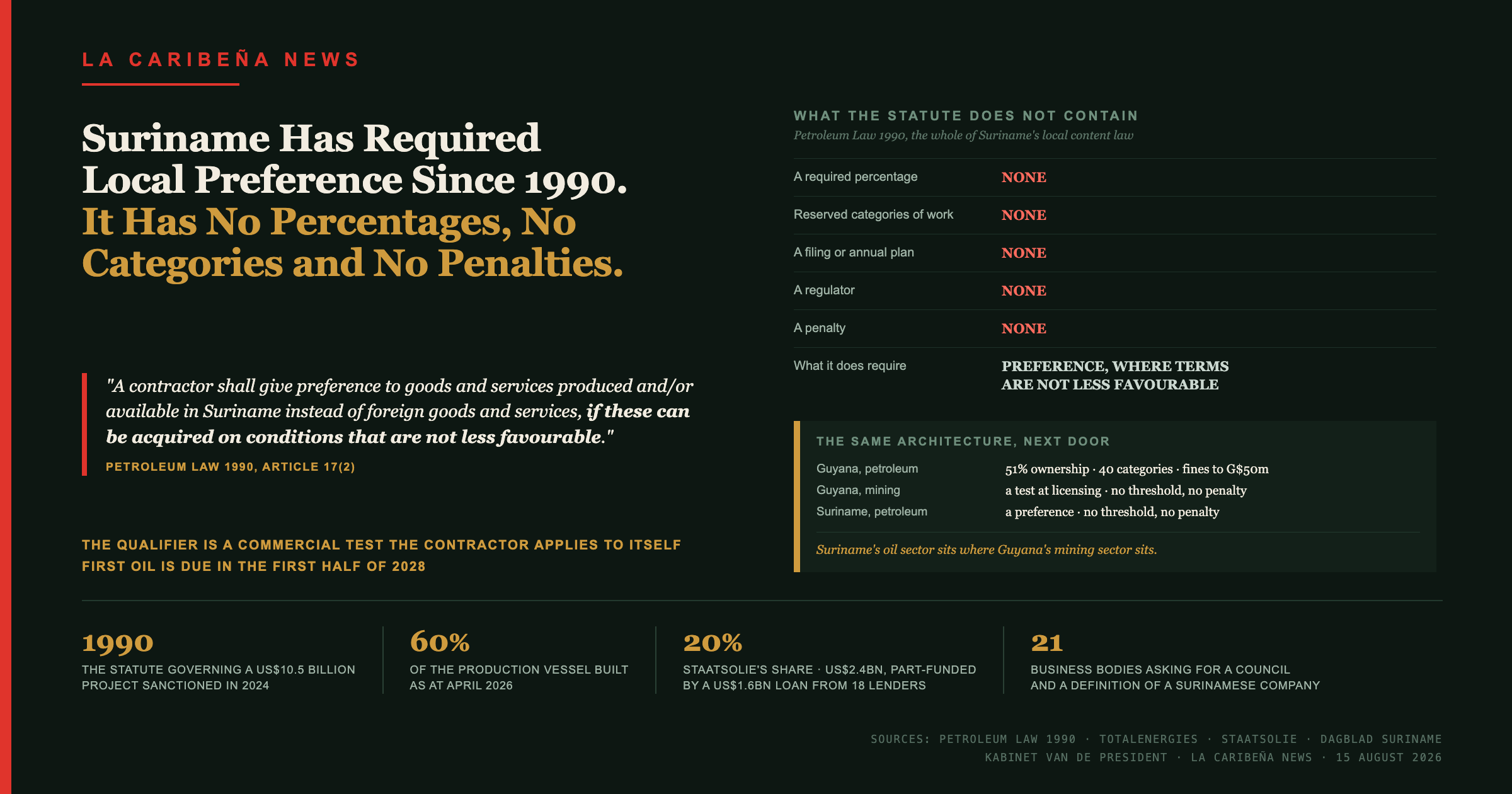
The second paragraph carries a condition that governs the whole of it: the preference applies where local goods and services can be acquired "on conditions that are not less favourable". That is a commercial test the contractor applies to itself.
The statute names no percentage, reserves no category, requires no filing, creates no regulator and imposes no penalty. Article 4 adds objectives, that the State encourage the transfer of petroleum technology and the training of Surinamese experts, which are duties on the State rather than on the contractor.
Around that sits a policy architecture: preferences in the production sharing agreements, a national local content programme for 2026 with hubs at Nickerie, Commewijne and Brokopondo, a local content board at the Cabinet of the President, and the supplier registration machinery Staatsolie runs for itself and for the offshore operators. A National Local Content law has been prepared by that board, and has not been enacted.
So the difference between Suriname and Guyana is not that one has a local content law and the other does not. It is that one has thresholds and penalties and the other has a preference qualified by commercial judgement.
On 15 July a coalition of twenty-one business organisations, including ASFA, the federation of Surinamese agricultural producers, the VSB and the Suriname Energy Chamber, called for an independent Local Content Council. Their argument was that Suriname need not wait for legislation to build institutions. Their first request was narrower and sharper than a statute: a definition of what counts as a Surinamese company.
Without that definition, the Article 17 preference can be satisfied by a company that is Surinamese on its letterhead and foreign in its ownership. Guyana settled the same question by statute, requiring 51 per cent Guyanese beneficial ownership and Guyanese in 75 per cent of senior positions, and has still found gaps in its schedule. Guyana's own mining sector, meanwhile, sits where Suriname's petroleum sector sits, with a local employment test and a local procurement test and no thresholds behind either.
Who is trying to change the law?
A party, a board, and twenty-one business organisations, at three different speeds.
On 1 August the party De Nieuwe Leeuw handed two drafted bills, on local content and on transfer pricing, to the Minister of Economic Affairs and Entrepreneurship, Baasaron. Its chairman, Dharm Mungra, said approval was urgently needed given the production sharing agreements coming up for signature, and that it must be prevented that the country is again confronted with secret contracts under which it is made dependent on favours. He said the bill as drafted meets World Trade Organization and General Agreement on Tariffs and Trade conditions, is investment-friendly, and guarantees mutual benefit.
The transfer pricing bill is aimed at profit shifting to tax havens, and at ensuring cost prices are real so that profit distribution and royalty revenues can be relied on. Both were presented as covering emerging oil and gas exploration and other mining agreements.
Those are proposals from a political party handed to a minister, not legislation before De Nationale Assemblee. A separate national local content law has been prepared by the Local Content Board and has not been enacted.
The business coalition of 15 July wanted institutions before legislation. Staatsolie has warned publicly against local content rules drawn too tightly. And the operators are already building.
Suriname is therefore arguing about what a local content law should say while the vessel that will produce the oil is sixty per cent built.
What is the government's own position?
That the country should not lean on oil at all.
Patrick Brunings, Suriname's Minister of Oil, Gas and Environment, has said the country must not become dependent on a single source of income, and that flexibility matters more than concentration. He put it plainly in February: the country absolutely must not lean on it, so that it stays flexible and does not become dependent on just one source.
That is the same argument he carried into July, when he warned that concentrating local content on one sector drains the others. His ministry launched a local content summit on 3 August and held it on 10 and 11 August, with a third day expected in the first week of October.
The petroleum file sits with that ministry rather than with the Ministry of Natural Resources, which is a distinction that matters for anyone trying to address the right department.
What else is coming?
Gas, and a floating plant that would be a first for the region.
On Block 52, PETRONAS Suriname operates with 80 per cent and Paradise Oil Company, a Staatsolie subsidiary, holds 20 per cent. Staatsolie approved the commercial field on 11 November 2025, the declaration that turns a discovery into a development.
The concept is gas wells feeding subsea infrastructure and a floating liquefied natural gas facility, which would be the first in this region. A final investment decision is planned for the second half of 2026 and first gas for 2030. PETRONAS reported in June that further discoveries and an appraisal had taken it to eight successful wells and more than a billion barrels of oil equivalent unlocked.
Acreage remains open. Staatsolie runs a standing open-door offering across five sectors covering more than 70,000 square kilometres, in water from 5 to 3,000 metres.
Suriname therefore has an oil project in construction, a gas project approaching decision, an open acreage offer, and a thirty-five-year-old provision that tells contractors to prefer Surinamese firms without saying how much of anything that means.
The data in this article
- GranMorgu, Block 58, offshore Suriname: Sapakara and Krabdagu fields, 150 kilometres offshore, water depths of 100 to 1,000 metres, recoverable reserves given by TotalEnergies as nearly 760 million barrels, a floating production vessel designed for 220,000 barrels a day, capital cost about US$10.5 billion.
- Partner interests: TotalEnergies 40 per cent and operator, APA Corporation 40 per cent, Staatsolie 20 per cent. At the final investment decision of 1 October 2024 the split was TotalEnergies 50 per cent and APA 50 per cent, with Staatsolie holding an option for up to 20 per cent.
- Staatsolie terms: the right to participate for a maximum of twenty per cent, participating from the announcement of the final investment decision, with the first two payments on a pre-agreed timetable, structured to allow time to arrange financing or to reduce the participation percentage.
- Financing: a US$1.6 billion loan from eighteen banks and financial institutions concluded on 14 May 2025, which also repaid an outstanding US$130 million loan. Staatsolie puts its own share of the development at US$2.4 billion, met from the loan, own cash, operating cash flow and March 2025 bond proceeds.
- Project status as given at the Cabinet of the President on 15 April 2026 by TotalEnergies' Americas exploration and production director Javier Rielo and Suriname general manager Artur Nunes-Da-Silva: more than 30 per cent of total work complete, the production vessel 60 per cent built, drilling to begin at the end of 2026, first oil in the first half of 2028.
- Projected local content from the project: more than US$1 billion and more than 6,000 jobs, being 2,000 direct and 4,000 indirect, with Paramaribo as the onshore hub.
- Petroleum Law 1990, Official Gazette of the Republic of Suriname 1991 no. 7, dated 6 March 1991. Article 17(1): a contractor shall see that employment of foreign personnel is strictly limited to functions for which there are no experienced and qualified Surinamese nationals available, and shall use all possibilities for Surinamese nationals to gain expertise and acquire responsible positions. Article 17(2): a contractor shall give preference to goods and services produced or available in Suriname over foreign goods and services, if these can be acquired on conditions that are not less favourable. Article 4(c) and (d): objectives include encouraging the transfer of petroleum-related technology and the training of Surinamese experts.
- The statute sets no percentage, reserves no category, requires no filing, creates no regulator and imposes no penalty. A National Local Content law has been prepared by the Local Content Board and has not been enacted.
- Around the statute sit preferences in the production sharing agreements, a national local content programme for 2026 with hubs at Nickerie, Commewijne and Brokopondo, a local content board at the Cabinet of the President, and Staatsolie's supplier registration systems.
- On 15 July 2026 a coalition of twenty-one business organisations, including ASFA, the federation of Surinamese agricultural producers, the VSB and the Suriname Energy Chamber, called for an independent Local Content Council and for a definition of a Surinamese company.
- The Minister of Oil, Gas and Environment, Patrick Brunings, said in February 2026 that the country must not lean on oil, so that it stays flexible and does not become dependent on one source. His ministry launched a local content summit on 3 August 2026 and held it on 10 and 11 August, with a third day expected in the first week of October.
- Block 52: PETRONAS Suriname operator with 80 per cent, Paradise Oil Company, a Staatsolie subsidiary, with 20 per cent. Staatsolie approved the commercial field on 11 November 2025. The concept is gas wells, subsea infrastructure and a floating liquefied natural gas facility, the first in the region. Final investment decision planned for the second half of 2026, first gas 2030. PETRONAS reported in June 2026 eight successful wells and more than one billion barrels of oil equivalent unlocked.
- Staatsolie operates a standing open-door acreage offering across five sectors covering more than 70,000 square kilometres in water depths of 5 to 3,000 metres.
Frequently Asked Questions
When will Suriname produce its first offshore oil? First oil from GranMorgu is expected in the first half of 2028. In April 2026 the project was more than thirty per cent complete, with the production vessel sixty per cent built and drilling due to begin at the end of 2026.
How much of GranMorgu does Suriname own? Staatsolie holds 20 per cent, alongside TotalEnergies at 40 per cent as operator and APA Corporation at 40 per cent. Staatsolie puts its own share of the cost at US$2.4 billion and financed it partly through a US$1.6 billion loan from eighteen lenders concluded in May 2025.
Does Suriname have a local content law? Yes. Article 17 of the Petroleum Law 1990 requires contractors to limit foreign personnel to roles no qualified Surinamese national can fill, and to prefer goods and services produced or available in Suriname where they can be had on conditions that are not less favourable. It sets no percentage, reserves no category, requires no filing and imposes no penalty. A dedicated local content Act has been prepared and not enacted.
What have Surinamese businesses asked for? On 15 July 2026 twenty-one business organisations called for an independent Local Content Council and for a definition of what counts as a Surinamese company, arguing that the country need not wait for legislation to build the institutions.
What is happening with gas? Staatsolie approved the commercial field on Block 52 on 11 November 2025, where PETRONAS holds 80 per cent and a Staatsolie subsidiary holds 20 per cent. The plan involves a floating liquefied natural gas facility, which would be the first in the region, with a final investment decision planned for the second half of 2026 and first gas in 2030.