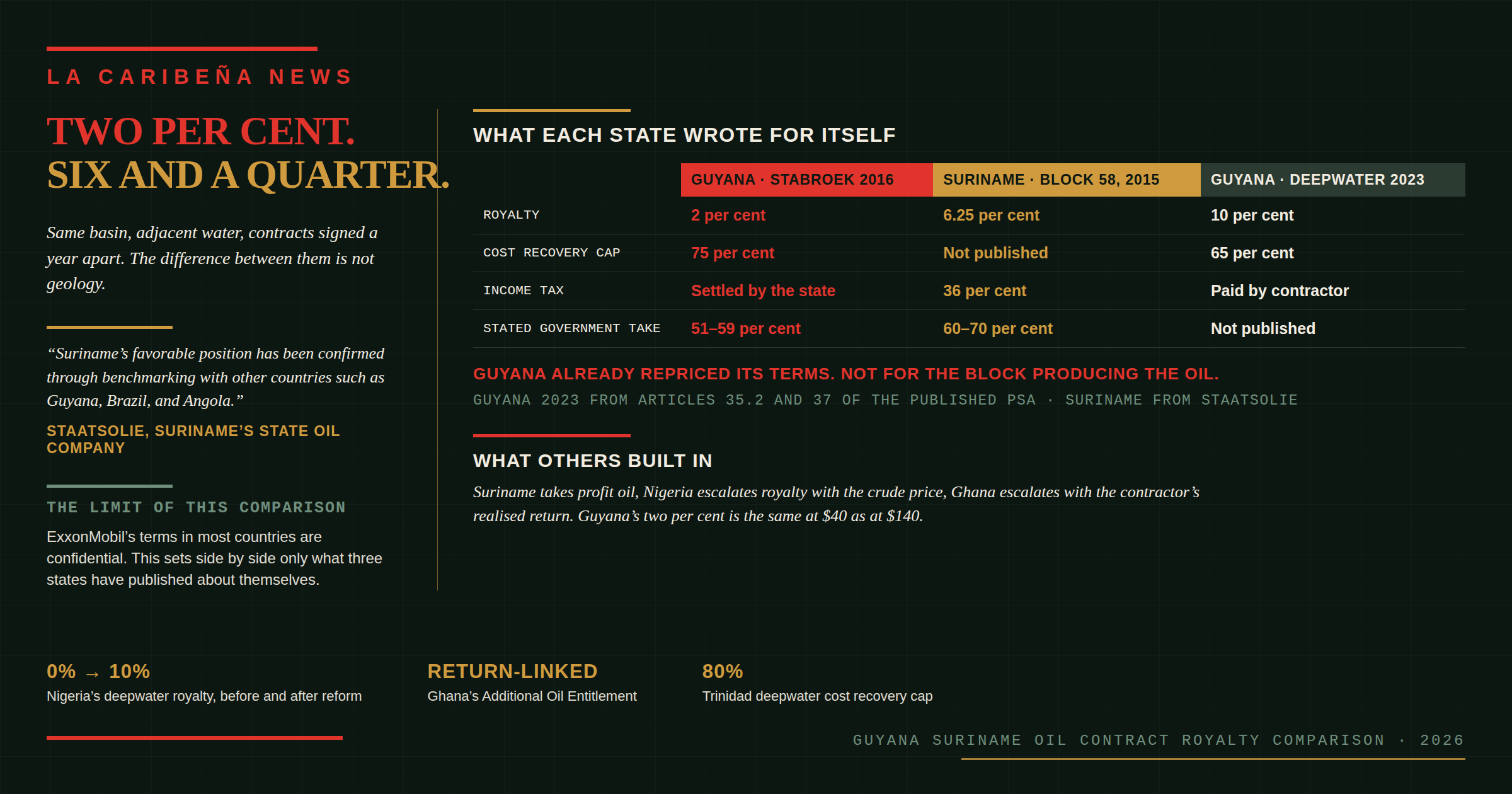
Same basin, adjacent water, comparable geology. Suriname's state oil company publishes its terms, says it benchmarked them against Guyana, and puts its own government take at 60 to 70 per cent. Guyana's royalty on the producing block is two per cent.
BY LA CARIBEÑA NEWS
Quick summary: Suriname signed its Block 58 contract in 2015 on a 6.25 per cent royalty and 36 per cent income tax, and its state oil company puts the resulting government take at 60 to 70 per cent. Guyana signed Stabroek in 2016 on a 2 per cent royalty, with the state settling the companies' corporation tax.
Why compare these two at all?
Because almost nothing else about them differs.
Guyana and Suriname sit on the same Guyana-Suriname Basin. The discoveries that made both countries oil producers came out of adjacent deepwater acreage, within a year of each other, from the same wave of exploration and the same class of operator. When two neighbours with the same rock and the same timing sign very different contracts, the difference is not geology. It is negotiation.
This is also the only comparison of its kind that can be made honestly from public documents, and that limit is worth stating up front. ExxonMobil's fiscal terms in most of the countries where it operates are confidential. There is no public register of what the company pays in Nigeria against Angola against Kazakhstan, and any table purporting to show it would be built substantially on estimate and inference. What can be established is what states have published about their own regimes. Guyana, Suriname and Trinidad and Tobago have each published enough to be compared directly.
What did Suriname sign?
Terms it publishes, and defends by name.
Suriname's state oil company Staatsolie sets out the Block 58 fiscal package in its own public FAQ: a 6.25 per cent royalty, profit oil distribution, and 36 per cent income tax. Staatsolie states that these produce "a government take for Suriname of 60-70% (after costs), depending on the oil price."
Then it goes further than most states would. Staatsolie writes that "Suriname's favorable position has been confirmed through benchmarking with other countries such as Guyana, Brazil, and Angola."
That is a neighbouring government's oil company saying, on its own website, that it measured its contract against Guyana's and came out ahead. The comparison in this article is not one La Caribeña News invented. It is one Suriname published.
Staatsolie also records that no signing bonus was paid for Block 58 when the contract was concluded with Apache in 2015, on the basis that offshore Suriname was then an unproven and high-risk frontier. That is the same risk argument made for Guyana's 2016 terms, applied to a contract that nonetheless carries three times the royalty.
What did Guyana sign?
Two per cent, and a tax bill it pays itself.
Under the 2016 Stabroek agreement, Guyana takes a 2 per cent royalty. Up to 75 per cent of production in a year may be taken as cost oil so the companies can recover exploration, development and operating costs before profit is divided. The remaining profit oil is split 50/50. OilNOW has set out the mechanics.
The corporation tax arrangement is the part that most distinguishes it. Guyana's share, not the companies' share, is where the contractors' corporation tax is settled.
Guyana's sharpest critic is Guyana
The state has already rewritten these terms. It simply has not applied them where the oil is.
The deepwater production sharing agreement Guyana published for blocks from 30 December 2023 is available from the Ministry of Natural Resources. Read against the 2016 contract, it is a different posture entirely.
| Term | Guyana, Stabroek 2016 | Suriname, Block 58 2015 | Guyana, Deepwater PSA 2023 |
|---|---|---|---|
| Royalty | 2 per cent | 6.25 per cent | 10 per cent (Article 37.2) |
| Cost recovery ceiling | 75 per cent | Not published in the FAQ | 65 per cent (Article 35.2) |
| Profit share | 50/50 | Profit oil distribution | 50/50 (Article 35.2(d)) |
| Income tax | Settled by the state | 36 per cent | Contractor subject to Guyana's tax laws (Article 37.1) |
| Stated government take | 51 to 53 per cent (S&P Global); about 59 per cent (Rystad) | 60 to 70 per cent after costs (Staatsolie) | Not published |
Guyana 2023 figures are quoted from the numbered articles of the agreement published by the Ministry of Natural Resources. Suriname figures are quoted from Staatsolie. Government take estimates are the estimators' own.
Five times the royalty. Ten percentage points less annual production available for cost recovery. And Article 37.1 subjects the contractor to the Income Tax Act, the Value Added Tax Act and the Corporation Tax Act, reversing the arrangement under which the state settles the bill.
Guyana did not need to be persuaded that the 2016 terms were low. It priced the next contract itself, and priced it five times higher.
The 2023 terms are also closer to what Suriname obtained in 2015, which is the more uncomfortable way of putting it. On royalty, Guyana's new contract now sits above its neighbour's. Its producing block sits at less than a third of it.
The complication, and it is a real one
Guyana is not the region's outlier on every measure.
OilNOW has reported that Trinidad and Tobago's deepwater model pays royalties and taxes on behalf of the oil companies and caps cost recovery at 80 per cent. On both counts that is more accommodating than Guyana's Stabroek terms, which cap cost recovery at 75.
This matters for how the Guyana contract should be argued about. The practice of a state settling a contractor's tax, which reads as scandalous in isolation, has regional precedent next door. Trinidad's model contract is published by its Ministry of Energy and Energy Industries. A case against Guyana's agreement that rests on the tax mechanism alone has to explain why the same mechanism is unremarkable in Port of Spain.
The distinguishing feature is not the tax treatment. It is the royalty floor. Royalty is the only element that pays regardless of whether costs have been recovered, regardless of how profit oil is computed, and regardless of what the companies declare as expenditure. It is the part of the deal that cannot be argued down by an accounting position. Guyana set that floor at two per cent, Suriname at 6.25, and Guyana's own next contract at ten.
What other producers built in that Guyana did not
A term that moves.
The frontier-risk argument made for Guyana's 2016 terms, that an unproven deepwater basin has to be bought with a low government share, is not unusual. What is unusual is leaving it there.
Nigeria went further than Guyana ever did. The International Bar Association's account of the country's deep offshore amendment records that royalty rates were graduated by water depth, 12 per cent from 201 to 500 metres, 8 per cent from 501 to 800, 4 per cent from 801 to 1,000, and no royalty at all beyond 1,001 metres. That exemption, the IBA notes, was "a concession given by the Federal Government of Nigeria, in recognition of the risks and high investment in offshore drilling at such depths." It is the Guyana argument, taken to zero.
Nigeria then reversed it. Deep offshore royalty became a flat 10 per cent at any depth, and the amendment added a second royalty keyed to the oil price: 2.5 per cent above US$20 a barrel, 4 per cent above US$60, 8 per cent above US$100 and 10 per cent above US$150. The IBA records that the amendment also introduced a mandatory periodic review of existing production sharing contracts. Upstream companies in Nigeria pay petroleum profits tax at 85 per cent, against up to 40 per cent for other companies.
Ghana built its progressivity into the return rather than the price. Its upstream guide, published through TaxLawGH, sets petroleum income tax at 35 per cent, GNPC carried interest at 15 per cent under the Act 919 framework with older agreements as low as 10, and a 1 per cent Growth and Sustainability Levy on gross production. The distinctive term is the Additional Oil Entitlement, under which the Republic's share of a field rises with the contractor's own after-tax, inflation-adjusted rate of return.
Ghana also does something Guyana does not: it treats royalty as biddable. There is no universal Ghanaian royalty rate, and the guide warns explicitly that "a royalty percentage quoted for Jubilee, TEN, Sankofa or another field is not a general Ghana rate." Each agreement is negotiated and ratified on its own terms, which means the rate is a live variable rather than a fixed national concession.
The pattern across these regimes is a single idea expressed three ways. Suriname takes a share of profit oil. Nigeria escalates royalty with the crude price. Ghana escalates the state's entitlement with the contractor's realised return. In each case, if the field turns out better than anyone expected at signature, the state's share rises with it.
Guyana's Stabroek royalty is two per cent whether oil sells at 40 dollars or 140. Nothing in the arrangement responds to the block having become one of the most productive deepwater discoveries of the century. That is the part the frontier-risk defence does not cover, because the frontier risk resolved years ago and the terms did not move.
Brazil and Angola could not be sourced to the same standard for this article. Both operate published regimes and both belong in a fuller comparison, but their headline terms sit in documents this newsroom has not yet read line by line, and estimates of them from secondary summaries are not the same thing.
Why the take estimates disagree
Because the headline percentage is doing more work than it looks.
S&P Global has put Guyana's government take at 51 to 53 per cent and called it "about average compared to other offshore jurisdictions it competes for investments." Rystad Energy has put it near 59 per cent, on the higher end of offshore producers. OilNOW reported both.
Neither is wrong arithmetically. Both count the corporation tax the state pays on the companies' behalf as government revenue, which inflates the measured take without any cash changing hands. Both are also sensitive to where in the production cycle the calculation sits, because the 75 per cent cost recovery ceiling does its heaviest work early, when development spending is being written off against the first barrels.
The Institute for Energy Economics and Financial Analysis argued in a 2021 paper that the absence of a ring-fencing provision, which would stop costs from one development being recovered against revenue from another, pushes Guyana's meaningful returns beyond 2030. Where a state's headline take of roughly half is achieved partly by counting a tax it pays itself, and partly before the cost recovery cycle has run, the figure describes the contract less well than the royalty does.
What this does not settle
Three things, and they should be said plainly.
Suriname's 60 to 70 per cent is Staatsolie's own figure for its own contract, not an independent assessment, and it is stated as a range that moves with the oil price. It should be read as a state oil company's account of its own deal.
Trinidad's terms are drawn here from OilNOW's reporting of the model contract rather than from a line-by-line reading of the document. The model is public and a full reading would sharpen the comparison.
And the global picture remains closed. What ExxonMobil pays across its worldwide portfolio is not a matter of public record, so this comparison stops at the states that publish. The honest boundary of the exercise is three neighbours and one company's producing block, not a league table.
The narrower point survives all of it. Guyana's own government, negotiating its own next contract, in its own published document, decided that two per cent was not the right number. The block producing the oil is the one place that decision does not reach.
Frequently Asked Questions
What royalty does Guyana receive from the Stabroek Block?
Two per cent, under the 2016 agreement, with up to 75 per cent of annual production available for cost recovery and the remaining profit oil split 50/50.
What did Suriname agree for Block 58?
A 6.25 per cent royalty, profit oil distribution and 36 per cent income tax, which Staatsolie says produces a government take of 60 to 70 per cent after costs depending on the oil price.
Did Suriname really compare its terms to Guyana's?
Yes. Staatsolie states on its public FAQ that Suriname's position "has been confirmed through benchmarking with other countries such as Guyana, Brazil, and Angola."
Has Guyana changed its terms since 2016?
Yes, for new acreage. The deepwater agreement published for blocks from 30 December 2023 sets royalty at 10 per cent, caps cost recovery at 65 per cent, keeps the 50/50 profit split and subjects the contractor to Guyana's income tax laws. Those terms do not apply to Stabroek.
Is Guyana's contract the most generous in the region?
Not on every measure. OilNOW has reported that Trinidad and Tobago's deepwater model pays royalties and taxes for the oil companies and caps cost recovery at 80 per cent, which is more accommodating than Guyana's on both. Guyana's distinguishing term is its 2 per cent royalty floor.
Can ExxonMobil's contracts in other countries be compared directly?
Largely no. Fiscal terms in most jurisdictions where the company operates are confidential, so a country-by-country table of its deals cannot be built from public documents. What can be compared is what states publish about their own regimes.