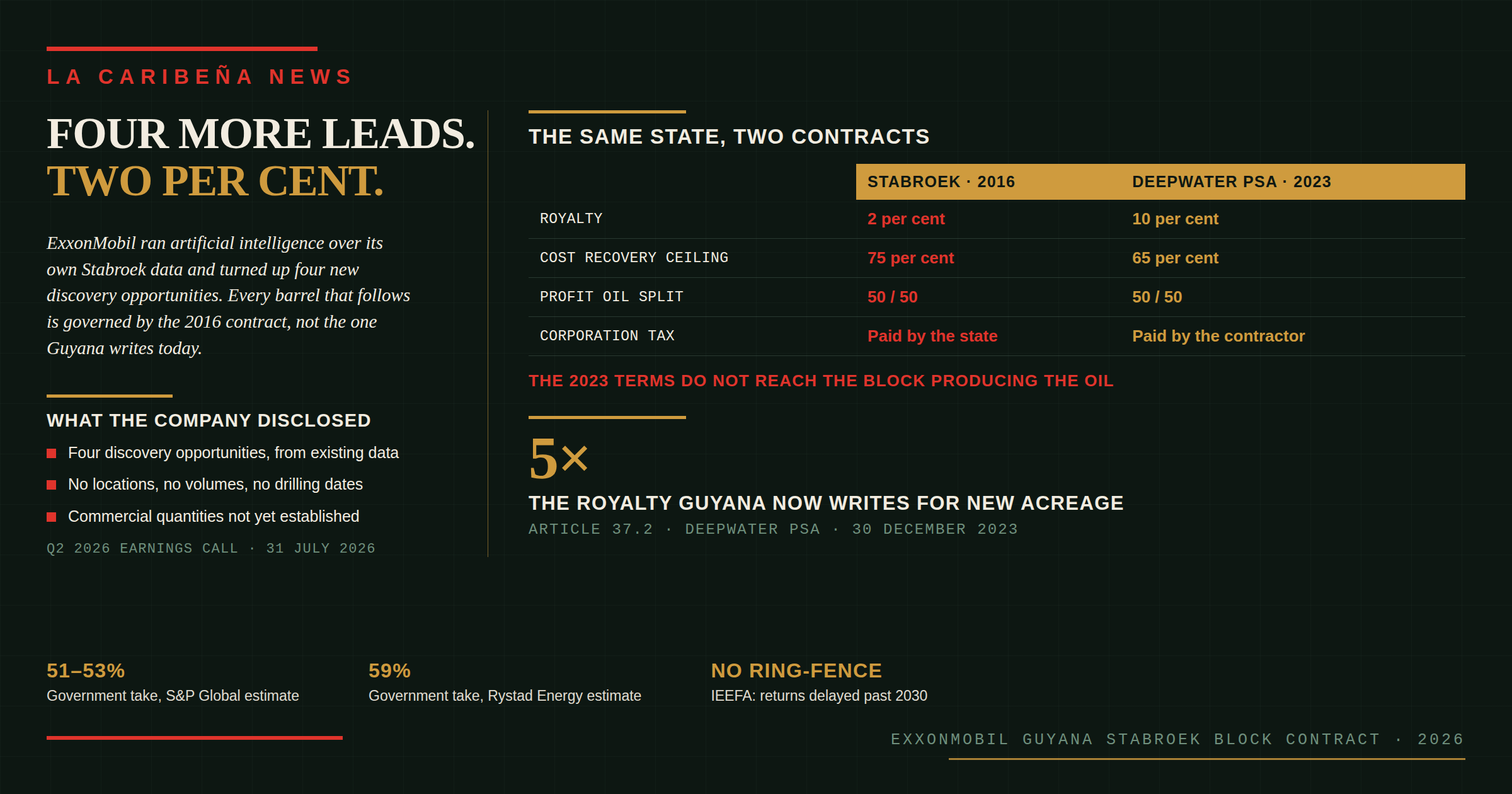
The company trained models on its own Stabroek data and turned up four new discovery opportunities. Under the 2016 contract that governs the block, Guyana's royalty on every barrel is two per cent. Its own 2023 contract for new blocks sets it at ten.
BY LCN WIRE
Quick summary: ExxonMobil identified four more potential discovery opportunities offshore Guyana by applying artificial intelligence to its Stabroek Block data, disclosed on its 31 July earnings call. Chief Financial Officer Neil Hansen said the company has not established whether they hold commercial quantities. Any barrel that follows falls under the 2016 Stabroek agreement, not the terms Guyana now writes.
What did ExxonMobil find?
Four leads, from data it already had.
OilNOW reported that the company trained AI models on information from previous discoveries, drilling operations and its analysis of the block's subsurface, then applied those models to other areas of the acreage. Hansen said the work produced "four new discovery opportunities above and beyond what we thought were opportunities."
Ocean Energy Resources carried the same account of the earnings-call disclosure, and reported that the company did not disclose the locations, estimated resource volumes, or any timetable for drilling.
Separately, Upstream Online reported on 3 August that ExxonMobil is drilling the Rockhead-1 wildcat in the Stabroek Block, in a report by South America correspondent Fabio Palmigiani.
How firm are they?
Not firm at all, on the company's own account.
Hansen's qualifier is the operative sentence: "Obviously, a lot more work to do to confirm those." A discovery opportunity is a lead, not a resource. Nothing in the disclosure establishes that any of the four contains hydrocarbons in commercial quantity, and no volumes were given.
What the disclosure does establish is direction. Exxon is finding more in Stabroek without acquiring new acreage, which matters because the acreage it already holds is governed by terms Guyana has since stopped offering.
What is a new Stabroek barrel worth to Guyana?
Less than a barrel from any block signed since.
Under the 2016 Stabroek agreement, Guyana takes a 2 per cent royalty. Up to 75 per cent of production in any year can be taken as cost oil, letting the companies recover exploration, development and operating expenses before profit is divided. What remains, the profit oil, is split 50/50. OilNOW has set out the mechanics of that arrangement.
Now set that beside the contract Guyana itself published for deepwater blocks awarded from 30 December 2023, available from the Ministry of Natural Resources.
| Term | Stabroek, 2016 | Deepwater PSA, 2023 |
|---|---|---|
| Royalty | 2 per cent | 10 per cent (Article 37.2) |
| Cost recovery ceiling | 75 per cent | 65 per cent (Article 35.2) |
| Profit oil split | 50/50 | 50/50 (Article 35.2(d)) |
| Corporation tax | Paid by the state on the contractor's behalf | Contractor subject to Guyana's income tax laws (Article 37.1) |
Article numbers refer to the 2023 deepwater agreement published by the Ministry of Natural Resources. Stabroek terms as set out by OilNOW from the 2016 agreement.
Five times the royalty. Ten percentage points less of annual production available for cost recovery before Guyana sees profit oil. And a tax position reversed outright: Article 37.1 subjects the contractor to the Income Tax Act, the Value Added Tax Act and the Corporation Tax Act, where the Stabroek arrangement has the state settle the companies' corporation tax out of its own share.
That is not an opposition talking point. It is the Guyanese state's own revealed judgment, in its own published contract, about what acceptable terms look like. It simply does not reach the block producing the oil.
The state did not need to be persuaded that the 2016 terms were low. It priced the next contract itself, and priced it five times higher.
Is the contract actually out of line?
That depends on what you count, and the analysts disagree.
S&P Global has put Guyana's government take at between 51 and 53 per cent for existing contracts, describing it as "about average compared to other offshore jurisdictions it competes for investments." Rystad Energy has put it at about 59 per cent, on the higher end of offshore producers. OilNOW reported both estimates.
Those numbers sit awkwardly beside a 2 per cent royalty for a reason. Government take counts the corporation tax paid on the companies' behalf as government revenue, even though no cash moves. It also flatters early years, when the 75 per cent cost recovery ceiling is doing the most work.
The Institute for Energy Economics and Financial Analysis argued in a July 2021 paper that the absence of a ring-fencing provision, which would stop costs from one development being recovered against revenue from another, pushes Guyana's meaningful returns out past 2030. Costs recovered against a producing field are barrels Guyana does not share in now.
This publication has separately reported what the IMF actually said about Guyana's cost-oil audits, which regional coverage had rendered as an instruction when the statement issued none.
La Caribeña News has also set Guyana's terms against what Suriname signed for the same basin a year earlier, where the royalty is 6.25 per cent and the contractor pays its own income tax.
Why four more leads matter more than they look
Because every one of them, if it produces, produces on 2016 terms.
New acreage carries the 2023 regime. Additional discoveries inside Stabroek do not. An AI pass over existing data that turns up four more opportunities is, in fiscal terms, four more chances to add production at two per cent rather than ten. The technology extends the reach of the old contract without reopening it.
Guyana's first-phase production began in December 2019 from Liza Phase 1, and subsea installation is under way at Whiptail, the block's fourth development. The leads disclosed on 31 July would sit behind all of it.
Frequently Asked Questions
What exactly did ExxonMobil announce?
Four new discovery opportunities offshore Guyana, identified by applying artificial intelligence to existing Stabroek Block data, disclosed on the second-quarter 2026 earnings call on 31 July by Chief Financial Officer Neil Hansen, as reported by OilNOW and Ocean Energy Resources.
Are these confirmed discoveries?
No. Hansen said the company has not determined whether they contain commercial quantities of hydrocarbons and that there is "a lot more work to do to confirm those." No locations, volumes or drilling dates were disclosed.
What royalty does Guyana receive from the Stabroek Block?
Two per cent under the 2016 agreement, with up to 75 per cent of annual production available for cost recovery and the remaining profit oil split 50/50.
Do newer Guyanese contracts use the same terms?
No. The deepwater production sharing agreement published for blocks from 30 December 2023 sets royalty at 10 per cent, caps cost recovery at 65 per cent, keeps the 50/50 profit split, and subjects the contractor to Guyana's income tax laws.
Is Guyana's overall take low by international standards?
Estimates differ. S&P Global puts government take at 51 to 53 per cent and calls it about average for competing offshore jurisdictions. Rystad Energy puts it near 59 per cent and calls it on the higher end. Both figures count corporation tax paid by the state on the companies' behalf as government revenue.
What is ring-fencing and why does it matter here?
Ring-fencing would prevent costs incurred on one development from being recovered against revenue from another. IEEFA argued in 2021 that its absence from the Stabroek agreement delays meaningful returns to Guyana beyond 2030.