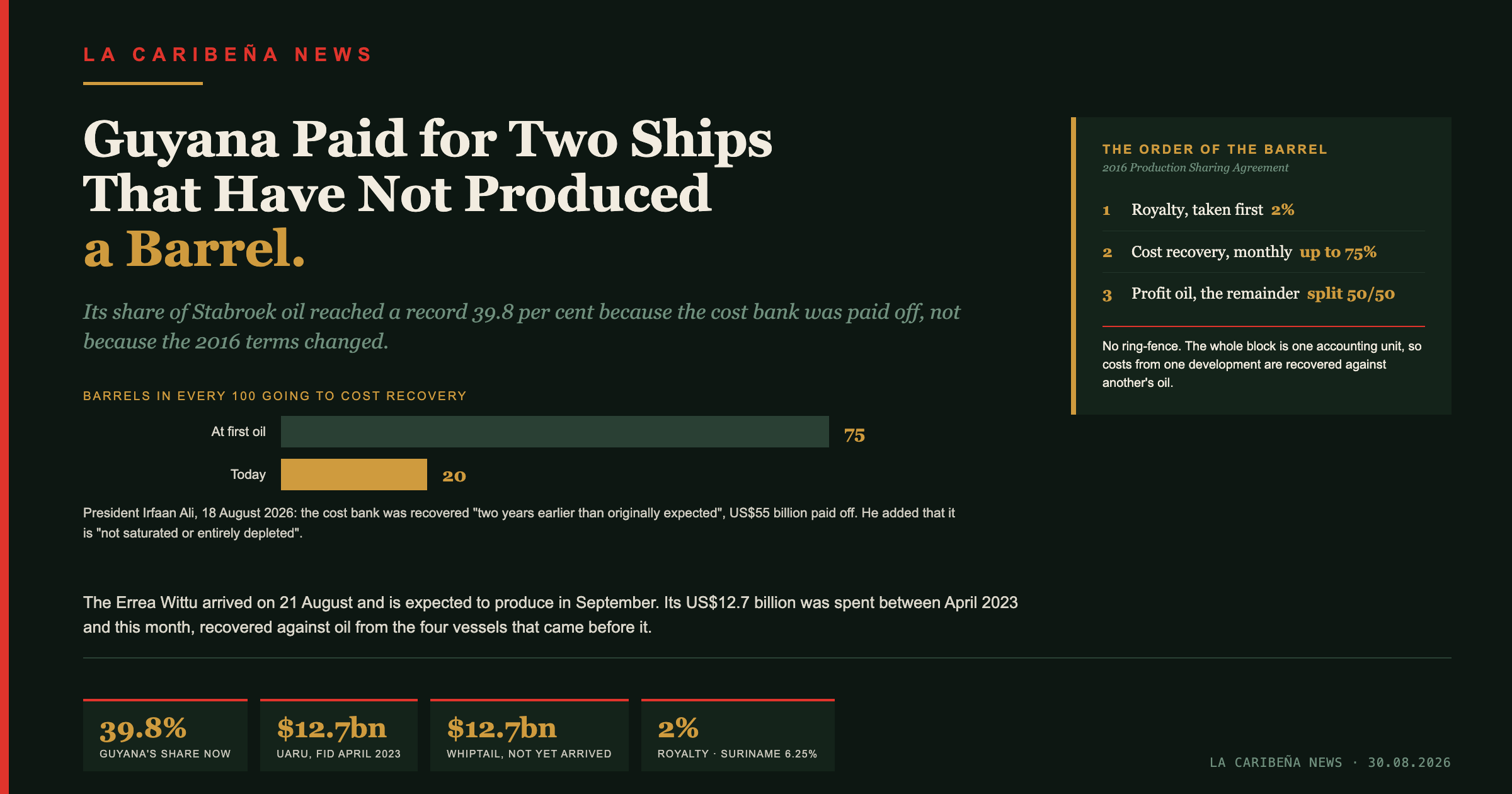
Quick summary: President Irfaan Ali said on 18 August that Guyana's share of Stabroek production had reached 39.8 per cent because the cost bank had been recovered two years early. The Stabroek Block is a single accounting unit, so the US$12.7 billion Errea Wittu was recovering against other fields from 2023.
By La Caribeña News · 30 August 2026
On 21 August the Errea Wittu arrived in Guyanese water, the fifth and largest floating production vessel on the Stabroek Block, built by MODEC for a development that cost US$12.7 billion. It has not produced a barrel. Production is expected in September.
Three days earlier, President Dr Mohamed Irfaan Ali told reporters at the Office of the President that Guyana's share of Stabroek production had risen to about 39.8 per cent.
Both statements are true. The relationship between them is the part that has not been reported.
Why did Guyana's share rise to 39.8 per cent?
Because the companies finished being paid back, not because Guyana negotiated anything.
The president was explicit that the formula had not moved. The Department of Public Information reported him saying the production-sharing formula "has remained as it was in the 2016 Production Sharing Agreement."
What changed is the cost bank.
"This has occurred, as I said, because the cost bank has been recovered two years earlier than originally expected," the president said.
At the start, he told reporters, "75 of every 100 barrels produced went to cost recovery." Today about 20 do. He put the sum already recovered at US$55 billion.
Under the 2016 agreement the order is fixed: a 2 per cent royalty comes off first, then cost recovery of up to 75 per cent of production, then the remaining profit oil is split equally. When cost recovery falls, Guyana's half of a larger remainder rises. That is the whole of the 39.8 per cent.
Who paid for the Errea Wittu?
Guyana did, out of oil from four other vessels, over three years before this one arrived.
Two features of the 2016 agreement produce that result together.
The Stabroek Block is not ring-fenced. The Institute for Energy Economics and Financial Analysis, in its summary of the agreement, sets out that costs incurred on one development are recoverable against revenue from another. The entire block is a single accounting unit. There is no separate ledger for Liza, for Payara, for Yellowtail or for Uaru.
And costs enter that ledger when they are incurred. Article 11 obliges the contractor to bear all contract costs and to recover them under Annex C. Annex C provides that where recoverable costs exceed the value of cost oil in any month, the unrecovered amount is carried forward and becomes recoverable in the month immediately following. Recovery is monthly and continuous. It does not wait for the project that generated the cost to start producing.
ExxonMobil took the final investment decision on Uaru in April 2023. The US$12.7 billion was spent between then and the vessel's arrival this month. Across those three years the only Stabroek oil in the water came from Liza Destiny, Liza Unity, Prosperity and One Guyana.
So the bill for the Errea Wittu was met out of the production of the four vessels that came before it, in the years when the fifth was still being built in Singapore.
The same is true of Whiptail, the sixth development, also budgeted at US$12.7 billion, whose vessel has not arrived at all.
Is the bill settled?
The president did not say that, and neither should anyone else.
"While the US$55 billion expenditure was paid off, the cost bank is not saturated or entirely depleted," he told reporters. "The 20 barrels today account for operating and other costs, which still form part of the cost bank."
That is a characterisation from a press conference, not an audited figure. It says the remaining fifth of production going to cost recovery is operating expenditure rather than a capital backlog. It does not establish how much of Uaru's or Whiptail's capital has cleared, or on what schedule the rest will.
Guyana's own cost-oil audits remain unresolved. The International Monetary Fund's 2026 Article IV concluding statement, issued on 31 July, records that "staff acknowledges the authorities' efforts to resolve outstanding cost-oil audits, including through arbitration" and that resolving them "in a timely manner remains important." This newspaper set out what that statement does and does not say on 3 August.
Until those audits close, the size of the bank is a figure the companies have submitted and the state has not finished checking.
What did the development actually cost?
US$12.7 billion, and 27 per cent more than an equivalent project before it.
ExxonMobil's April 2023 announcement put Uaru at up to 10 drill centres and 44 production and injection wells, developing an estimated resource of more than 800 million barrels, with capacity of about 250,000 barrels a day. Reporting of the final investment decision recorded that the project would cost 27 per cent more than the prior project of comparable size, reflecting rising costs.
Under a 75 per cent cost-recovery ceiling with no ring-fence, a cost increase of that order does not fall where it would in a concession regime. It enters the same monthly ledger as every other cost on the block.
Esso Exploration and Production Guyana holds 45 per cent of Stabroek and operates it. Hess Guyana Exploration holds 30 per cent and CNOOC Petroleum Guyana 25 per cent. The president said the consortium's 39.8 barrels are shared among them.
How do the terms compare next door?
Suriname signed a higher royalty in the same basin a year earlier.
This newspaper compared the two contracts on 4 August. Suriname's Block 58 carries a 6.25 per cent royalty and 36 per cent income tax, and its state oil company Staatsolie puts the resulting government take at 60 to 70 per cent. Guyana's Stabroek carries 2 per cent, and the state settles the companies' corporation tax.
Same basin, adjacent water, one year apart.
What is a 39.8 per cent share worth?
Whatever a barrel fetches, which the agreement does not fix.
The 2016 terms settle proportions and nothing else. Two per cent of production, then cost recovery in barrels, then a half share of the barrels left over. Every one of those is a quantity. What Guyana receives in money is that quantity multiplied by a price set somewhere else.
Guyana signed those proportions in 2016. Venezuela's oil was then largely closed to Western operators, and it holds the largest proven crude reserves in the world.
On 27 August the United States issued General Licence 50C, naming six companies authorised to work Venezuela's oil and gas sector: BP, Chevron, Eni, Maurel & Prom, Repsol and Shell.
ExxonMobil is not among them. Chevron is.
So the operator of the Stabroek Block is the one major absent from the reopening two hundred miles to the west, while a direct competitor is admitted to it. A company shut out of the cheaper province has more reason, not less, to press on in the expensive one. That is the reading favourable to Guyana, and it is available.
The other is that a percentage agreed when Venezuela was closed is now a percentage of barrels sold into a market where Venezuela is opening. The contract does not adjust for that. It was not written to.
What does a Guyanese get?
Two per cent, then a share of what is left after the companies are paid.
The gains are real and the IMF has measured them. Its Article IV statement records real growth of 19 per cent in 2025 after averaging nearly 40 per cent across 2023 and 2024, production past 900,000 barrels a day by end-2025, non-oil growth of 14 per cent led by construction, and unemployment of 6.2 per cent.
The Errea Wittu takes production past a million barrels a day for the first time. The four vessels now producing run at roughly 900,000 to 920,000.
What has not kept pace is the law that decides how much of the spending reaches Guyanese firms. The Local Content Act 2021 reserves 90 per cent of catering and 100 per cent of customs brokerage. It contains no category for software at all, and every target in its First Schedule is set against the end of 2022.
Text equivalent of the title card
Every data point shown on the title image, with its source.
- Guyana's share of Stabroek production: 39.8 per cent. Source: President Dr Mohamed Irfaan Ali, press conference 18 August 2026, reported by the Department of Public Information, 19 August 2026.
- Cost recovery fell from 75 barrels in every 100 to about 20. Source: as above.
- US$55 billion recovered, the cost bank cleared "two years earlier than originally expected". Source: as above.
- Errea Wittu / Uaru: US$12.7 billion, final investment decision April 2023, up to 10 drill centres, 44 wells, 800m+ barrels, ~250,000 bpd. Source: ExxonMobil, 26 April 2023.
- Whiptail, the sixth development: also US$12.7 billion.
- 2016 PSA: 2 per cent royalty, cost recovery up to 75 per cent, profit oil split 50/50. Source: Department of Public Information; IEEFA summary of the agreement.
- The Stabroek Block is not ring-fenced: costs from one development are recoverable against revenue from another. Source: IEEFA.
- Suriname Block 58: 6.25 per cent royalty, 36 per cent income tax, government take 60 to 70 per cent. Source: Staatsolie.
- General Licence 50C names six companies. ExxonMobil is not one. Source: OFAC annex, 27 August 2026.
The order of the barrel
| Step | Under the 2016 agreement |
|---|---|
| 1. Royalty | 2 per cent, taken first |
| 2. Cost recovery | up to 75 per cent of production, monthly, carried forward if unrecovered |
| 3. Profit oil | the remainder, split 50/50 |
| Ring-fence | none. One accounting unit for the whole block |
| Contractor income tax | settled by the state |
| Guyana's share today | about 39.8 per cent, at roughly 20 per cent cost recovery |
Frequently Asked Questions
Why did Guyana's share of Stabroek oil rise to 39.8 per cent?
Because cost recovery fell, not because the terms changed. President Ali said the 2016 formula is unchanged and that the cost bank was recovered two years earlier than expected, taking cost recovery from 75 barrels in every 100 down to about 20.
Did Guyana pay for the Errea Wittu before it arrived?
The Stabroek Block is a single accounting unit with no ring-fencing, and Annex C makes costs recoverable monthly as they are incurred. Uaru's US$12.7 billion was spent between the April 2023 investment decision and the vessel's arrival in August 2026, and during that period the only producing vessels on the block were the four that preceded it.
Is the cost bank now empty?
No. President Ali said it is "not saturated or entirely depleted" and attributed the remaining share to operating and other costs. That is his characterisation. Guyana's cost-oil audits are unresolved and partly in arbitration.
How does the Guyanese royalty compare with Suriname's?
Guyana's Stabroek royalty is 2 per cent and the state settles the companies' corporation tax. Suriname's Block 58 carries 6.25 per cent and 36 per cent income tax, with Staatsolie putting government take at 60 to 70 per cent.
Does the agreement protect Guyana if oil prices fall?
The 2016 terms fix proportions, not money: a 2 per cent royalty, cost recovery in barrels, and a half share of the remainder. What those barrels are worth is set by the market. General Licence 50C, issued on 27 August 2026, authorised six companies to work Venezuela's oil and gas sector. ExxonMobil, which operates Stabroek, is not among them.