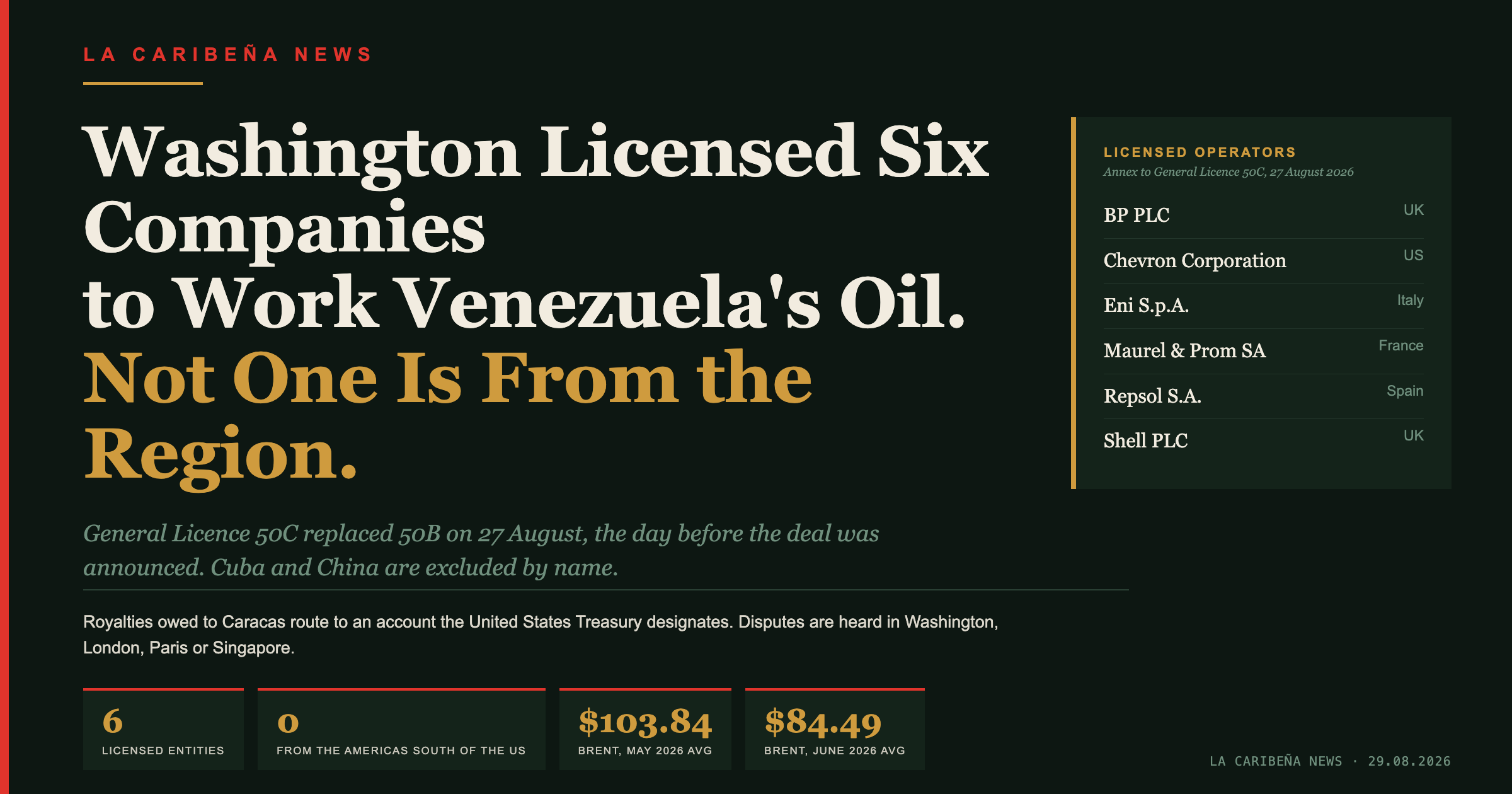
The Office of Foreign Assets Control issued General Licence No. 50C on 27 August 2026, signed at 08:36 Eastern time, and it states its own effect plainly: "Effective August 27, 2026, General License No. 50B, dated June 10, 2026, is replaced and superseded in its entirety by this General License No. 50C."
This newspaper reported on 15 August that Washington had authorised BP and Shell to work in Venezuela under General Licence 50B. That instrument no longer governs. The terms that replaced it are more specific, and they are more consequential for the region than the announcement that followed it the next day.
President Trump said on the evening of Friday 28 August that the United States had secured majority control of more than 65 billion barrels of Venezuelan reserves, calling it "THE BIGGEST OIL DEAL IN WORLD HISTORY" and saying it came at no cost to American taxpayers. He said it in a social media post. The Associated Press reported the claim as his: "Trump says US has entered deal with Venezuela to take control of 65 billion barrels of oil reserves." CNBC reported the same evening post.
The licence that governs who may lawfully operate there was signed the previous morning.
Which companies may work Venezuela's oil?
Six, and the licence lists them by name in its annex.
BP PLC. Chevron Corporation. Eni S.p.A. Établissements Maurel & Prom SA. Repsol S.A. Shell PLC.
Two are British, one Italian, one French, one Spanish, one American. No Latin American or Caribbean company appears on the list. The recovery of the largest proven crude reserves in the hemisphere is licensed, for now, to European and North American operators.
ExxonMobil is not on the annex either. The company that operates the Stabroek block off Guyana holds no authorisation under this licence, while Chevron, its principal American rival, does.
What does the licence actually permit?
Transactions related to oil or gas sector operations of the six named entities and their subsidiaries, subject to conditions that are not boilerplate.
Any contract with the Government of Venezuela, Petróleos de Venezuela (PdVSA) or a PdVSA entity must specify that dispute resolution proceedings occur in the United States, the United Kingdom, France, or Singapore. Treasury clarified the point in a frequently asked question released the same day, confirming that the requirement governs the forum rather than the law of the contract.
Payments are routed. Guyana's own royalty rate is two per cent, and it is paid to Guyana. Any monetary payment to a blocked person, excluding local taxes, permits and fees, must be made into the Foreign Government Deposit Funds specified in Executive Order 14373 of 9 January 2026, or another account Treasury designates. A note to the licence removes any ambiguity about scope: "Any payments of oil or gas taxes or royalties to the Government of Venezuela, PdVSA, or any PdVSA Entity must be paid into the Foreign Government Deposit Funds."
Companies operating under the licence must report to the State Department and the Department of Energy, identifying the parties, the quantities, values and dates of transactions, and any taxes or fees paid to the Venezuelan government. The first report falls due ten days after the first transaction, and every ninety days while transactions continue.
Who is shut out?
The exclusions are where the regional consequence sits.
General Licence 50C does not authorise any transaction involving a person located in the Russian Federation, Iran, North Korea, the Republic of Cuba, or the People's Republic of China, or any entity owned or controlled by, or in a joint venture with, such persons.
General Licence 46D, covering Venezuelan-origin oil and petrochemical products for importation into the United States, goes further and gives China its own paragraph. It bars any transaction involving an entity organised under the laws of Venezuela or the United States that is owned or controlled, directly or indirectly, by or in a joint venture with a person organised under the laws of the People's Republic of China.
Cuba is a member of the Community of Latin American and Caribbean States and has received Venezuelan crude for two decades. China is the largest single creditor to the region's energy sector. Both are written out of the licensed recovery by name.
General Licence 46D also restricts who may import. It authorises an "established U.S. entity", defined as an entity organised under the laws of the United States on or before 29 January 2025. A company incorporated after that date does not qualify.
Does the licence authorise the deal announced on 28 August?
On the public record this newspaper can find, no instrument issued on or after 28 August 2026 authorises a transfer of control over Venezuelan reserves. Treasury's published actions record the issuance of Venezuela-related general licences on 24 August and amended licences on 27 August. Nothing follows them. The announcement itself came in a social media post rather than through an executive order, a Treasury release or a licence.
The pattern Treasury has used elsewhere is instructive. General Licence 62, issued 21 August, authorises the negotiation of and entry into contingent contracts for investment in Venezuela's telecommunications sector, and requires that "the performance of any such contract is made expressly contingent upon separate authorization from the Office of Foreign Assets Control." Treasury's guidance on contingent contracts under General Licence 49 states that applications to perform them "will be assessed on a case-by-case basis consistent with U.S. foreign policy and national security priorities."
Under that architecture, signing and performing are separate acts requiring separate authority.
What market is this supply returning to?
Not a tight one.
Brent averaged US$103.84 a barrel in May 2026, according to the St. Louis Federal Reserve's series for the global Brent price. In June it averaged US$84.49, a fall of US$19.35 in a single month, or nineteen per cent. July averaged US$83.73. Brent traded at about US$88.29 on 28 August, the day of the announcement, with West Texas Intermediate in the low eighties.
So the licensed return of Venezuelan production is being arranged into a market that has already given back most of the ground it gained in the spring, while crude and product movements through the Strait of Hormuz remain constrained by the Iran conflict.
Venezuelan crude does not fetch the headline price. Merey, the heavy grade that carries most Venezuelan exports, was quoted at US$71.13 on the most recent monthly comparison published by Oilprice, against a Brent average of US$84.49 for the same month, a discount of about thirteen dollars. That figure is single-sourced and the underlying reference is not identified. It also sits well outside the other public marker: Reuters reported in January 2026 that Merey-16 was being offered to United States Gulf Coast refiners at roughly six dollars under Brent. The two are not reconcilable from the public record, and the gap between them is the difference between a barrel that competes with Guyanese crude and one that undercuts it.
What does this mean for Guyana?
Two things, and they pull in opposite directions.
Venezuelan barrels returning to market under licence compete with Guyanese crude, and they arrive discounted twice over. Brent closed at US$88.29 on the day of the announcement against a May average of US$103.84, so the market itself is already US$15.55 down on the spring. Venezuelan heavy crude then sells at a further discount to that. Guyana's fiscal position rests on production from a small number of offshore developments sold into that same market.
Guyana's strategic position rests on something the licences now touch. Guyanese crude loads in the Atlantic basin, outside the Strait of Hormuz, which is what has made it valuable to buyers hedging against the Gulf. Restoring Venezuelan production creates a second Atlantic-basin source of scale, licensed and reported to Washington.
The company that operates Guyana's production is not among the six cleared to work in Venezuela. Chevron is.
At the same time, the terms of the licence reach further than any producer state's own law. Guyana's Local Content Act 2021 governs procurement inside Guyana. It does not govern which jurisdictions a contract must name for dispute resolution, or which treasury receives a royalty. General Licence 50C does both, for Venezuela, and it does so through the licensing power of a third country.
Where does Trinidad and Tobago sit?
Under the same licence, through two of its six names.
Shell and BP both appear in the annex to General Licence 50C. The gas Trinidad and Tobago needs for its LNG trains and petrochemical plants sits mostly in Venezuelan water, and Shell and BP are the operators pursuing it. Trinidad's gas supply therefore now runs through an instrument that requires disputes to be heard in Washington, London, Paris or Singapore, and payments to Caracas to pass through an account the United States Treasury designates.
What does it mean for CELAC?
The instrument sets terms for the hemisphere's largest oil reserves without a Latin American or Caribbean signatory, forum or operator.
Dispute resolution runs to Washington, London, Paris or Singapore. Royalties run to an account designated by the United States Treasury. Two CELAC-relevant parties, Cuba and China, are excluded by name. The six licensed entities are headquartered in the United States and Western Europe.
For member states weighing energy partnerships, the operative fact is that participation in Venezuela's oil sector now carries a compliance perimeter set in Washington, reported to Washington every ninety days, and adjudicated outside the region.
Text equivalent of the title card
Every data point shown on the title image, with its source.
- Licensed entities: 6. BP PLC (UK), Chevron Corporation (US), Eni S.p.A. (Italy), Établissements Maurel & Prom SA (France), Repsol S.A. (Spain), Shell PLC (UK). Source: Annex to General Licence 50C, listed as of 27 August 2026.
- From the Americas south of the United States: 0. Derived by inspection of the same annex.
- Brent crude, May 2026 monthly average: US$103.84 a barrel. Source: Federal Reserve Bank of St. Louis, global price of Brent crude.
- Brent crude, June 2026 monthly average: US$84.49 a barrel. Same source.
- General Licence 50C replaced 50B on 27 August 2026, the day before the deal was announced. Source: the licence text.
- Cuba and China are excluded by name. Source: paragraph (b) of General Licence 50C and paragraph (b) of General Licence 46D.
- Royalties route to a United States Treasury account, and disputes are heard in Washington, London, Paris or Singapore. Source: paragraphs (a)(1) and (a)(2) of General Licence 50C.
The licences at a glance
| Instrument | Issued | What it does |
|---|---|---|
| General Licence 50C | 27 August 2026 | Authorises oil and gas operations of six named entities; supersedes 50B of 10 June |
| General Licence 46D | 27 August 2026 | Authorises Venezuelan-origin oil and petrochemical imports by an established U.S. entity |
| General Licence 62 | 21 August 2026 | Authorises contingent telecommunications contracts; performance requires separate authorisation |
| Executive Order 14373 | 9 January 2026 | Establishes the Foreign Government Deposit Funds that receive Venezuelan royalties |
Entities named in the Annex to General Licence 50C as of 27 August 2026: BP PLC, Chevron Corporation, Eni S.p.A., Établissements Maurel & Prom SA, Repsol S.A., Shell PLC.
Frequently Asked Questions
Which companies are licensed to operate in Venezuela's oil and gas sector?
Six are named in the annex to General Licence 50C as of 27 August 2026: BP PLC, Chevron Corporation, Eni S.p.A., Établissements Maurel & Prom SA, Repsol S.A. and Shell PLC. The list may be amended by Treasury.
Where must disputes be heard?
Contracts with the Government of Venezuela, PdVSA or PdVSA entities must specify that dispute resolution proceedings occur in the United States, the United Kingdom, France or Singapore. Treasury confirmed on 27 August that this governs the forum and not the governing law of the contract.
Where do Venezuelan oil royalties go?
Payments of oil or gas taxes or royalties to the Government of Venezuela, PdVSA or any PdVSA entity must be paid into the Foreign Government Deposit Funds established by Executive Order 14373 of 9 January 2026, or another account designated by the United States Treasury. Local taxes, permits and fees are excluded from that requirement.
Are Chinese and Cuban parties able to participate?
No. General Licence 50C excludes any transaction involving a person located in Cuba or China, or an entity owned or controlled by or in a joint venture with such persons. General Licence 46D carries a separate paragraph directed at Chinese-owned or Chinese-controlled entities.
How does this affect Trinidad and Tobago?
Shell and BP are both named in the annex to General Licence 50C, and both are pursuing gas in Venezuelan water that Trinidad and Tobago needs. Trinidad's supply route therefore sits inside the same licensing terms, including the dispute-resolution and payment-routing conditions.
Has the region responded?
On the public record this newspaper can find, no statement from the Government of Guyana, CARICOM or the Government of Trinidad and Tobago addresses General Licence 50C or the deal announced on 28 August.