Quick summary: Venezuela confirmed an oil accord with the United States on 28 August 2026 covering 17 fields and 65 billion barrels. Article 150 of its Constitution requires National Assembly approval for public interest contracts with companies not domiciled in Venezuela. No such approval is on the public record.
By La Caribeña News · 30 August 2026
Two years ago the same transaction would have run through at least four institutions on two continents.
The route that was available in 2024 is written down. Venezuela's Constitution, its Organic Hydrocarbons Law and the United States sanctions regime each imposed a gate, and each gate had a named body behind it.
What was confirmed, and when?
An accord covering a fifth of the country's proven reserves, announced over three days.
On 27 August the United States issued General Licence 50C, naming six companies cleared to work Venezuela's oil and gas sector: BP, Chevron, Eni, Maurel & Prom, Repsol and Shell.
The following day President Donald Trump announced what he called the largest oil deal in world history. That night Interim President Delcy Rodríguez confirmed it in a written statement, putting the accord at 17 strategic fields with a potential of 65 billion barrels, about US$100 billion in private investment and more than US$209 billion in revenue for the state.
What would the 2024 route have required in Caracas?
Approval by the legislature, before signature.
Article 150 of the Constitution provides that no public interest contract may be executed with foreign official entities, or with companies not domiciled in Venezuela, without the approval of the National Assembly. Article 187, paragraph 9 gives the Assembly the corresponding power to authorise the National Executive to conclude such contracts.
The hydrocarbons statute is narrower still. Article 33 of the Organic Hydrocarbons Law subjects the constitutive contract of a joint venture to prior control by the National Assembly, and the 2006 reform extended that control to any modification of it.
The corporate form is prescribed as well. Where private companies take part in primary hydrocarbon activity, they do so through an empresa mixta, in which the private shareholder cannot hold control of management and the venture operates under the effective control of the State.
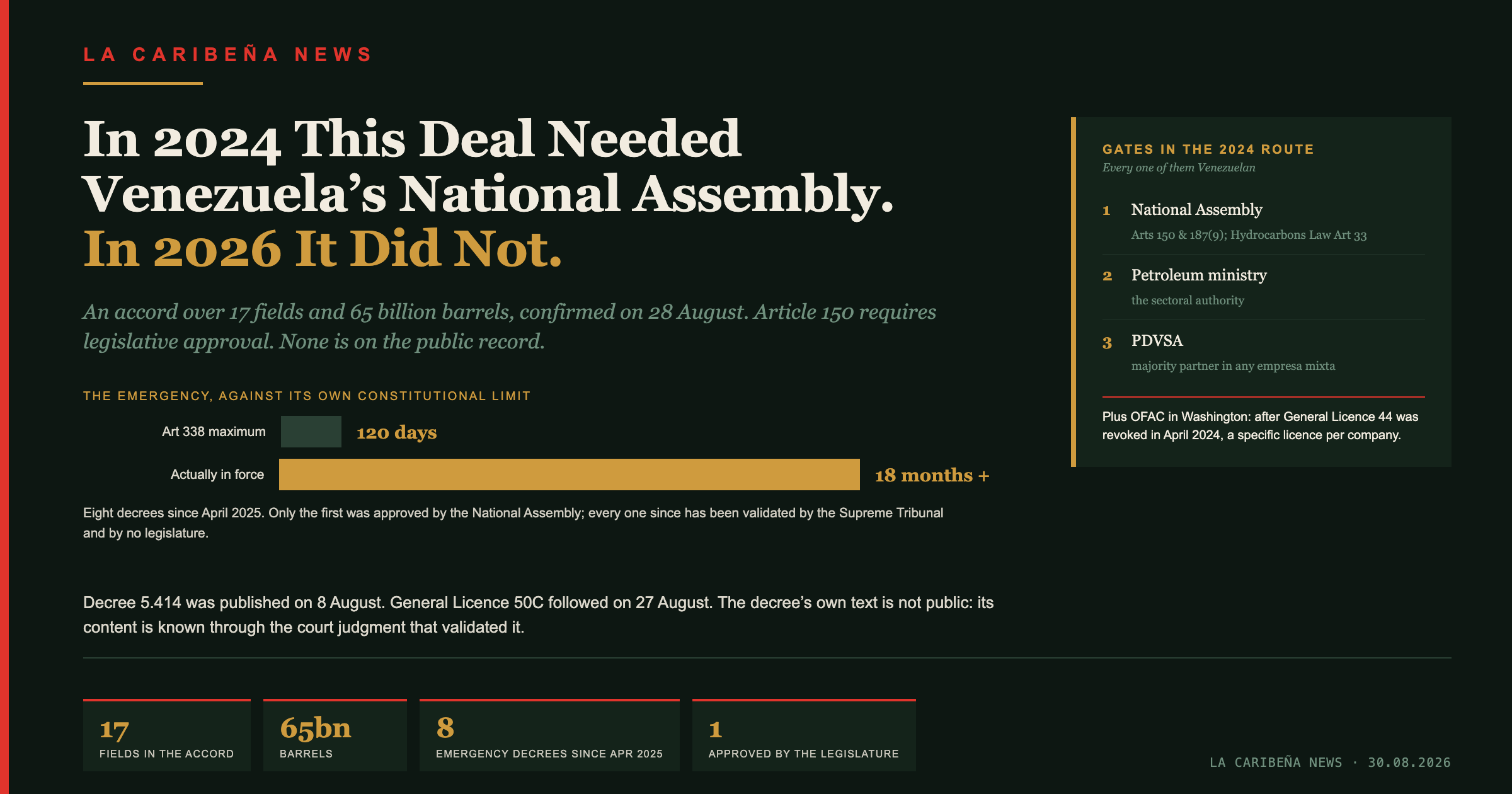
Three bodies therefore sat in the path before anything was signed: the National Assembly, the ministry with the petroleum portfolio, and PDVSA as the majority partner in any joint venture.
What would it have required in Washington?
A separate licence, company by company.
Venezuela's oil sector was under United States sanctions. General Licence 44, issued in October 2023, had authorised a broad range of oil and gas transactions. On 17 April 2024 the Office of Foreign Assets Control revoked it and issued General Licence 44A in its place, a wind-down authorisation running only to 31 May 2024.
After that date the broad authorisation was gone. What remained were narrow instruments: General Licence 41, which covered Chevron's joint ventures alone, and General Licence 8M. Firms outside those were directed to apply to OFAC for specific licences, each application judged on its own.
Six companies would have meant six applications.
What does the 2026 record show instead?
Two instruments, and neither is an act of a legislature.
On the American side, one general licence names all six companies at once.
On the Venezuelan side, the accord was confirmed by an Interim President exercising powers under a state of economic emergency. Decree 5.414, published in Gaceta Oficial 7.066 Extraordinario on 8 August 2026, declared that emergency across the national territory for 60 days, to early October. The Constitutional Chamber of the Supreme Tribunal of Justice declared it constitutional.
The decree confers extraordinary powers over economic, tax and financial matters. Among them, in the account of the rule-of-law observatory Acceso a la Justicia, is authority to approve public credit operations "exceptionally and without submission to any other public power".
On the public record this newspaper can find, the National Assembly has not approved the accord under Article 150.
How many institutions is that?
Four in 2024. Two in 2026, and the legislature is not among them.
| 2024 route | August 2026 | |
|---|---|---|
| Venezuelan legislature | National Assembly, Articles 150 and 187(9), and Article 33 of the hydrocarbons law | not on the record |
| Sectoral authority | ministry holding the petroleum portfolio | not on the record |
| State oil company | PDVSA, majority partner in any empresa mixta | not on the record |
| Constitutional court | not engaged in an ordinary approval | TSJ, validating the emergency decree |
| United States | OFAC, specific licence per company | OFAC, one general licence for six |
The count is the point. Every gate that has disappeared was a Venezuelan one.
What has the emergency decree got to do with it?
It removes the rule that reserves economic law-making to the legislature.
Under the decree the Executive may act in tax, financial and monetary matters that are ordinarily subject to reserva legal. In Acceso a la Justicia's account, the Executive "assumes law-making powers that belong to the Legislative Power" and exercises them with wide discretion and no sufficiently precise limits, weakening Articles 136 and 137 of the Constitution.
The emergency is also not new. Article 338 permits an economic emergency of up to sixty days, extendable once by the same period. A maximum of 120 days. Venezuela has been under one for more than a year and a half, through eight decrees since April 2025.
Only the first of the eight, issued by Nicolás Maduro in April 2025, was approved by the National Assembly. Every decree since has been validated by the Supreme Tribunal and by no legislature. In the observatory's account, the court has held that once the 120 days are exhausted the Executive may issue a fresh decree under a different number, on essentially the same grounds, keeping the same powers.
Nineteen days separated Decree 5.414 from General Licence 50C.
What is not established?
The legal form of the accord, and its text.
No contract has been published. Whether the arrangement takes the form of joint ventures under the hydrocarbons law, service contracts, or something else is not on the record, and the answer determines which approval provisions apply.
Decree 5.414's own text is not public either. Acceso a la Justicia records that its content is known so far only through the Supreme Tribunal judgment that validated it, rather than through the Gazette. The same observatory notes that several decrees in the series became known first through the rulings approving them.
The sequence set out above is a sequence. This newspaper does not assert that the emergency powers were used to conclude the accord, because no published instrument says so.
Delcy Rodríguez's own position is likewise unresolved. Acceso a la Justicia recorded in July that 180 days had passed since the executive vice-president assumed the presidency in the condition of encargada following the absence of Nicolás Maduro, and that the National Assembly had not pronounced on it.
Text equivalent of the title card
Every data point shown on the title image, with its source.
- Article 150 of the Constitution: no public interest contract may be executed with foreign official entities or companies not domiciled in Venezuela without National Assembly approval. Article 187(9) grants the Assembly the corresponding authorising power.
- Article 33, Organic Hydrocarbons Law: the constitutive contract of a joint venture is subject to prior National Assembly control; the 2006 reform extended this to any modification.
- Article 338: economic emergency of up to 60 days, extendable once by the same period. A maximum of 120 days.
- Eight decrees since April 2025, keeping the emergency in force for more than eighteen months. Only the first was approved by the National Assembly. Source: Acceso a la Justicia, 21 August 2026.
- Decree 5.414, Gaceta Oficial 7.066 Extraordinario, 8 August 2026, running to early October. Its text is not public; its content is known through the Supreme Tribunal judgment validating it.
- General Licence 44 revoked 17 April 2024, replaced by 44A winding down to 31 May 2024. Source: Office of Foreign Assets Control.
- General Licence 50C, 27 August 2026, names six companies: BP, Chevron, Eni, Maurel & Prom, Repsol, Shell.
- The accord as confirmed: 17 fields, 65 billion barrels, about US$100 billion in investment, more than US$209 billion in state revenue.
Frequently Asked Questions
Does Venezuela's Constitution require legislative approval for a deal like this?
Article 150 provides that no public interest contract may be executed with foreign official entities or with companies not domiciled in Venezuela without National Assembly approval, and Article 187(9) gives the Assembly the power to authorise the Executive to conclude such contracts. Whether the August accord falls within those provisions depends on its legal form, which has not been published.
What would the United States have required in 2024?
Separate authorisation. General Licence 44 was revoked on 17 April 2024 and replaced by a wind-down licence expiring 31 May 2024. After that, companies relied on narrow instruments such as General Licence 41, which covered Chevron alone, or applied to OFAC for specific licences.
What does the economic emergency decree allow?
Extraordinary powers over economic, tax and financial matters ordinarily reserved to legislation, including, in Acceso a la Justicia's account, authority to approve public credit operations without submission to any other public power.
How long can an economic emergency last in Venezuela?
Article 338 permits sixty days, extendable once by the same period, so 120 days in total. Venezuela has been under one continuously for more than eighteen months through eight decrees since April 2025.
Has the National Assembly approved any of this?
It approved the first decree of the series, issued in April 2025. On the public record this newspaper can find, it has approved neither the later decrees nor the August accord.