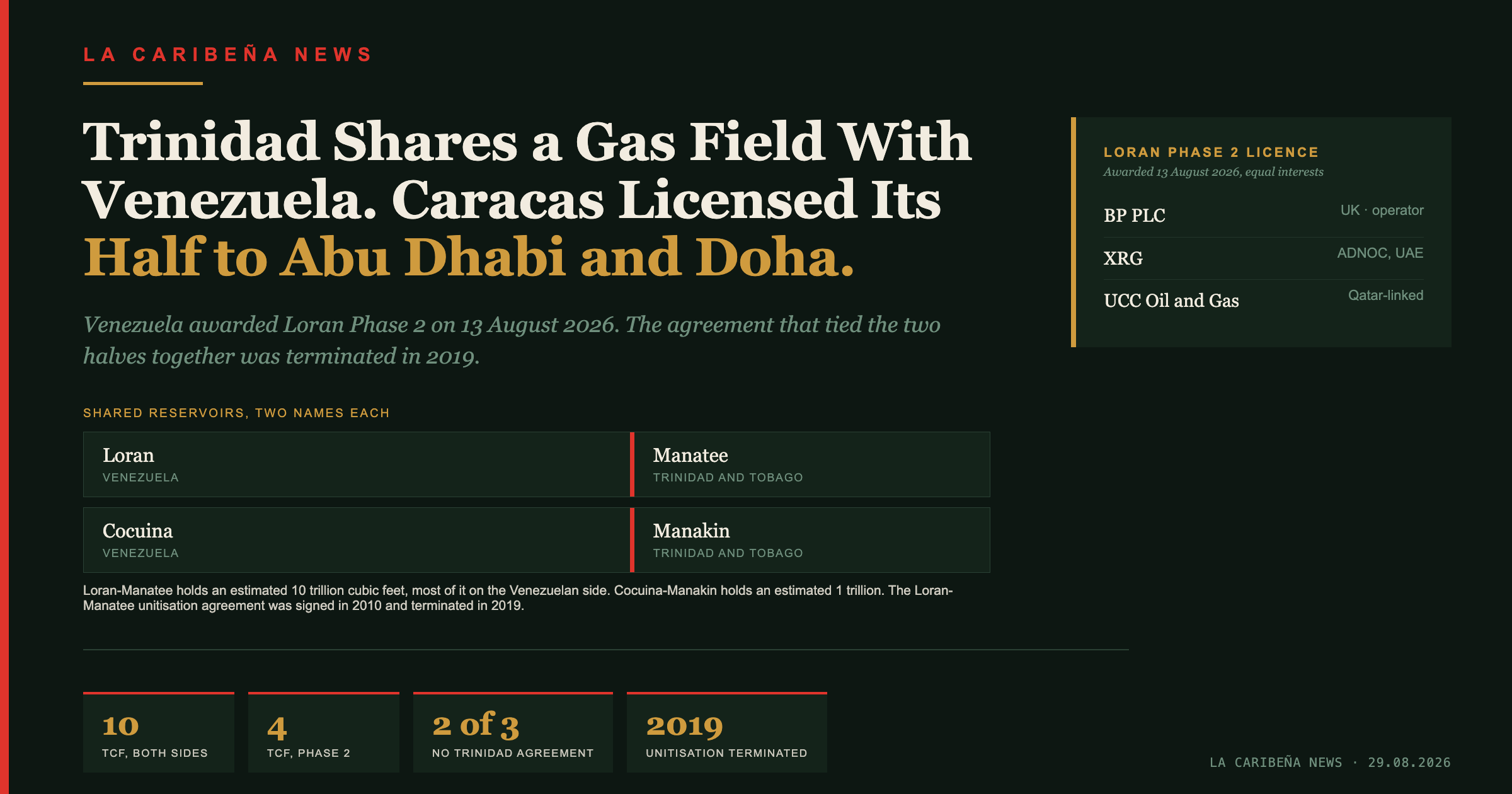
Quick summary: Venezuela awarded Loran Phase 2 to a BP-led group on 13 August 2026, with ADNOC's XRG and Qatar-linked UCC holding two thirds of the equity. Loran and Trinidad's Manatee are one reservoir, and the agreement tying them together was terminated in 2019. Trinidad's Energy Chamber confirmed a new chief executive the following day.
By La Caribeña News · 29 August 2026
Loran and Manatee are not two fields. They are one gas reservoir with a maritime boundary drawn across it, Loran on the Venezuelan side, Manatee on the Trinidadian side, holding an estimated ten trillion cubic feet between them, most of it in Venezuelan water.
On 13 August 2026, BP announced it had been granted an exploration and production licence for Phase 2 of Loran. It holds that licence with XRG, the international investment arm of the Abu Dhabi National Oil Company, and UCC Oil and Gas Holding, each with an equal working interest, BP operating. BP put Phase 2's recoverable resources at four trillion cubic feet.
Two of the three licence holders have no agreement with the Government of Trinidad and Tobago.
What happened to the agreement that tied the two halves together?
It was terminated seven years ago.
Trinidad and Venezuela signed a framework treaty on cross-border fields in 2007 and a unitisation agreement covering Loran-Manatee in 2010. In 2019 the two governments ended that agreement and replaced it with one permitting each country to develop its own share independently.
That is the arrangement still in force. Shell has taken a final investment decision on Manatee, on the Trinidad side, and Venezuela has licensed its side separately, first to Shell for Loran and now to the BP-led group for Phase 2. Analysts following the field have noted that a fresh unitisation agreement would be the logical next step given a reservoir that does not recognise the boundary. None has been concluded.
Trinidad's acreage has not been given away. Manatee sits in Trinidadian water and Shell is developing it. What changed is on the other side of the line, in the same rock.
Who now holds the Venezuelan side?
Three parties, and only one of them answers to Port of Spain.
BP is deeply committed in Trinidad. On 6 August 2026 it agreed to buy Woodside Energy's seventy per cent operated interest in Block TTDAA 14, the acreage holding the Calypso deepwater gas project, taking BP from thirty per cent to full ownership and assuming operatorship, with completion targeted by the end of 2026. BP is a Trinidadian operator of long standing and is now the operator on both sides of the Loran-Manatee boundary in all but name.
XRG is ADNOC's international energy investment company. UCC Oil and Gas Holding is a Qatar-linked investor. Neither holds Trinidadian acreage. Between them they hold two thirds of the equity in a licence to produce from a reservoir that Trinidad shares.
There is a second cross-border field in the same frame. A memorandum of understanding announced on 29 April 2026 covers development of Cocuina-Manakin, which also straddles the maritime border, and which carries an estimated one trillion cubic feet.
Where does Shell stand?
On both sides, and having just walked away from a third project.
Shell holds Manatee on the Trinidad side. It holds a forty-five per cent stake in Atlantic LNG. With the National Gas Company it holds the thirty-year exploration and production licence Venezuela granted for the Dragon field on 21 December 2023. That licence is the right to the gas. Acting on it also requires an American authorisation, which is a separate instrument and has been revoked once already.
In late August 2026 Shell shelved its Aphrodite project offshore Trinidad after commercial talks with the National Gas Company collapsed, according to Reuters, citing three people familiar with the decision. Shell had already taken a positive final investment decision on the field, which was set to deliver around one hundred million cubic feet of gas a day, and released the jack-up rig it had contracted to drill the production wells. Shell told Reuters it remained in negotiations.
What does the American licensing regime add?
A condition on all of it.
General Licence 50C, issued by the United States Office of Foreign Assets Control on 27 August 2026, names the six companies authorised to work Venezuela's oil and gas sector. BP and Shell are both on that annex. So is Chevron, Eni, Maurel & Prom and Repsol.
The licence carries terms that travel with the gas. Contracts with the Government of Venezuela, Petróleos de Venezuela or its entities must specify that disputes are heard in the United States, the United Kingdom, France or Singapore. Royalties owed to Caracas must be paid into an account the United States Treasury designates. Companies operating under it report to the State Department and the Department of Energy every ninety days.
This is not the first time the conditions have bitten. The American authorisation that let Shell and the National Gas Company act on their Venezuelan licence at Dragon was revoked in April 2025, and both were given until 27 May to wind down. BP's authorisation covering its own cross-border field was revoked at the same time. A replacement followed in October 2025, running two years and structured in three stages, the first of them lasting until April 2026 and requiring American companies to be included in the development phase.
Trinidad's cross-border gas therefore reaches its LNG trains through instruments written in Washington, developed by companies licensed in Washington, on terms adjudicated outside the region.
Where has Trinidad been looking for gas instead?
Guyana, and without result.
Trinidad has been asking Guyana for hydrocarbons since February 2024 and no binding deal has followed. Guyana signed energy agreements with Jamaica and the Dominican Republic in that period.
Where the ministries did not move, the chambers did. The Georgetown Chamber of Commerce and Industry signed a memorandum of understanding with the Energy Chamber of Trinidad and Tobago at the Offshore Technology Conference in Houston in early May 2026. The Energy Chamber lists four areas in it: removing trade barriers between the two countries, local content policy development and supply chain integration, energy transition and diversification, and technical exchanges on gas monetisation.
Trinidad's chamber signed a gas-monetisation exchange with Guyana in May. Three months later Venezuela licensed the gas on Trinidad's own boundary to Abu Dhabi and Doha.
The first joint event under that agreement has not taken place. Dr Priya Marajh said on 9 July 2026 that a work plan was agreed and an event was roughly three months away, virtual in the first instance. Nothing further has been announced, and no Guyana event appears on the Energy Chamber's published calendar through January 2027.
Who speaks for the industry?
The person who signed the Houston agreement, confirmed in the job in August.
Dr Priya Marajh signed the Houston memorandum for Trinidad on 5 May 2026, as this newspaper reported on 17 August, while running the Energy Chamber's executive office on an interim basis. She was made substantive President and Chief Executive Officer on 14 August 2026.
She had been acting since March, after the departure of Dr Thackwray Driver, whose resignation took effect on 31 March 2026.
On the May agreement she put the case for smaller firms. "We bring a lot of capabilities in terms of knowledge transfer," she told OilNOW on 6 May. "But I think what we're going to learn, and what's important for me with this MOU is the value added that it's going to bring to some of our smaller members and some of the partnerships that they're able to forge with members from GCCI."
She attended the second agreement, signed on 8 July 2026 with the Trinidad and Tobago Chamber of Industry and Commerce, but did not sign it. Karen Yip Chuck signed for Trinidad on that one.
Marajh came to the post from inside the Chamber, most recently as Vice President for Advocacy and Membership Engagement, with a stated background covering local content development, policy, diplomacy and international law, and a lectureship in international relations at the University of the West Indies.
She is also a director of Touchstone Exploration Inc, the Canadian-listed producer with onshore Trinidad operations, a seat she has held since July 2022.
Text equivalent of the title card
Every data point shown on the title image, with its source.
- Loran Phase 2 licence, awarded 13 August 2026, held in equal interests by BP PLC (United Kingdom, operator), XRG (the Abu Dhabi National Oil Company's international investment arm) and UCC Oil and Gas Holding (Qatar-linked). Source: BP press release, 13 August 2026.
- Loran (Venezuela) and Manatee (Trinidad and Tobago) are one reservoir divided by the maritime boundary, holding an estimated 10 trillion cubic feet, most of it on the Venezuelan side. Source: reporting on the cross-border field, June 2026.
- Loran Phase 2, recoverable: 4 trillion cubic feet. Source: BP press release, 13 August 2026.
- Cocuina (Venezuela) and Manakin (Trinidad and Tobago) also straddle the boundary and hold an estimated 1 trillion cubic feet, covered by a memorandum announced 29 April 2026.
- Two of the three Loran Phase 2 licence holders have no agreement with the Government of Trinidad and Tobago.
- Loran-Manatee unitisation agreement signed 2010, terminated 2019.
The August sequence
| Date | Event |
|---|---|
| 6 August 2026 | BP agrees to buy Woodside's 70% of Block TTDAA 14, taking Calypso to 100% |
| 13 August 2026 | Venezuela awards Loran Phase 2 to BP, XRG and UCC in equal shares, BP operating |
| 14 August 2026 | Energy Chamber confirms Dr Priya Marajh as President and CEO |
| 27 August 2026 | General Licence 50C names BP and Shell among six licensed operators |
| Late August 2026 | Shell shelves Aphrodite after terms with the National Gas Company collapse |
Frequently Asked Questions
Has Trinidad lost acreage to Venezuela?
No. Manatee sits in Trinidadian water and Shell is developing it. What changed is that Venezuela licensed its own side of the shared reservoir to a group in which two of three partners have no Trinidadian interest.
Why does the 2019 termination matter?
Because a unitisation agreement is what obliges two states to develop a shared reservoir as one unit and share what comes out. Without it, each side produces independently from rock that does not recognise the boundary.
Which of the Loran Phase 2 partners operate in Trinidad?
BP does, extensively, and is taking Calypso to full ownership. XRG, ADNOC's international investment arm, and UCC Oil and Gas Holding do not hold Trinidadian acreage on the record this newspaper can find.
Did the United States license Dragon after Venezuela had already awarded it?
No. They are two different instruments from two different governments. Venezuela granted Shell and the National Gas Company a thirty-year exploration and production licence for Dragon on 21 December 2023, which is the right to the gas itself. Because Petroleos de Venezuela is under American sanctions, acting on that right also requires an authorisation from the United States Treasury, which confers no rights to the field. That American authorisation was revoked in April 2025 and replaced in October 2025 with a two-year, three-stage version.
What did the Energy Chamber leadership change involve?
Dr Thackwray Driver's resignation took effect on 31 March 2026. Dr Priya Marajh acted in the role from March and was confirmed as President and Chief Executive Officer effective 14 August 2026.