By La Caribeña News · 15 August 2026
The gas Trinidad and Tobago needs sits mostly in Venezuelan water, and the timetable for reaching it is being set in Washington.
BP announced on 13 August that it had been awarded an exploration and production licence for Phase 2 of the Loran field in Venezuela's Plataforma Deltana, holding an equal working interest with XRG, the international energy investment company of Abu Dhabi National Oil Company, and UCC Oil and Gas Holding, with BP operating. The parties signed in Caracas. BP puts recoverable resources for Phase 2 at 4 trillion cubic feet.
Shell won the Phase 1 licence at Miraflores Palace on 11 June.
The instrument that permits either company to be there at all is dated the day before that.
What did Washington actually authorise?
Conditional access, not a lifting of sanctions.
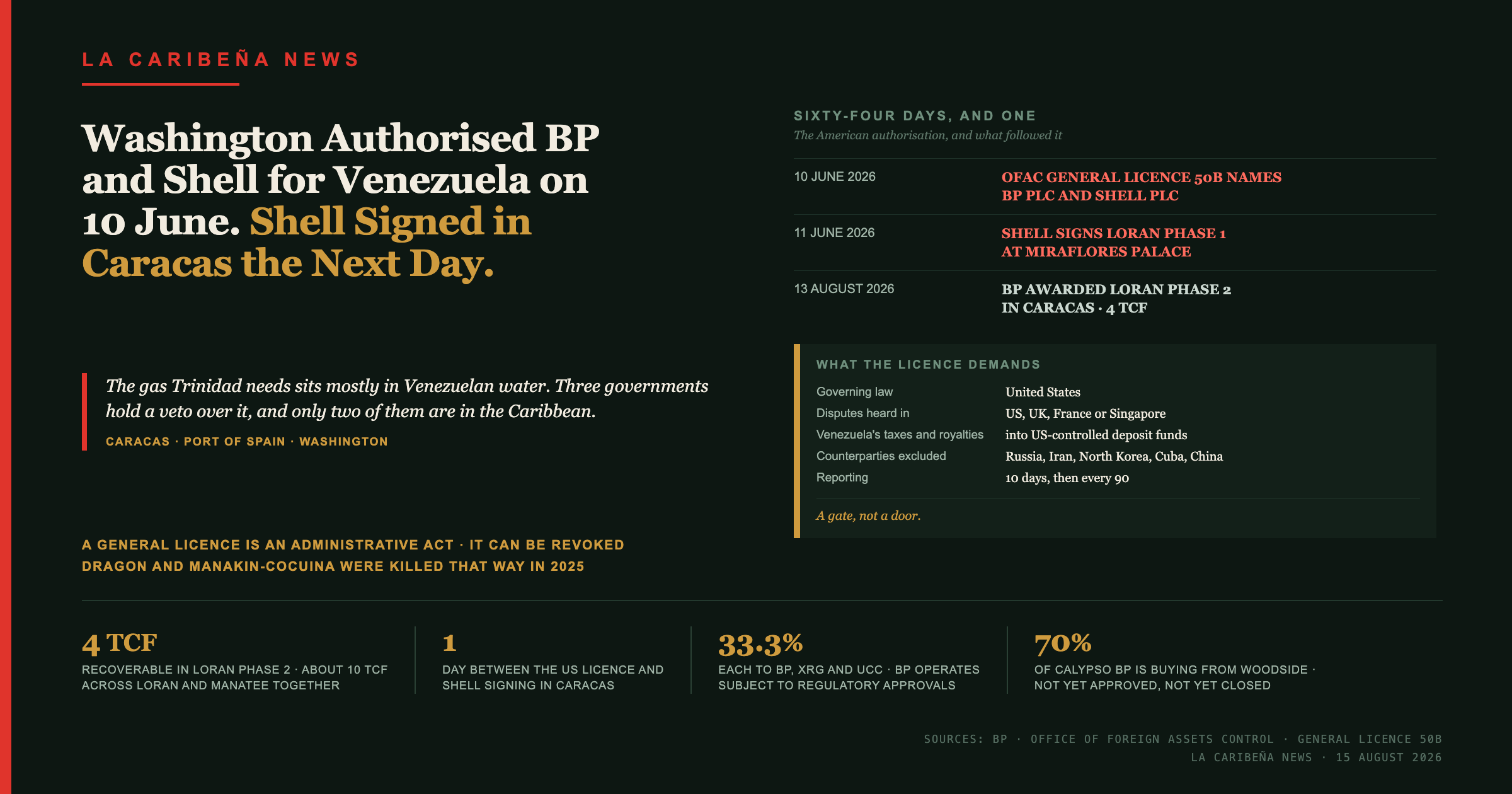
The Office of Foreign Assets Control issued General Licence No. 50B on 10 June 2026, superseding an earlier version from February. Its annex names six companies, BP PLC and Shell PLC among them, and authorises transactions relating to their Venezuelan oil and gas operations involving the Government of Venezuela and Petróleos de Venezuela.
The conditions are the substance of it. Contracts must be governed by United States law, with disputes heard in the United States, the United Kingdom, France or Singapore. Payments that would otherwise reach blocked persons, including taxes and royalties owed to Venezuela, are directed into deposit funds established under an executive order of 9 January 2026. Any counterparty located in Russia, Iran, North Korea, Cuba or China is excluded. Participants must report to the State Department and the Department of Energy within ten days and every ninety days thereafter.
A licence of that shape is a gate rather than a door. It authorises named companies, on American legal terms, with the host government's own tax receipts routed through an American mechanism.
Shell's Loran Phase 1 licence was signed on 11 June. The general licence is dated 10 June.
Why does a Venezuelan field matter to Trinidad?
Because Loran does not stop at the maritime boundary.
The field extends across the border into Manatee, which Shell operates in Trinidad and Tobago waters. Together the Loran-Manatee system holds about ten trillion cubic feet of recoverable gas, most of it on the Venezuelan side. Trinidad's plan has long been to industrialise that gas through its own liquefaction and petrochemical plant, which is running below capacity.
That plan has been interrupted before by the same instrument that now enables it. Authorisations for the Dragon field and for Manakin-Cocuina were revoked in 2025, and the 2026 general licences are the reopening.
Trinidad has spent two years looking for gas in more than one direction. It has been asking Guyana for hydrocarbons since 2024 without an agreement, while Guyana signed with Jamaica and the Dominican Republic instead. And its own acreage has been thinning: BP agreed on 6 August to acquire Woodside's 70 per cent of the Calypso project, which Woodside had written down and exited, a transaction still awaiting government and regulatory approval and expected to close by the end of the year.
Who is on the other side of the table?
The chief executive who ran Woodside until March.
BP's statement on Loran is made by Meg O'Neill, chief executive officer of BP, who said the award "is an important step forward" and reflected the collaboration established with the Venezuelan government and BP's partners. O'Neill was appointed to lead BP with effect from 1 April 2026, having previously been chief executive of Woodside Energy.
So the company acquiring Woodside's Trinidad position, and the company taking the Venezuelan field that feeds the Trinidad system, is now led by the person who ran Woodside until three months before the Calypso agreement.
Also present in Caracas was David Campbell, BP's senior vice president for Latin America and the Caribbean. The award followed a memorandum of understanding signed with the Venezuelan government in April 2026. A further memorandum, covering the Carúpano East Block in the Mariscal Sucre area, was signed by Paula Henao, Venezuela's Minister of Hydrocarbons, with Campbell. That second document is a framework for evaluating exploration opportunities rather than a licence.
What has to happen before any gas moves?
Approvals on both sides, and a licence that can be withdrawn.
BP describes the equal working interests as subject to regulatory approvals. The Calypso acquisition is subject to government and regulatory approval in Trinidad and Tobago. And the American authorisation that makes the Venezuelan side lawful for BP and Shell is a general licence, which is an administrative act that can be superseded or revoked, as the 2025 revocations demonstrated.
Three governments therefore hold a veto over gas that Trinidad's plant needs: Caracas, Port of Spain and Washington. Only two of them are in the Caribbean.
For a region that has watched an American defence programme buy into a Guyanese mine and visa access used as an instrument of policy this year, the pattern is not unfamiliar.
The data in this article
- BP announced on 13 August 2026, from Caracas, an exploration and production licence for Loran Phase 2 in the Plataforma Deltana, with XRG, the international energy investment company of Abu Dhabi National Oil Company, and UCC Oil and Gas Holding. Each party holds an equal working interest and BP operates. BP does not state a percentage; trade reporting gives 33.3 per cent each, subject to regulatory approvals.
- BP puts recoverable resources for Loran Phase 2 at 4 trillion cubic feet. The Loran-Manatee system together holds about 10 trillion cubic feet, most of it in Venezuelan waters.
- Shell won the Loran Phase 1 licence on 11 June 2026 at Miraflores Palace.
- The statement is made by Meg O'Neill, chief executive officer of BP, who said the award "is an important step forward". O'Neill was appointed BP chief executive with effect from 1 April 2026, having previously led Woodside Energy.
- David Campbell, BP senior vice president for Latin America and the Caribbean, attended in Caracas. The award followed a memorandum of understanding with the Venezuelan government in April 2026.
- A further memorandum covering the Carúpano East Block in the Mariscal Sucre area was signed by Paula Henao, Minister of Hydrocarbons, with David Campbell. It is a framework for evaluating exploration opportunities, not a licence.
- Office of Foreign Assets Control General Licence No. 50B, dated and effective 10 June 2026, superseded General Licence 50A of 18 February 2026. Its annex names six entities including BP PLC and Shell PLC and authorises transactions relating to their Venezuelan oil and gas sector operations involving the Government of Venezuela and Petróleos de Venezuela.
- Conditions of the general licence: contracts governed by United States law with disputes in the United States, United Kingdom, France or Singapore; payments to blocked persons including taxes and royalties directed into deposit funds established under an executive order of 9 January 2026; counterparties located in Russia, Iran, North Korea, Cuba or China excluded; reporting to the State Department and Department of Energy within ten days and every ninety days thereafter.
- Authorisations for the Dragon field and Manakin-Cocuina were revoked in 2025.
- BP agreed on 6 August 2026 to acquire Woodside Energy's 70 per cent interest in Block TTDAA 14, the Calypso project in Trinidad and Tobago, taking its stake to 100 per cent and assuming operatorship. The transaction is expected to close by the end of 2026 and is subject to government and regulatory approval. BP's release states no resource figure for Calypso.
Frequently Asked Questions
What did BP win in Venezuela? An exploration and production licence for Phase 2 of the Loran field in the Plataforma Deltana, announced on 13 August 2026. BP holds an equal working interest with XRG and UCC Oil and Gas Holding and operates the development. BP puts Phase 2 recoverable resources at 4 trillion cubic feet.
How does an American licence control a Venezuelan field? Office of Foreign Assets Control General Licence No. 50B, dated 10 June 2026, names BP and Shell among six entities authorised to transact in Venezuela's oil and gas sector. Without that authorisation the companies could not lawfully participate. It is conditional and can be superseded or revoked, as happened to earlier authorisations in 2025.
Why does this matter to Trinidad and Tobago? Loran crosses the maritime boundary into the Shell-operated Manatee field in Trinidad waters. Together the two hold about 10 trillion cubic feet, most of it on the Venezuelan side, and Trinidad's liquefaction and petrochemical capacity is running below its potential.
What is the connection to Calypso? BP agreed on 6 August 2026 to buy Woodside's 70 per cent of Calypso, taking full ownership and operatorship, subject to government and regulatory approval and expected to close by the end of the year. BP's chief executive, Meg O'Neill, led Woodside until taking the BP role on 1 April 2026.
Has any gas started moving? No. The working interests are subject to regulatory approvals, the Calypso acquisition awaits approval in Trinidad and Tobago, and the American authorisation is an administrative licence rather than a permanent removal of sanctions.