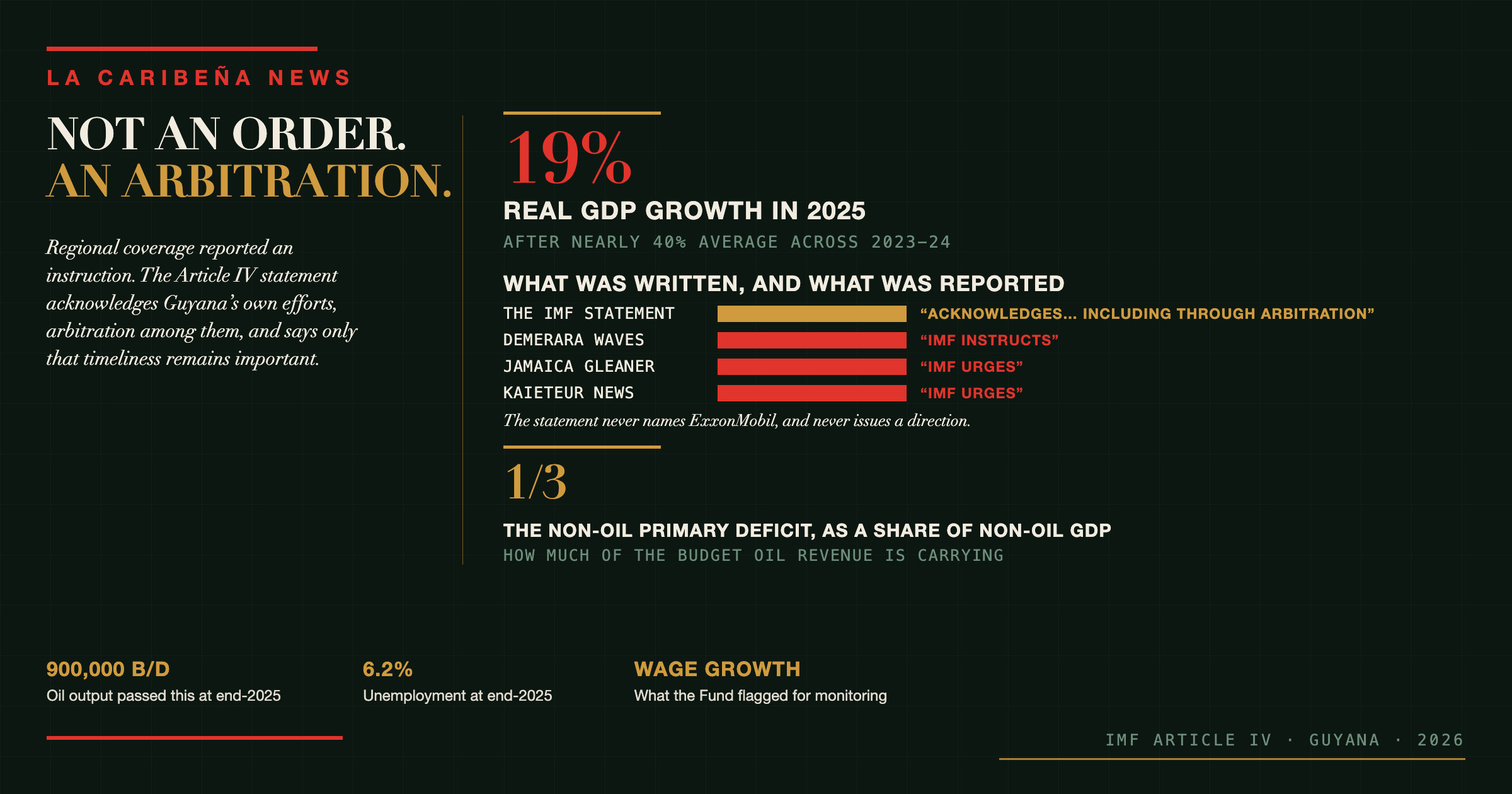
Regional coverage reported an instruction. The Article IV statement acknowledges Guyana's own efforts, arbitration among them, and says timeliness remains important.
BY LA CARIBEÑA NEWS
Quick summary: The IMF's 2026 Article IV concluding statement on Guyana, issued on 31 July, was widely reported across the region as an instruction to resolve ExxonMobil cost-oil audits. The document says something narrower and more interesting: staff acknowledge the authorities' own efforts, arbitration among them, and note only that timely resolution remains important.
What does the statement say about the cost-oil audits?
One sentence of the concluding statement carries the whole matter:
"Staff acknowledges the authorities' efforts to resolve outstanding cost-oil audits, including through arbitration. Given their fiscal and governance implications, resolving these audits in a timely manner remains important."
Read it closely. It is an acknowledgement of work already under way, followed by an observation that timeliness matters. It is not a direction, and it does not name ExxonMobil.
The separate audit-capacity line is also softer than reported: "The authorities are encouraged to continue strengthening audit capacity, especially in oil and gas sector." The operative word is continue.
What the title card shows
Every data point on the article's title card, in text.
- 19 per cent. Real GDP growth in 2025, following average growth of nearly 40 per cent during 2023 to 2024. Source: IMF 2026 Article IV concluding statement, 31 July 2026.
- 900,000 barrels per day. Oil production surpassed this by end-2025, a 35 per cent increase in one year, with similar volumes in the first half of 2026.
- 14 per cent. Non-oil economy growth, with construction the largest driver, against a projection of about 7 per cent on average over the next five years.
- 6.2 per cent. Unemployment at end-2025.
- 5.5 per cent of GDP. The overall fiscal deficit in 2025, having narrowed by nearly two percentage points.
- One third. The non-oil primary deficit as a share of non-oil GDP.
The statement is published by the IMF and was also reproduced in full by Caribbean News Global.
How was it reported?
More forcefully than it was written.
Demerara Waves headlined "Resolve ExxonMobil cost-oil audits quickly IMF instructs Guyana gov't." The Jamaica Gleaner and the St Kitts Nevis Observer both ran "IMF urges Guyana to resolve Exxon cost-oil disputes, strengthen oversight." Kaieteur News reported that the Fund "urges Guyana to strengthen oil and gas audit capacity."
Instruct, urge, and strengthen are all stronger than acknowledge, continue, and remains important. The gap is not enormous, but it is the difference between a multilateral criticising a government and a multilateral noting that a government is already acting.
For a country whose relationship with its principal oil operator is scrutinised constantly, that distinction is worth getting right in both directions.
What did the coverage miss?
The arbitration, which is the most consequential clause in the sentence.
"Including through arbitration" tells readers that resolving the outstanding cost-oil audits is not purely an accounting exercise conducted between the parties. Arbitration is a formal dispute mechanism, and the statement places it among the authorities' current efforts rather than among the IMF's recommendations. That is a material fact about how Guyana is pursuing the audits, and it appeared in none of the headlines.
Several figures also went unreported. Non-oil growth ran at about 14 per cent, roughly double the 7 per cent average the Fund projects for the next five years, which frames the coming period as a deceleration from an exceptional base rather than a continuation. Unemployment fell to 6.2 per cent by end-2025. The overall fiscal deficit narrowed by nearly two percentage points to 5.5 per cent of GDP, while the non-oil primary deficit still ran at one third of non-oil GDP, a reminder of how much of the budget the oil revenue is carrying.
The Fund also flagged something closer to a warning than anything in the audit paragraph: while "available indicators do not point to clear signs of overheating or resource-driven competitiveness pressures," it said "strong wage growth and wage-based real exchange rate indicators warrant close monitoring."
Why does the precision matter here?
Because the cost-oil audits are where the fiscal and the governance arguments meet.
Cost oil is the share of production an operator recovers against its costs before profit is divided, a mechanism at the centre of Guyana's local-content debate. An unresolved audit is therefore not a paperwork backlog, it is an open question about how much of the revenue belongs to the state. The statement says as much in its own restrained way: the audits carry "fiscal and governance implications."
That is also why the framing matters. Reported as an instruction, the story reads as the Fund pressing a reluctant government. Read as written, it says the government is already in the process, including through arbitration, and the Fund's contribution is to note that time is not neutral.
What else is in the statement?
A broadly favourable picture with specific pressure points.
The economy grew by over 19 per cent in 2025 after averaging nearly 40 per cent across 2023 and 2024. Oil production passed 900,000 barrels per day by the end of 2025, up 35 per cent in a year. Inflation was contained at 3.3 per cent in 2025 but edged up by mid-2026 on global energy and food prices. Accumulation in the Natural Resource Fund is building external and fiscal buffers, and the five-year development plan, built on the Low Carbon Development Strategy 2030, keeps its focus on diversification and resilience.
Alongside the audit language, the Fund pointed to timeliness of financial accounts for public enterprises and agencies, and to consistent compliance with the procurement framework as public expenditure expands. Those are compliance questions rather than growth questions, and they sit in the same paragraph as the audits for a reason. Procurement scrutiny arrives as Guyana stands up new spending machinery, including a development bank whose credit policies the Act does not require it to publish.
Frequently Asked Questions
Did the IMF instruct Guyana to resolve the ExxonMobil cost-oil audits?
No. The 2026 Article IV concluding statement says staff "acknowledges the authorities' efforts to resolve outstanding cost-oil audits, including through arbitration" and that resolving them in a timely manner "remains important." It does not name ExxonMobil and it does not issue a direction.
Is Guyana pursuing arbitration over the cost-oil audits?
The statement places arbitration among the authorities' efforts to resolve the outstanding audits. It gives no further detail on the proceedings.
How fast did Guyana's economy grow?
Real GDP grew by over 19 per cent in 2025, after averaging nearly 40 per cent during 2023 and 2024. The non-oil economy grew about 14 per cent, led by construction.
What does the IMF project next?
The outlook is described as "highly favourable," with the non-oil economy projected to grow about 7 per cent on average over the next five years.
What did the Fund flag as a risk?
It found no clear signs of overheating, but said strong wage growth and wage-based real exchange rate indicators "warrant close monitoring."