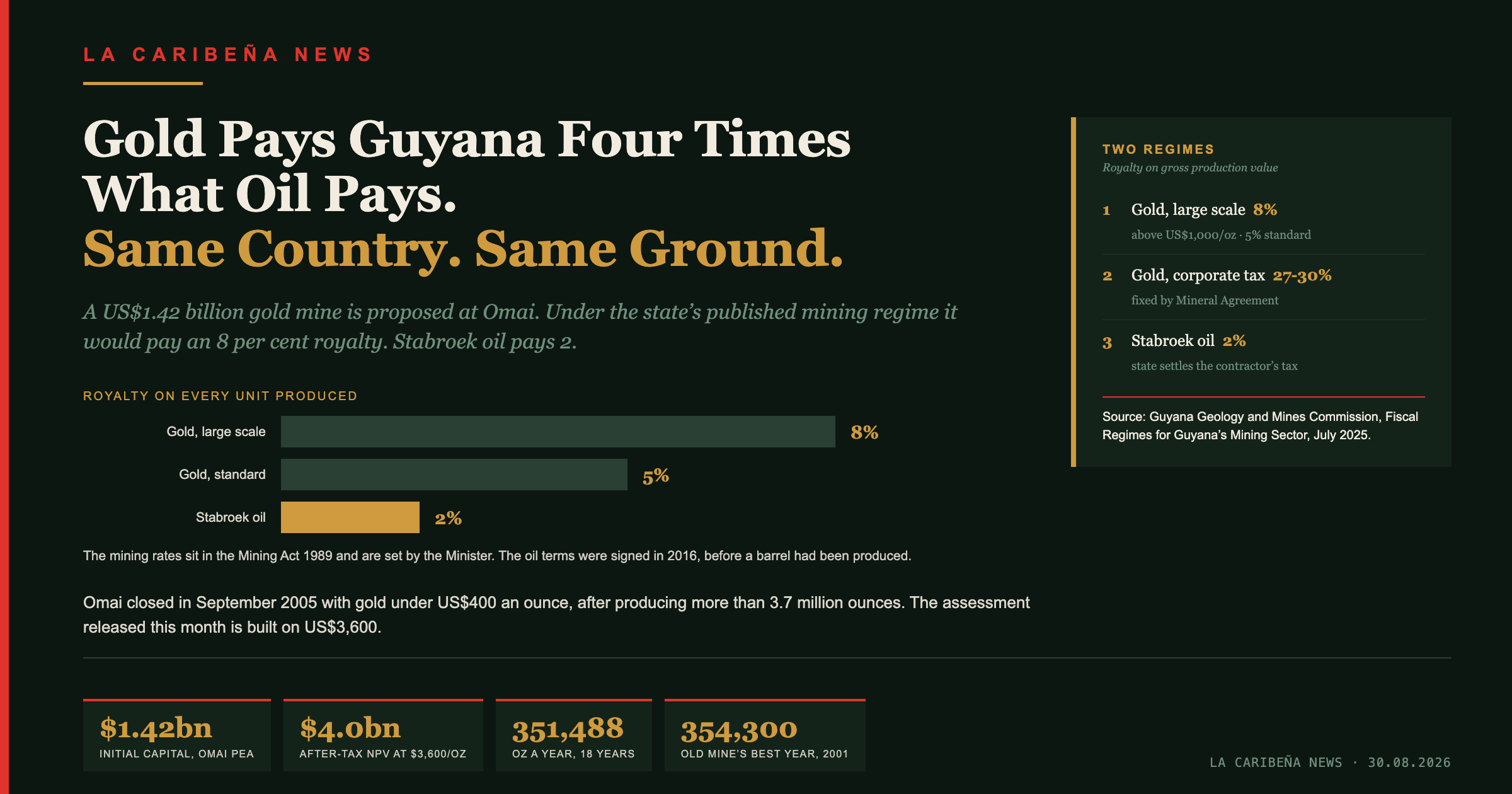
Quick summary: Omai Gold Mines published a preliminary economic assessment on 19 August proposing a US$1.42 billion gold mine in Guyana. Under the state's own published mining regime, large-scale gold pays an 8 per cent royalty above US$1,000 an ounce. Stabroek oil pays 2 per cent.
By La Caribeña News · 30 August 2026
Guyana's mining regime is published. Its oil agreement was not, until it leaked.
Read side by side, they describe two different countries.
On 19 August, Omai Gold Mines Corp. released a preliminary economic assessment for the mine that gave the company its name. It proposes US$1.42 billion of initial capital to reopen a pit that closed in September 2005.
What does the assessment propose?
US$1.42 billion of capital, and about 6.3 million ounces of gold over eighteen years.
The assessment puts initial capital at US$1.42 billion and average production at 351,488 ounces of gold a year over an 18-year mine life, with a peak year of 435,667 ounces. It reports an after-tax net present value of US$4.0 billion at an assumed gold price of US$3,600 an ounce, an internal rate of return of 24 per cent, and payback in 4.1 years. The resource is stated at 2,495,000 ounces indicated and 5,465,000 inferred.
The old Omai mine ran from 1993 to September 2005 and produced more than 3.7 million ounces. Its best year was 354,300 ounces, in 2001.
So the proposal is to produce, on average every year for eighteen years, slightly less gold than the old mine managed in its single best year. Over the life of it, that is roughly 6.3 million ounces against the 3.7 million the first mine produced in twelve.
It closed when gold averaged under US$400 an ounce. The assessment is built on US$3,600.
The licence is held by Avalon Gold Exploration Inc., the wholly owned Guyanese subsidiary of Omai Gold Mines Corp., listed in Toronto as OMG. Reporting carried by OilNOW and the Guyana Chronicle puts direct employment at about 900 over the mine life and between 1,500 and 2,000 during construction.
What would a mine like that pay Guyana?
Considerably more, proportionally, than the oil does.
The Guyana Geology and Mines Commission publishes the terms. In Fiscal Regimes for Guyana's Mining Sector, issued in July 2025, it states that "for gold, the standard royalty is 5% of production value for all scales (small, medium, and large); however, large-scale mining agreements now commonly apply an elevated 8% royalty when gold prices exceed US$1,000/oz."
Gold was US$3,600 an ounce in the assessment's own base case.
On corporate tax the same document says large-scale miners "pay corporate income tax on their profits at rates up to 40%", and that in practice "recent large-scale gold mining agreements fix the corporate tax rate between 27% - 30%."
Royalties are charged ad valorem, on gross production value. There is no separate export duty. Gold royalty is collected through the Guyana Gold Board.
How does that compare with the oil?
| Large-scale gold | Stabroek oil | |
|---|---|---|
| Royalty | 8% above US$1,000/oz | 2% |
| Corporate income tax | 27 to 30%, fixed by agreement | Settled by the state |
| Cost recovery | none of this kind | up to 75% of production, monthly |
| Ring-fence | project by project | none. One accounting unit |
Under the 2016 production sharing agreement, Stabroek pays a 2 per cent royalty, the contractor recovers costs from up to 75 per cent of production, and what remains is split equally. The state settles the companies' corporation tax. This newspaper set out on 4 August how those terms compare with Suriname's Block 58, which carries 6.25 per cent and 36 per cent income tax in the same basin.
A gold miner at Omai would therefore pay four times the royalty rate on every ounce, and pay its own corporation tax, which the oil contractor does not.
Why would gold pay more than oil?
Because the terms were set in different decades, by different instruments, under different pressure.
Guyana's mining royalties sit in the Mining Act 1989 and its regulations, with the rate set by the Minister and adjustable by regulation. They predate the oil.
The Stabroek terms were signed in 2016, before a barrel had been produced, when the country had no offshore industry and no leverage. Guyana's share of Stabroek production reached 39.8 per cent this month, and it got there not by renegotiating anything but because the companies finished recovering US$55 billion of cost.
The pattern is not confined to oil. Guyana charges a single royalty rate for every grade of bauxite it exports, while India charges many times more for the refractory grades.
What is not yet known?
Whether Omai will be governed by those published terms at all.
The commission's document describes what large-scale gold agreements "commonly" contain. It does not state the terms for Omai. In Guyana, large projects are typically governed by Mineral Agreements negotiated between the company and the government, which fix the fiscal regime and stabilise it, in the commission's account for a set period of currently 15 years for a mining licence.
No Mineral Agreement for a redeveloped Omai has been published. Until one is, the 8 per cent is what the regime provides, not what the project has agreed.
A preliminary economic assessment is also not a decision to build. It is the earliest of the three standard studies, carries the widest error bars, and is explicitly preliminary.
What happened at Omai before?
The worst industrial disaster in the country's history, at the same site, thirty-one years ago this month.
In August 1995 the tailings dam at Omai failed, releasing more than 400 million gallons of cyanide-bearing tailings into the Omai River and from there into the Essequibo, Guyana's largest river and a source of drinking water and fish. The Guyana Geology and Mines Commission has described it as the worst industrial disaster to hit the country. A class action was filed against the operator, Cambior, in the Québec Superior Court in 1997.
Cambior held 65 per cent of the mine at the time. Golden Star Resources held 30 per cent and the Government of Guyana 5 per cent.
The company proposing to reopen the site is not that company, and modern tailings practice is not 1995 practice. But the assessment released this month runs to net present value, internal rate of return and payback period, and the questions Guyanese asked in 1995 were about none of those.
What does it mean for an economy that is now oil?
It is the largest non-oil investment proposed in years, and that is the point of it.
The International Monetary Fund's 2026 Article IV concluding statement records real growth of 19 per cent in 2025 after averaging nearly 40 per cent across 2023 and 2024, with the non-oil economy growing 14 per cent, led by construction.
Gold was Guyana's principal export before oil and remains its principal non-oil mineral export. A US$1.42 billion mine would be a substantial addition to the part of the economy that does not depend on the Stabroek Block.
Whether Guyanese firms capture the spending is a separate question, and one the law does not currently answer well. The Local Content Act 2021 reserves 90 per cent of catering and 100 per cent of customs brokerage, and has no category for software at all, with every target in its schedule set against the end of 2022.
Text equivalent of the title card
Every data point shown on the title image, with its source.
- Gold royalty, large-scale: 8 per cent above US$1,000/oz; 5 per cent standard for all scales. Source: Guyana Geology and Mines Commission, Fiscal Regimes for Guyana's Mining Sector, July 2025.
- Corporate income tax on large-scale mining: 27 to 30 per cent, fixed by Mineral Agreement; statutory rate up to 40 per cent. Source: as above.
- Stabroek oil royalty: 2 per cent, with the state settling the contractor's corporation tax and cost recovery of up to 75 per cent of production. Source: 2016 Production Sharing Agreement; Department of Public Information.
- Omai PEA: US$1.42 billion initial capital, after-tax NPV US$4.0 billion at US$3,600/oz, IRR 24 per cent, payback 4.1 years. Source: Omai Gold Mines Corp., 19 August 2026.
- 351,488 ounces a year average over 18 years, peak year 435,667. Source: as above.
- The old mine's best year: 354,300 ounces, in 2001. It closed September 2005 with gold under US$400/oz, after producing more than 3.7 million ounces from 1993.
- August 1995: more than 400 million gallons of cyanide-bearing tailings entered the Omai River and the Essequibo.
Frequently Asked Questions
What royalty does gold pay in Guyana?
The Guyana Geology and Mines Commission states the standard royalty is 5 per cent of production value at all scales, and that large-scale mining agreements commonly apply 8 per cent when gold exceeds US$1,000 an ounce.
How does that compare with oil?
The 2016 Stabroek production sharing agreement carries a 2 per cent royalty, cost recovery of up to 75 per cent of production, an equal split of the remainder, and the state settling the contractor's corporation tax.
Has Omai agreed to pay 8 per cent?
No Mineral Agreement for a redeveloped Omai has been published. Large projects in Guyana are typically governed by negotiated Mineral Agreements that fix and stabilise the fiscal regime, so the published regime indicates what applies by default rather than what the project has agreed.
What does the preliminary economic assessment say?
Initial capital of US$1.42 billion, average production of 351,488 ounces a year over 18 years, an after-tax net present value of US$4.0 billion at US$3,600 an ounce, a 24 per cent internal rate of return and payback in 4.1 years.
Is the mine going to be built?
A preliminary economic assessment is the earliest of the standard studies and is not a decision to build.