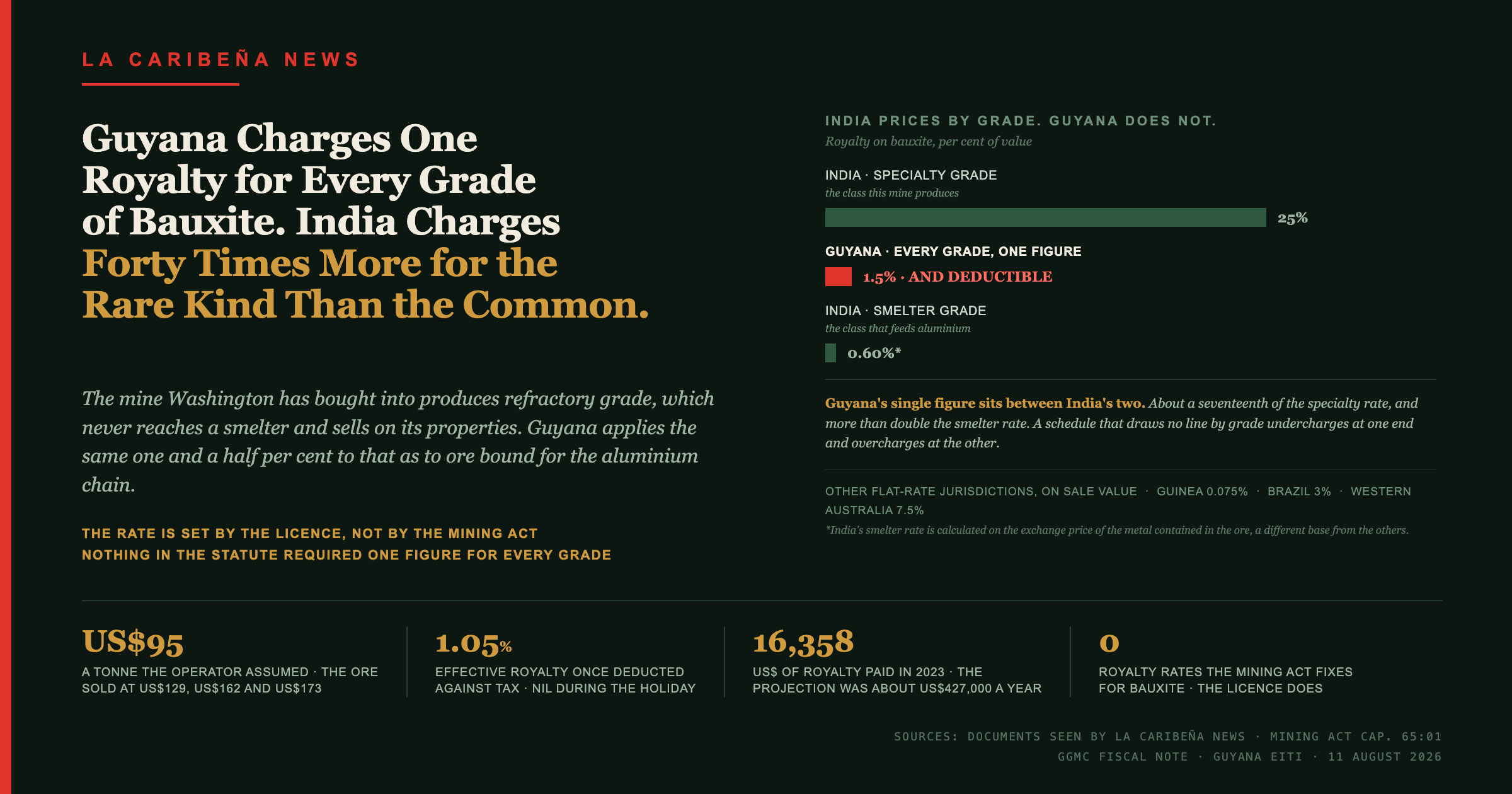
Quick summary: Guyana charges one royalty rate, 1.5 per cent, on every grade of bauxite it produces. The mine the United States has just bought into produces refractory grade, a specialty product that does not go to aluminium smelters. India separates the two classes in its own schedule and charges about forty times more for the specialty grade than for smelter ore, and about seventeen times what Guyana charges for the same material.
BY LA CARIBEÑA NEWS · 11 AUGUST 2026
Guyana's bauxite royalty is 1.5 per cent. It is 1.5 per cent at Linden, 1.5 per cent at Kwakwani, and 1.5 per cent at the Bonasika operation between the Essequibo and Demerara rivers that the United States has just put US$85.5 million into. The mining licences of every operator in the sector carry the same figure, and the terms surrounding it are, as this newspaper has reported, common to five Guyanese mineral agreements.
What the rate does not do is distinguish between what is being mined.
What is refractory bauxite?
Ore that never sees a smelter.
Most bauxite in the world is metallurgical grade. It is refined into alumina, smelted into aluminium, and priced as a bulk commodity in a market where volume decides everything. Refractory grade is a different product with a different buyer. It is calcined at high temperature and used to line furnaces, to make abrasives, and in equipment for oil and gas and aerospace, where the requirement is that the material survives heat and abrasion that would destroy anything ordinary.
The company operating Bonasika described its ore, through its vice-president of government relations to Stabroek News in February 2019, as the purest known to it, usable in high-specification products for oil and gas and jet engines. Its revenue projection assumed a price of US$95 a tonne. Metallurgical bauxite in the same period traded at a fraction of that.
The United States Department of Defense, which the current administration also styles the Department of War, described the ore in the same terms when it announced its investment on 7 August: refractory-grade material for furnace linings, oil and gas equipment and abrasives, with money attached for calcination facilities and a follow-on brown-fused alumina plant in the United States.
Everyone involved agrees on what the material is. The royalty schedule does not ask.
Which countries price the difference?
India, and it prices the gap between its own two grades at a factor of about forty.
India's royalty schedule separates the classes explicitly. Metallurgical bauxite carries 0.60 per cent, calculated on the London Metal Exchange price of the metal contained in the ore. Non-metallurgical bauxite carries 25 per cent ad valorem of the average sale price. The logic is that one is a bulk input into a commodity chain with thin margins and the other is a specialty product sold on its properties.
Two things follow, and they run in opposite directions. Against India's specialty rate, Guyana's 1.5 per cent on the same class of ore is about one seventeenth. Against India's smelter rate, Guyana charges more than twice as much. A schedule that draws no line by grade will overcharge at one end and undercharge at the other, and Guyana's single figure does both.
A caution on the arithmetic. India's two rates are not calculated on the same base, and only one of them shares Guyana's. India's metallurgical rate applies to the exchange price of the metal contained in the ore; its non-metallurgical rate and Guyana's both apply to sale value. The forty-times spread between India's own grades is the sound comparison. Any multiple set against Guyana's rate is an approximation, and is offered as one.
The wider international picture shows there is no single market rate to appeal to in either direction:
| Jurisdiction | Bauxite royalty | Base |
|---|---|---|
| Guinea | 0.075 per cent | sales revenue, crude ore |
| India, metallurgical | 0.60 per cent | LME price of contained metal |
| Brazil | 3 per cent | sales revenue |
| Western Australia | 7.5 per cent bauxite, 1.65 per cent alumina | sale revenue |
| India, non-metallurgical | 25 per cent | average sale price |
The bases differ, so this is not a league table. Guinea, Brazil, Western Australia, India's non-metallurgical rate and Guyana all apply their percentage to sale value or sales revenue. India's metallurgical rate does not, and sits on the exchange price of contained metal.
Guyana sits near the bottom of that range and applies its single figure to everything.
This is not a case of Guyana undercharging against a world standard. For ordinary metallurgical bauxite, 1.5 per cent is defensible and close to what much of the sector pays. The Guyana Geology and Mines Commission's own published note on fiscal regimes records that bauxite operations have historically negotiated rates in a band of 1.5 to 3 per cent of export value, so the country set that band itself and this sits at its floor.
The question the schedule does not reach is what happens when the ore is not ordinary.
Where does the rate come from?
The licence, not the law.
The Mining Act fixes no royalty rate for bauxite. Royalty is payable at the rate fixed by the mining licence, and a rate set by regulation applies only where a licence is silent. The published regulations still carry a per-tonne bauxite figure that predates independence.
So the rate is negotiated instrument by instrument. Nothing in the statute would have prevented a different figure for a different grade, and nothing in it requires one.
What does 1.5 per cent actually cost the company?
Less than 1.5 per cent, and for a period, nothing.
The royalty is deductible as an expense against taxable income. At a thirty per cent corporation tax rate that leaves an effective burden of about 1.05 per cent of value. During a tax holiday, when there is no liability to reduce, the deduction is worth nothing at all, so the effective rate in those years is the full 1.5.
There is a more generous mechanism in the sector, and this mine does not have it. The mining licences held by Bosai Minerals Group at Linden, seen by La Caribeña News, provide that where the company pays corporation tax in a year it may apply to the Minister for remission of royalty against the tax paid, on production of a certificate from the Guyana Revenue Authority. That is a set-off against tax rather than a deduction from income. A deduction returns thirty cents in the dollar. A set-off returns the whole of it, up to the tax paid.
Two bauxite operators, the same headline rate, and two different answers to what the rate costs.
How does that compare with what the state takes elsewhere?
Bauxite is the lowest-rated resource in the country on the face of the schedules.
Gold carries 5 per cent, rising to 8 per cent in large-scale agreements once the price passes US$1,000 an ounce. Diamonds run at 3 per cent for claims and medium scale and 5 per cent for large-scale titles.
The Stabroek oil contract is often set beside these, and the comparison misleads unless the whole instrument is described. Its royalty is 2 per cent, against the 6.25 per cent Suriname signed on the block next door, but that royalty comes off gross production, is not deductible, and sits on top of the state's share of profit oil, which is at least 12.5 per cent of revenue while development costs are being recovered. Guyana's minimum share of Stabroek revenue is therefore about 14.5 per cent. Recent exploration has added further leads on those same terms.
At a bauxite mine the 1.5 per cent is close to the whole of the state's production-linked share, and the company writes it off before tax.
What has the rate produced?
Less than the operator itself forecast, in years when the ore sold for more than it assumed.
The company projected royalty of about US$427,000 a year. Guyana's extractive industries reconciliation reports record royalty paid of US$64,006 in 2021, US$287,297 in 2022 and US$16,358 in 2023. Across those three years the mine delivered under a third of what it had forecast, while Guyanese bauxite sold at US$129, US$162 and US$173 a tonne against the US$95 the projection assumed.
The ore fetched more than expected. The payments came in lower.
Guyana has priced this material differently before. In 1974 it levied bauxite against the world aluminium price at roughly eight cents in every dollar of the metal's value. That levy was aimed at the metallurgical trade, in an era when Guyana's bauxite went to smelters. The mine now drawing American money sells into a market that did not then exist at this scale.
The rate has not changed. What is being taken out of the ground has.
The data in this article
- Guyana's bauxite royalty: 1.5 per cent, applied to every grade, fixed by the mining licence rather than by statute. The Mining Act sets no bauxite rate, and a regulated rate applies only where a licence is silent.
- Guyana Geology and Mines Commission fiscal note: bauxite royalties historically negotiated in a band of 1.5 to 3 per cent of export value.
- India: 0.60 per cent on metallurgical bauxite, calculated on the London Metal Exchange price of contained metal; 25 per cent ad valorem of average sale price on non-metallurgical grade. The spread between India's two grades is about forty times. India's specialty rate is about seventeen times Guyana's flat rate, and India's smelter rate is less than half of it. The bases are not identical and the cross-country multiples are approximations.
- Other jurisdictions: Guinea 0.075 per cent of sales revenue on crude ore; Brazil 3 per cent of sales revenue; Western Australia 7.5 per cent on bauxite and 1.65 per cent on alumina.
- Deductibility: royalty is deductible as an expense against taxable income, giving an effective rate of about 1.05 per cent at a 30 per cent corporation tax rate, and the full 1.5 per cent during a tax holiday when there is no liability to reduce.
- Bosai Minerals Group's mining licences at Linden allow the company to apply to the Minister for remission of royalty against corporation tax paid, on production of a Guyana Revenue Authority certificate. That is a set-off against tax, not a deduction from income, and the Bonasika arrangement does not carry it.
- Product: Bonasika produces refractory-grade bauxite for furnace linings, oil and gas equipment and abrasives, not the metallurgical grade that feeds aluminium smelters. The operator described the ore in February 2019 as the purest known to it and assumed US$95 a tonne.
- Comparative Guyanese royalties: gold 5 per cent, and 8 per cent in large-scale agreements above US$1,000 an ounce; diamonds 3 per cent for claims and medium scale and 5 per cent for large-scale titles; Stabroek oil 2 per cent, non-deductible, alongside a profit oil share taking Guyana's minimum revenue share to about 14.5 per cent; Suriname Block 58, 6.25 per cent.
- Royalty received from Bonasika: US$64,006 in 2021, US$287,297 in 2022, US$16,358 in 2023, against a projection of about US$427,000 a year. Guyanese bauxite sold at US$129, US$162 and US$173 a tonne in those years.
- 1974: Guyana levied bauxite against the world aluminium price at roughly eight cents in every dollar of the metal's value.
Frequently Asked Questions
What royalty does Guyana charge on bauxite?
One and a half per cent, applied to every grade. The rate is fixed by each mining licence rather than by statute, and every operator in the sector carries the same figure.
What is refractory bauxite and why does grade matter?
Refractory grade is calcined and used to line furnaces and to make abrasives and high-specification equipment for oil, gas and aerospace. It is not refined into aluminium. It is sold on its properties rather than as a bulk commodity, and it commands a substantially higher price than metallurgical ore.
Which countries charge different rates for different grades of bauxite?
India is the clearest example. It charges 0.60 per cent on metallurgical bauxite, calculated on the London Metal Exchange price of contained metal, and 25 per cent ad valorem on non-metallurgical grade, a spread of about forty times between its own two classes.
Is 1.5 per cent low by international standards?
It depends entirely on the grade, which is the point. For ordinary metallurgical bauxite 1.5 per cent is defensible, and is more than India charges. For the specialty grade it is roughly one seventeenth of India's rate. Rates run from 0.075 per cent in Guinea to 7.5 per cent in Western Australia, with Brazil at 3 per cent, and Guyana's own mines commission records a historic band of 1.5 to 3 per cent, so there is no single world rate to appeal to. The distinction other jurisdictions draw is by grade, and Guyana's schedule does not draw it.
What does the royalty actually cost the company?
About 1.05 per cent of value once it is deducted as an expense at a thirty per cent corporation tax rate, and the full 1.5 per cent during a tax holiday, when there is no tax liability for the deduction to reduce.
Do all Guyanese bauxite operators get the same treatment?
No. Bosai Minerals Group's licences at Linden allow royalty to be remitted against corporation tax paid, which returns the whole of the royalty up to the tax paid rather than thirty cents in the dollar. The Bonasika arrangement does not carry that mechanism.