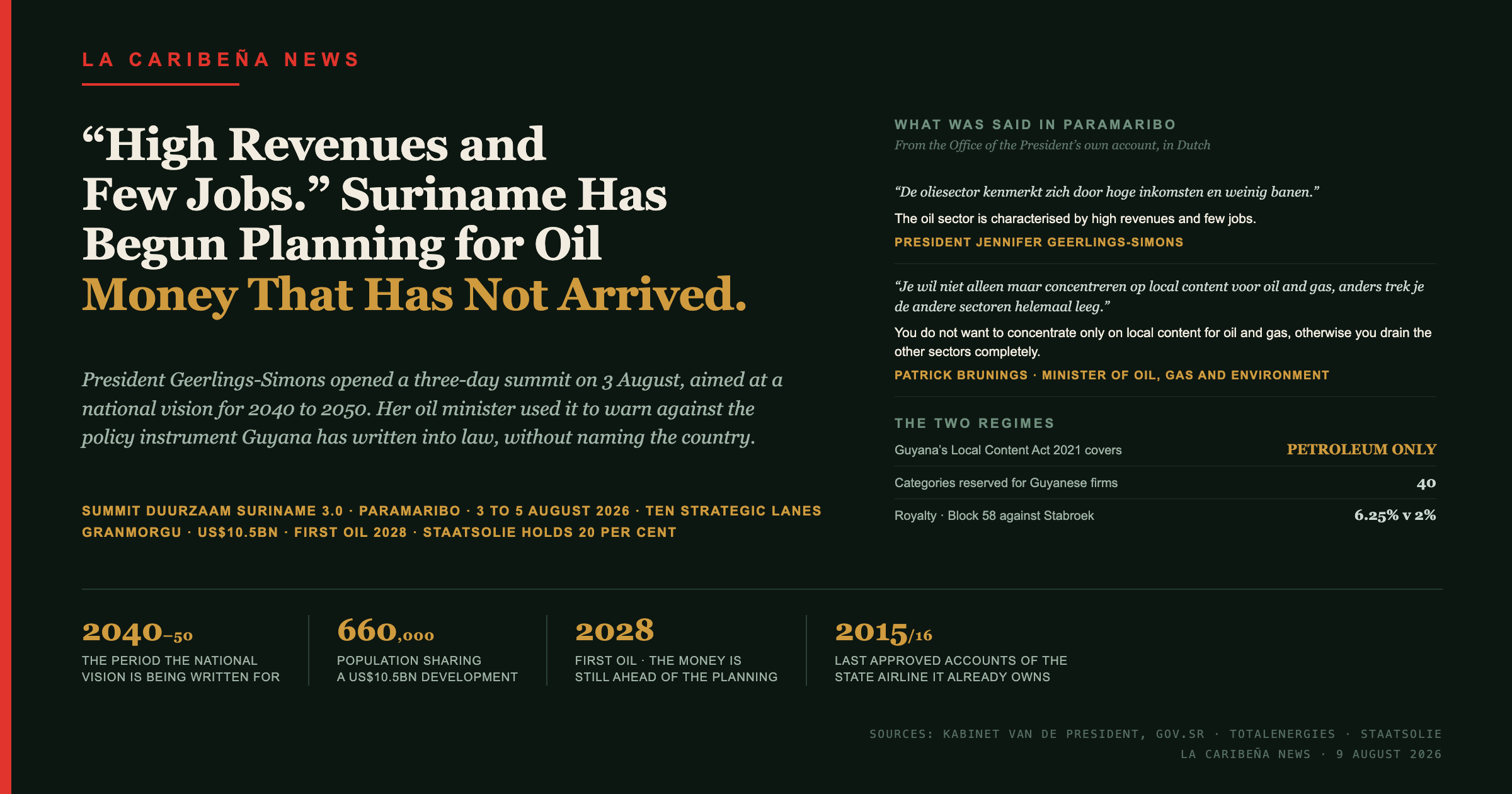
Quick summary: Suriname's President Jennifer Geerlings-Simons opened the Summit Duurzaam Suriname 3.0 in Paramaribo on 3 August 2026, saying the oil sector delivers high revenues and few jobs and that other sectors must supply the employment. Her oil minister warned that concentrating local content on oil and gas would drain the rest of the economy. The vision runs to 2050.
BY LA CARIBEÑA NEWS · 9 AUGUST 2026
Suriname has begun designing what to do with oil money that has not yet been earned, and the most striking thing said in the room was a warning about the policy its neighbour has already legislated.
President Jennifer Geerlings-Simons opened the Summit Duurzaam Suriname 3.0 on Monday 3 August at the Torarica in Paramaribo. It ran three days. According to the release from the Office of the President, it is the starting point of a broader process attached to the Roadmap Suriname, and it is aimed at a shared national vision for 2040 to 2050, organised across ten strategic development areas the organisers call Strategic Lanes.
What did the President actually say?
That the oil sector will not employ Surinamers, and that something else has to.
"De oliesector kenmerkt zich door hoge inkomsten en weinig banen," she told the summit. "Het zijn daarom de omliggende sectoren in het land die aan onze mensen kwalitatief goede jobs zullen moeten geven." The oil sector is characterised by high revenues and few jobs. It is therefore the surrounding sectors in the country that will have to give our people good quality jobs.
This is not a controversial proposition in the industry. Offshore production is capital intensive and employs few people directly relative to the revenue it generates. It is an unusual thing for a head of state to lead with while the money is still ahead of her, which is the point of saying it now rather than in 2030.
Geerlings-Simons also argued the eventual course must be broadly carried and must outlast any one administration.
What did the oil minister warn about?
The sharper remark came from Patrick Brunings, Minister of Oil, Gas and Environment.
"Je wil niet alleen maar concentreren op local content voor oil and gas, anders trek je de andere sectoren helemaal leeg." You do not want to concentrate only on local content for oil and gas, otherwise you drain the other sectors completely.
Read that against what has happened next door. Guyana's Local Content Act 2021 reserves forty categories of service work for Guyanese-owned companies, and it applies to petroleum operations and the petroleum sector alone. A US-backed bauxite mine in Guyana falls entirely outside it. Guyana's oldest extractive industry has no local content statute. Its newest does.
Brunings did not name Guyana, and nothing in the government's account suggests he was referring to it. But the mechanism he describes is precisely the one a petroleum-only local content regime creates. If the law reserves work in one sector and not in others, capital and labour move toward the sector where the work is reserved. A Guyanese supplier has a statutory floor when the customer is an oil operator and none when the customer is a mine, a farm or a factory.
Suriname is deciding whether to build that same instrument, and its oil minister has put the objection on the record before the drafting starts.
He wants the roadmap anchored in law so it survives a change of government. "Het mooiste zou zijn als die roadmap ook wettelijk op een gegeven moment zou worden vastgelegd." The best thing would be if that roadmap were at some point also legally established.
That is a harder problem than it sounds. A development plan written into statute binds the next administration's hands, which is the intention, and it also removes the flexibility to respond when the oil price moves or a field disappoints.
Who is doing the work?
The Nationaal Ontwikkelingsplatform, the National Development Platform, chaired by Karl Eckhorst.
Eckhorst was explicit that the platform will not write the national development plan itself. It will supply the building blocks. "We staan aan de vooravond van grote ontwikkelingen en het is dan belangrijk om dit soort discussies nu te voeren," he said, adding that it was equally important to act on them. We are on the eve of major developments, and it is important to hold this kind of discussion now.
He also placed consultation at the front rather than the end. "Het is dus van belang dat we de samenleving meenemen vanaf de formulering van de plannen." It is important that we bring society along from the formulation of the plans.
Whether a platform that supplies building blocks and does not write the plan produces something a ministry then implements is the question that decides if any of this matters. Suriname will know by the time the 2040 to 2050 vision has a document attached to it.
What is the money the planning is for?
GranMorgu, in Block 58, offshore Suriname.
It is a US$10.5 billion development, operated by TotalEnergies, with first oil targeted for 2028. The equity is 40 per cent TotalEnergies, 40 per cent APA Corporation and 20 per cent Staatsolie, the state oil company, which exercised its option to take the full participating interest. Staatsolie funded that position with a US$516 million bond and a US$1.6 billion syndicated loan.
That structure is the reason the summit is happening in 2026 rather than 2029. Staatsolie has already borrowed against production that has not started, so the state's exposure to the project began before the revenue did.
Scale matters here. Suriname's population is roughly 660,000, on the figure Americas Quarterly used in its interview with the President. A US$9 billion figure for the TotalEnergies project, announced in September 2023, still circulates. That was the study stage. The project has since taken its final investment decision and is costed at US$10.5 billion.
Can the state manage what it already owns?
The diversification argument runs into an awkward test case, and it is one this newspaper reported last week.
Suriname pays its national airline up to US$2.2 million a month in state support, and the last approved annual accounts of Surinaamse Luchtvaart Maatschappij are from 2015 and 2016. The transport minister has said money owed to the airport and the civil aviation authority was booked as income and that the real debt may be several times higher. Since 3 June 2025 all Suriname-certified carriers have been on the European Union Air Safety List, which is why the Amsterdam service runs on a wet lease under a German certificate. The full account is here.
None of that makes the summit unserious. It does set the standard against which its output should be read. A government proposing to steward a US$10.5 billion development for the benefit of surrounding sectors is proposing to do something considerably harder than running an airline, and the airline has not produced audited figures in a decade.
Suriname is also negotiating from a weaker fiscal starting position than its neighbour is often assumed to have. Its own contract terms are better: the royalty on Block 58 is 6.25 per cent against Guyana's 2 per cent on Stabroek. Suriname will collect a larger share of a smaller field.
What to watch
Three things will show whether the summit produced a plan or a document.
Whether the ten Strategic Lanes are published with owners and dates attached, or remain a framing device. Whether Brunings's proposal to anchor the roadmap in law reaches a bill, and what it does to the flexibility a small open economy needs. And whether Suriname writes a local content regime that covers the whole economy rather than only the sector with the money, which is the choice its oil minister has just publicly framed.
The data in this article
- Event: Summit Duurzaam Suriname 3.0, opened Monday 3 August 2026 at Hotel Torarica, Paramaribo, by President Jennifer Geerlings-Simons. Three days. Source: Office of the President, gov.sr.
- Purpose: starting point of a process attached to the Roadmap Suriname, targeting a shared national vision for 2040 to 2050 across ten Strategic Lanes.
- Convening body: Nationaal Ontwikkelingsplatform, chaired by Karl Eckhorst. It will supply building blocks rather than write the national plan.
- President: "The oil sector is characterised by high revenues and few jobs. It is therefore the surrounding sectors in the country that will have to give our people good quality jobs."
- Minister of Oil, Gas and Environment Patrick Brunings: "You do not want to concentrate only on local content for oil and gas, otherwise you drain the other sectors completely."
- Brunings on durability: the roadmap should at some point be legally established so it survives a change of government.
- GranMorgu: US$10.5 billion, Block 58, operated by TotalEnergies, first oil targeted 2028. Equity 40 per cent TotalEnergies, 40 per cent APA Corporation, 20 per cent Staatsolie.
- Staatsolie funded its 20 per cent with a US$516 million bond and a US$1.6 billion syndicated loan.
- Suriname population: approximately 660,000, per Americas Quarterly.
- Block 58 royalty: 6.25 per cent. Guyana's Stabroek royalty: 2 per cent.
- Guyana's Local Content Act 2021 covers petroleum operations and the petroleum sector only, reserving forty service categories.
- State support to Surinaamse Luchtvaart Maatschappij: up to US$2.2 million a month. Last approved annual accounts: 2015 and 2016.
Frequently Asked Questions
What is the Summit Duurzaam Suriname 3.0?
A three-day summit opened by President Jennifer Geerlings-Simons in Paramaribo on 3 August 2026. It is the starting point of a broader process attached to the Roadmap Suriname, aimed at a shared national vision for 2040 to 2050 across ten strategic development areas. The Nationaal Ontwikkelingsplatform, chaired by Karl Eckhorst, is convening it.
What did President Geerlings-Simons say about oil and jobs?
That the oil sector is characterised by high revenues and few jobs, and that the surrounding sectors of the economy will have to provide Surinamers with good quality employment. She also argued that the eventual national course must be broadly supported and must outlast any single administration.
What did the oil minister say about local content?
Patrick Brunings, Minister of Oil, Gas and Environment, warned against concentrating local content policy on oil and gas alone, saying it would drain the other sectors completely. He did not name any other country. He also proposed anchoring the roadmap in law so that it survives a change of government.
How much oil money is Suriname expecting, and when?
GranMorgu in Block 58 is a US$10.5 billion development operated by TotalEnergies, with first oil targeted for 2028. TotalEnergies and APA Corporation hold 40 per cent each and the state company Staatsolie holds 20 per cent, funded through a US$516 million bond and a US$1.6 billion syndicated loan.
How does Suriname's share compare with Guyana's?
Suriname's royalty on Block 58 is 6.25 per cent, against 2 per cent on Guyana's Stabroek Block. Suriname has better contract terms on a smaller resource.