ANALYSIS
A member of the National Assembly asked this week what a year of subsidy to the state airline had produced. The government's own transport minister said in June that the company's debt figures did not reflect reality.
BY LCN NEWSROOM · GEORGETOWN, GUYANA
Quick summary: Suriname's state airline SLM receives between US$1 million and US$2.2 million a month in state support. On 6 August 2026 a member of the National Assembly asked what a year of it bought. The airline's last approved annual accounts cover 2015/2016, and the transport minister said in June its debts had been presented more favourably than reality.
What does the title card show?
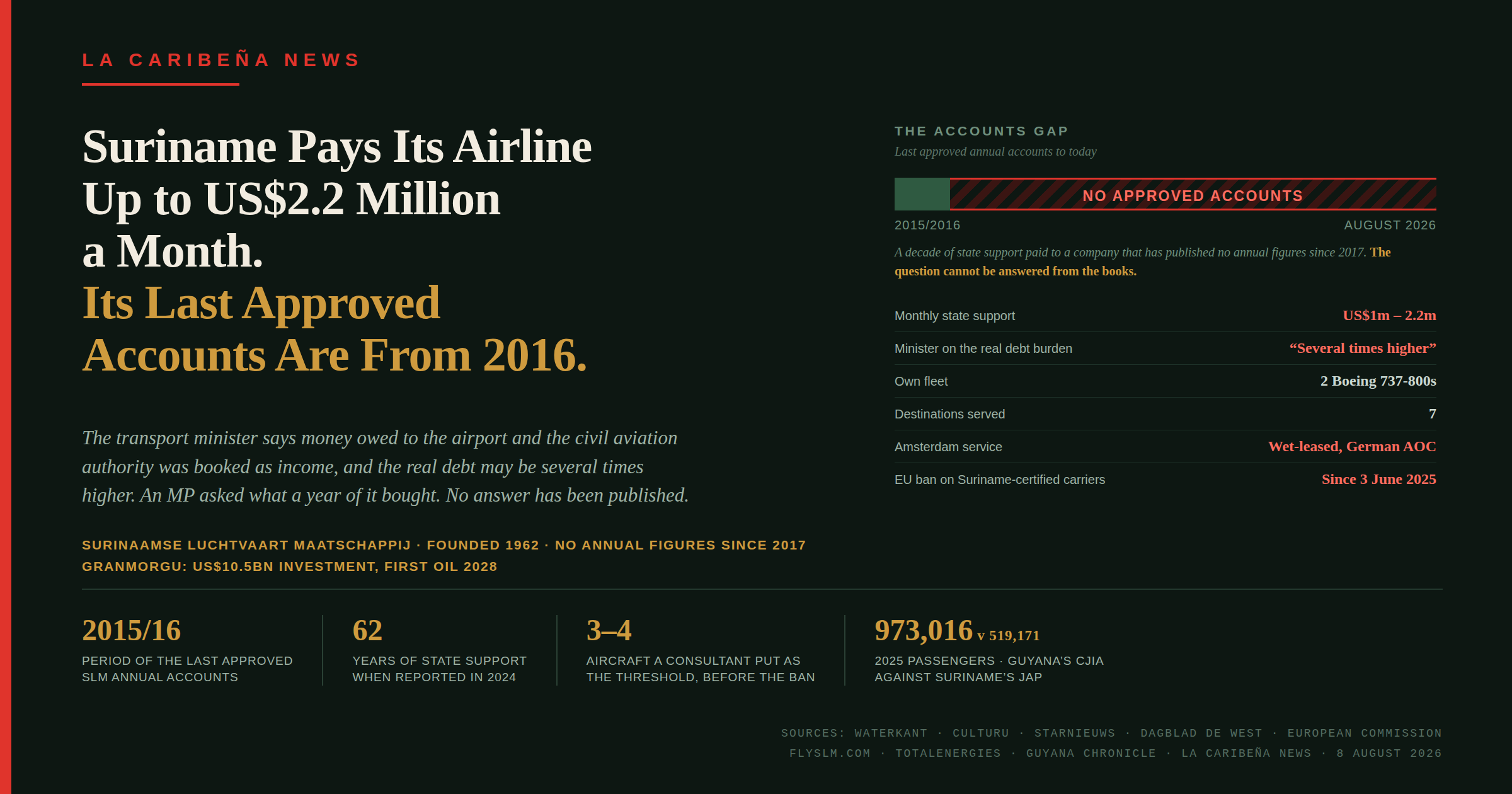
Every data point on the article's title card, in text.
- 2015/2016. The period covered by the last approved SLM annual accounts. Source: Waterkant, 24 December 2025.
- 62 years. How long SLM had been dependent on state support when Dagblad de West reported on it in September 2024. The airline was founded in 1962. Source: Dagblad de West, 8 September 2024.
- US$1m to US$2.2m a month. The state support arranged for SLM. Source: Waterkant, 7 August 2026.
- "Several times higher." The Minister of Transport, Communication and Tourism on how far SLM's real debt burden may exceed the figure previously assumed. Source: Culturu, 22 June 2026.
- 7 destinations. SLM's network from Paramaribo. Source: flyslm.com.
- 3 June 2025. The date the European Commission banned all Suriname-certified carriers from operating in the European Union. Source: European Commission.
- 3 to 4 aircraft. The fleet size at which an aviation consultant said profitability becomes possible without subsidy. Source: GFC Nieuws, 20 March 2025.
- US$10.5 billion. Estimated investment in the GranMorgu development offshore Suriname, targeting first oil in 2028. Source: TotalEnergies.
- 973,016 against 519,171. Passengers through Guyana's Cheddi Jagan International Airport in 2025, against Suriname's Johan Adolf Pengel International Airport. Sources: Guyana Chronicle; airport statistics.
What was asked in the National Assembly?
How much the airline received in a year, and what it produced.
During the current affairs round in De Nationale Assemblee on Thursday 6 August, Mahinder Jogi of the Vooruitstrevende Hervormings-Partij (VHP) asked the government to state how much subsidy the Surinaamse Luchtvaart Maatschappij (SLM) had received since the present government took office, and what had been achieved with it. He put the support at between US$1 million and US$2 million a month, and asked whether the airline's financial and operational position had improved or deteriorated, whether additional staff, consultants or foreign experts had been engaged, and at what cost.
He asked the government to inform the Assembly as soon as possible. On the public record this newspaper can find, it has not.
The support runs a little above Jogi's estimate. Waterkant puts the arrangement at just over US$1 million to US$2.2 million a month, or roughly US$12 million to US$26.4 million a year.
Jogi's question covers one government's term. The subsidy is older than that. SLM was founded in 1962, and Dagblad de West reported in September 2024 that the airline was still dependent on state support after 62 years, having published no annual reports since 2017. The same report noted that an earlier arrangement of more than US$2 million a month had been stopped some months previously, which the then Minister of Finance, Stanley Raghoebarsing, presented as a sign of improvement.
The present support is therefore a resumption, not a departure. What Jogi asked is what a resumed arrangement has bought, and whether the position that justified stopping the last one has returned.
Can the question be answered from the accounts?
No. There are no current accounts to answer it from.
SLM's last approved annual accounts cover 2015/2016. The company has published no annual figures since 2017. When the airline's leadership presented a financial quick scan to President Jennifer Geerlings-Simons in December 2025, that decade-long gap was the headline finding. The delegation was led by director Johan Sandie with the full Board of Commissioners and the President's aviation adviser, Faizel Baarn. The chairman of the board, Marlon Telting, said there was a long way to go on the financial figures. A fuller set was promised the following month.
Six months later the picture had darkened. On 22 June 2026 the Minister of Transport, Communication and Tourism, Raymond Landveld, said the airline's financial position had been presented more favourably than it actually was. Sums owed to the airport operator and to CASAS, Suriname's civil aviation authority, had been booked as income, which he said produced a distorted picture. Preliminary findings indicated the debt burden might be several times higher than previously assumed.
Landveld declined to give figures, citing a pending case against SLM's former management. The investigation was due to report in July.
The state has spent a year funding a company whose own minister says its books showed money it was going to have to pay out as money it had taken in.
Jogi asked his question in August, after that deadline.
What does the money buy?
Two Boeing 737-800s, seven destinations, and a leased widebody flown by a German operator.
SLM's own network lists seven points from its hub at Johan Adolf Pengel International Airport: Georgetown, Belém, Miami, Aruba, Curaçao, Barbados and Amsterdam. Read as a route map, that is a list of Suriname's commercial corridors rather than a leisure network: the Dutch corridor, the United States corridor through Florida, the neighbouring oil economy at Georgetown, Brazil at Belém, and three Caribbean points.
The Amsterdam service, the longest and most valuable route on that list, is not flown by SLM's own aircraft. Since September 2024 it has operated on a wet-leased Airbus A340-600 from Universal Sky Carrier, a German operator that supplies the aircraft, the crew and the certificate. Any assessment of what the subsidy buys has to account for that lease before it divides anything across two airframes.
One market on Suriname's doorstep is closed by policy rather than by capacity. Suriname issues no visas to Haitian nationals and bars their entry except for residents holding an official permit, and direct flights between the two countries have been prohibited since August 2021. A narrow relaxation introduced in 2023 permits family reunification and family visits on scheduled commercial services, subject to proof of funds, a return ticket and insurance. Haiti is the Caribbean Community's most populous member and, as this newspaper reported in July, an import market of close to US$4 billion in 2023 whose nationals only two of the bloc's fifteen members admit without a visa. On this newspaper's earlier reporting, Suriname refuses transit as well as entry, including to passengers who never leave the aircraft.
SLM does not serve Haiti, so no subsidised aircraft flies into that closure. It is a constraint on the airline's market that no fleet plan reaches.
Why can SLM not fly its own aircraft to Europe?
Because Suriname's aviation regulator failed a European safety assessment.
On 3 June 2025 the European Commission added every air carrier certified in Suriname to the EU Air Safety List, barring them from operating in the European Union. The Commission cited a shortage of qualified personnel and ineffective oversight of flight operations and airworthiness, and concluded that the civil aviation authority could not ensure compliance with international safety standards.
The bar is on the country's oversight, not on any one airline's aircraft. It is why a German operator flies Paramaribo to Amsterdam. It also sets a limit on every proposal to fix SLM by buying aircraft: a larger fleet certified in Suriname is still a fleet that cannot be flown to Europe.
Can an airline this size be profitable?
Not at two aircraft, on one consultant's assessment, though that assessment predates the European ban.
Canadian aviation consultant Tomas Chlumecky, speaking to Radio Stanvaste alongside analyst Sonny Koeblal in March 2025, said a carrier with only two aircraft can never be profitable. He put the threshold at three to four aircraft, at which point he said profitability without subsidy becomes achievable, and set a longer objective of ten or more by 2030 at a rate of one or two a year, so that crew training, marketing and commercial functions grow with the fleet. He named Jamaica, Barbados, Belize and Sint Maarten as markets SLM should open.
Chlumecky is a commentator on Surinamese aviation rather than a retained government adviser, and he has argued publicly for SLM's expansion for years. His threshold is a rule of thumb, not a finding, and the underlying mechanics matter more than the number: a two-aircraft operator carries the fixed cost of an air operator's certificate over very few seats, holds no spare airframe, and loses half its capacity every time one aircraft goes in for a heavy check.
His route list has also dated. SLM now flies Barbados. And on the evidence of June 2025, the constraint on the Amsterdam corridor is a regulator, not a fleet plan.
Does the 2028 oil timeline change the question?
It raises the demand, and it does not settle who should carry it.
TotalEnergies took a final investment decision on the GranMorgu development on Block 58 on 1 October 2024, developing the Sapakara and Krabdagu discoveries about 150 kilometres offshore, with recoverable reserves put at more than 750 million barrels, an estimated investment of about US$10.5 billion, a floating production, storage and offloading unit rated at 220,000 barrels per day, and first oil targeted for 2028. TotalEnergies and APA Corporation hold 40 per cent each. Staatsolie exercised its option and holds 20 per cent, funded with a US$516 million bond and a US$1.6 billion syndicated loan.
Guyana is the nearest guide to what a development of that size does to an airport. Passenger movements through Cheddi Jagan International Airport rose from 182,736 in 2020 to 973,016 in 2025, an increase of 432.5 per cent. Available seats rose from 341,506 to 1,708,095. International landings went from 1,646 to 5,827.
Johan Adolf Pengel handled 519,171 passengers in 2025. Its 2019 figure was 528,999. Six years on, Suriname's main airport was still carrying fewer people than before the pandemic, while its neighbour's had nearly quintupled.
Two qualifications belong on that comparison. Offshore projects move their crews by helicopter and dedicated charter, not on the flag carrier, so the demand lands on the international and onshore legs rather than in the seats that fly to the rig. And Guyana's growth was captured largely by foreign carriers adding capacity rather than by a state flag carrier. What that capacity cost the Guyanese state, in route incentives, landing and handling concessions, marketing support or revenue guarantees, is not on the public record this newspaper can find. Rising demand on the Paramaribo corridors is an argument for capacity. It is not on its own an argument for state-owned capacity, and the cheaper alternative has a price that nobody has published either.
What has the government said?
That the airline loses money, that it matters, and that it will not fund it at Trinidadian scale.
President Geerlings-Simons has said SLM operates at a loss while remaining crucial to the country, and has compared it to Caribbean Airlines, which she said in August 2025 receives annual subsidies of between US$60 million and US$200 million, a level Suriname cannot match. That range is not a like-for-like figure for an annual subvention, and it should be read as a statement of political limit rather than an accounting comparison.
At a press conference at the presidential palace on 3 August 2026, Geerlings-Simons set out her government's first-year account. She said the first phase of the recovery had largely succeeded, that the primary budget balance is positive, and that state enterprises had been reorganised, with more than fifty cases filed with the Public Prosecutor's Office.
Three days later Jogi asked what one of those reorganised state enterprises had produced. Both statements can hold. A company can be under new management, under audit, and still unable to say what it owes.
| Figure | |
|---|---|
| Last approved SLM annual accounts | 2015/2016 |
| Monthly state support | US$1m to US$2.2m |
| Implied annual support | About US$12m to US$26.4m |
| Minister on the real debt burden | "Several times higher" than assumed |
| Own fleet | 2 Boeing 737-800s |
| Amsterdam service | Wet-leased A340-600, German operator |
| EU operating ban on Suriname-certified carriers | Since 3 June 2025 |
| GranMorgu investment, first oil 2028 | US$10.5bn |
What would an answer look like?
Four documents, and none of them is a subsidy total.
1. A set of accounts. Not a quick scan and not a range. An audited balance sheet, which the company has not produced for a decade.
2. The audit, published. It was due in July. A report the state commissioned into a company the state funds is not a private document.
3. The support, as a budget line. Whether the money is an appropriation the Assembly voted or a transfer arranged outside it determines who was ever in a position to answer Jogi's question.
4. The cost of the connectivity, not the company. If the state is buying air links rather than an airline, it can price them. Route support tendered to any carrier is a different instrument from a subvention to one, and it survives a safety ban that a fleet plan does not.
Suriname is two years from first oil, and the flag carrier serving its corridors cannot say what it owes. The question is not whether a state should hold commercial assets. It is whether anyone can still read the books.
Frequently Asked Questions
How much subsidy does SLM receive?
Between just over US$1 million and US$2.2 million a month, or roughly US$12 million to US$26.4 million a year, according to Waterkant. Mahinder Jogi, who raised the matter in the National Assembly on 6 August 2026, put it at US$1 million to US$2 million a month. The government has not published a figure.
When were SLM's last approved accounts?
They cover 2015/2016. The airline has published no annual figures since 2017. The gap was the central finding of a financial quick scan presented to President Jennifer Geerlings-Simons in December 2025.
What did the transport minister say about SLM's debts?
On 22 June 2026 Raymond Landveld said the airline's financial situation had been presented more favourably than it actually was, and that sums owed to the airport operator and to the civil aviation authority had been booked as income. He said the real debt burden might be several times higher than previously assumed, and declined to give figures because of a pending case against former management.
Why does a German airline fly Paramaribo to Amsterdam?
Since 3 June 2025 the European Commission has banned all air carriers certified in Suriname from operating in the European Union, citing weak regulatory oversight. SLM has operated the Amsterdam route on a wet-leased Airbus A340-600 from Universal Sky Carrier since September 2024. Amsterdam is one of seven destinations SLM serves from Johan Adolf Pengel International Airport, alongside Georgetown, Belém, Miami, Aruba, Curaçao and Barbados.
Why does Suriname's oil timeline matter to this?
TotalEnergies' GranMorgu development carries an estimated US$10.5 billion investment and targets first oil in 2028. In Guyana, passenger movements through Cheddi Jagan International Airport rose 432.5 per cent between 2020 and 2025. Suriname's main airport carried fewer passengers in 2025 than in 2019.