TRADE · ANALYSIS
Haiti in CARICOM: US$4.0B import market; visa-free to Benin ~9,000km yet visa required for Jamaica ~300km; visa-free entry in only 2 of 15 CARICOM states; excluded from October 2025 free movement.
July 5, 2026 | By La Caribeña News
Quick summary: Haiti is the most populous member of the Caribbean Community (CARICOM) and bought close to US$4 billion in imports in 2023. Yet 13 of the bloc’s 15 states still require visas from Haitian nationals, and none extended to Haiti the full free movement four members began in October 2025. The region sells to Haiti. It does not let Haitians in.
PORT-AU-PRINCE / GEORGETOWN. When four Caribbean governments opened their borders to one another on 1 October 2025, letting each other’s citizens live, work and settle without limit, they described it as the closest thing the region had ever built to the free movement Europeans take for granted. The four were Barbados, Belize, Dominica, and St. Vincent and the Grenadines. The Caribbean Community’s largest member by population was not among them, and was never going to be. Haiti, home to more than 11 million people, watched the door open for everyone else.
That gap between what CARICOM says about Haiti and what it does to Haitians is not a matter of sentiment. It shows up in trade ledgers, in a landmark court ruling the region wrote itself, and in the fine print of the deals Caribbean leaders signed this year. Read together, the record describes a market the Community is happy to sell into and a people it keeps at the gate.
How big a market is Haiti for the rest of CARICOM?
Bigger than any single country in the bloc. Haiti’s population passed 11 million in 2024, according to World Bank data, which makes it more populous than Jamaica, Trinidad and Tobago, Guyana, Suriname and Barbados combined. Haiti joined CARICOM on 2 July 2002 as the 15th member and the only one whose working languages are French and Haitian Creole, a point the CARICOM Secretariat records without irony.
A market that size buys. Haiti imported close to US$4 billion in goods in 2023 against exports of roughly US$900 million, per the country’s trade profile, a structural deficit that tells any exporter where the selling opportunity lies. The United States and the Dominican Republic dominate that import bill. CARICOM firms take a slice, and the ones that do are the bloc’s biggest producers: Trinidad and Tobago, which supplies fuel and manufactured goods across the region, and Guyana, whose rice has long found buyers in Haitian markets.
The terms of that trade run one way. Rice, a signature Caribbean export to Haiti, enters the country at a 3% duty while Haiti’s own goods already move duty-free into the rest of CARICOM, according to regional agribusiness body Caribbean Agri-Business. Haiti, in other words, extends the courtesy of open markets to its neighbours and pays for the privilege of buying from them.
What does the trade data show about who profits?
It shows a customer, not a partner. Haiti runs a deep and widening deficit with the rest of CARICOM, buying far more than it sells back, a pattern regional trade analysts have flagged for years. The reason is not a shortage of Haitian goods. It is that the machinery of the Caribbean Single Market and Economy (CSME), the tools that let a Guyanese producer sell into Barbados as a regional national rather than a foreign importer, has never been switched on for Haiti in any practical way.
HAITI IN CARICOM, BY THE NUMBERS
11M+ people, the largest population of any CARICOM member US$4.0B in imports in 2023, against US$0.9B in exports 2 of 15 member states let Haitians enter without a visa 0 free-movement access under the October 2025 arrangement
The numbers behind the chart
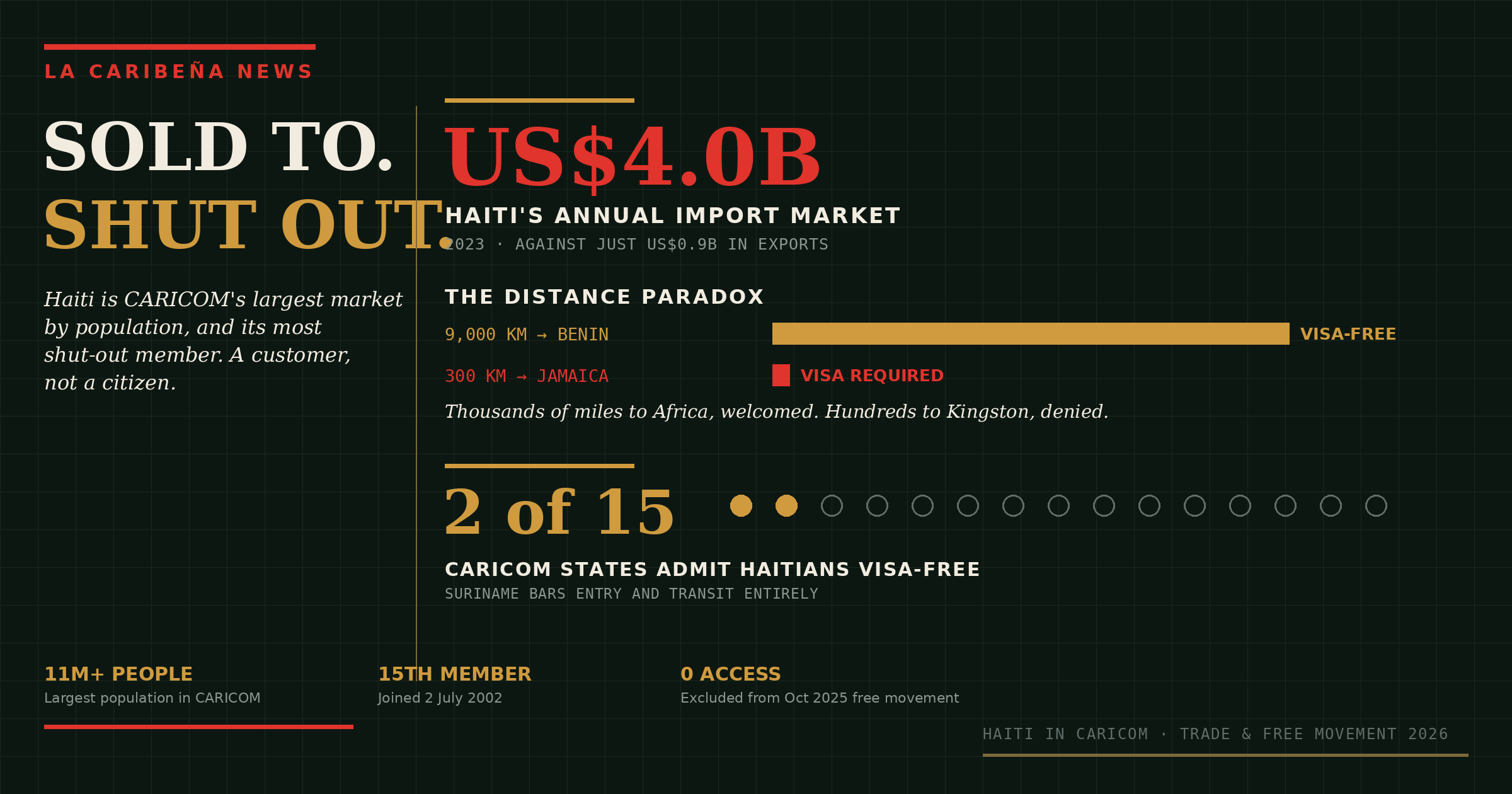
The title graphic accompanying this article carries three call-outs on Haiti’s standing inside CARICOM, drawn from the sources cited throughout this piece. Call-out one, the market:
Haiti imported approximately US$4.0 billion in goods against US$0.9 billion in exports in 2023 (Haiti trade profile, drawing on World Bank and mirror data), a deficit of roughly US$3 billion. Call-out two, the distance paradox: a Haitian can enter Benin, roughly 9,000 kilometres from Port-au-Prince, without a visa, but must obtain a visa to reach Jamaica, less than 300 kilometres away (Africanews / Remitly; Surinam Airways for the Suriname bar). Call-out three, the exclusion: only 2 of 15 member states, Grenada and Montserrat, admit Haitians without a visa (Jamaica Gleaner / Henley & Partners, July 2025), the other 13 require one, Suriname refuses entry and transit entirely, and Haiti holds zero access under the full free-movement regime four members began on 1 October 2025 (CARICOM Secretariat). Supporting figures on the card: Haiti has more than 11 million people, the most of any member state, exceeding the combined populations of Jamaica, Trinidad and Tobago, Guyana, Suriname and Barbados; it joined as the 15th member on 2 July 2002. The pattern is the same across every measure: Haiti is CARICOM’s biggest market and its least included member.
The blunt version is the one a founder in Georgetown or Port of Spain already understands. There is money to be made in Haiti. The Community has organised its trade to make it, and organised its borders to make sure Haitians cannot do the same in return.
What rights does a Haitian actually have under CARICOM law?
On paper, the same rights as any other Caribbean national, and the region’s own court said so in plain language. In Shanique Myrie v The State of Barbados, decided by the Caribbean Court of Justice (CCJ) on 4 October 2013, the judges ruled that every CARICOM national has a right of entry to any member state and an automatic stay of six months on arrival. The right flows from the Revised Treaty of Chaguaramas and a 2007 decision of the Conference of Heads of Government. An immigration officer may refuse entry only in narrow cases, an undesirable person or someone genuinely likely to become a charge on public funds, and even then must give reasons and a chance to respond.
The facts of the case still sting. Shanique Myrie, a 22-year-old Jamaican, was subjected to a body-cavity search, detained overnight in a cell and expelled from Barbados. The CCJ ordered Barbados to pay her damages, as Stabroek News reported at the time, and set the six-month entry right as binding Community law that sits above ordinary domestic immigration rules.
Haiti signed the same Revised Treaty of Chaguaramas. Its nationals are, in law, entitled to the Myrie right like anyone else in the bloc. The gap between that entitlement and the treatment Haitians actually receive is the whole story.
Why can’t most Haitians use those rights?
Because most of CARICOM keeps a visa wall in front of them. As of July 2025, only Grenada, which grants 90 days, and Montserrat, which grants six months, let Haitian nationals enter without a visa, the Jamaica Gleaner reported, citing the Henley & Partners passport rankings. The other 13 member states, including Barbados, Jamaica, Trinidad and Tobago and Guyana, require Haitians to apply. A Haitian passport reached just 15 destinations visa-free in 2025, among the weakest travel documents on earth.
Suriname goes further than a visa wall. It refuses Haitians entry altogether, and refuses them transit even when they never leave the aircraft, a bar that reaches connecting passengers at Paramaribo’s Johan Adolf Pengel International Airport, according to the published travel-document rules of the national carrier Surinam Airways and IATA entry data. Only Haitians who already hold Surinamese residence are exempt. For a Haitian, one CARICOM member state is not merely hard to enter. It is sealed.
The choice is pointed, because no member state resembles Haiti more than Suriname does. Both were among the most brutal plantation colonies in the Americas, Dutch Suriname and French Saint-Domingue, and each produced powerful Maroon societies, the Ndyuka and Saramaka of the Surinamese interior and the Maroons of the Haitian mountains, that carried West and Central African language, faith and kinship into the present. Historians have studied the two together as the clearest surviving cases of African cultural retention in the hemisphere, and the Maroon heritage they share is celebrated on both sides. The CARICOM country that mirrors Haiti’s history most closely is the one that shuts its door hardest.
Then came the October 2025 breakthrough, and Haiti was left out of it. The CARICOM Secretariat confirmed that only Barbados, Belize, Dominica, and St. Vincent and the Grenadines would grant each other’s citizens the right to reside and work indefinitely. The defenders of the status quo point to Haiti’s instability. In July 2023, then Prime Minister Ariel Henry acknowledged that Haiti could not immediately meet the obligations of free movement, and Barbados Prime Minister Mia Mottley confirmed, as reported at the time, that “the status quo will remain for those countries who, in fact, still have visa requirements for Haitians.” Haiti’s foreign ministry later clarified that Henry had not asked for Haiti to be excluded, only that it was not positioned to deliver its side immediately. The distinction matters, and it changes little at the border.
Why is it easier for a Haitian to reach Africa than the Caribbean next door?
Because the door opens wider across an ocean than across a channel. A Haitian passport holder can enter Benin, The Gambia and Rwanda without a visa for up to 90 days, and reach Kenya on a simple electronic authorisation, part of a wave of African states that opened their borders to African and Caribbean travellers in 2025. Cotonou, Benin’s commercial capital, sits roughly 9,000 kilometres from Port-au-Prince, and welcomes a Haitian at the gate.
Kingston sits less than 300. Yet a Haitian cannot take the short hop to Jamaica, Barbados or Trinidad without first obtaining a visa, and cannot enter Suriname on any terms. The arithmetic is blunt: it is easier for a Haitian to cross the Atlantic and be received in West Africa than to cross a few hundred kilometres of Caribbean Sea to a fellow member of their own Community. The corridor this newsroom’s companion column at No USA Visa Travel maps from the Caribbean to Africa without a US visa is, for a Haitian, more open than the one to the island next door.
How does the 2026 deportee deal expose the double standard?
It puts the contradiction in writing. Under pressure from Washington, several CARICOM states agreed in January 2026 to accept third-country deportees from the United States, but limited the arrangement to deportees who are themselves CARICOM citizens. Haiti was carved out by name. CARICOM Chairman and St. Kitts and Nevis Prime Minister Dr. Terrance Drew said the deal excluded Haiti “because of security matters,” as NevisPages reported.
“Because of security matters, it does not include Haiti at this time.”
Dr. Terrance Drew · Prime Minister of St. Kitts and Nevis and CARICOM Chairman, January 2026
The same chairman leads CARICOM’s diplomatic effort on Haiti’s political transition. The Community that presents itself abroad as Haiti’s advocate declined, at home, to count Haitians among the Caribbean nationals it would take back, a contradiction WiredJA and others in the regional press did not miss. A Haitian is Caribbean enough to sell to and not Caribbean enough to admit.
What would it take to actually open the door to Haiti?
The tools already exist. The CSME was built to let Caribbean nationals move, work and set up businesses across the region as locals rather than foreigners, and a companion column at No USA Visa Travel lays out how founders can use the CSME advantage most people never claim, from the automatic six-month stay to the right of establishment. Every instrument in that piece is one Haitians are formally entitled to and practically denied.
Opening the door does not require a new treaty. It requires member states to apply the one they signed. A phased inclusion of Haiti in free movement, visa waivers matched to the Myrie standard, and real access to the CSME’s skills and establishment regimes would let Haitian producers and workers do what their neighbours already do: sell into the regional market as members, not supplicants. Haiti has kept its side of the bargain, buying from the region and holding its own market open. The question the numbers leave on the table is whether the rest of CARICOM intends to keep its side, or whether Haiti’s membership will remain, as the trade data suggests, a one-way transaction dressed as a family.
The Community marks its founding every July, in honour of the Treaty of Chaguaramas signed on 4 July 1973. It is the same treaty that promises free movement to every Caribbean national, Haitians among them. Happy CARICOM Day to you!
Frequently Asked Questions
Which CARICOM countries let Haitians enter without a visa?
As of July 2025, only two of the 15 member states admit Haitian nationals without a visa: Grenada, for up to 90 days, and Montserrat, for up to six months. The other 13, including Barbados, Jamaica, Trinidad and Tobago and Guyana, require Haitians to obtain a visa or electronic authorisation. Suriname is the strictest of all, refusing Haitians both entry and transit, even for passengers merely connecting through its airport, with an exception only for existing residents.
What did the Shanique Myrie case decide?
In 2013 the Caribbean Court of Justice ruled that every CARICOM national has a right to enter any member state and stay for up to six months, refusable only in narrow, justified cases. The court awarded damages to Shanique Myrie, a Jamaican denied entry to Barbados, and established the six-month right as binding Community law under the Revised Treaty of Chaguaramas.
Does CARICOM free movement include Haiti?
No. The full free-movement regime that began on 1 October 2025 covers only Barbados, Belize, Dominica, and St. Vincent and the Grenadines. Haiti, the bloc’s most populous member, was not included, and no member state currently extends indefinite residence rights to Haitian nationals.
Can a Haitian travel to Africa more easily than within the Caribbean?
In several cases, yes. A Haitian passport holder can enter Benin, The Gambia and Rwanda visa-free for up to 90 days and reach Kenya on an electronic authorisation, while most CARICOM states, including Jamaica, Barbados and Trinidad and Tobago, require a visa, and Suriname bars entry entirely. It is often easier for a Haitian to reach West Africa, thousands of kilometres away, than a neighbouring Caribbean island.
How much does Haiti trade with the rest of CARICOM?
Haiti is a large net importer, buying close to US$4 billion in goods in 2023 against roughly US$900 million in exports. CARICOM suppliers, chiefly Trinidad and Tobago and Guyana, sell fuel, manufactured goods and rice into Haiti, while Haiti’s exports back into the region remain small, leaving a lopsided trade relationship.