LA CARIBEÑA NEWS | TRADE & ECONOMICS | 12 JUNE 2026
TRADE & ECONOMICS
A near-final deal with Colombia, fractured WTO dispute settlement, and the bloc's response to US tariff policy dominated the 62nd COTED agenda.
GEORGETOWN, Guyana | 12 June 2026 | La Caribeña News
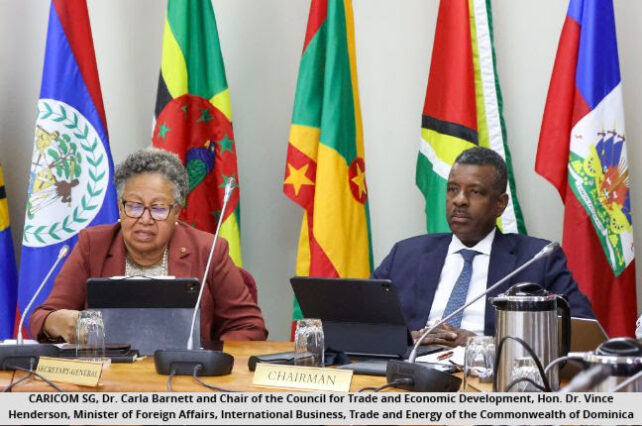
CARICOM trade ministers convened in Georgetown on 11 June 2026 for the 62nd Regular Meeting of the Council for Trade and Economic Development, with a Colombia trade deal, CSME implementation, and US tariff policy topping the agenda.
Speaking at the opening ceremony, CARICOM Secretary-General Dr Carla Barnett pointed to volatile energy markets and fractured supply chains as forces driving up prices and clouding the medium-term growth outlook for the region. The meeting runs through 12 June at CARICOM Secretariat headquarters and is chaired by Dr Vince Henderson, Dominica's Minister of Foreign Affairs, International Business, Trade and Energy.
The external backdrop is deteriorating. According to UN Trade and Development (UNCTAD), global merchandise trade growth in real terms is projected to slow from 4.7 per cent in 2025 to between 1.5 and 2.5 per cent in 2026, a deterioration driven by geopolitical tensions, shipping disruptions, and weakening investment. For CARICOM economies the strain runs deeper. UNCTAD notes that the pressure on developing economies hits on several fronts at once: higher costs for fuel, food, and fertiliser compound the difficulties of weakening currencies, constrained borrowing, and retreating investors. Small island states with limited fiscal buffers sit squarely in that category.
Colombia deal reaches final stage
The meeting's sharpest news peg is the proposed expansion of CARICOM's Trade, Economic and Technical Cooperation Agreement with Colombia. Dr Barnett told ministers the bloc is close to concluding those negotiations and that COTED is expected to provide the strategic guidance to position negotiators to finalise a deal.
The original agreement dates to 1994. Negotiations to expand preferential market access were launched in Jamaica in 2022, and a third round of talks was held in Bridgetown, Barbados, in November 2025. The two sides had agreed to conduct a final negotiating round in March 2026 ahead of this ministerial meeting.
"The mandate from our Heads of Government is to exploit opportunities for market diversification arising from existing bilateral trade agreements." — Dr Carla Barnett, CARICOM Secretary-General
The talks touch on tariff mechanisms, sanitary and phytosanitary standards, product sensitivities, and the protection of less developed CARICOM member states. Preserving Article 164 of the Revised Treaty of Chaguaramas, which allows smaller CARICOM economies to temporarily suspend preferential treatment on certain imports, remains a declared priority for several delegations. Those protections run until 2031.
CSME implementation and digital trade
Ministers are also reviewing the performance of the CARICOM Single Market and Economy. Dr Barnett described the CSME as "the Region's core platform for economic development and resilience" and said the assessment confirms the need for stronger implementation of the Revised Treaty of Chaguaramas to deliver a more durable single market.
Trade ministers are also expected to consider a regional digital trade policy as part of efforts to respond to a more technology-driven global economy. A preparatory meeting of senior officials held in May covered the Revised Common External Tariff and CARICOM Rules of Origin alongside this item.
US trade policy and the WTO
The implications of the United States' America First trade posture are also before ministers. A CARICOM Expert Working Group has been tracking the issue, and Dr Barnett confirmed the team is maintaining communication with the Office of the US Trade Representative as the bloc prepares to engage on the future of that trading relationship.
On the multilateral front, Dr Barnett urged ministers to follow developments at the World Trade Organization flowing from the 14th Ministerial Conference held in March 2026. She argued that a fractured dispute settlement system and a stalled rule-making agenda, however damaging, still leave small states better protected than a trading order decided by economic weight alone.
The 62nd COTED concludes on 12 June. No outcomes have been announced as of publication.
Frequently Asked Questions
What was on the agenda at the 62nd COTED?
A proposed expansion of CARICOM's trade agreement with Colombia, CSME implementation, a regional digital trade policy, and United States tariff policy. Trade ministers convened in Georgetown on 11 June 2026 for the 62nd Regular Meeting of the Council for Trade and Economic Development, at CARICOM Secretariat headquarters, chaired by Dr Vince Henderson, Dominica's Minister of Foreign Affairs, International Business, Trade and Energy.
How close is the CARICOM-Colombia trade deal?
Secretary-General Dr Carla Barnett told ministers the bloc is close to concluding negotiations and that COTED was expected to give the strategic guidance to position negotiators to finalise a deal. The original agreement dates to 1994. Expansion talks were launched in Jamaica in 2022, a third round was held in Bridgetown in November 2025, and a final round was agreed for March 2026.
What is Article 164 and why does it matter to the talks?
Article 164 of the Revised Treaty of Chaguaramas allows smaller CARICOM economies to suspend preferential treatment temporarily on certain imports. Preserving it is a declared priority for several delegations, alongside tariff mechanisms, sanitary and phytosanitary standards and product sensitivities. Those protections run until 2031.
How is the global trade outlook expected to affect CARICOM in 2026?
UN Trade and Development projects global merchandise trade growth in real terms will slow from 4.7 per cent in 2025 to between 1.5 and 2.5 per cent in 2026, driven by geopolitical tensions, shipping disruptions and weakening investment. UNCTAD notes developing economies face higher fuel, food and fertiliser costs alongside weakening currencies, constrained borrowing and retreating investors.
What did the meeting decide?
No outcomes had been announced as of publication. Ministers convened on 11 June 2026 and the 62nd COTED concluded on 12 June. Dr Carla Barnett also urged ministers to follow developments at the World Trade Organization flowing from its 14th Ministerial Conference in March 2026, arguing that a fractured dispute settlement system and a stalled rule-making agenda still leave small states better protected than a trading order decided by economic weight alone.