LA CARIBEÑA NEWS | TRADE & POLICY | JUNE 2026
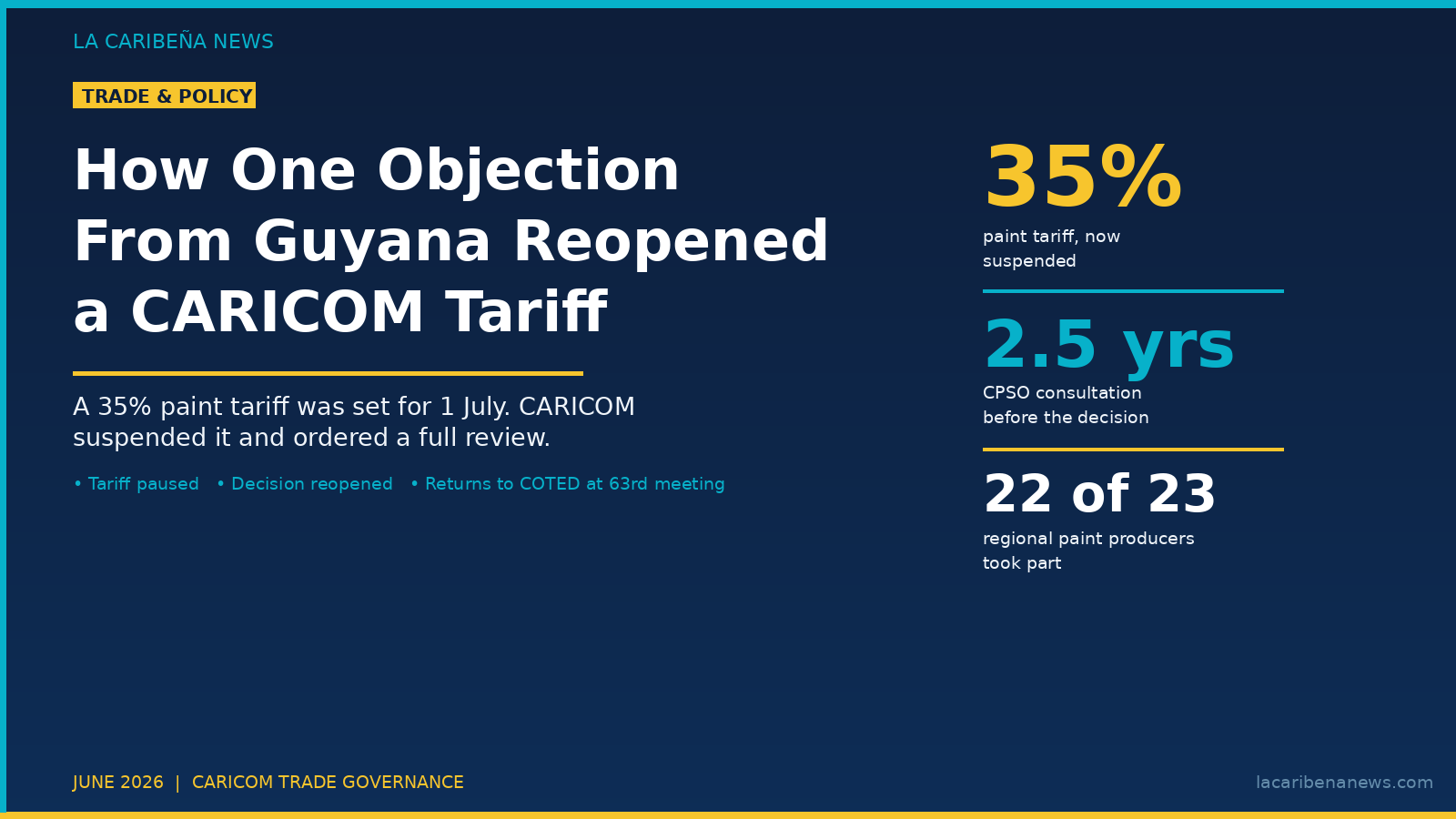
35 per cent regional tariff on paints was set to take effect on 1 July. Instead, CARICOM suspended it and ordered a full review. The story of how that happened reveals the strains inside a trade bloc trying to serve a booming economy and a cluster of fragile ones at the same time.
By LCN Newsroom | GEORGETOWN, GUYANA | June 30, 2026
CARICOM's COTED agreed on 11-12 June 2026 not to implement the 35 per cent tariff on paints and varnishes due 1 July, and to reassess regional supply and demand. The reversal followed a formal objection from Guyana. |
A regional tariff that was due to reshape the price of paint across the Caribbean from 1 July 2026 will not take effect. At its meeting on 11 and 12 June, the Caribbean Community's Council for Trade and Economic Development agreed to hold back the planned 35 per cent Common External Tariff on paints and varnishes and to reopen the entire decision, ordering a fresh assessment of regional demand, supply and production before anything is implemented.
The reversal is a notable outcome for Guyana, which had objected to the measure at two successive COTED meetings and argued that the decision reached the ministerial table without adequate technical review. It is also a revealing moment for CARICOM itself. The episode shows how much friction now runs through a trade bloc attempting to hold together the interests of Guyana, whose oil-driven economy is expanding faster than any other in the hemisphere, and the small eastern Caribbean states for whom a single manufactured product can be the largest export they have.
What Did COTED Actually Decide, and Then Undo?
The original decision was taken at the 60th meeting of COTED in June 2025, raising the Common External Tariff on paints and varnishes under eight tariff headings to 35 per cent, with effect from 1 July 2026. In a written response to La Caribeña News, the CARICOM Secretariat confirmed that the Council, meeting on 11 and 12 June 2026, agreed that the alteration of the Common External Tariff would not be implemented on 1 July 2026 and that all aspects of the decision would be reconsidered after an assessment of regional demand, supply and production of all paints and varnishes, taking into account other matters including market sensitivities.
In plain terms, the tariff is paused and the decision behind it has been sent back for review. The question of whether regional manufacturers can genuinely supply the market, and at what price, will now be examined before any rate change is reintroduced. An assessment team is expected to carry out that work, and the matter is due to return at the 63rd regular meeting of COTED.
How Was the Original Decision Reached?
The case for the tariff did not begin in Trinidad or Guyana. It began in the Organisation of Eastern Caribbean States, and in Grenada in particular, where paint is the single largest manufactured export. For several small economies with little arable land, a handful of light manufacturing lines, paint, beer, a few soft drinks, carry real weight in the export accounts, and the Revised Treaty of Chaguaramas reserves a protected space for exactly those producers under its provisions for disadvantaged countries.
The CARICOM Private Sector Organisation, the bloc's main private sector advisory body, undertook the analytical work to determine that CARICOM paint suppliers could achieve 75 per cent of regional demand from existing production potential. In an interview with La Caribeña News, its Chief Executive Officer and Technical Director, Dr Patrick Antoine, said the CPSO supported the conduct of the study by Business Facilitation Studies over roughly two and a half years, beginning with trade and pricing analysis and then moving to consultations with ministries and producers across the region. He said the work drew on standard trade-pricing models and data from UN Comtrade as well as figures supplied to the CARICOM Secretariat by member states, and that 22 of the region's 23 paint producers took part in the producer consultations.
Dr Antoine's central argument is a treaty argument. The Common External Tariff, he says, exists to stimulate production and trade within the single market, and a member state or sector that can show it meets at least 75 per cent of regional demand has a right under the treaty to seek protection. On that test, he maintains, the regional paint industry qualifies.
Guyana's indigenous domestic paint producer was not absent from the process. Documentation reviewed by La Caribeña News, along with accounts from people at the manufacturer who have knowledge of the matter but no authority to speak for it, indicates the producer was part of the CPSO's manufacturer consultation and was supplying production data to the study as early as 2023. That engagement ran in parallel with the government-level consultation Guyana later called inadequate. The manufacturers were in the room even where the officials were not.
If we cannot find a place for small countries to get a little benefit in the single market, we are going to have a challenge. DR PATRICK ANTOINE, CEO, CARICOM PRIVATE SECTOR ORGANISATION, IN AN INTERVIEW WITH LA CARIBEÑA NEWS |
Why Did Guyana Object?
Guyana's case, as recorded in the COTED officials' report, was both procedural and economic. The country's representative argued that the decision had not received sufficient scrutiny at the technical level before ministers approved it, and that Guyana had objected during the ministerial caucus rather than supporting the increase. Guyana also submitted trade data indicating that CARICOM paint exports to it had grown in recent years, which in its own reading undercut the claim that regional producers were being shut out of the market.
The economic logic behind Guyana's position is straightforward. The country is in the middle of a construction boom with few parallels. The International Monetary Fund projects GDP growth of more than 14 per cent in 2025 and over 20 per cent in 2026, driven by oil and gas investment, and paint demand follows construction closely. A higher tariff on imported paint lands first on the builders, developers and households at the centre of that expansion.
These are not necessarily contradictory accounts. The CPSO is looking at aggregate regional capacity and at the survival of small-economy producers. Guyana is looking at the cost imposed on its own fast-growing market by a measure designed mainly for the benefit of producers elsewhere. The June reversal means that tension was acknowledged rather than resolved, and pushed into a technical review.
What Does the Reversal Reveal About CARICOM's Trade Model?
Dr Antoine, who supported referring the matter for legal and technical review, is candid about the risk the reversal carries. Reopening a decision on the basis of market sensitivities, he argues, is a slope that could eventually be applied to rice, flour, sugar, milk and other goods more essential than paint, including goods that are potential beneficiaries under CARICOM's 25 by 2030 mandate. He also noted that Jamaica and Guyana have reserved the right to exempt themselves from the decision at the level of Heads of Government if the reassessment comes back in favour of the tariff, a sign that the pressure to opt out of regional decisions is no longer confined to the smaller economies.
CARICOM operates by intergovernmental consensus. A measure advances when member states agree, and unravels when they do not. The paints episode is a working illustration of how fragile that settlement becomes when one member state has the economic weight to press a point and the others have the treaty on their side. The bloc's challenge is to reconcile Guyana's scale with the smaller economies' need for protected space, and the paints file is now a live test of whether that can be done without either side concluding the system no longer works for them.
Where Does the CPSO Stand in Relation to Guyana?
The picture of the CPSO as simply working against Guyana's interests does not survive contact with the record. In February 2026 the organisation publicly backed the sugar refinery investments in Guyana and Belize, championed by President Irfaan Ali, even though regional refining may raise sugar prices in the short run. Dr Antoine framed that support in terms of long-term regional capacity, arguing that "private capital can only transform regional agriculture into agroindustry, where market certainty and policy coherence exist across CARICOM."
On the question of whether Guyana's refined sugar applications were treated differently from those of Trinidad and Tobago, Jamaica and Barbados, the CARICOM Secretariat was explicit in its response to La Caribeña News: the actions taken in respect of refined sugar supply were applicable to all Member States.La Caribeña News found no documentary basis to report otherwise, and does not.
What Happens Next?
The paints decision returns to COTED at its 63rd regular meeting, following the work of an assessment team examining regional demand, supply and production. Until then, the 35 per cent rate does not apply, and the existing tariff treatment continues.
A separate proposal from Trinidad and Tobago, to place glass bottles on the list of items ineligible for conditional duty exemptions, remains at an early stage. Several member states, including Guyana, asked for more consultation before it advances, and no decision has been taken.
For Guyana, the immediate outcome is a win on paints and an open question on much else. The deeper issue the episode raises, how a consensus-based trade bloc accommodates a member growing far faster than the rest, will not be settled by a single assessment team. It is the question CARICOM will keep returning to for as long as Guyana's boom lasts.
Frequently Asked Questions
Did the 35 per cent paint tariff take effect on 1 July 2026?
No. COTED agreed in June 2026 not to implement the tariff on 1 July and to reassess the decision. The existing tariff treatment continues until that review is complete.
Why did CARICOM reopen the decision?
Guyana, later joined by Jamaica, objected that the decision lacked adequate technical review and would raise costs in Guyana's construction sector. COTED agreed to reassess regional demand, supply and production before implementing any change.
Who wanted the tariff in the first place?
The measure originated with the Organisation of Eastern Caribbean States, particularly Grenada, where paint is the largest manufactured export. The CARICOM Private Sector Organisation undertook the analytical work on regional supply capacity, and supported the study conducted by Business Facilitation Studies.
What is the 75 per cent rule?
Under the Revised Treaty of Chaguaramas, a member state or sector that can show regional supply meets at least 75 per cent of regional demand may seek a protective Common External Tariff. It is the threshold the CPSO says the paint industry meets.
What happens to the decision now?
An assessment team will examine regional demand, supply and production. The matter is expected to return to COTED at its 63rd regular meeting for a fresh decision.
Editorial Disclosure: Theon Alleyne, Founder and Managing Director of La Caribeña News, serves as Director and Chair of the Services Sub-Sector at the Guyana Manufacturing and Services Association (GMSA). This article was produced independently by the LCN Newsroom. Editorial decisions were made solely on news value in accordance with LCN Guidelines v1.1, Section 12. The CARICOM Secretariat and the CARICOM Private Sector Organisation were given the opportunity to respond and their responses are reflected above.