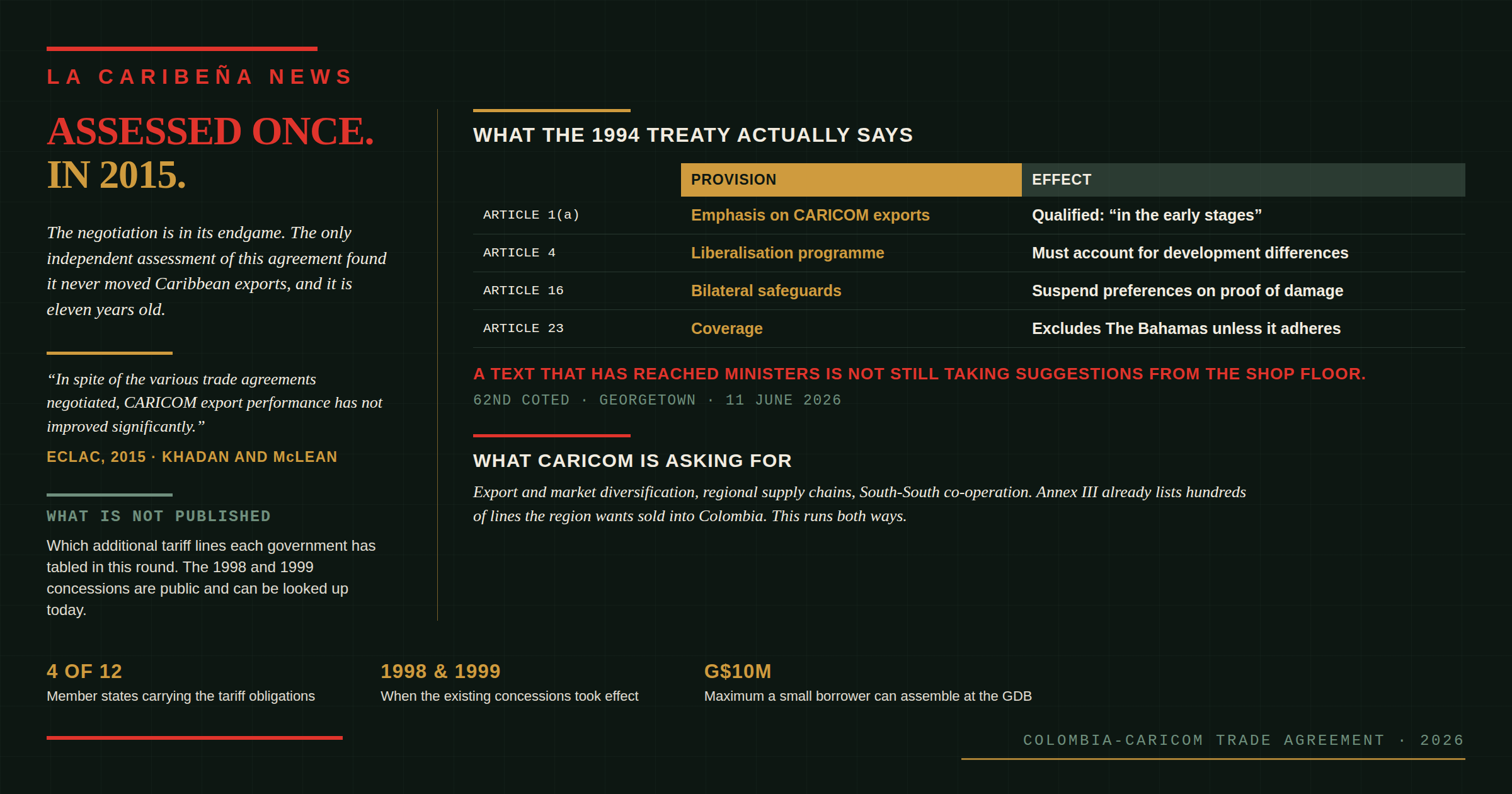
The negotiation is in its endgame. Trade ministers were asked for guidance in Georgetown in June. The schedules that decide which Guyanese products meet cheaper competition have not been published, and the last independent assessment of this agreement found it never delivered what it promised.
BY LCN NEWSROOM
Quick summary: CARICOM and Colombia are close to concluding negotiations to expand their 1994 trade agreement, with the CARICOM Secretary-General addressing it at the 62nd Council for Trade and Economic Development in Georgetown on 11 June 2026. The tariff schedules governing which Guyanese products face cheaper imports have not been published.
What the title card shows
Every data point on the article's title card, in text.
- 11 June 2026. CARICOM Secretary-General Dr Carla Barnett's remarks to the 62nd Regular COTED, Georgetown, where the Colombia agreement featured. Source: CARICOM Secretariat.
- 10 September 2025 and 4 to 6 November 2025. Second and third negotiating rounds, Bogotá and Bridgetown. Source: CARICOM Secretariat.
- 2015. Year of the last published independent assessment of the agreement's performance, by ECLAC. Source: ECLAC Subregional Headquarters for the Caribbean.
- Article 16. The bilateral safeguard clause in the existing agreement, allowing temporary suspension of preferences on proof of damage. Source: verbatim treaty text.
- Four of twelve. CARICOM's More Developed Countries carrying the tariff-reduction obligations, among the member states party to the agreement. Source: verbatim treaty text, Article 23.
- G$10 million. The maximum a small borrower can assemble at the Guyana Development Bank. Source: Guyana Development Bank Act 2026, as reported by La Caribeña News.
How far along is the Colombia negotiation?
Far. This is the endgame, not an early round.
CARICOM Secretary-General Dr Carla Barnett addressed the 62nd Regular Meeting of the Council for Trade and Economic Development in Georgetown on 11 June 2026, a session the Secretariat files under the Economic and Technical Cooperation Agreement with Colombia. Trade ministers met over 11 and 12 June under the chairmanship of Dominica's Minister of Foreign Affairs, International Business, Trade and Energy.
Behind that sit three completed rounds. The second concluded in Bogotá on 10 September 2025, co-chaired by Cherryl Gordon, Senior Director of Foreign Trade in Jamaica's Ministry of Foreign Affairs and Foreign Trade, and Manuel Chacón Peña, Director of Economic Integration in Colombia's Ministry of Commerce and Tourism. The third concluded in Bridgetown from 4 to 6 November 2025, co-chaired by Belize's Deputy Director General for Foreign Trade, Tricia Gideon, and Colombia's Vice Minister of Trade, Luis Felipe Quintero. The parties agreed a final round for March 2026.
Manufacturers reading this should take the practical point rather than the procedural one. A text that has reached ministers for strategic guidance is not a text still taking suggestions from the shop floor.
What is actually being traded, in both directions?
Access for agricultural and industrial goods, and CARICOM is asking for things too.
The Secretariat's Bogotá account records that the round covered expanded preferential market access "for agricultural and industrial products as well as institutional issues," and that the parties confirmed procedures for including Haiti and Suriname in the agreement.
This is not a one-way exercise, and reporting it as one would be wrong. Gordon set out CARICOM's own objective directly: "The focus is to consolidate and update the Trade Agreement to become a mechanism to support trade in high value-good support export and market diversification; promote the development of regional supply chains; and expand South-South co-operation." She described Colombia as CARICOM's third largest trading partner in Central and South America.
The existing agreement already carries a Caribbean offensive list. Annex III sets out hundreds of coded lines drawn from CARICOM's exportable offer for possible future Colombian preference under Article 5(4). Those are products the region wants sold into Colombia, not products it fears.
The exposure sits on the other side of the ledger, in the annexes recording what CARICOM's More Developed Countries conceded: immediate duty-free treatment on a substantial list of Colombian goods from 1 June 1998, and further duty reductions from 1 January 1999. Those lists are public. What is not public is which additional lines each government has tabled in this round.
Which Guyanese products are already conceded, and which are not?
Fewer than manufacturers might fear, which is what makes the current round the thing to watch.
Annex II of the 1994 agreement is headed "PRODUCTS FOR WHICH IMMEDIATE DUTY FREE CONCESSIONS WILL BE OFFERED ON IMPORTS ORIGINATING IN COLOMBIA INTO THE MDCs OF CARICOM PARTICIPATING IN THE AGREEMENT FROM 1 JUNE 1998." Annex IV carries further reductions from 1 January 1999. Between them they are the exposure side of the bargain, and they are public.
La Caribeña News searched both. On the categories that make up most of Guyana's small manufacturing base, the concessions are not there.
No furniture. No headings under 9401 or 9403 appear in either annex.
No bottled water or soft drinks. No 2201 or 2202 lines. The word "water" appears in Annex II only in machinery entries: water boilers, water heater parts, water gas generators. "Beverage" appears twice, both times as equipment, once as "machinery for aerating beverages" and once as apparatus "for filtering or purifying beverages other than water." Those are the machines a bottler buys, not the drinks a bottler competes with.
No soaps, shampoos or hair preparations. No 3305 lines, and no personal care products.
No fruit juices. Grapefruit, citrus and pineapple juice appear in the agreement, but in Annex III, which sits under Article 5 and concerns Colombia's treatment of CARICOM goods. That is the side of the ledger where the region is asking, not conceding.
And nothing at all on beer or rum. Neither appears anywhere in the agreement, in either direction. No headings under 2203 or 2208 sit in Annex II or Annex IV, so they were never conceded to Colombia. They are absent from Annex III as well, meaning the region never placed them on its own exportable offer. The nearest entry in the concession annex is "Malt extract," a food ingredient rather than a drink.
That is worth pausing on, because Guyana's two largest manufacturers operate in beer and rum. Under the existing agreement they carry no exposure to Colombian competition, and they hold no preferential access into Colombia either. The Caribbean's most valuable manufactured export was never tabled as something to sell in.
So a Guyanese furniture maker, bottler, juice producer or soap manufacturer sits outside the conceded lines today, and the brewers and distillers sit outside the agreement altogether. That is the position the current negotiation could change, and it is why the specific question matters more than the general one.
What protection already exists?
A safeguard clause, written into the original agreement.
The 1994 agreement contains a safeguard clause. Article 16 permits CARICOM member states and Colombia to apply bilateral safeguard measures where imports "are made in such quantities that such products cause or may cause damage to the national production of like or directly competitive products of the importing country." The remedy is temporary suspension of the tariff preferences and reinstatement of Most Favoured Nation duties on the specific product, for an initial period of up to one year, renewable for a second if the causes persist. Imposition does not require consensus.
That matters in two directions. A manufacturer facing a surge is not without recourse. But the remedy is reactive and evidential. It requires demonstrating damage after the imports arrive, which is a different proposition for a small firm than a duty that simply holds the price at the wharf.
The agreement also builds in asymmetry deliberately. Article 4 commits the parties to a liberalisation programme "taking into account the difference in the levels of development between Colombia and CARICOM generally, and, in particular, those countries designated the Less Developed Countries (LDCs) of CARICOM."
Did the first agreement work?
No, on the only independent assessment anyone has published.
The Economic Commission for Latin America and the Caribbean examined this. Jeetendra Khadan and Sheldon McLean's assessment of the performance of CARICOM's extraregional trade agreements, published in 2015 in the Studies and Perspectives series of ECLAC's Subregional Headquarters for the Caribbean, covered the partial scope agreements with Venezuela, Colombia and Cuba alongside the free trade agreements with the Dominican Republic and Costa Rica and the European Partnership Agreement.
Its conclusion was blunt: in spite of the various trade agreements negotiated, CARICOM export performance has not improved significantly. In 2012 the region's goods exports remained dominated by the United States at 39.1 per cent and the European Union at 23.5 per cent.
Set that against what the 1994 agreement promised itself. Article 1(a) states the objective as "the promotion and expansion of the sale of goods originating in CARICOM and Colombia with particular emphasis on exports from CARICOM States in the early stages of the implementation of this Agreement."
The emphasis on Caribbean exports was written in. A United Nations body then found the agreements as a class did not move Caribbean export performance. That is a stronger foundation for caution than any argument about secrecy, and it is on the public record.
The qualifier in Article 1(a) matters too, and cuts the other way. The emphasis applied "in the early stages." It was transitional by its own wording. So the live question is not whether an old asymmetry survives, but whether a new one is being written into the new text now.
The last time anyone independently assessed this agreement, they found it had not moved Caribbean exports. That assessment is eleven years old, and the region is deepening the agreement anyway.
What does this mean for a Guyanese manufacturer?
It decides what price you compete against, and you cannot look it up.
Trade terms are recorded as tariff schedules: tables listing goods by customs classification number with a duty rate and a phase-in date beside each. Your product is not called by its name there. It is a code. A manufacturer would need to know their own tariff heading, locate it among thousands of lines, and work out what a falling duty does to a competitor's landed price against their own cost sheet.
The conceded lines from 1998 and 1999 are public and can be looked up today by anyone who knows their heading. What no one outside the negotiating room can see is which lines are being added now.
Guyana carries these obligations as one of CARICOM's More Developed Countries, alongside Barbados, Jamaica and Trinidad and Tobago. Not every member is a party: Article 23 provides that the agreement does not apply to The Bahamas unless it adheres, and the Bogotá round was still working through procedures to bring Haiti and Suriname in.
There is a further wrinkle worth understanding. Because the Less Developed Countries grant Colombia nothing, Colombian goods landed in Guyana cannot move on into the OECS as CARICOM origin. The home market opens. The regional export leg does not.
What has this to do with the Guyana Development Bank?
You may be borrowing against a price that is under negotiation.
Under the Guyana Development Bank Act 2026, the headline facility is G$3 million at zero interest with no collateral, with commercial co-financing able to add up to G$7 million. This publication has reported that the co-financing power carries no amount, rate or obligation and that commencement still awaits a ministerial Order. Agriculture and agro-processing sit among its five named priority sectors.
Agro-processing is squarely in the category under negotiation. A projection built on today's landed cost of a competing import is built on a number two governments are currently discussing. That is not an argument against borrowing. It is an argument for pricing the risk, and for asking which lines are on the table before signing.
What should you be asking, and of whom?
Four questions, and the people with standing to ask them are manufacturers, not this newspaper.
That distinction matters practically. A press query can be noted and filed. A written question from a levy-paying member of a manufacturers' association, or from a constituent to their own ministry, creates a record somebody has to answer to. If you make anything in this country that Colombia also makes, these are yours to send.
To the CARICOM Office of Trade Negotiations and the Secretariat. Did the final round take place, what is the current status of the text, and will the tariff schedules be published before signature rather than after it.
To the CARICOM Private Sector Organisation. What consultation was carried out with national manufacturers before positions were tabled on their products, and how were their views recorded.
To Guyana's Ministry of Foreign Affairs and International Cooperation. Furniture, bottled water and soft drinks, soaps and hair preparations, and fruit juices are not among the lines conceded to Colombia in 1998 or 1999. Beer and rum appear nowhere in the agreement at all. Has this country offered any of them in the current round, and has it sought Colombian preference for rum in return.
To the Guyana Manufacturing and Services Association and the Georgetown Chamber of Commerce and Industry. Have you seen the schedules, have you asked for them, and will you circulate them to members.
Send them in writing, keep the reply, and send it to this newsroom. La Caribeña News will publish substantive answers, and will report where answers do not come.
A companion piece for manufacturers. La Caribeña News has published a plain-language version of this story for the small manufacturers it affects, explaining what a tariff is, why your product appears in these schedules as a customs code rather than by name, and what it means if you are preparing a Guyana Development Bank application: What the Colombia Trade Talks Mean for Guyana’s Small Manufacturers.
Frequently Asked Questions
Does the existing agreement protect local producers at all?
Yes. Article 16 allows either side to suspend tariff preferences temporarily and reinstate Most Favoured Nation duties on a specific product where imports cause or may cause damage to national production, for up to one year and renewable for a second.
Has the agreement been evaluated?
Once, independently and publicly, by ECLAC in 2015. That assessment found CARICOM export performance had not improved significantly under its extraregional trade agreements as a class.
Which CARICOM countries carry the tariff obligations?
The More Developed Countries: Barbados, Guyana, Jamaica and Trinidad and Tobago. The agreement does not apply to The Bahamas unless it adheres, and procedures for Haiti and Suriname were still being settled in September 2025.
Is Colombian furniture, bottled water or beer already entering Guyana duty-free under this agreement?
No. Furniture, bottled water and soft drinks do not appear in the annexes recording what CARICOM's More Developed Countries conceded in 1998 and 1999. Beer and rum appear nowhere in the agreement in either direction. Whether any of them are being added in the current round has not been published.
What can a manufacturer do now?
Identify your customs tariff heading, check it against the annexes conceded in 1998 and 1999, and put the questions in this article in writing to your association and to the Ministry. A written question from a member creates a record that a press query does not.