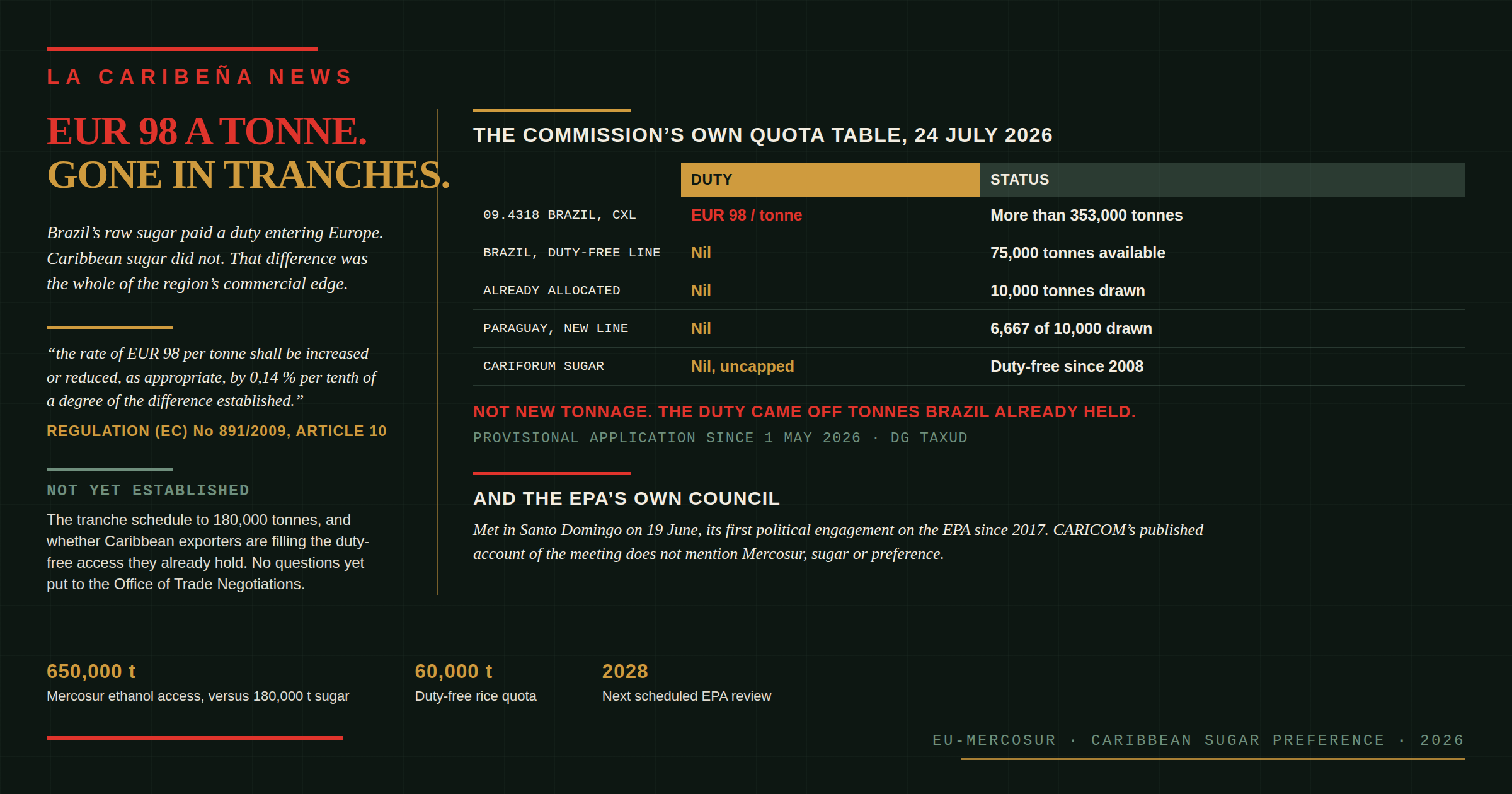
Brazil's raw sugar paid a duty entering Europe. Caribbean sugar did not. That difference was the whole of the region's commercial edge, and by 24 July the Commission had already allocated 10,000 tonnes of Brazilian sugar duty-free.
BY LCN NEWSROOM
Quick summary: The EU-Mercosur interim Trade Agreement entered provisional application on 1 May 2026. Brazil's raw cane sugar for refining previously carried a duty of EUR 98 per tonne under quota order number 09.4318. Caribbean sugar entered duty-free. By 24 July the European Commission had allocated 10,000 tonnes to Brazil at zero duty, closing that gap in tranches.
What the title card shows
Every data point on the article's title card, in text.
- EUR 98 per tonne. The in-quota duty on Brazil's CXL raw cane sugar for refining. Source: Commission Regulation (EC) No 891/2009, Article 10, consolidated text; confirmed on the European Commission DG AGRI sugar sector import quota table for marketing year 2025/26, data to 24 July 2026.
- 09.4318. The quota order number for Brazil, CN codes 1701 13 10 and 1701 14 10. Source: as above.
- Zero. What Caribbean sugar pays entering the EU. Source: CARIFORUM-EU Economic Partnership Agreement; corroborated by tralac and by peer-reviewed analysis of the EU sugar sector.
- 75,000 tonnes. Volume shown available under the Brazil duty-free line for the current marketing year. Source: Commission DG AGRI quota table, 24 July 2026.
- 10,000 tonnes. Already allocated under that line, at a 100 per cent allocation coefficient. Source: as above.
- 6,667 tonnes. Allocated under Paraguay's separate 10,000-tonne line. Source: as above.
- 1 May 2026. Provisional application of the interim Trade Agreement. Source: European Commission, Directorate-General for Taxation and Customs Union.
- 19 June 2026. Fifth Meeting of the Joint CARIFORUM-EU Council, Santo Domingo. Source: CARICOM Secretariat.
What did Brazil actually pay, and what changed?
A duty of EUR 98 a tonne, and it is coming off.
Brazil's raw cane sugar for refining enters the European Union under a World Trade Organization quota, order number 09.4318, covering CN codes 1701 13 10 and 1701 14 10. The duty on it is set in European law. Commission Regulation (EC) No 891/2009, at Article 10, provides that for CXL concession sugar under that order number and its neighbours, where the polarimetric reading departs from 96 degrees, "the rate of EUR 98 per tonne shall be increased or reduced, as appropriate, by 0,14 % per tenth of a degree of the difference established."
That is not a round political figure. It is an engineered duty that moves with the sugar's purity. Regulation 891/2009 has since been superseded by Commission Implementing Regulation (EU) 2020/761, and the rate carried across: the Commission's own current quota table prints 98/t against Brazil's line and against no other CXL line on the page.
The EU-Mercosur interim Trade Agreement entered provisional application on 1 May 2026, following signature on 17 January. What it does to sugar is remove that duty from part of the volume Brazil already held.
Is this new tonnage or a tariff cut?
A tariff cut, and the Commission's own table proves it.
This is the distinction most of the coverage has missed, and it matters because getting it wrong makes the story sound smaller than it is. The Commission has stated plainly that no new sugar quota was created for Brazil. Read alone, that sounds like nothing happened.
The quota table for the current marketing year shows what actually happened. Two Brazil lines sit adjacent. The dutiable CXL line at 98 euros a tonne shows a headline quantity and a smaller available quantity, and the difference between them is 75,000 tonnes. That is precisely the volume shown as available under a separate Brazil line carrying no duty at all.
Seventy-five thousand tonnes has been lifted out of the dutiable quota and reopened without duty. The tonnage did not grow. The duty came off part of it, in a tranche, against an endpoint the Commission's agriculture factsheet puts at 180,000 tonnes of raw cane sugar for refining. Paraguay holds a separate new duty-free line of 10,000 tonnes.
The quota Brazil holds under that dutiable line runs to more than 353,000 tonnes. Published figures for its exact size differ between the Commission's table and independent trade analysis, most likely because the quantity was amended after the United Kingdom's withdrawal and again in 2023, so this article uses the floor both sources support. The discrepancy does not touch the duty, and the duty is the story.
Why does a duty on Brazilian sugar matter to the Caribbean?
Because Caribbean sugar was never paying it.
Sugar from the fourteen CARIFORUM states covered by the Economic Partnership Agreement, in force since October 2008, enters the European Union duty-free. Trade research centre tralac records that the EU takes roughly 60 per cent of its cane sugar demand from African, Caribbean and Pacific countries under duty-free, quota-free access. Peer-reviewed analysis of the EU sugar sector records the same position, that sugar could be imported duty-free under the EPA and EBA arrangements while CXL sugar carried the reduced rate of EUR 98 a tonne.
So the region's advantage in that market was never a subsidy, a quota or a guarantee. It was the 98 euros a tonne that its competitor paid and it did not.
That gap is now closing in tranches, and the removal is not prospective. The Commission's table shows 10,000 tonnes already allocated under Brazil's duty-free line by 24 July, at a full allocation coefficient, with 65,000 tonnes of balance remaining for the year. Paraguay had drawn 6,667 tonnes of its 10,000. This is not a question of what an agreement will do. It is a record of sugar that has already moved.
The Caribbean's commercial edge in European sugar was one number. That number was 98 euros a tonne, it belonged to somebody else's tariff line, and it is being taken away in instalments.
Does the Caribbean keep any advantage at all?
Yes, above the cap, and only if it can ship.
Caribbean access is duty-free and unlimited. Mercosur's zero rate is capped, at 75,000 tonnes available this year against a 180,000-tonne endpoint, with the dutiable rate still applying beyond it. On volume above the cap the Caribbean advantage survives intact.
Whether that is worth anything depends on a question this publication cannot yet answer: how much sugar the region actually ships. Peer-reviewed analysis of the EU sugar market notes that quantitative limits on these quotas "were not fully utilized." A producer that is not filling the duty-free, unlimited access it already holds is constrained by supply, not by tariffs, and for that producer the Mercosur change is close to irrelevant.
There is also a third party in the frame. Ukrainian sugar became duty-free and unlimited into the EU from June 2022. Pressure on the ACP position did not begin with Mercosur.
What does this do to Guyana specifically?
Less through sugar than through rice and alcohol.
Guyana's own Ministry of Finance Mid-Year Report 2025 records sugar prices averaging US$0.4 per kilogramme in the first half of 2025, down 13.1 per cent, and attributes the decline "largely to increased output in Brazil" alongside India easing export restrictions. Georgetown's own document already names Brazilian supply as the thing moving its sugar price, before any tariff came off. Rice prices fell 30.5 per cent over the same period, averaging US$434.2 a tonne.
The larger exposure sits in commodities the earlier coverage treated as footnotes. The Commission's factsheet for European farmers sets out a duty-free rice quota of 60,000 tonnes, into a market where the EU's rice self-sufficiency was under 50 per cent in 2023-24. Ethanol runs far larger: 450,000 tonnes duty-free for chemical use and a further 200,000 tonnes at one third of the in-quota rate for all other uses, including fuel, both phased over five years. Honey adds 45,000 tonnes.
Set against 180,000 tonnes of sugar, ethanol access of 650,000 tonnes is the bigger number by a distance. For a country whose European trade runs through rice and bulk alcohol rather than refined sugar, those are the lines to watch.
Did the EPA's own institutions respond?
Not in any account they have published.
The Joint CARIFORUM-EU Council is the highest body of the Economic Partnership Agreement. It met for the fifth time in Santo Domingo on 19 June 2026, seven weeks after the Mercosur interim agreement entered provisional application. According to the CARICOM Secretariat's account, the meeting was the first dedicated political engagement between CARIFORUM and the EU on the EPA since 2017.
The Council reviewed implementation, examined whether the agreement's objectives were being met, and agreed priority actions. It set the next EPA review for 2028. The readout lists what was discussed: supply constraints, limited institutional capacity, and EU regulatory measures affecting market access.
Mercosur does not appear. Neither does sugar, rice, nor preference.
The meeting was chaired by the CARIFORUM High Representative, Eduardo Sanz Lovatón, the Dominican Republic's Minister of Industry, Trade and MSMEs, with the EU side led by Trade Commissioner Maroš Šefčovič.
La Caribeña News was unable to retrieve the communiqué itself, which sits behind an access control on the Council's servers. What is reported here is the absence of any reference in CARICOM's own published account of the meeting, which is not the same as establishing that the communiqué is silent. The Secretariat can settle that by pointing to a paragraph.
What is still unestablished?
Three things, and they are the reporting this story still needs.
The tranche schedule. Seventy-five thousand tonnes came off in the current year against a 180,000-tonne endpoint, so the rest is still arriving, and the phase-in profile is not something this publication has established.
The regional volume. Whether Caribbean raw sugar into the EU is material today, or whether the EPA entitlement is largely unfilled, decides whether this is a live commercial injury or a paper one. That is one data request to the CARICOM Office of Trade Negotiations.
And the response. La Caribeña News has put no questions to the Office of Trade Negotiations, the Ministry of Agriculture or the Guyana Sugar Corporation on any of this. That is the difference between analysis and reporting, and it is the next step rather than a caveat.
Frequently Asked Questions
What was the duty gap between Brazilian and Caribbean sugar?
EUR 98 per tonne. Brazil's raw cane sugar for refining paid that rate under quota order number 09.4318, set in EU law and adjusted by 0.14 per cent for every tenth of a degree the sugar's polarimetric reading departs from 96. Sugar from the fourteen CARIFORUM states covered by the Economic Partnership Agreement paid nothing, with access not capped by quota.
Did Mercosur get more sugar tonnage?
No. The agreement removes the duty from volume Brazil already held, phased in tranches toward 180,000 tonnes, with a separate new 10,000-tonne duty-free line for Paraguay.
Has any of it actually moved?
Yes. The European Commission's quota table shows 10,000 tonnes allocated duty-free to Brazil by 24 July 2026, with 65,000 tonnes of balance remaining, and 6,667 tonnes drawn under Paraguay's line.
Is sugar the biggest exposure for Guyana?
Probably not. Ethanol access totals 650,000 tonnes across two quotas and rice adds 60,000 tonnes duty-free, against 180,000 tonnes for sugar.
Has CARIFORUM responded?
The Joint CARIFORUM-EU Council met on 19 June 2026, its first dedicated political engagement on the EPA since 2017. CARICOM's published account of the meeting makes no reference to Mercosur, sugar or preference, and sets the next EPA review for 2028.