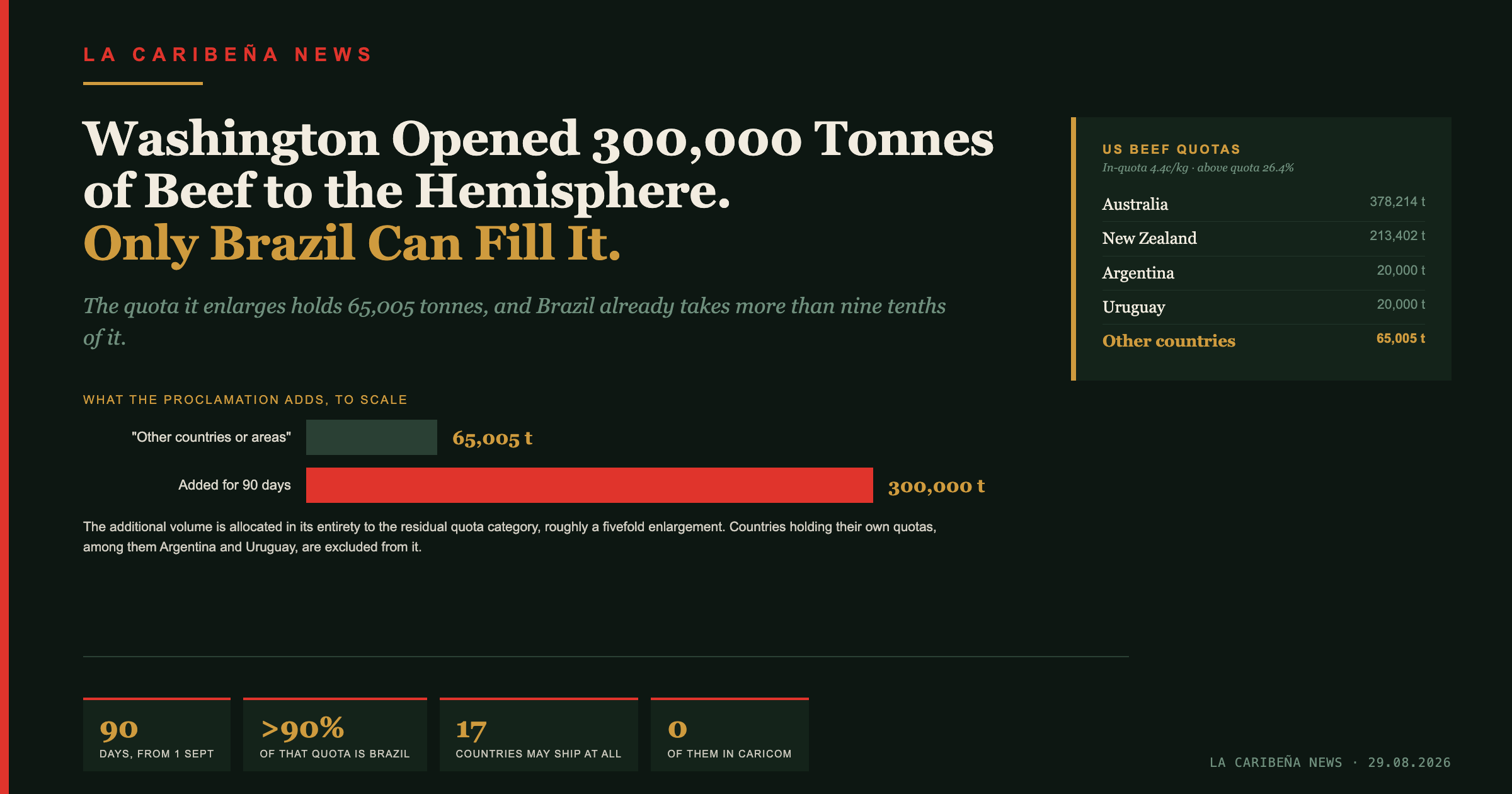
Quick summary: President Donald Trump signed a proclamation on 26 August 2026 adding 300,000 tonnes of lean beef trimmings to a United States quota, for 90 days from 1 September. The volume goes to a category holding 65,005 tonnes, in which Brazil already takes more than nine tenths.
By La Caribeña News · 29 August 2026
The United States has been short of the lean beef it grinds into hamburger for two years. Its cattle herd is the smallest in seventy-five years. Ground beef costs nine per cent more than it did a year ago, and a mid-term election falls on 2 November.
On 26 August, President Donald Trump signed a proclamation that adds 300,000 tonnes of lean beef trimmings to an American import quota for ninety days.
The quota it enlarges holds 65,005 tonnes.
What did Washington actually do?
It widened a tariff-rate quota, temporarily, using a power Congress gave the president in 1994.
Proclamation 11059, Further Ensuring Affordable Beef for the American Consumer, invokes section 404 of the Uruguay Round Agreements Act, which permits a president to expand a tariff-rate quota for a limited period. It was signed on 26 August and published in the Federal Register of 31 August at 91 FR 55989.
The additional 300,000 tonnes is released first come, first served in three tranches of 100,000: 1 to 30 September, 1 to 30 October, and from 31 October until the quantity is filled or 30 November arrives, whichever comes first. It covers lean beef trimmings only, under four statistical codes of the United States tariff schedule. Whole muscle cuts are excluded.
American beef enters under quotas that carry two rates. Inside the quota the duty is 4.4 cents a kilogram. Outside it, the duty is 26.4 per cent. The proclamation does not make the beef free. It moves 300,000 tonnes from the higher band to the lower one.
The discount that has been widely reported as a condition is neither a requirement nor a request. The proclamation directs the Secretary of Agriculture and the Trade Representative to monitor whether the beef entering under the enlarged quota is being sold at a price twenty-five per cent below the market price for lean beef trimmings. If they find it is not, they are to notify the president "immediately", so that he "may determine whether to eliminate what remains of the increased in-quota quantity".
The volume can therefore be withdrawn part-way through.
Why can only Brazil use it?
Because of which quota was enlarged.
The United States operates separate quotas for Australia, New Zealand, Argentina and Uruguay, and a residual quota for everyone else. That residual quota, which the tariff schedule calls "other countries or areas", holds 65,005 tonnes. Entry to it requires three things at once: approval to export fresh and frozen beef to the United States, no country-specific quota, and no free trade agreement with Washington.
Very few countries meet all three. According to the United States Department of Agriculture, the qualifying group is Brazil, Ireland, Japan, Namibia, France and the Netherlands, with the United Kingdom having since taken a 13,000-tonne allocation of its own.
Brazil occupies more than ninety per cent of it.
The proclamation allocates the additional 300,000 tonnes, in its own words, "in its entirety to 'other countries or areas.'" It is a roughly fivefold enlargement of a quota one country already dominates.
Brazil is also the only country that needs it. It exhausted its share of the residual quota in the middle of January and has paid the 26.4 per cent rate on every tonne since.
Which Caribbean countries can ship beef to the United States?
None.
The Department of Agriculture lists seventeen countries eligible to export fresh and frozen beef to the United States: Argentina, Australia, Brazil, Canada, Chile, Costa Rica, the Dominican Republic, France, Ireland, Japan, Mexico, Namibia, the Netherlands, New Zealand, Nicaragua, the United Kingdom and Uruguay.
No member of the Caribbean Community appears on it. Eligibility requires clearance from the Animal and Plant Health Inspection Service on animal disease status, and certification by the Food Safety Inspection Service that the exporting country's food safety system is equivalent to the American one. No CARICOM state currently holds both.
For the Caribbean Community the quota question therefore does not arise. A ninety-day opening in the largest beef market in the world is not available to any of its members on any terms.
What about the rest of Latin America?
Five of the region's exporters are already on better terms than the new quota offers.
Mexico and Chile ship duty-free under their free trade agreements. Costa Rica, Nicaragua and the Dominican Republic ship duty-free under the Dominican Republic-Central America Free Trade Agreement, which removed beef duties for its members in 2021. Costa Rica and Nicaragua are the two CAFTA-DR countries that actively export.
Duty-free is better than 4.4 cents a kilogram. None of them is shut out of anything. Colombia and Panama hold the same duty-free access but are not currently eligible to export.
That leaves eight Latin American and Caribbean exporters with access to the American market, of whom exactly one gains from the proclamation.
Why is Argentina excluded?
Because of something it won in February.
The additional volume is allocated to the "other countries or areas" category, which by definition excludes any country holding a quota of its own. That takes out Argentina and Uruguay, along with Australia, New Zealand and the United Kingdom, and Canada and Mexico under their free trade agreement.
Argentina's own quota was enlarged six months ago. Proclamation 11010, Ensuring Affordable Beef for the American Consumer, signed on 6 February 2026, increased the in-quota amount for lean beef trimmings from Argentina by 80,000 tonnes for calendar 2026 and allocated that increase, in its own words, "in its entirety to Argentina". Added to the 20,000 tonnes Argentina holds under the World Trade Organisation, that is 100,000 tonnes for the year.
The February volume is not a single pool. It is released in four quarterly tranches of 20,000 tonnes each: 13 February to 31 March, 1 April to 30 June, 1 July to 30 September, and 1 October to 31 December.
Argentina shipped 67,118 tonnes to the United States between January and July, against 22,183 tonnes in the same period of 2025. By the end of July, three tranches and its treaty quota had made 80,000 tonnes available. That leaves roughly 12,882 tonnes, inside a tranche that closes on 30 September. The next opens on 1 October.
Mario Ravettino, president of Argentina's ABC Export Consortium, confirmed the exclusion and said the only beneficiary would be Brazil. "We are analysing it," he told La Nación.
Is Brazil being punished or protected?
Both, by the same government, five weeks apart.
On 20 July the Office of the United States Trade Representative published a notice imposing a twenty-five per cent tariff on all imports from Brazil under section 301 of the Trade Act of 1974, effective 22 July. The investigation covers Brazil's conduct on digital trade and electronic payments, preferential tariffs, anti-corruption enforcement, intellectual property, ethanol market access and illegal deforestation.
Beef is exempt. Every subheading of the American tariff schedule covering beef, thirty-four in all, sits in the notice's exemption annex.
Commenters asked the Trade Representative to remove that exemption. The notice records their argument: that beef "and certain wood and wood products are linked to certain acts, policies, and practices found actionable in this investigation, and that exempting these products would fail to hold Brazil accountable".
The Trade Representative kept the exemption, and gave a reason.
"There remains limited availability of these products outside of Brazil."
Four days later, on 24 July, the same office finalised its separate forced-labour tariffs at rates of 10 to 12.5 per cent, the regime Guyana entered at 12.5 per cent while most of CARICOM stayed outside it. The law firm Alston & Bird noted that Brazilian goods caught by both actions could face 37.5 per cent in total. Beef is caught by neither.
What else is Brazil doing with its beef?
Filling a quota on the other side of the world.
Brazil is close to exhausting its 2026 Chinese beef quota, a process this newspaper reported in April as it began to tighten supply for Caribbean food importers. The American window opens as the Chinese one closes.
Caribbean importers buy Brazilian beef on the same world market that Washington has just enlarged its call on by 300,000 tonnes.
What are American producers saying?
That it will not work, and that it costs them.
The additional volume is roughly two per cent of American beef consumption. The White House says the action lifts supply by around ten per cent over current projections. The Nebraska Farm Bureau put the same figure against consumption and called it "too little to change the underlying supply and demand conditions: decades' low cattle inventory, lower beef production, and steady to strong consumer demand".
Senator Tim Sheehy of Montana said the action "will make it more difficult for American ranchers to rebuild our herd and bring prices down for the American people". Representative Thomas Massie of Kentucky called it "a slap in the face to American cattlemen and consumers".
The United States Department of Agriculture forecasts American beef output falling around four per cent this year from already low 2025 levels. Imports ran to 3.3 billion pounds through July, up twelve per cent, and are projected at 6.1 billion pounds for the year, about twenty-one per cent of American consumption.
Text equivalent of the title card
Every data point shown on the title image, with its source.
- Additional quota: 300,000 tonnes, lean beef trimmings, in three tranches of 100,000 running 1 to 30 September, 1 to 30 October, and 31 October to 30 November 2026. Source: Proclamation 11059, Further Ensuring Affordable Beef for the American Consumer, signed 26 August 2026, 91 FR 55989.
- The quota it enlarges holds 65,005 tonnes. Source: United States Department of Agriculture, Reviewing the Tariff-Rate Quotas for U.S. Beef Imports.
- In-quota duty 4.4 cents per kilogram; above-quota duty 26.4 per cent. Source: as above.
- Brazil holds more than 90 per cent of the "other countries or areas" quota. Source: as above.
- Seventeen countries are eligible to export fresh and frozen beef to the United States. No CARICOM member is among them. Source: as above.
- Argentina: 20,000 tonnes treaty quota plus 80,000 tonnes allocated in February, in four quarterly tranches. Source: Proclamation 11010, 6 February 2026, 91 FR 7107.
- Argentina shipped 67,118 tonnes January to July 2026, against 22,183 in 2025.
- Brazilian beef is exempt from the 25 per cent Section 301 tariff of 22 July 2026. Source: 91 FR 45516.
The quotas at a glance
| Quota | Volume | In-quota duty | Above-quota duty |
|---|---|---|---|
| Australia | 378,214 t | 0% | 21.1% |
| New Zealand | 213,402 t | 4.4 c/kg | 26.4% |
| Argentina (treaty) | 20,000 t | 4.4 c/kg | 26.4% |
| Uruguay | 20,000 t | 4.4 c/kg | 26.4% |
| "Other countries or areas" | 65,005 t | 4.4 c/kg | 26.4% |
| Added for 90 days from 1 Sept | 300,000 t | 4.4 c/kg | n/a |
Frequently Asked Questions
Is the additional beef duty-free?
No. The proclamation expands the quantity subject to the in-quota tariff rate, which is 4.4 cents a kilogram. It removes the 26.4 per cent above-quota duty on that volume rather than eliminating duty altogether.
Can any Caribbean Community country use the quota?
No. The United States Department of Agriculture lists seventeen countries eligible to export fresh and frozen beef to the United States, and no CARICOM member is among them. Eligibility requires both animal-health clearance and a food-safety equivalence determination.
Why is Argentina excluded when it is a major beef exporter?
The additional volume is assigned to the "other countries or areas" category, which excludes countries holding their own quotas. Argentina holds a 20,000-tonne treaty quota, enlarged by a further 80,000 tonnes for 2026 by a proclamation of 6 February, released in four quarterly tranches.
Does Brazil pay the 25 per cent Section 301 tariff on beef?
No. Beef is listed in the exemption annex to the notice published on 20 July 2026. The Trade Representative declined requests to remove the exemption, stating that limited availability of the products exists outside Brazil.
How long does the additional quota last?
Ninety days, in three tranches of 100,000 tonnes allocated first come, first served: 1 to 30 September, 1 to 30 October, and 31 October until the quantity is filled or 30 November, whichever is earlier. The proclamation allows the president to eliminate whatever remains of the volume if the beef is not being sold at twenty-five per cent below market price.