By La Caribeña News Desk • Georgetown, Guyana • May 21, 2026
SUMMARY
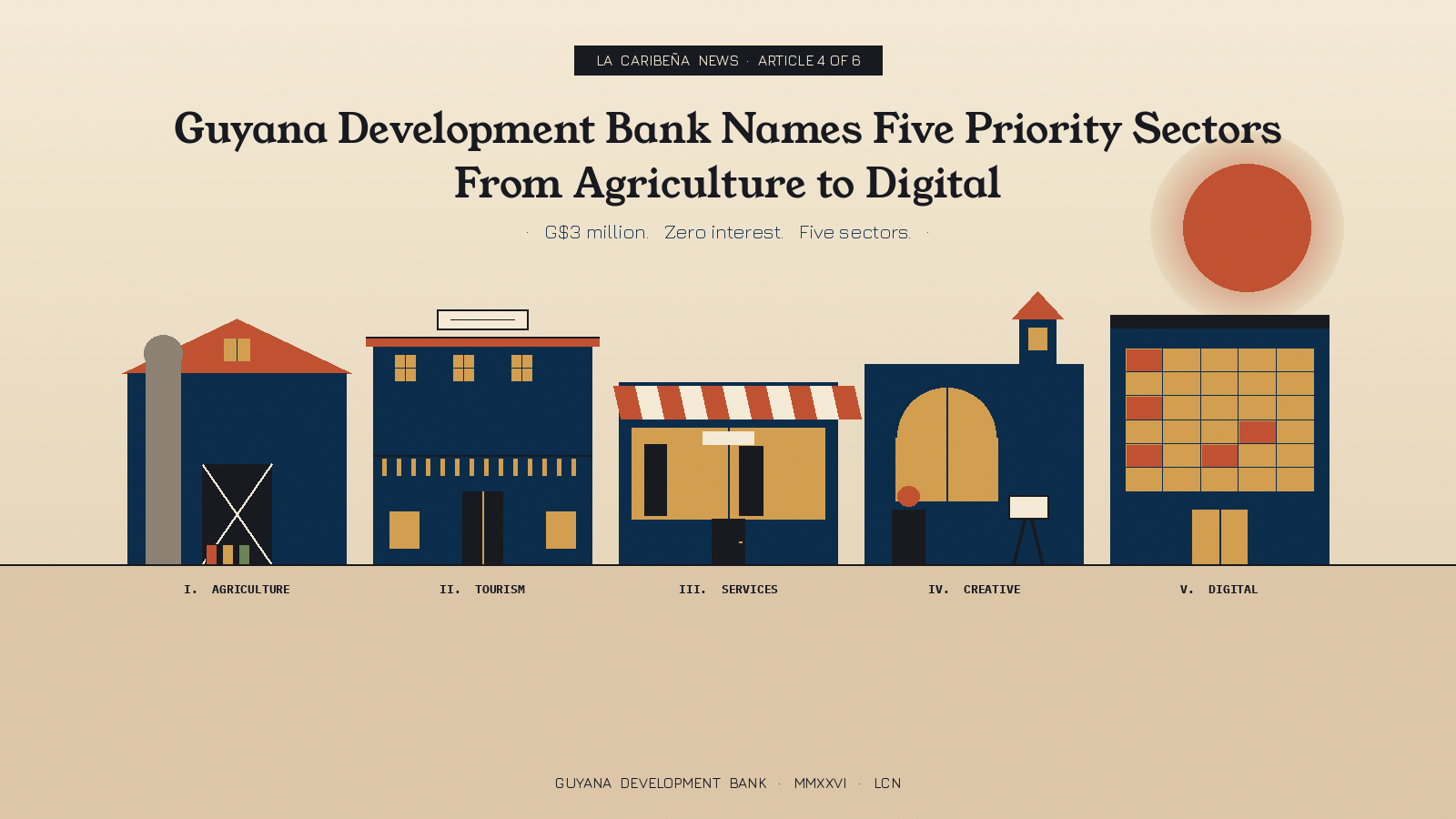
The new Guyana Development Bank names five priority sectors: agriculture and agro-processing, tourism and hospitality, services and trade, creative industries, and digital industries. Eligible borrowers can access G$3 million at zero interest with no collateral required, Minister Zulfikar Ally confirmed.
GEORGETOWN, Guyana. The new Guyana Development Bank will direct its lending and advisory focus to five priority sectors, Hon. Zulfikar Ally, Minister of Public Service, Government Efficiency and Implementation, told members of the Guyana Manufacturing & Services Association (GMSA) on Thursday. The sectoral framework, set out alongside the bank’s eligibility design, signals where the institution expects to concentrate capital, technical support, and capacity-building as it widens credit access for micro, small, and medium-sized enterprises (MSMEs).
The five priority sectors are:
- Agriculture and agro-processing
- Tourism and hospitality
- Services and trade
- Creative industries
- Digital industries
Each sector was selected with reference to Guyana’s emerging non-oil economy and to the kinds of businesses that have historically struggled to access affordable commercial credit. The selection is part of a broader framework the Minister set out for the bank, which positions the institution as open to entrepreneurs across every region and demographic, including women-led ventures, youth entrepreneurs, and differently abled individuals as named priority groups.
Agriculture and agro-processing
Agriculture is the first sector named. Credit to the sector grew G$1.3 billion in 2025 to reach G$32.8 billion, according to data the Minister cited in his address. The new bank’s primary focus extends to agro-processing operations: cottage food production, sauces, jams, preserves, and the small-scale manufacturing of agricultural inputs into export-ready goods.
For agro-processors specifically, the bank’s advisory layer is positioned to address the quality gap that Caribbean agro-processors face when scaling to export markets, including production standards, packaging, and certification that informal operators struggle to acquire without technical support.
Tourism and hospitality
The second priority sector reflects what the Minister identified as one of Guyana’s most underutilised economic opportunities. Eco-tourism operators, guesthouses in interior communities, restaurant operators, and transportation services all sit within the bank’s tourism focus. The Minister cited a hypothetical during his remarks: a small operator with an idea for five cottages on the Mahaica River, a proposal he said a commercial bank would routinely turn down but the development bank is designed to receive.
International travellers, he noted, increasingly pay premium rates to experience exactly the kind of riverine, interior, and rural settings that Guyana can supply at scale. The advisory package the bank will offer is meant to help operators in this category formalise pricing, marketing, and certification well before scaling.
Services and trade
Services lending expanded G$18 billion in 2025, reaching G$175.9 billion, the largest credit category in the country’s private-sector lending base. The bank’s services and trade priority covers professional services, logistics operations, retail trade, and the broad category of business-to-business support work. The category also reaches established woman-owned ventures in professional services, such as Georgetown’s executive concierge firm filling the city’s executive-support gap.
The sector’s growth rate, 11.4 percent in 2025, signals continued private-sector confidence and a widening base of small operators serving both domestic and oil-and-gas-adjacent demand.
Creative industries
Creative industries are the fourth priority sector. Music, film, fashion, design, craft production, and content production are all eligible. The selection acknowledges what Caribbean policy literature has long named as one of the region’s most underdeveloped export categories. Cultural production at scale requires capital that commercial banks have historically been reluctant to extend, given the unconventional revenue models of creative businesses.
The advisory package the bank will offer, including financial literacy training, mentorship, business development assistance, and technical guidance, is calibrated for first-time entrepreneurs and operators without conventional audited financials.
Digital industries
The fifth and final priority sector is digital industries: software, e-commerce, digital services, and technology-enabled businesses. Globally, this category has been the fastest-growing employer of young entrepreneurs over the last decade. In Guyana, the digital sector remains comparatively small but is positioned to absorb a meaningful share of the youth entrepreneurs the bank has named as a priority group.
A mobile-friendly application platform for the bank itself is in development, which the Minister cited as one of several digital-government initiatives shaping how citizens will interact with public services in the coming years.
What the 2025 lending data shows
Private-sector credit across the Guyanese economy grew 18 percent in 2025, reaching G$531.8 billion. The growth was not evenly distributed:
- Mining and quarrying: +30 percent / +G$1.7 billion
- Manufacturing: +29.7 percent / +G$12.9 billion
- Services: +11.4 percent / +G$18 billion
- Agriculture: +4 percent / +G$1.3 billion
The pattern reveals what the new bank is designed to address. Mining and manufacturing, both established sectors with large operators, attracted disproportionate commercial credit. Agriculture and the creative and digital industries received far less, despite their strategic importance to the non-oil economy. The bank’s priority designation is intended to rebalance that flow.
A wider strategy
The five-sector framework sits inside the government’s broader macroeconomic strategy, anchored by President Dr. Mohamed Irfaan Ali, to diversify the economy beyond oil revenue and to widen the base of formal entrepreneurship. By naming five priority sectors with explicit alignment to the bank’s priority groups and the recently confirmed eligibility of public servants with private business interests, the bank’s design treats sectoral diversification and demographic inclusion as a single integrated agenda.
A formal launch date has not been publicly announced. An application platform with a mobile-friendly interface for tracking submissions, mentorship sessions, and repayments is in development.
Related coverage
GMSA luncheon series
- Development Bank “For Every Guyanese,” Minister Ally Says, Not Just Georgetown — The bank’s national openness frame, Article 1 of the series
- Guyana Development Bank: Public Servants Eligible, With Conflict-of-Interest Rules — The eligibility reform for public servants and the conflict-of-interest framework, Article 2 of the series
- Women, Youth, and Differently Abled Entrepreneurs Named Priority Groups for Guyana Development Bank — The bank’s inclusion design, Article 3 of the series
Earlier LCN coverage on Caribbean enterprise and the non-oil economy
- The Quality Gap Caribbean Agro-Processors Cannot Afford to Ignore — Production standards, packaging, and certification as the next frontier for Caribbean agro-processing businesses
- Guyana Women Economic Rights at the OAS CIM Forum 2026 — The policy frame around financial access and economic participation
- Woman-Owned Concierge Firm Fills Georgetown’s Executive Support Gap — An example of scaled women-led services in Guyana