The region is negotiating to let more Colombian goods in. The terms sit in tariff schedules written in customs codes. If you make sauces, paint, blocks or bottled drinks, this decides what you compete against.
BY LCN NEWSROOM
Quick summary: CARICOM and Colombia held a third round of talks in Bridgetown from 4 to 6 November 2025 to expand preferential access for agricultural and industrial goods, with a final round scheduled for March 2026. The last independent assessment of the existing agreement, published by ECLAC in 2015, found the region's trade agreements had not improved CARICOM export performance.
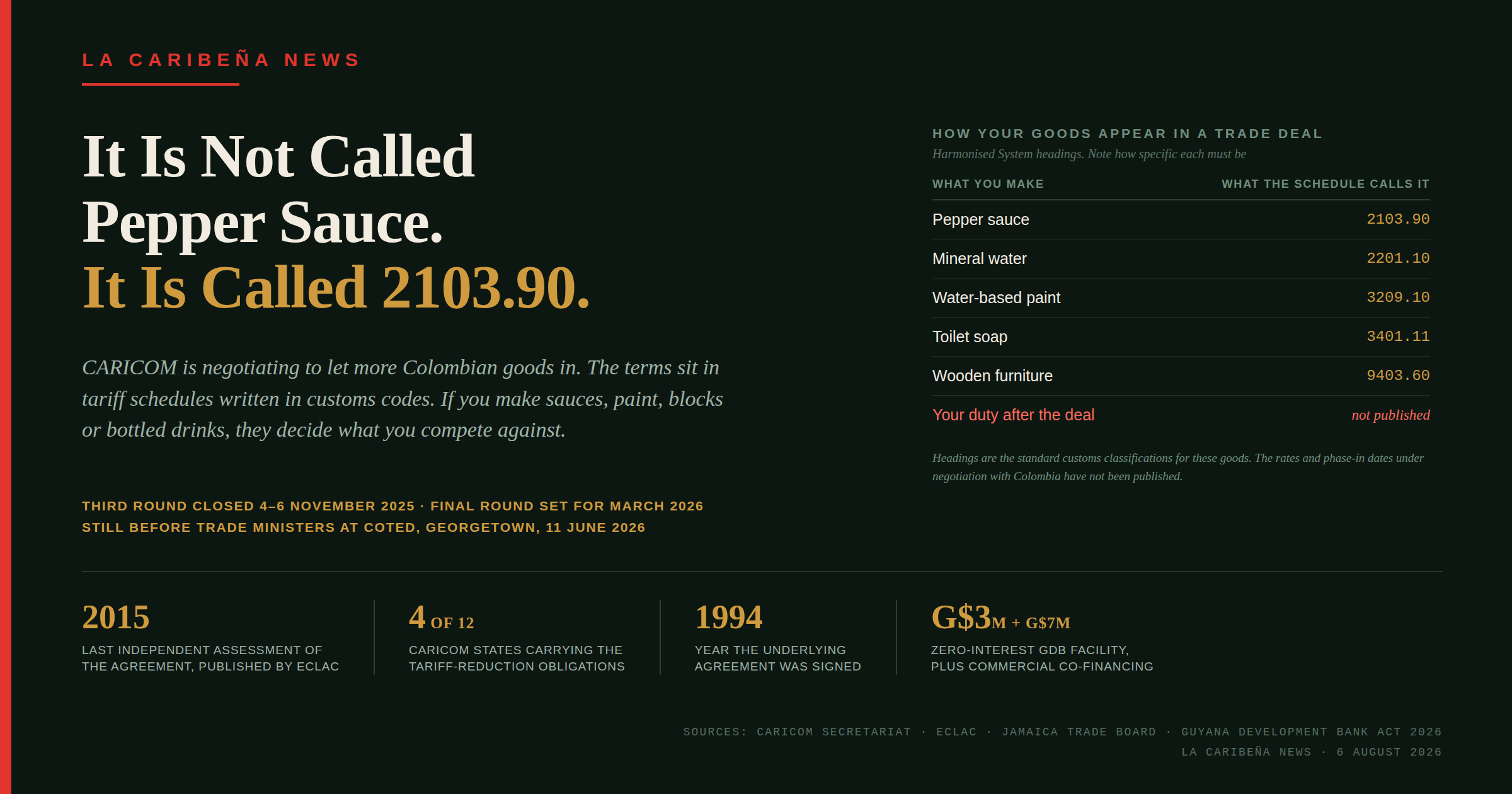
What the title card shows
Every data point on the article's title card, in text.
- 4 to 6 November 2025. Third round of CARICOM-Colombia negotiations, Bridgetown. Source: CARICOM Secretariat.
- March 2026. The final round the parties agreed to hold. Source: CARICOM Secretariat.
- 11 June 2026. CARICOM Secretary-General Dr Carla Barnett's remarks to the 62nd Regular COTED in Georgetown, where the Colombia agreement featured. Source: CARICOM Secretariat.
- 2015. Year of the last published independent assessment of the agreement's performance, by ECLAC. Source: ECLAC Subregional Headquarters for the Caribbean.
- Four of twelve. CARICOM states carrying the tariff-reduction obligations: Barbados, Guyana, Jamaica and Trinidad and Tobago. Source: Jamaica Trade Board.
- G$3 million and G$7 million. The Guyana Development Bank's zero-interest facility and the commercial co-financing on top of it. Source: Guyana Development Bank Act 2026, as reported by La Caribeña News.
- 1994. The year the underlying agreement was signed. Source: Jamaica Trade Board.
- The customs headings shown on the card. Pepper sauce 2103.90, mineral water 2201.10, water-based paint 3209.10, toilet soap 3401.11, wooden furniture 9403.60. These are the standard Harmonised System headings for those goods, listed to show the form a tariff schedule takes. The duty rates and phase-in dates under negotiation with Colombia have not been published, which is why the final row of the card reads "not published."
What is a tariff, and why does it decide whether you survive?
It is the tax that makes an imported product cost more than yours.
Say you make pepper sauce in Georgetown. A Colombian factory makes pepper sauce too, on bigger machines, buying bottles by the million instead of by the thousand. Their cost per bottle is lower than yours and always will be. Nothing you do about efficiency closes that gap, because the gap is scale.
What keeps their sauce off the shelf beside yours at a lower price is the tariff. When their bottle lands at the wharf, a duty is added. That duty is what makes their cheaper sauce arrive at a price close to yours. It is the reason your business exists in a market where somebody bigger can make the same thing.
CARICOM sets that duty jointly, through what is called the Common External Tariff. It is the wall around Caribbean manufacturing.
A trade agreement lowers that wall for one country's goods. That is what is being negotiated with Colombia now, and the word Colombia's own trade ministry uses for it is profundización, deepening. Deepening means the wall comes down further than it already has.
What exactly is being negotiated?
Access for agricultural and industrial goods, which is most of what small Guyanese factories make.
The CARICOM Secretariat's account of the second round in Bogotá says the negotiations covered expanded preferential market access "for agricultural and industrial products as well as institutional issues."
"Industrial products" does not mean heavy industry. In the Caribbean it means processed foods and sauces, drinks, cleaning products, soaps and cosmetics, paint, packaging, blocks and building materials, furniture. That is the MSME manufacturing base of this country almost exactly.
The third round concluded in Bridgetown from 4 to 6 November 2025, and the parties agreed to hold a final round in March 2026. The agreement was still live business at ministerial level in June, when CARICOM Secretary-General Dr Carla Barnett addressed the 62nd Regular Meeting of the Council for Trade and Economic Development in Georgetown.
This newspaper has examined the negotiation, the 1994 treaty text and its annexes in detail in a companion article, Colombia and CARICOM Are Finishing a Deal Manufacturers Cannot See. This piece is the shorter version, written for the person running the factory rather than the person reading the treaty.
Has anyone checked whether the last agreement worked?
Yes, once, eleven years ago, and the finding was not encouraging.
This is worth stating plainly, because it is the single most useful fact available to a manufacturer forming a view. The Economic Commission for Latin America and the Caribbean, a United Nations body, published an assessment in 2015. Jeetendra Khadan and Sheldon McLean examined the performance of CARICOM's extraregional trade agreements, including the partial scope agreement with Colombia, in the Studies and Perspectives series of ECLAC's Subregional Headquarters for the Caribbean.
Their conclusion was blunt. In spite of the various trade agreements negotiated, CARICOM export performance had not improved significantly. As of 2012 the region's goods exports were still dominated by the United States at 39.1 per cent and the European Union at 23.5 per cent.
So the honest position is not that nobody has looked. Somebody looked, and found that this class of agreement had not moved Caribbean exports. That assessment is now eleven years old, and the region is deepening the agreement anyway.
Where is the information, and can you actually read it?
This is the part that matters, and it is not really about secrecy.
Trade terms are recorded as tariff schedules. A schedule is a long table listing goods by a customs classification number, with a duty rate and a phase-in date beside each one. Your pepper sauce is not called pepper sauce in that table. It is a six or eight digit code.
So even when such tables are eventually published, they are unreadable to the person whose livelihood they govern. A manufacturer cannot look up "sauces" and see what happens. They would need to know their own tariff heading, find it among thousands of lines, read the phase-in column, and work out what a duty falling from one figure to another over several years does to a landed price against their own cost sheet.
Almost no small manufacturer in Guyana can do that, and there is no reason they should have to. That is not a failure of the business owner. It is a failure of translation, and it is the gap this article is about.
The terms may well exist in draft. What La Caribeña News searched for and did not find is a document that tells a Guyanese manufacturer, in ordinary words, which of their products are affected and by how much.
Your product is not called by its name in a tariff schedule. It is a number in a column. That is why an agreement can reach your business before you ever hear about it.
Whose job is it to explain this to you?
That question has three possible answers, and this newspaper could not find any of them claiming it.
The government. Guyana negotiates as one of the four More Developed Countries that carry the tariff-reduction obligations, alongside Barbados, Jamaica and Trinidad and Tobago, per Jamaica's Trade Board. A government that takes on an obligation on behalf of an industry has at least an arguable duty to tell that industry what it has taken on.
The business support organisations. The Guyana Manufacturing and Services Association, the Georgetown Chamber of Commerce and Industry, the Private Sector Commission and the Small Business Bureau all exist in part to carry technical information to members who cannot generate it themselves. Translating a tariff schedule into a members' briefing is squarely that job.
The business owner. There is a real argument that a manufacturer should know the trade rules governing their own product, the way they are expected to know their tax obligations.
The honest answer is probably all three, which is exactly how a duty ends up discharged by nobody in particular. What this publication can report is narrower: we looked for a plain-language explanation from each of them and did not find one. If any exists, we will publish it.
What does this have to do with your GDB loan?
You may be borrowing to expand into a market whose rules are being rewritten.
Guyana has just stood up a development bank aimed at small business. Under the Guyana Development Bank Act 2026, the headline facility is G$3 million at zero interest with no collateral, with commercial co-financing able to add up to G$7 million. This publication has reported that the co-financing power carries no amount, rate or obligation, and that commencement still awaits a ministerial Order. Its five named priority sectors include agriculture and agro-processing.
Agro-processing is precisely the category exposed to the Colombia negotiation. So a Guyanese owner could reasonably borrow to buy a filling line, expand a sauce or seasoning operation, and take on a repayment schedule running years, while the duty that protects the selling price of that product is being renegotiated.
That is not an argument against the loan. Access to capital at zero interest is a genuine opportunity and this publication has said so. It is an argument that the two conversations belong in the same room. A business plan built on today's landed cost of a competing import is a business plan built on a number that is under negotiation.
Anyone preparing a Guyana Development Bank application in agro-processing should be asking one question before they sign: is my product in a category on the table with Colombia? If the answer is yes, the margin in your projections is not a fixed number.
What can a business owner actually do this month?
Four things, none of which require a trade lawyer.
Find your tariff heading. The Guyana Revenue Authority classifies your product under a customs code for import duty purposes. Your customs broker or your own import paperwork will show it. Once you know that number you can ask a specific question instead of a general one.
Put the question in writing to your association. Ask the Guyana Manufacturing and Services Association or the Georgetown Chamber of Commerce and Industry directly whether your heading is in the schedules under negotiation with Colombia, and whether members were consulted before positions were tabled. A written question creates a record.
Ask the Ministry. The Ministry of Foreign Affairs and International Cooperation leads trade negotiations for Guyana. Which lines the country has offered, and which it has obtained, is a legitimate question from a citizen whose business is affected.
Build the risk into the loan. If you are preparing a GDB application in a category that could face cheaper competing imports, price that into your projections rather than assuming current margins hold. A lender is entitled to see that you have thought about it, and so are you.
These questions are published here so that the businesses affected can put them directly. La Caribeña News is not asking them on anyone's behalf, and an answer given to a manufacturer who asks in writing is worth more than an answer given to a newspaper.
Frequently Asked Questions
Is Guyana about to be flooded with Colombian goods tomorrow?
No. Tariff reductions in these agreements are normally phased over years, and the schedules under negotiation have not been published. The point is that decisions setting those years are being taken now.
Does this mean the Colombia agreement is a bad deal?
This article does not say that. It says the terms have not been put in front of the manufacturers who will live with them in a form they can read, and that the last independent assessment of the existing agreement, by ECLAC in 2015, found this class of agreement had not improved CARICOM export performance.
Has the existing agreement ever been assessed?
Yes. ECLAC published an assessment in 2015 by Jeetendra Khadan and Sheldon McLean, covering CARICOM's extraregional trade agreements including the Colombia partial scope agreement. It found export performance had not improved significantly, with the region's goods exports in 2012 still dominated by the United States and the European Union.
What is a tariff schedule?
A table listing goods by customs classification number, with the duty rate and the timetable for reducing it. It is the operative part of a trade agreement, and it is written for customs officials rather than for business owners.
Which products are most exposed?
Any locally made good that Colombia also produces at larger scale. In practice that means processed foods and sauces, drinks, cleaning and personal care products, paint, packaging and building materials.
Should I still apply to the Guyana Development Bank?
That is a decision for you and your accountant. This article's point is narrower: if your product could face cheaper imports under a new trade schedule, that belongs in your projections before you sign for the money.