July 6, 2026 | By La Caribeña News
Quick summary: The Caribbean Community (CARICOM) turned 53 on 4 July 2026, marking the 1973 Treaty of Chaguaramas. Its landmark recent win came on 1 October 2025, when four member states opened full free movement. Yet economic integration lags: intra-regional trade is only about 15% of the bloc's total, and Haiti remains largely shut out.
GEORGETOWN, GUYANA. Fifty-three years ago, on 4 July 1973, the leaders of Barbados, Guyana, Jamaica and Trinidad and Tobago signed the Treaty of Chaguaramas and turned a loose trade association into a community. This CARICOM Day, the Caribbean Community counts 15 member states, roughly 18 million people, and a record that deserves to be read honestly: real, hard-won achievements next to promises still unkept.
The temptation on a birthday is to pick one story and tell only that. The integration project has both, a genuine leap forward in the past year and a persistent failure at its economic core. A fair accounting holds them together.
What is CARICOM celebrating on its 53rd anniversary?
A community that outlasted the doubts of its own founding. CARICOM grew out of the collapse of the West Indies Federation, and few expected a group of small, newly independent states to hold a common project together for half a century. It has. The bloc has expanded from four founding members to 15, admitted its first French- and Creole-speaking member in Haiti in 2002, and built a shared institutional life that touches ordinary Caribbean lives more than the politics usually admits.
That life runs through institutions most citizens use without naming CARICOM. The University of the West Indies educates the region's professionals across three campuses. The Caribbean Examinations Council (CXC) sets the exams Caribbean students sit. The Caribbean Public Health Agency (CARPHA) coordinates the response to outbreaks, and the Caribbean Disaster Emergency Management Agency (CDEMA) mobilises the region when a hurricane flattens an island. As the CARICOM Secretariat argued at the bloc's 50th anniversary, functional cooperation, the quiet machinery of health, education and disaster response, is where integration has worked best.
Why is the 2025 free movement agreement historic?
Because it turned a decades-old promise into a lived right for the first time. On 1 October 2025, four member states, Barbados, Belize, Dominica, and St. Vincent and the Grenadines, switched on full free movement among themselves, according to the CARICOM Secretariat. A national of any of the four can now move to any of the others to live, work and stay indefinitely, with access to primary health care and to public schooling for their children.
What the title card shows
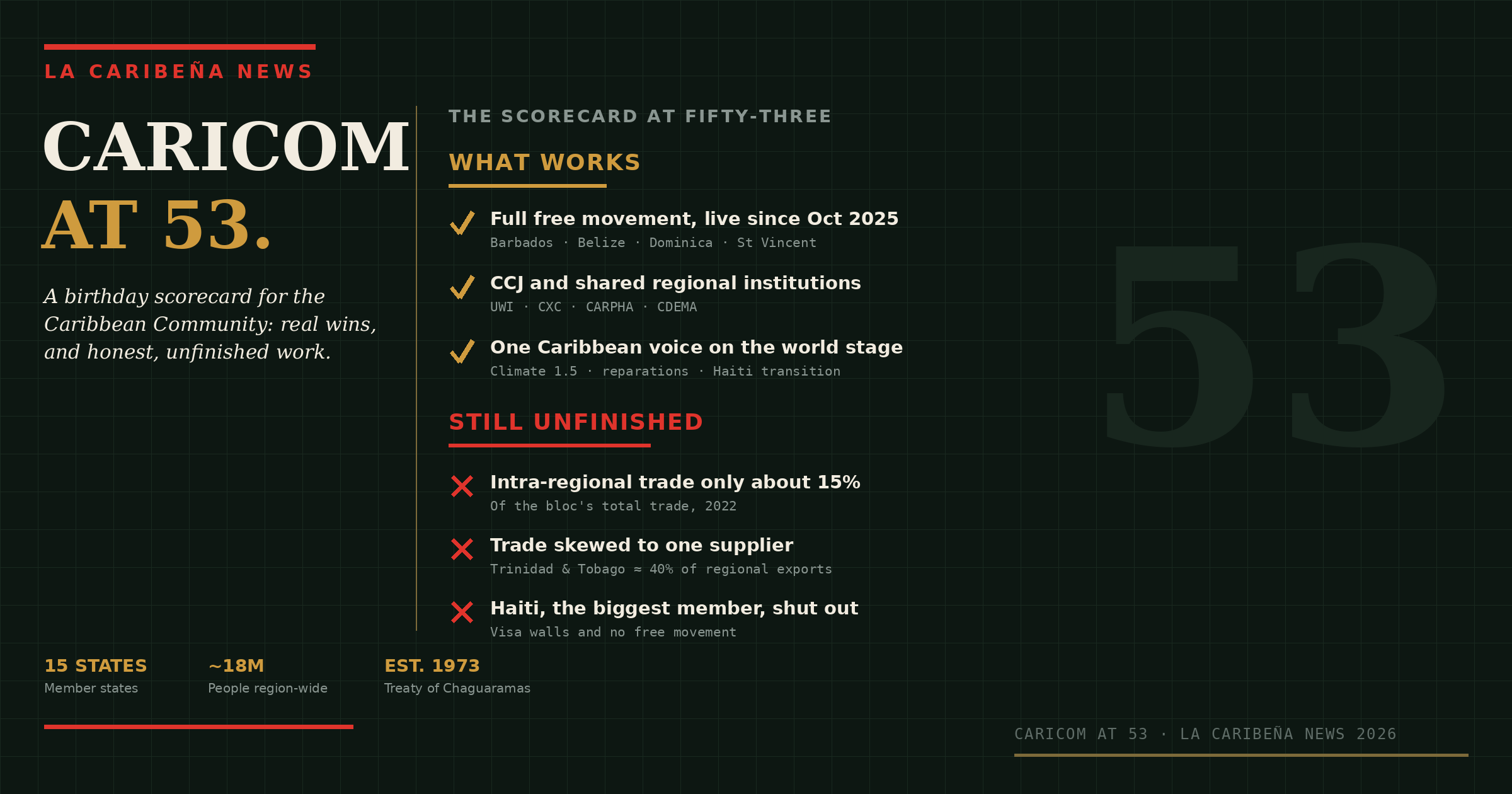
The title graphic accompanying this article summarises CARICOM at 53 across the measures cited in this piece. Founding: the Treaty of Chaguaramas was signed on 4 July 1973 by four states, Barbados, Guyana, Jamaica and Trinidad and Tobago (CARICOM Secretariat). Membership: 15 member states today, home to roughly 18 million people. Free movement: full free movement began on 1 October 2025 among four states, Barbados, Belize, Dominica, and St. Vincent and the Grenadines (CARICOM Secretariat). Trade: intra-regional trade was about US$2.8 billion in 2022, roughly 15% of the bloc's total, with Trinidad and Tobago supplying close to 40% of regional exports (ECLAC and regional trade data). The card frames these as a birthday scorecard: strong on shared institutions and a 2025 breakthrough, weak on the trade its single market was built to grow.
That is the closest the Caribbean has come to the way Europeans move inside the European Union, and it happened quietly, in our own lifetime. The rest of the region has committed to follow. It rests on a legal foundation the Community built for itself: the Caribbean Court of Justice (CCJ), whose 2013 ruling in the Shanique Myrie case established that every CARICOM national has a right of entry and an automatic six-month stay across member states. The right existed on paper for years. In 2025 it finally began to look like the real thing.
What has CARICOM achieved beyond free movement?
A single voice in rooms where small states are usually not heard. On climate, CARICOM helped put "1.5 to stay alive" into the global vocabulary and negotiates as a bloc at United Nations climate talks, punching above the weight of any one island. Through the CARICOM Reparations Commission and its Ten-Point Plan, the region built the most developed reparatory-justice case in the world. On Haiti's political transition, the Community has led the diplomatic effort where larger powers hesitated.
There is an economic scaffolding too, even where it is incomplete. The CARICOM Single Market and Economy (CSME), launched in 2006, created a common external tariff, a right of establishment, and the CARICOM Skills Certificate that lets approved workers take jobs across the region without a permit. Caribbean producers who use these tools sell as regional nationals rather than foreign importers, the difference between visiting a market and holding ground in it. La Caribeña News has documented that machinery in motion, from a Guyanese agro-processor taking Rupununi-sourced sauces to regional buyers to the CARICOM tariff decision Guyana forced back open in 2026.
Where does CARICOM still fall short?
The economic core it was built to fix. Economic integration remains CARICOM's weakest pillar, and the numbers show why. Intra-regional trade was only about US$2.8 billion in 2022, roughly 15% of the region's total trade, and it is skewed hard toward a single supplier: Trinidad and Tobago alone accounts for around 40% of regional exports, mostly petroleum and manufactured goods, per ECLAC and regional trade data. Most member states sell little to one another and run persistent deficits with the few that sell a lot.
The barriers are not only tariffs. Non-tariff obstacles, licensing frictions and disputes over the common external tariff still treat a neighbour's product as a stranger, as the region saw when a 35% regional tariff on paint was set to take effect before Guyana forced a rethink. And the free movement the bloc rightly celebrates is still partial. Only four of 15 states have switched it on, and the Community's largest member by population is largely locked out. As La Caribeña News reported this week, Haiti is a near-US$4-billion market that most of CARICOM sells into while keeping Haitians behind a visa wall. A community that means its motto cannot leave two of every nine of its people at the gate.
What comes next for the Caribbean Community?
Finishing what 2025 started. The near-term test is whether the other 11 member states join free movement on a real timetable rather than a rhetorical one, and whether Haiti is brought in rather than carved out. On the economic side, CARICOM's flagship goal is food security: the "25 by 2025" drive, championed by Guyana's President Dr. Mohamed Irfaan Ali, to cut the region's multibillion-dollar food import bill by producing more of what Caribbean people eat, at home, for each other.
The through line is the same one the founders drew in 1973. A cluster of small states can do together what none can do alone, if they actually use the machinery they built. CARICOM at 53 is neither the failure its critics claim nor the triumph its brochures suggest. It is a real community, unfinished, and still, on balance, worth the work. Happy CARICOM Day to you.
Frequently Asked Questions
How old is CARICOM, and when is CARICOM Day?
The Caribbean Community was established by the Treaty of Chaguaramas, signed on 4 July 1973, which makes 2026 its 53rd anniversary. CARICOM Day is observed as a public holiday in several member states, including Guyana, on the first Monday of July.
What is the CARICOM Single Market and Economy?
The CSME, launched in 2006, is the framework meant to create a single economic space across CARICOM. It provides for a common external tariff, the free movement of goods, services, capital and approved skilled workers, and the right to set up a business in another member state as a national rather than a foreigner.
What changed with CARICOM free movement in 2025?
On 1 October 2025, Barbados, Belize, Dominica, and St. Vincent and the Grenadines began full free movement among themselves, allowing each other's citizens to live, work and remain indefinitely with access to health care and public schooling. It was the first time the long-promised right was fully implemented, and the other member states have committed to follow.
How much do CARICOM countries trade with each other?
Not much, relative to their trade with the wider world. Intra-regional trade was about US$2.8 billion in 2022, roughly 15% of the bloc's total trade, and Trinidad and Tobago alone supplies close to 40% of regional exports. Deepening that trade is widely seen as CARICOM's central unfinished task.
Which countries use the Caribbean Court of Justice?
The CCJ, based in Port of Spain, holds original jurisdiction over CARICOM treaty matters for all member states. As its final appellate court, replacing the London-based Privy Council, it has so far been adopted by a smaller group, including Barbados, Belize, Dominica, Guyana and St. Lucia.