EXCLUSIVE
Guyana is negotiating tariff bands abroad and writing local content law at home. Both assume goods can move. On the Essequibo today, the vessel that moves them is 67 years old, water is running across its passenger deck, and it has not left.
BY LCN NEWSROOM · GEORGETOWN, GUYANA
Quick summary: La Caribeña News was informed of conditions aboard the MV Makouria at Bartica on 7 August 2026, where water ran across the passenger deck and the vessel remained alongside. The 67-year-old ferry was left out of Guyana's $440 million repair programme. Bartica has no connected road to Georgetown, yet, so that sailing is a well established scheduled trade route.
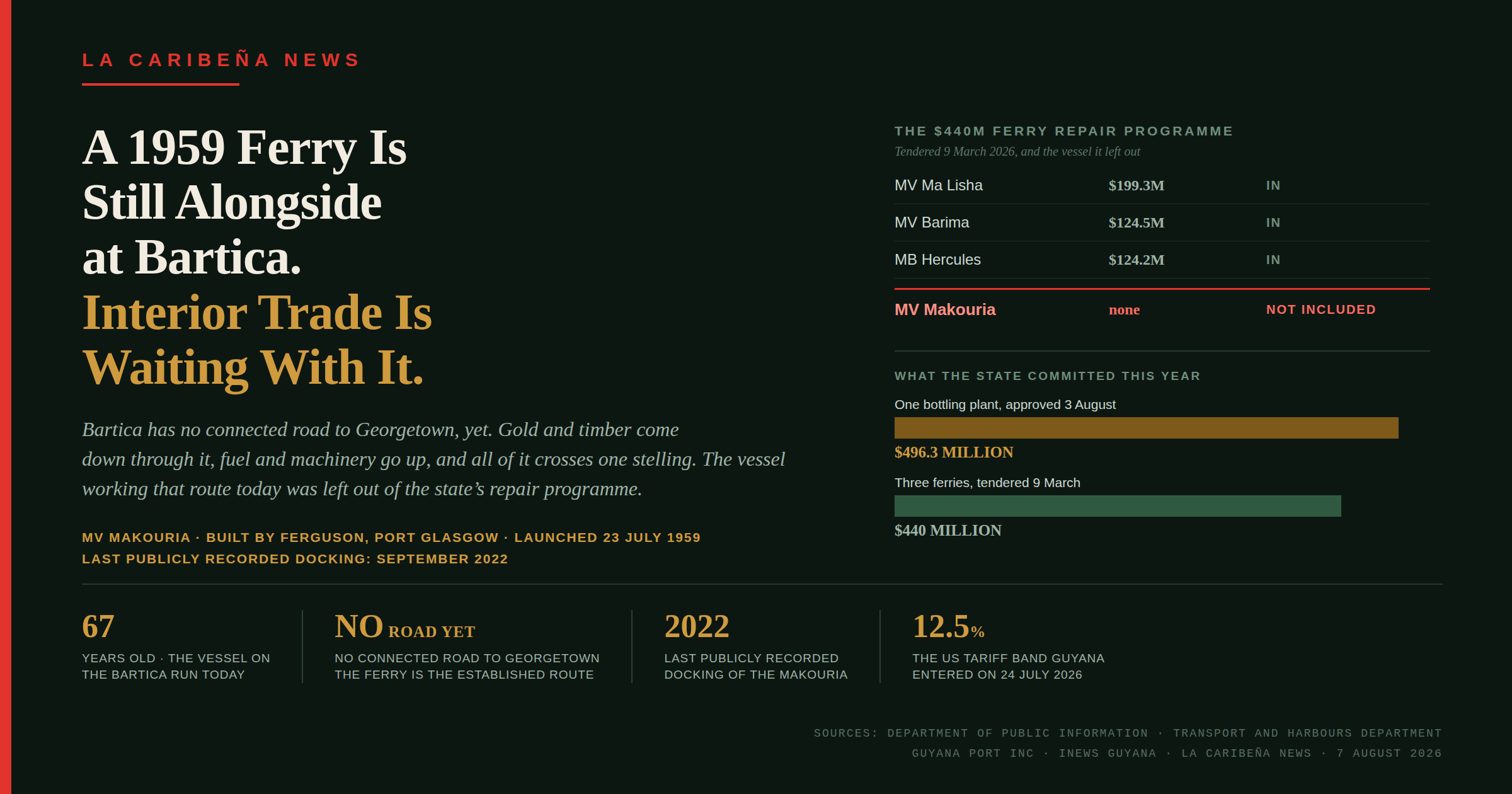
What the title card shows
Every data point on the article's title card, in text.
- 1959. The year the MV Makouria was built, by Ferguson at Port Glasgow, Scotland. It was launched on 23 July 1959 and is 67 years old. Sources: Ferguson yard records; contemporaneous accounts.
- Not in the programme. The MV Makouria does not appear among the three vessels in the state's $440 million ferry rehabilitation tender of 9 March 2026. Source: Department of Public Information, Guyana.
- 2022. The vessel's most recent publicly recorded docking, at Guyana Port Inc, from 25 August to 19 September. Source: Guyana Port Inc.
- $440 million. The value of the three-vessel ferry rehabilitation programme, tendered 9 March 2026. Source: Department of Public Information.
- $496.3 million. Approved by the National Assembly on 3 August 2026 for a Guyana Water Incorporated bottling facility. Source: INews Guyana, 7 August 2026.
- No connected road. Bartica has no connected road to Georgetown, yet. The ferry is a well established scheduled trade route. Source: Transport and Harbours Department route schedules.
- 12.5 per cent. The United States tariff band Guyana entered on 24 July 2026. Source: White House presidential memorandum, 23 July 2026.
What is happening aboard the MV Makouria at Bartica?
The vessel is alongside, and water is moving across the deck where passengers sit.
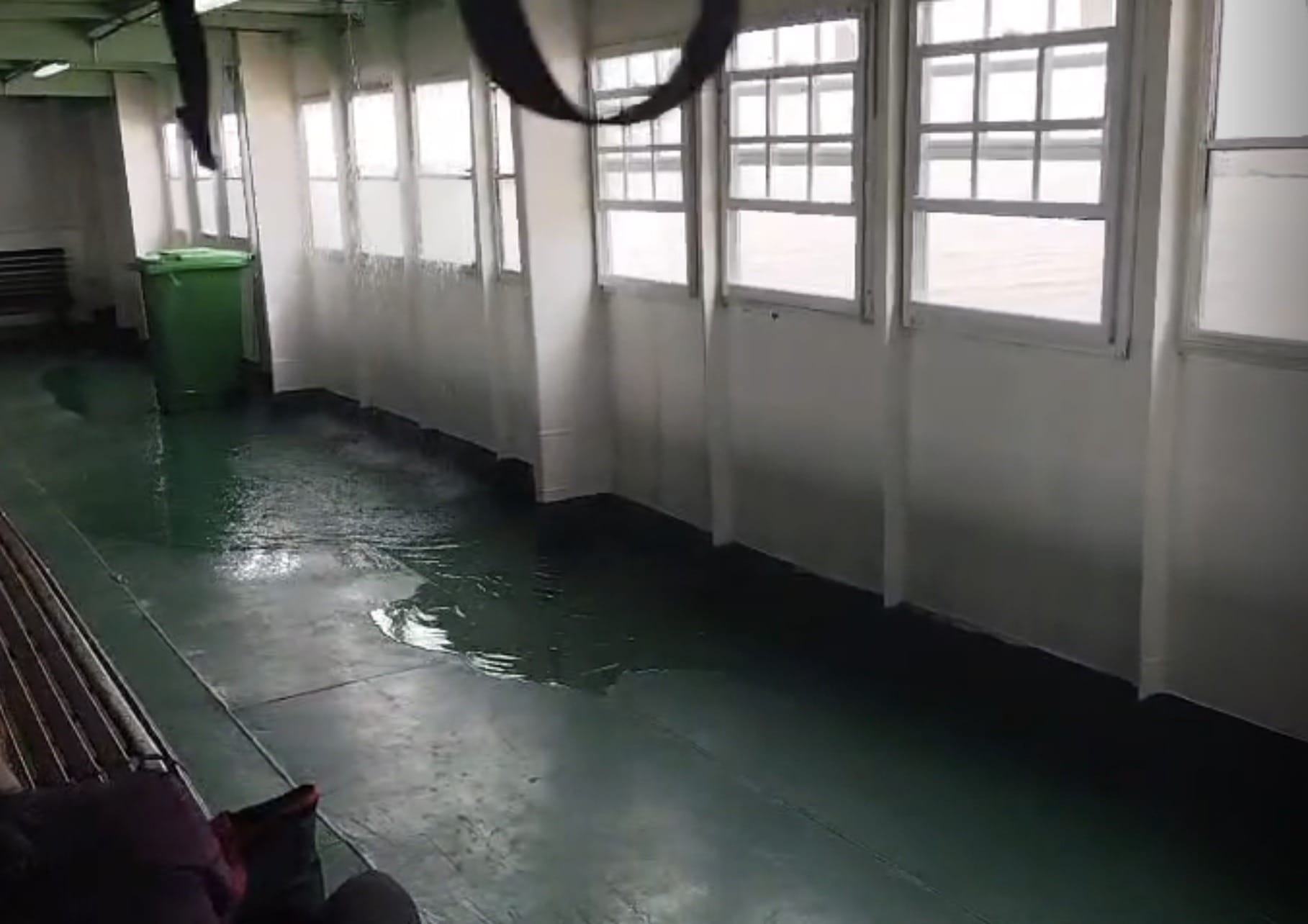
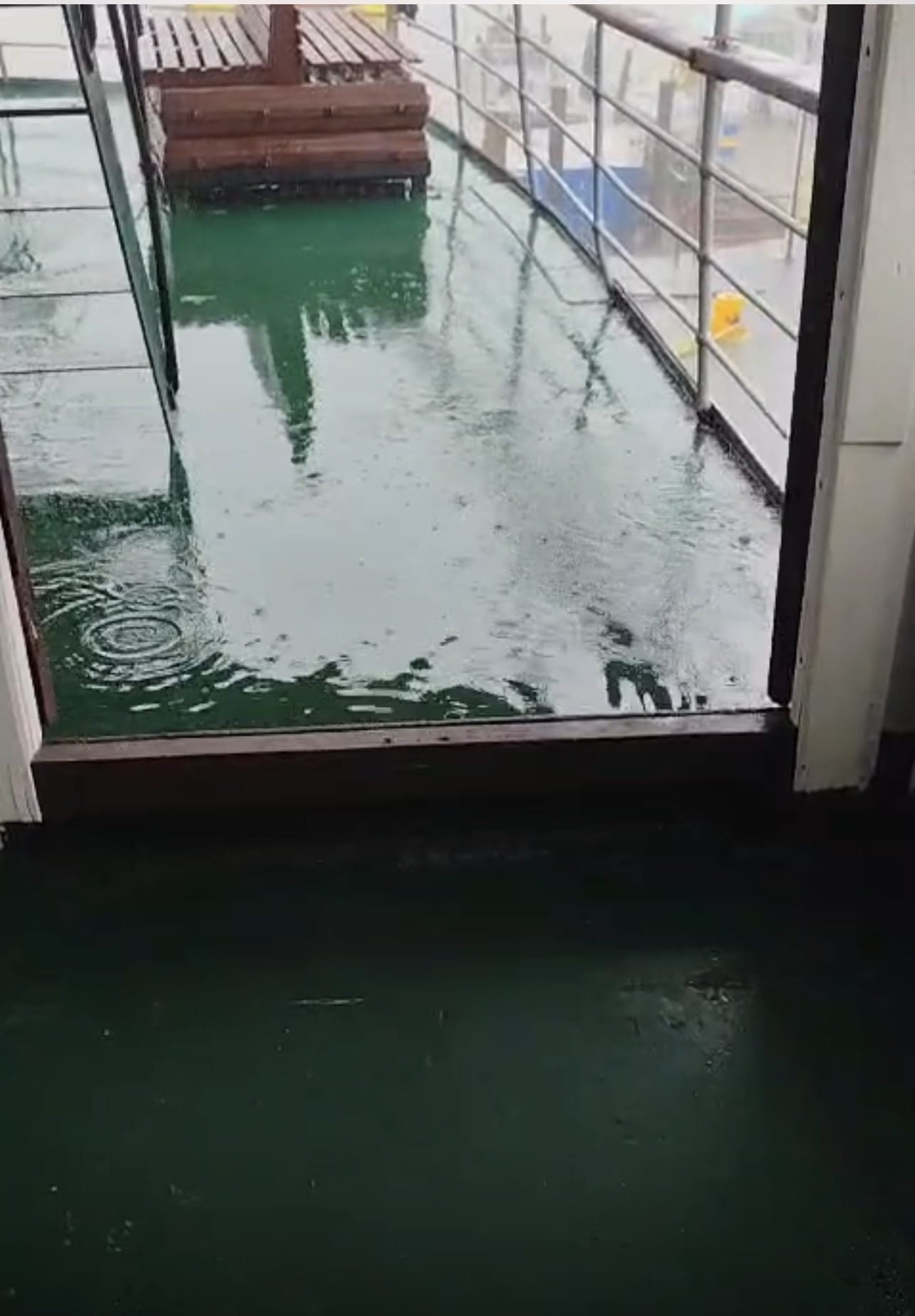
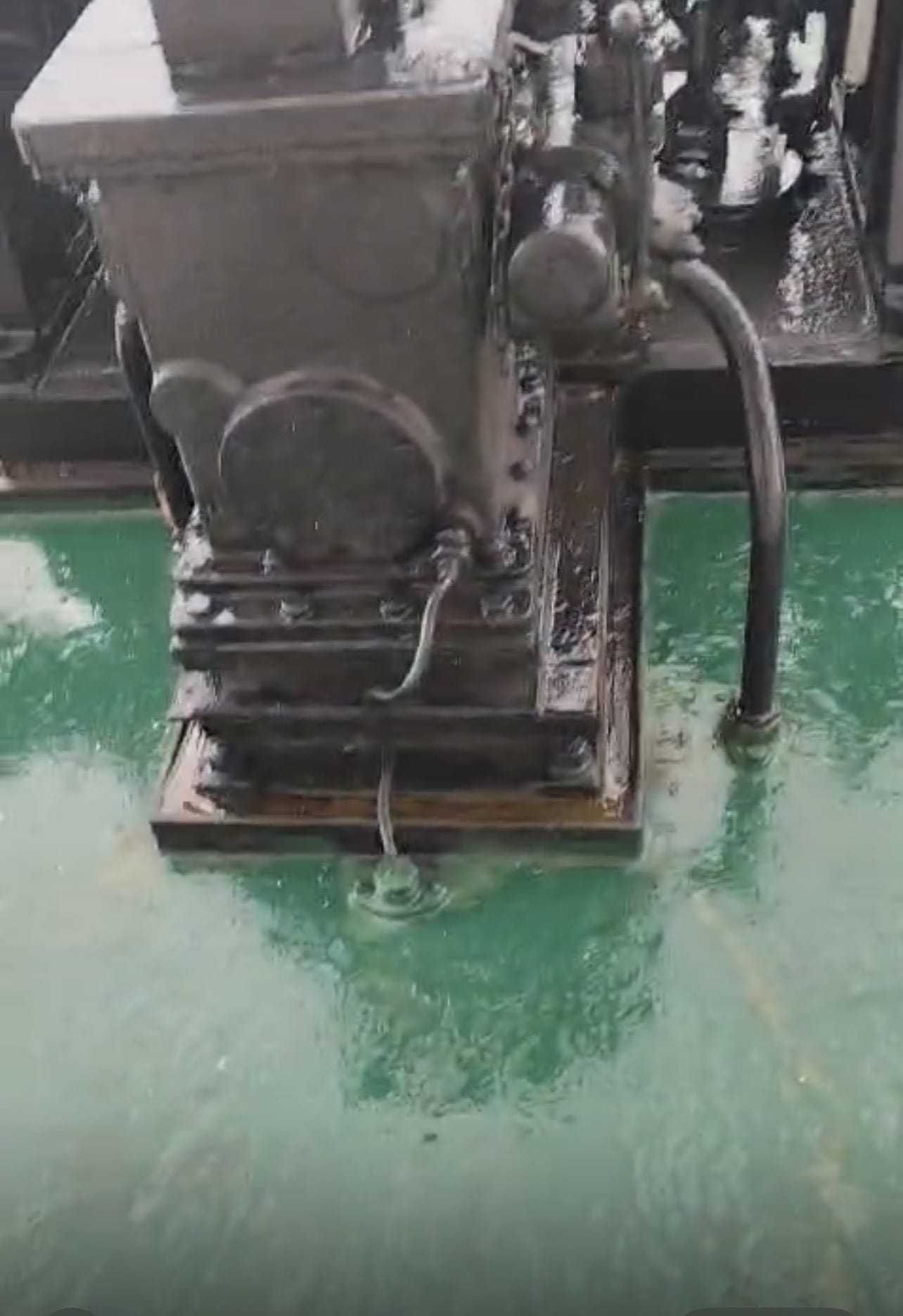
La Caribeña News was informed of conditions aboard the MV Makouria at Bartica on 7 August 2026 by a Citizen Reporter, who submitted images recorded during heavy rain. In the passenger saloon, water ran in a sheet across the deck and pooled along the line of the seating, with wet streaking down the bulkhead beneath the window line. On the open deck, rain stood in flats that did not clear. Deck machinery carried heavy corrosion at its mounting. The vessel remained alongside.
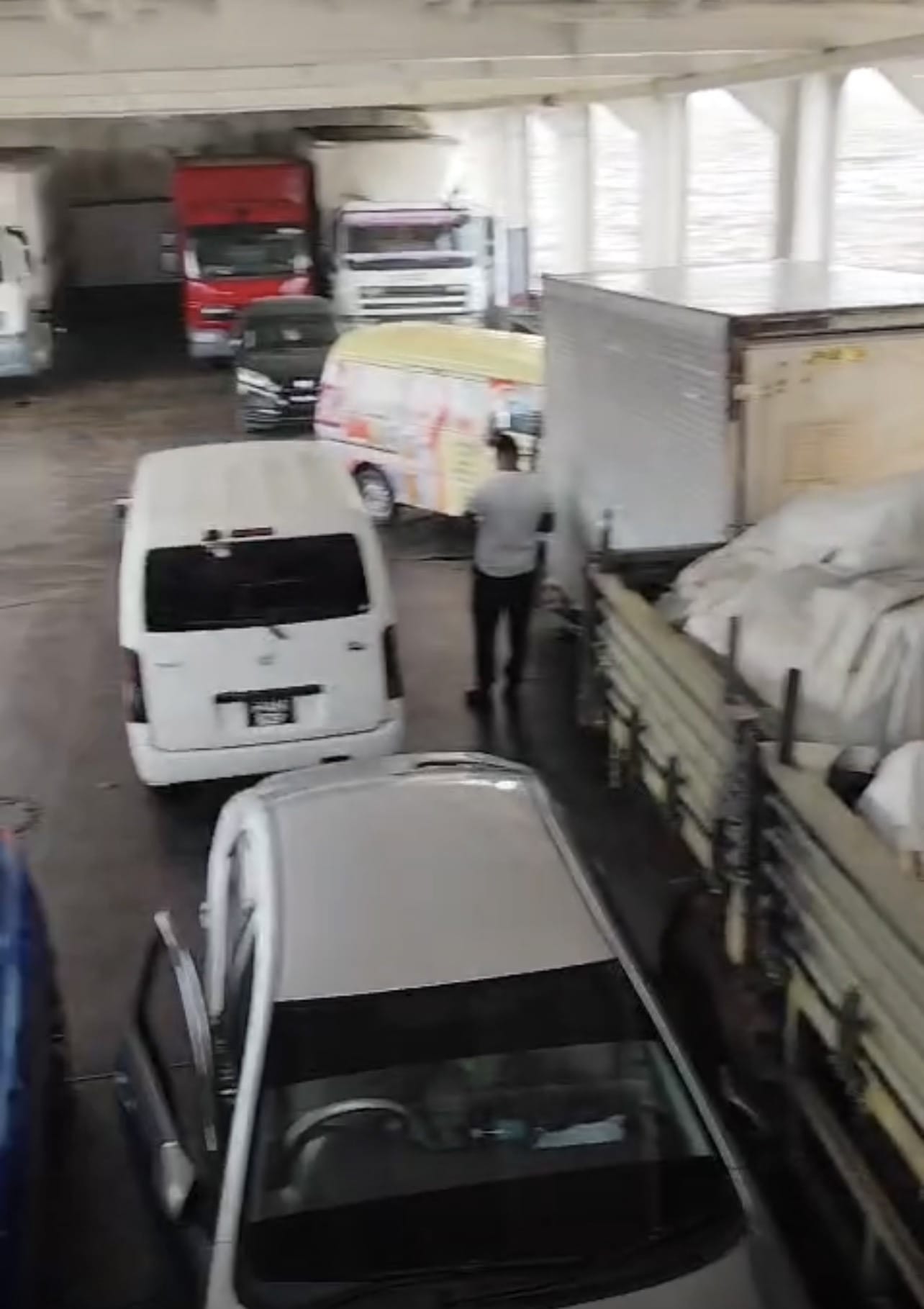
This newspaper makes no claim about the vessel's loading. It holds no manifest, no load calculation and no stability data for the sailing. Those documents sit with the operator and the regulator.
Why is a river ferry a trade question?
Because Bartica is a trade corridor, and the ferry is its first mile.
Bartica sits where the Essequibo, Mazaruni and Cuyuni rivers meet, and it is the staging point for the mining and forestry districts of the interior. Gold and timber come down through it. Fuel, machinery, spares, dry goods and provisions go up through it. There is no connected road to Georgetown, yet. Everything that enters or leaves the interior economy by this route crosses a stelling and boards a vessel.
That makes the ferry trade infrastructure, not a commuter service. Every export from the interior has a first mile, and this is it. A country can hold the most favourable tariff schedule ever negotiated and still fail to ship, because tariff schedules govern goods that arrive at a port. Getting them to the port is a domestic problem, and it is solved or not solved at places like Bartica.
Guyana entered the United States' 12.5 per cent tariff band on 24 July. This newspaper argued in its reporting on Argentina's currency swap that instruments matter less than capability, and that a state which can only respond to terms will keep receiving them. Logistics is where that argument stops being abstract. A trader who cannot guarantee a delivery window cannot sign a supply contract, and a firm that cannot sign a supply contract does not become an exporter, whatever the tariff line says.
What does an unreliable sailing actually cost?
The margin first, then the contract.
Reports reaching La Caribeña News indicate that business people have been left waiting in Bartica when the service does not run in wet weather, and that the vessel was inspected and cleared for sailing within the past seven days. This newspaper has not verified the inspection independently. It is set out below as a question for the authorities, not as a finding.
The commercial arithmetic does not depend on that verification. A missed sailing is stock that does not arrive, a chiller that empties, a delivery window that is broken and a wage bill that runs regardless. Perishables are written off. Fuel and cement sit on the wrong bank. The buyer promised Thursday is told Monday.
The firms that absorb this best are the ones that can hold buffer stock, charter a private vessel, or carry a broken week. Those are the larger operators. The firms that absorb it worst are small traders, who have no depot, no second route and no reserve. Unreliable transport is therefore not a neutral inconvenience. It is a cost that falls hardest on the smallest businesses, and it quietly decides which of them can grow into the supply chains the state says it wants them in.
Guyana's Local Content Act reserves categories of work for Guyanese firms. Reservation on paper does not deliver a pallet. A Bartica firm bidding into any supply chain answers one question before price: can you deliver, on the day you said?
A tariff schedule governs goods that reach a port. Bartica's problem is getting them there.
Is the MV Makouria in the state's repair programme?
No. It is the vessel that was left out.
On 9 March 2026 the Ministry of Public Works, through the Transport and Harbours Department, invited bids on docking and overhaul works for three vessels worth more than $440 million. The MV Makouria is not among them. The Essequibo vessel named in that tender is the MB Hercules.
| Vessel | Estimate | In the March 2026 programme |
|---|---|---|
| MV Ma Lisha | $199.3 million | Yes |
| MV Barima | $124.5 million | Yes |
| MB Hercules | $124.2 million | Yes |
| MV Makouria | None | No |
Source: Department of Public Information, Guyana, 9 March 2026. Figures are Guyana dollars. At rates prevailing in early August 2026 the programme is roughly US$2.1 million.
The Makouria was built by Ferguson at Port Glasgow and launched on 23 July 1959. It has served the Demerara crossing, the Berbice route between Rosignol and New Amsterdam, and now the Essequibo run to Bartica. Its most recent publicly recorded docking was at Guyana Port Inc between 25 August and 19 September 2022, close to four years ago.
The MV Barima, an 87-year-old state ferry built at the same Port Glasgow yard, sank on 18 July with about 179 people aboard, and around 100 were feared dead. Its $124.5 million overhaul had been tendered on 9 March, four months and nine days earlier. The work had not been completed.
What is the state reviewing, and what is it not?
Vessel safety. Not whether goods can move.
The Safety and Compliance Audit Team, announced at the end of July, reviews the fleet. Its three members are Dr Ivor English, a former Director-General of the Maritime Administration Department; Colonel Julius Skeete of the Guyana Defence Force; and Captain Joseph Lewis, a marine officer and surveyor of ships. Its remit is to assess compliance with maritime safety requirements for vessels operating in Guyana and to recommend stronger regulatory oversight and enforcement.
Those are the right questions and they are overdue. But they ask whether a vessel is fit to sail, not whether a shipper can plan a quarter around it.
Service reliability, published cancellation data, guaranteed minimum sailings, redundancy when a vessel is withdrawn, and notice or recourse for shippers left standing are not, on the public record this newspaper can find, within the audit's scope.
That is a gap in trade policy, not only in maritime policy. Guyana publishes investment promotion material, negotiates market access and legislates local content. None of it reaches a Bartica warehouse if the sailing does not happen and nobody is counting how often it does not.
What is the state spending on instead?
More on bottled water than on the ferries.
On 3 August the National Assembly approved $496.3 million for a Guyana Water Incorporated bottling facility. The entire three-vessel ferry rehabilitation programme, tendered in March, was $440 million.
The Guyana Manufacturing and Services Association called for a review of the bottling project, arguing that the goal of fully locally produced bottled water could be met through partnership with existing producers rather than direct state participation. Its members, it said, "have invested capital, built distribution networks, and created jobs in this space over many years," and it warned that a taxpayer-funded competitor could discourage future private investment.
President Dr Mohamed Irfaan Ali rejected the framing. "GWI is not in competition with anyone," he told reporters, adding that the utility has "a responsibility to provide safe drinking water to the population and water that is affordable," and asking why foreign water was displacing local producers.
Both arguments can be entertained. The ordering is harder to reconcile. Bottled water is a market Guyanese firms already serve. River transport to Bartica is a service only the state provides, on which those same firms depend to reach their customers, and for which the vessel now working the route was left out of the repair programme.
What should citizens be asking?
Five questions belong to the people who depend on this route.
La Caribeña News is not putting these to anyone. They are set out here so that the traders, shippers and residents who use the Parika to Bartica service, and the business bodies that represent them, can ask them of the authorities that hold the answers.
1. Was the MV Makouria inspected and certified for service within the past seven days, and will the certificate and survey report be published?
2. What is the vessel's current passenger and vehicle capacity, and what were the recorded loadings at Bartica on 7 August 2026?
3. Why was the MV Makouria excluded from the $440 million rehabilitation programme, and when was it last dry docked?
4. How many Parika to Bartica sailings have been cancelled or delayed in the last twelve months, and is that figure published anywhere?
5. Does the Safety and Compliance Audit Team's remit include service reliability and trade continuity for riverine communities, and if not, which body owns that question?
Frequently Asked Questions
What was La Caribeña News told about the MV Makouria on 7 August 2026?
That the vessel was alongside at Bartica and had not sailed. Images submitted to this newspaper by a Citizen Reporter show water running across the passenger deck during heavy rain, standing water on the open deck, and corrosion on deck machinery.
Why does a ferry matter to trade?
Bartica has no connected road to Georgetown, yet, and is the staging point for interior mining and forestry. Every export from that economy has a first mile, and on this corridor it is the ferry. Tariff schedules govern goods that reach a port; getting them there is a domestic logistics problem.
How old is the MV Makouria?
It was launched on 23 July 1959 at Port Glasgow, Scotland, and is 67 years old.
Is the MV Makouria being repaired?
It is not part of the $440 million, three-vessel rehabilitation programme tendered on 9 March 2026. Its most recent publicly recorded docking was in 2022.
Who is reviewing vessel safety in Guyana?
A three-member Safety and Compliance Audit Team announced at the end of July, comprising Dr Ivor English, Colonel Julius Skeete and Captain Joseph Lewis. Its published remit covers safety and regulatory compliance.
---
Disclosure. La Caribeña News is owned by Theon Alleyne, who is a Director of the Guyana Manufacturing and Services Association and Chair of its Services Sub-Sector, and Vice President and Public Relations Officer of the Essequibo Islands-West Demerara Chamber of Commerce and Industry. The Guyana Manufacturing and Services Association is a named party in the bottled water dispute reported above. Images of conditions aboard the MV Makouria on 7 August 2026 were submitted to this newspaper by a Citizen Reporter.