The Federation's chief operating officer calls transport networks a nation's circulatory system, linking road spending to trade, health and growth.
By Theon Alleyne · La Caribeña News · GEORGETOWN, GUYANA
Quick summary: Investment in roads directly drives national prosperity, IRF Global chief operating officer Magid Elabyad told La Caribeña News in Georgetown on 22 July 2026. He described transport networks as a nation's circulatory system, moving the goods, patients and workers that economies depend on, and argued that building roads to last 30 or 40 years frees the repair budget to build more of them.
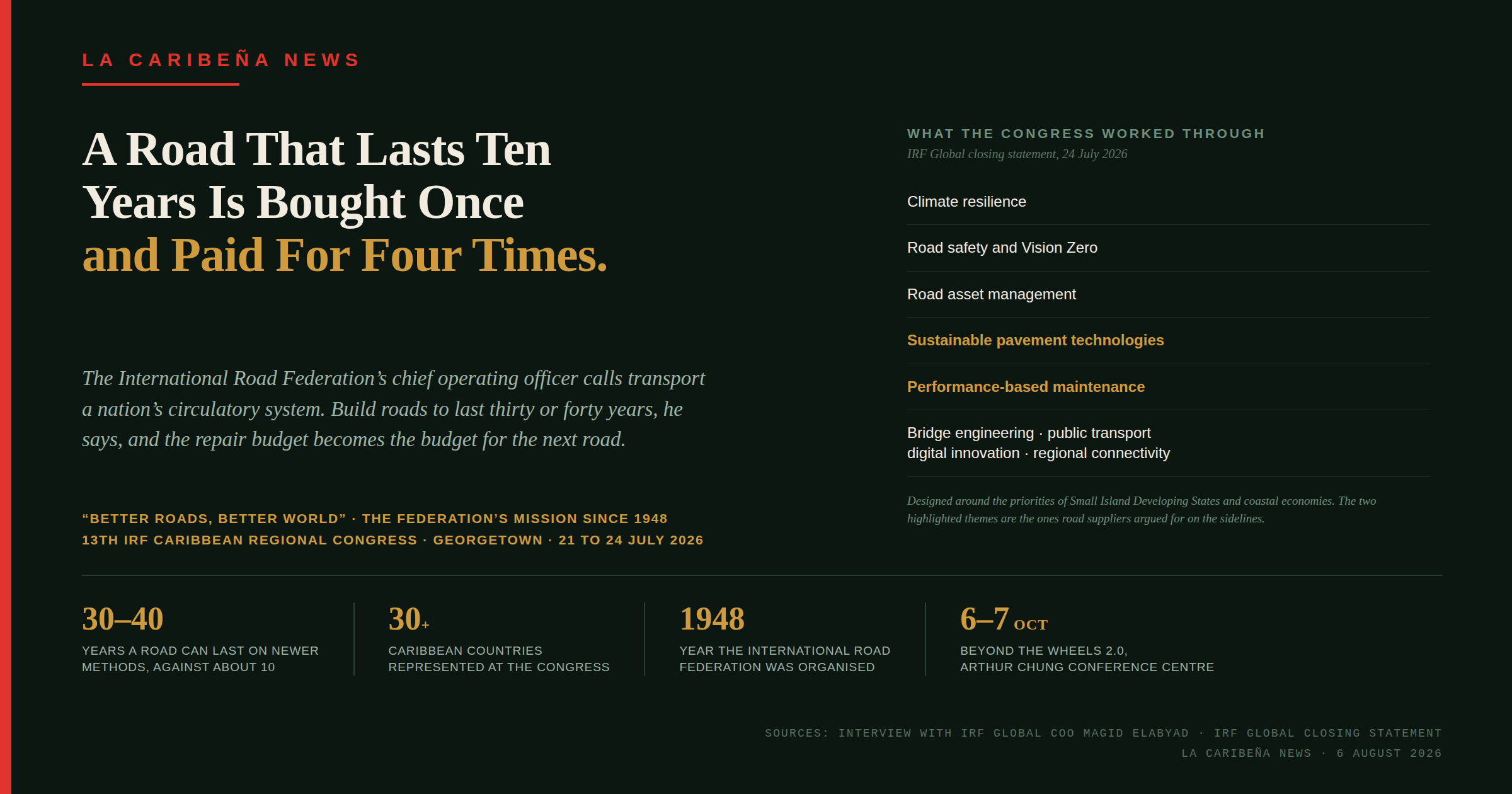
What the title card shows
Every data point on the article's title card, in text.
- 21 to 24 July 2026. Dates of the 13th IRF Caribbean Regional Congress, Georgetown, where the interview was given on 22 July. Source: IRF Global.
- 30 to 40 years. The road lifespan Elabyad says newer methods can deliver, against about 10 years otherwise. Source: interview.
- 1948. The year the International Road Federation was organised. Source: IRF Global.
- Over 30. Caribbean countries represented at the Congress. Source: IRF Global.
- The nine themes listed on the card. Climate resilience; road safety and Vision Zero; road asset management; sustainable pavement technologies; performance-based maintenance; bridge engineering; public transport; digital innovation; regional connectivity. The two highlighted on the card are sustainable pavement technologies and performance-based maintenance. Source: IRF Global closing statement, 24 July 2026.
- 6 to 7 October 2026. Beyond the Wheels 2.0, the Guyana National Transportation and Safety Summit, Arthur Chung Conference Centre. Source: Clarke's Productions Inc.
How do roads shape a country's prosperity?
Magid Elabyad, chief operating officer of the International Road Federation, put the relationship plainly on the sidelines of the 13th IRF Caribbean Regional Congress in Georgetown. He sees a direct correlation between a country's prosperity and the strength of its road and transport network. The more a nation invests in that network, he said, the more its economy gets back.
His image for it was the human body. Transport, he said, is the circulatory system of a nation. When it flows, everything the economy needs reaches where it has to go. When it clogs, the whole system suffers, whether or not anyone traces the cost back to the road.
The Federation has worked under one banner since it was organised in 1948, on a mission Elabyad summarised in three words that have not changed in almost eighty years: better roads, better world.
What does poor road access cost in daily life?
Elabyad's examples were ordinary and sharp. Goods that cannot reach the market on time lose value. Children need safe roads to get to school. A patient who needs emergency care may not survive the trip if there is no fast, reliable way to reach a hospital. These are not abstractions. They are the daily arithmetic of a weak network.
Guyana knows this pattern. On Wakenaam, farmers produce heavily yet lose margin to the transport gap between the field and the buyer. The road, or the missing road, decides who profits.
Can better road technology save money?
Yes, and Elabyad tied the savings directly to more building.
When a country uses newer methods that make a road last thirty or forty years instead of ten, it stops paying to rebuild the same stretch again and again. The money it saves on repairs becomes money it can spend on new projects.
That is the argument for treating road technology as an investment rather than a cost. Spend well once, and the network pays a dividend in budget freed for the next corridor, the next bridge, the next link to a community that had none.
It is also an argument with a specification attached, which is where it stops being rhetoric. At the same Congress, Power Curbers made the granular version of Elabyad's case, arguing that Guyana should pour continuous concrete barriers instead of bolting up metal guardrails and that its new highways still ride rougher than they should. Thirty-year roads are not bought by intention. They are bought by writing them into a contract.
A road that lasts ten years is bought once and paid for four times. A road that lasts forty is bought once. The difference is not the budget. It is the specification.
What did the Congress actually conclude?
That the region's problems are shared, and so are the fixes.
IRF Global's closing account of the Congress, published on 24 July, listed what four days of delegates had worked through: climate resilience, road safety and Vision Zero, road asset management, bridge engineering, sustainable pavement technologies, performance-based maintenance, public transportation, digital innovation and regional connectivity.
The Federation says the programme was built specifically around the priorities of Small Island Developing States and coastal economies, which is the category most of the Caribbean falls into and Guyana partly does.
IRF chairman Randell Iwasaki set the tone at the opening. "The challenges facing small island and coastal states are real," he said, "but so is the talent, experience, and determination in this room." He returned to the theme in his own session, telling Guyana to investigate the failure, then maintain what you build.
That last phrase is Elabyad's economics restated as a discipline. Maintenance is what converts a road from an expense into an asset.
What does this mean for Guyana's oil-era economy?
Guyana grew by about 43 per cent in 2024, yet growth alone does not build a road network or keep skilled people at home. The country still loses trained workers faster than almost any nation in South America, and infrastructure is part of what decides whether they stay.
Financing that infrastructure sustainably, and building it to withstand a changing climate, were core themes of this year's congress. Guyana's Ministry of Public Works hosted the staging, and its minister opened it with a prayer for the victims of the MV Barima, a reminder that transport policy in this country is not only about asphalt.
Where does this conversation go next?
To a national summit in October.
The national version of this conversation lands at Beyond the Wheels 2.0, the Guyana National Transportation and Safety Summit, on 6 and 7 October 2026 at the Arthur Chung Conference Centre in Georgetown. It is organised by Clarke's Productions Inc. and led by Carlyne Stewart, who frames road safety as a collective responsibility shared across behaviour, engineering and public health.
The IRF Congress was the region's technical meeting. The summit is Guyana's own, and it reaches the people who use what gets built: fleet operators, whom the Private Sector Commission has already met the organisers about, clinicians such as the National Road Safety Council's Dr John Anderson, and engineers including CARITRANS' Lacey Williams.
Elabyad's message gives that summit a clear frame. A road is not a line on a map. It is the artery an economy lives or dies by.
Disclosure: Beyond the Wheels 2.0 is organised by Clarke's Productions Inc., which is a client of EICCIO Advisors. Theon Alleyne, the author of this article, is the proprietor of EICCIO Advisors and the founder and managing director of La Caribeña News. La Caribeña News reports on the summit as news, and readers should weigh that relationship when reading its coverage of it. The International Road Federation is not a client of either business.
Frequently Asked Questions
How does road investment affect prosperity?
IRF Global chief operating officer Magid Elabyad says there is a direct correlation between a country's prosperity and the strength of its road and transport network. More investment yields more economic return.
Why does Elabyad call transport a circulatory system?
Because roads and transport move the goods, patients and workers an economy depends on. When the network fails, commerce, health and education all suffer.
Can better road technology reduce costs?
Yes. Elabyad says methods that make roads last 30 to 40 years instead of 10 cut repeat repair spending, freeing budget for new projects.
What did the 13th IRF Caribbean Regional Congress cover?
IRF Global's closing statement lists climate resilience, road safety and Vision Zero, road asset management, bridge engineering, sustainable pavement technologies, performance-based maintenance, public transportation, digital innovation and regional connectivity. The programme was designed around the priorities of Small Island Developing States and coastal economies.
How does this connect to Guyana's oil boom?
Guyana grew about 43 per cent in 2024, but strong infrastructure is needed to move goods, retain skilled workers and sustain that growth.
Where is this discussed in Guyana?
Beyond the Wheels 2.0, on 6 and 7 October 2026 at the Arthur Chung Conference Centre in Georgetown, carries the transport and safety agenda into a national summit. Details are at beyondthewheelsforum.com.