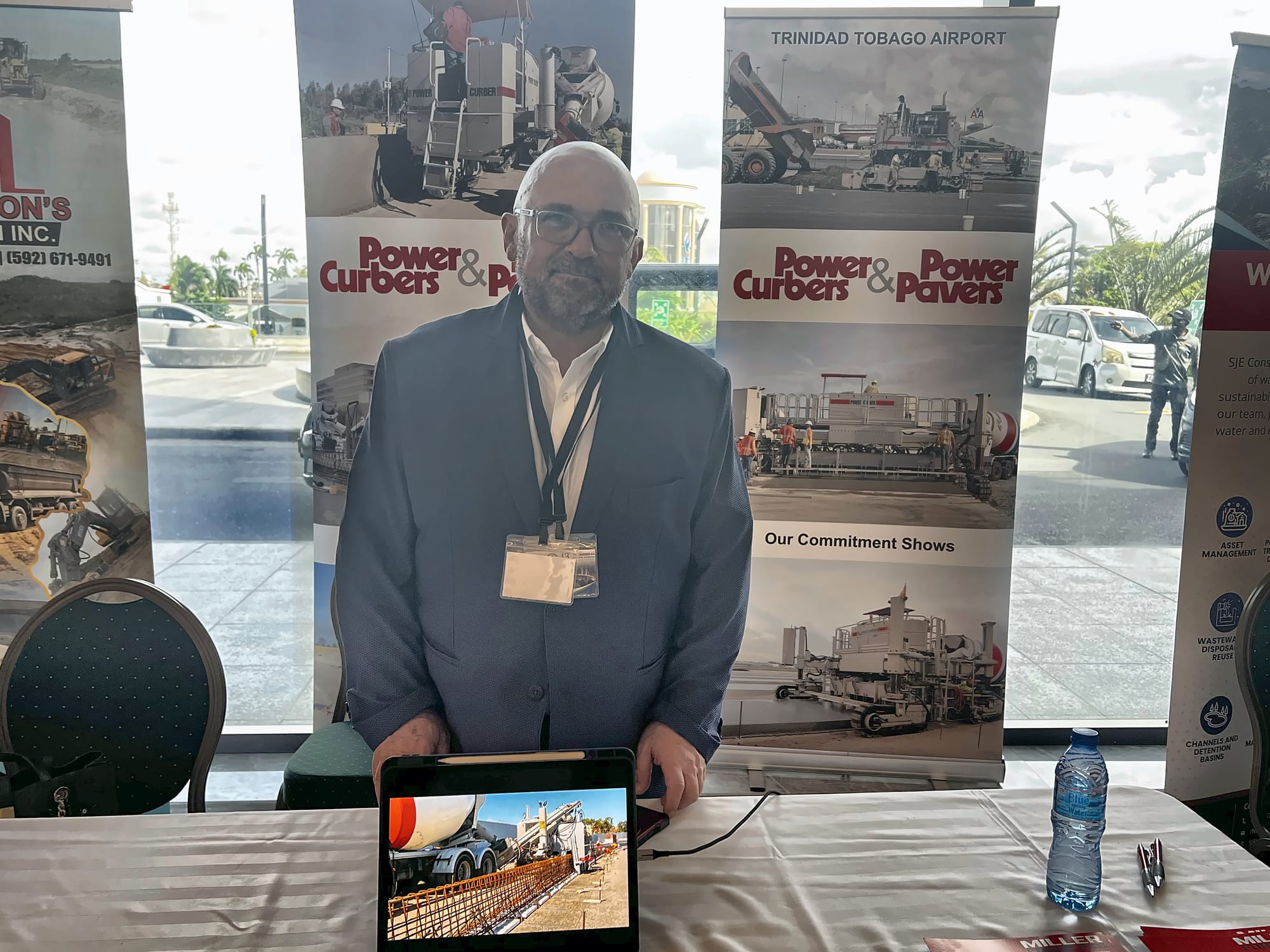
At the 13th IRF Caribbean Regional Congress, a maker of road-building machines used in more than 120 countries makes a blunt case. Pour the barriers in one continuous line, and Guyana protects more kilometres of highway for the same money.
By Theon Alleyne · La Caribeña News · GEORGETOWN, GUYANA, 21 July 2026
THE SHORT ANSWER
Juan-Luis Fumadó, Director of International Sales at Power Curbers Companies, LLC, told La Caribeña News at the 13th International Road Federation (IRF) Caribbean Regional Congress in Georgetown on 21 July 2026 that continuous slipform concrete barriers are cheaper and safer than metal guardrails on high-speed highways. He said Guyana could protect more kilometres of road per dollar by adopting them.
What did Power Curbers tell Guyana at the IRF Caribbean Congress?
Power Curbers Companies, LLC, an American manufacturer founded in 1953 that invented slipform curb-and-gutter technology and now sells machines in more than 120 countries, came to Georgetown with a single message. Guyana is one of the last markets in Latin America where its equipment is not yet in use, and that gap is costing the country money and lives.
“Guyana is one of our targets now, because it's one of the only countries in Latin America that our machines are not still used,” Fumadó said on the sidelines of the congress, which runs from 21 to 24 July 2026 and is hosted by Guyana's Ministry of Public Works. “This is something that we think our equipment can give Guyana advantages.”
His pitch centres on how safety barriers are built. Power Curbers' machines produce continuous concrete barriers cast in place. The machine is fed concrete and extrudes the barrier as one solid, unbroken line, rather than assembling it block by block.
Why does Power Curbers say concrete barriers are safer than metal guardrails?
Fumadó drew a sharp distinction between the barrier types Guyana uses today and the continuous concrete alternative. Metal guardrail, he said, is safe when freshly installed but degrades in ways that matter on a fast road.
“When it's new, just recently installed, it's very safe, as the concrete barriers are,” he said. “But in some places it happens that people go and steal the bolts to sell, or there is a small accident that affects the performance of that barrier.” Search the words “metallic barrier accident” online, he added, and “you will see thousands of pictures of those barriers going inside of the cars, and killing people inside the cars.”
The safety argument has independent backing. The United States Federal Highway Administration lists median barriers among its Proven Safety Countermeasures, and rigid concrete barrier walls have been found effective at stopping a vehicle from crossing into oncoming traffic. Fumadó's point is narrower and practical. A solid concrete line has no bolts to steal and no rails to fold, so its protective value holds up over time. He noted the exception. At low speed, at corners, near toll plazas and stores, metal or shorter barriers have their place. “But in the middle of the highway, high speed, it must be concrete.”
How much can continuous concrete barriers save Guyana?
The cost claim is where Fumadó expects to win the argument with the authorities. Poured continuously by machine, he said, a concrete barrier is “much cheaper than any other way, especially precast blocks, and much more safe because it's much more stable and solid than block by block.”
The framing he offered is about coverage, not just unit price. For the same budget, continuous concrete lets a government “protect much more kilometres of highway.” For a country importing vehicles at the rate Guyana is, that trade-off compounds quickly.
Barrier options as described by Power Curbers
How does this connect to Beyond the Wheels 2.0?
Fumadó's argument lands in the middle of a conversation Guyana is already having. The 13th IRF Caribbean Regional Congress feeds directly into Beyond the Wheels 2.0, the Guyana National Transportation and Safety Summit organised by Clarke's Productions Inc. and led by Carlyne Stewart, set for 6 to 7 October 2026 at the Arthur Chung Conference Centre.
Stewart frames road safety as “a collective responsibility,” and her summit leans on the behavioural side of the problem, how people drive. Fumadó supplies the other half, the physical road itself. A barrier that stays strong after a knock, or after someone tries to strip it for scrap, is behaviour policy written in concrete. The summit's own line-up already points that way, with transportation engineer Lacey Williams of CARITRANS and the National Road Safety Council's Dr John Anderson among the voices bringing engineering and public-health perspectives to the table.
The backdrop is stark. Guyana recorded 137 road deaths in 2025, and its fatality rate of roughly 18 per 100,000 people runs close to nine times Singapore's. La Caribeña News examined that gap in its report on how Singapore engineered safer driving. Against that backdrop, the choice of what lines the edge of a new highway stops being a procurement detail.
What happens next for Guyana's highways?
Fumadó was candid that Power Curbers is here to sell machines, and equally candid that the sale depends on persuading Guyana's road authorities to change a specification, not just a supplier. He pointed to Argentina, Colombia, Panama, Ecuador and Peru as places where the continuous-concrete approach is now routine, and returned to a simple close. The aim is “to help Guyana to save money, and to protect with the same budget much more kilometres of highway.”
Whether that message reaches the procurement stage is a question the IRF Congress and Beyond the Wheels 2.0 are, between them, built to answer.
Frequently asked questions
Are concrete barriers safer than metal guardrails on highways?
On high-speed highways, continuous concrete barriers are generally considered safer. The US Federal Highway Administration lists median barriers among its Proven Safety Countermeasures, and rigid concrete resists penetration by out-of-control vehicles. Metal guardrails can lose effectiveness after impact, corrosion, or theft of components, a risk Power Curbers' Juan-Luis Fumadó highlighted for Guyana.
What is a slipform concrete safety barrier?
It is a continuous, cast-in-place highway barrier formed on site by a machine that is fed concrete and extrudes the barrier in one solid line. Because it is poured as one structure rather than assembled block by block, it is more stable and, Power Curbers says, cheaper than precast alternatives.
How many people died on Guyana's roads in 2025?
Guyana recorded 137 road deaths in 2025. The country's fatality rate is estimated at roughly 18 per 100,000 people, close to nine times Singapore's. Nearly 100,000 vehicles were imported in 2025.
When and where is Beyond the Wheels 2.0 taking place?
Beyond the Wheels 2.0, the Guyana National Transportation and Safety Summit led by Carlyne Stewart of Clarke's Productions Inc., runs from 6 to 7 October 2026 at the Arthur Chung Conference Centre in Georgetown, one month before National Road Safety Month.
Theon Alleyne is Managing Director of La Caribeña News and EICCIO Advisors. He writes on Caribbean business, compliance and infrastructure.
Disclosure: Beyond the Wheels 2.0 is organised by Clarke's Productions Inc., which is a client of EICCIO Advisors. Theon Alleyne, the author of this article, is the proprietor of EICCIO Advisors and the founder and managing director of La Caribeña News. La Caribeña News reports on the summit as news, and readers should weigh that relationship when reading its coverage of it. Power Curbers is not a client of either business.