A veteran of the road-building industry says Guyana's new highways still ride rough, and that the fix is not only what you pave with, but how well you finish it.
By Theon Alleyne · La Caribeña News · GEORGETOWN, GUYANA
Quick summary: Juan-Luis Fumadó, Director of International Sales at Power Curbers Companies, LLC, told La Caribeña News at the 13th International Road Federation Caribbean Regional Congress on 21 July 2026 that concrete roads last longer and cost less to maintain than asphalt in Guyana's climate. He said the roads still ride rough, meaning a high International Roughness Index. On the United States benchmark, a road is only "good" below about 1.5 metres per kilometre.
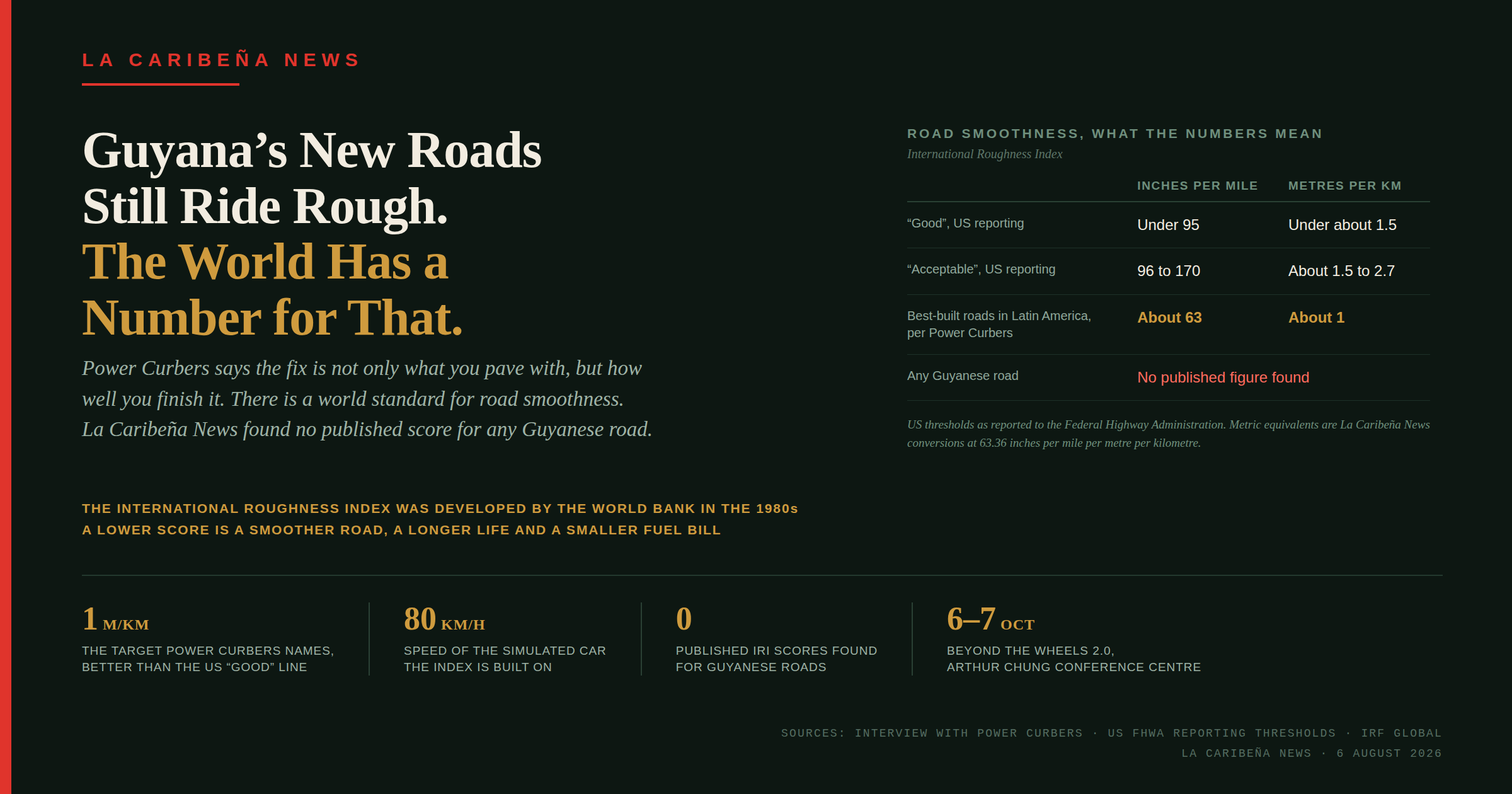
What the title card shows
Every data point on the article's title card, in text.
- 21 July 2026. Date of the interview, at the 13th IRF Caribbean Regional Congress, Georgetown. Source: La Caribeña News.
- 1 m/km. The roughness score the best-built roads in Latin America reach, as described by Fumadó, equivalent to about 63 inches per mile. Source: interview, with the conversion by La Caribeña News.
- 1.5 m/km. The United States threshold for a "good" road, converted from 95 inches per mile. Source: La Caribeña News conversion of the US Federal Highway Administration reporting threshold.
- 2.7 m/km. The upper bound of "acceptable" in the same system, converted from 170 inches per mile. Source: as above.
- 63.36. Inches per mile in one metre per kilometre, the conversion used throughout. Source: standard IRI conversion.
- 1980s. The decade the World Bank developed the International Roughness Index. Source: IRI technical literature.
- 6 to 7 October 2026. Beyond the Wheels 2.0, the Guyana National Transportation and Safety Summit, Arthur Chung Conference Centre. Source: Clarke's Productions Inc.
- No published figure found. The card's final row, recording that La Caribeña News did not find a published roughness score for any Guyanese road. It is a report of what this search returned, not proof that none exists.
What did Power Curbers say about concrete versus asphalt roads in Guyana?
Fumadó, who has worked with Power Curbers since 1998 and is based between Barcelona and Panama, has watched Guyana change. "I've been here eight years ago, and now again," he said. "There is a big improvement since that time. But still, you can feel that the smoothness of the roads, even the new ones, is not the best you can find."
His argument is that Guyana should weight its choice toward concrete for the roads that carry the heaviest loads. In places exposed to strong weather and heavy, overloaded traffic, he said, "concrete is much more solid than asphalt." The everyday problem with asphalt is familiar to any Guyanese driver. "You need to mill and replace, because potholes appear, deformation appears. With concrete, that doesn't happen."
Why does concrete outlast asphalt in Guyana's climate?
Fumadó was careful not to overclaim. Guyana does not face hurricanes, but it has the two stressors that matter most for a road surface, heat and rain. Add overloading, meaning trucks that carry more than the regulations allow, and asphalt suffers. "Especially in hot-weather countries," he said, an overloaded road surface is "much more sensitive."
Concrete, poured and cured properly, sits under that same load for far longer with very low maintenance cost. That is the trade he wants Guyana's planners to see, a higher price at construction against years of avoided milling, patching and replacement. It is the same lifecycle logic behind the World Bank's push for more durable, resilient transport in Guyana. But he flagged the catch plainly. "Concrete is less forgiving than asphalt. Asphalt is easy to repair; concrete is quite complicated. So when you move to concrete, you must do it the right way."
What is the International Roughness Index, and why does road smoothness matter?
The technical heart of Fumadó's case is a number most drivers have never heard of but feel every day. The International Roughness Index, or IRI, measures how smooth a road is. A lower IRI means a smoother ride, and the consequences of a high one are not cosmetic.
"There are studies that prove a higher IRI means a less smooth road, and it will last less. It will be destroyed before its time," he said. A rough road also raises "the consumption of oil" and "the damage to the vehicles," and it tires drivers. "More accidents, also, because people are more tired driving in that condition." In other words, road roughness is a fuel bill, a repair bill and a safety risk rolled into one.
What counts as a good roughness score?
Fumadó named a target but not a scale. Here is the scale.
The IRI was developed by the World Bank in the 1980s and is now the most widely used measure of road smoothness in the world. It works by simulating a standard "quarter car" travelling at 80 kilometres per hour and adding up how much that vehicle's suspension moves over each kilometre. The result is expressed in metres per kilometre. Zero is a perfectly smooth surface. The method is fixed by standards including ASTM E1926 and AASHTO PP 37, which is why a reading taken in Georgetown is comparable with one taken in Bogotá.
The United States has reported roughness on every state highway network to the Federal Highway Administration since the early 1990s, and its reporting thresholds give a usable yardstick. Road segments below 95 inches per mile are treated as good. Segments from 96 to 170 inches per mile are treated as acceptable.
Those are imperial figures. Converted at the standard rate of 63.36 inches per mile to one metre per kilometre, they come out as follows.
| Condition | Inches per mile | Metres per kilometre |
|---|---|---|
| Good | Under 95 | Under about 1.5 |
| Acceptable | 96 to 170 | About 1.5 to 2.7 |
| Best-built roads in Latin America, per Fumadó | About 63 | About 1 |
Thresholds as reported to the US Federal Highway Administration. Metric equivalents are La Caribeña News conversions at 63.36 inches per mile per metre per kilometre, rounded. The Latin American figure is Fumadó's own, given in the interview.
Read against that table, Fumadó's target of about 1 m/km is not a routine standard. It is better than the American definition of good. His complaint about Guyana is not that its new roads fail a test. It is that nobody here is publicly holding them to one.
That matters because La Caribeña News has not found a published IRI figure for any Guyanese road. Without one, "the roads ride rough" stays an impression rather than a measurement, and impressions are not procurable. A specification is.
Did the Congress agree with him?
Its closing statement lands on the same ground, three days later.
Fumadó spoke on 21 July, on the sidelines. When IRF Global published its closing account of the Congress on 24 July, the themes it listed as having occupied delegates included sustainable pavement technologies, road asset management and performance-based maintenance, alongside climate resilience and road safety.
Those three are precisely the frame Fumadó was arguing from. Performance-based maintenance in particular is the formal name for the idea underneath his pitch: that a road should be bought against how it performs over its life, not against what it costs to lay. The Federation, which has operated under one banner since 1948, designed the programme around the priorities of Small Island Developing States and coastal economies.
So a supplier's sales argument and the Congress's official conclusions converged on the same point. That does not make the argument correct. It does mean it is no longer a fringe view in the room.
How does this connect to Beyond the Wheels 2.0?
Georgetown gets a second, national conversation on the same subject in October.
Beyond the Wheels 2.0, the Guyana National Transportation and Safety Summit, runs on 6 and 7 October 2026 at the Arthur Chung Conference Centre. It is organised by Clarke's Productions Inc. and led by Carlyne Stewart, whose approach treats road safety as a collective responsibility rather than a policing problem.
The IRF Congress was a technical meeting of the region's road professionals. The summit is the national one, and its agenda reaches the people who drive on what gets built. Roughness belongs in both. A road that tires drivers is a road safety issue before it is an engineering one, which is the argument transportation engineer Lacey Williams of CARITRANS has made about local data: the Caribbean cannot manage what it does not measure for itself.
This is the second of two reports from the same interview. The first covered Power Curbers' case that continuous concrete barriers beat metal guardrails on both safety and cost. Read together, they make one argument: that Guyana's road spending is a specification problem more than a budget problem.
What happens next?
The question is whether roughness becomes a number in a contract.
Fumadó's commercial interest is plain, and he did not hide it. Power Curbers sells the machines that pour continuous concrete, and Guyana is one of the few Latin American markets where they are not yet working. He is arguing for a specification that his equipment happens to meet.
That does not settle whether he is right. The way to settle it is to measure. Guyana's Ministry of Public Works hosted this Congress, its minister opened it with a prayer for the victims of the MV Barima, and the Federation's own chairman used the platform to tell the country to investigate the failure, then maintain what you build. Publishing roughness scores for the new corridors would test every claim in this article at once, including the supplier's.
Disclosure: Beyond the Wheels 2.0 is organised by Clarke's Productions Inc., which is a client of EICCIO Advisors. Theon Alleyne, the author of this article, is the proprietor of EICCIO Advisors and the founder and managing director of La Caribeña News. La Caribeña News reports on the summit as news, and readers should weigh that relationship when reading its coverage of it. Power Curbers is not a client of either business.
Frequently Asked Questions
Is concrete better than asphalt for roads in Guyana?
Power Curbers' Juan-Luis Fumadó argues concrete outlasts asphalt in hot, heavy-rain climates with overloaded trucks, because it resists the potholes and deformation that force asphalt to be milled and replaced. The advantage only holds if the concrete is built with the right mix and finished correctly, since concrete is much harder to repair than asphalt.
What is the International Roughness Index (IRI) and why does it matter?
The IRI measures how smooth or rough a road is; a lower number is smoother. It was developed by the World Bank in the 1980s and simulates a standard vehicle travelling at 80 kilometres per hour, reporting the result in metres per kilometre. Rough roads wear out faster, raise fuel consumption, damage vehicles and tire drivers, which contributes to crashes.
What counts as a good IRI score?
In the United States, road segments below 95 inches per mile are reported as good and those from 96 to 170 inches per mile as acceptable. Converted, that is roughly under 1.5 metres per kilometre for good, and up to about 2.7 for acceptable. Fumadó said the best-built roads in Latin America reach about 1 metre per kilometre, which is about 63 inches per mile.
Why do Guyana's roads develop potholes so quickly?
Heat, heavy rain and overloaded vehicles stress asphalt, which is more sensitive to these conditions than concrete. When load limits are exceeded, asphalt deforms and potholes appear, requiring repeated milling and replacement. Concrete resists this but is far less forgiving to repair, so it must be built correctly the first time.
What is Beyond the Wheels 2.0?
It is the Guyana National Transportation and Safety Summit, organised by Clarke's Productions Inc. and led by Carlyne Stewart, running from 6 to 7 October 2026 at the Arthur Chung Conference Centre in Georgetown. Details are at beyondthewheelsforum.com.