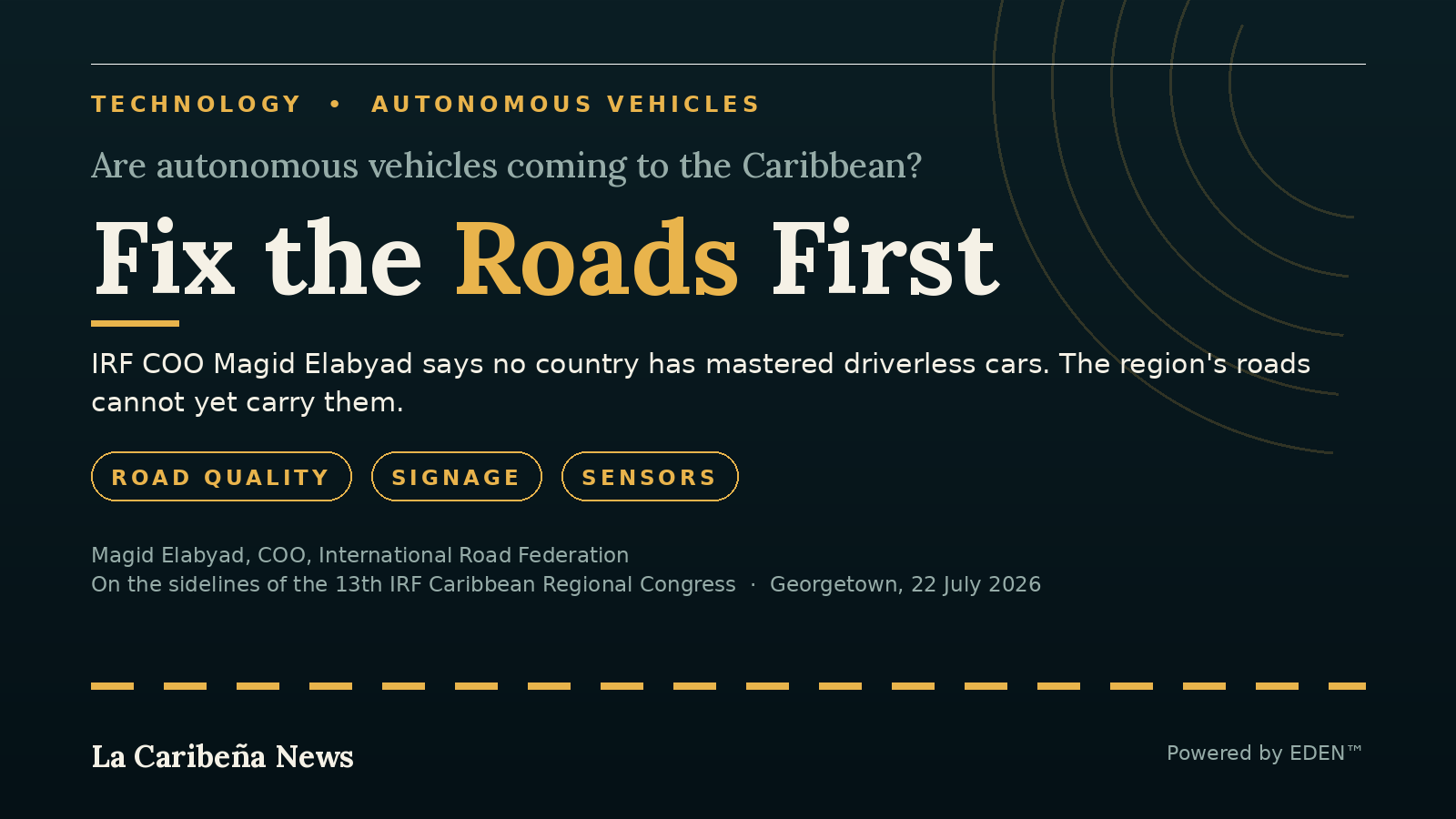
RF COO Magid Elabyad says driverless cars still need road quality, signage, and sensors that no country has fully mastered yet.
By Theon Alleyne, Founder and Managing Director, La Caribeña News
Georgetown, Guyana · 22 July 2026
IN BRIEF
Autonomous vehicles will not run on Caribbean roads until basic infrastructure improves, IRF COO Magid Elabyad said in Georgetown on 22 July 2026. He cited road quality, signage, and sensors as prerequisites even advanced markets have not fully met.
Can self-driving cars operate in the Caribbean today?
Not yet, and Magid Elabyad, chief operating officer of the International Road Federation, is quick to add that this is not a Caribbean problem. Speaking on the sidelines of the 13th IRF Caribbean Regional Congress in Georgetown, he said no country has truly mastered the technology at scale. Even the clear market leader, Waymo, still runs its driverless service inside a small set of carefully mapped United States cities, on grids it knows in detail.
His framing was practical, not critical. The question, he suggested, is not whether the region wants the technology. It is whether the roads beneath any car, driven by a person or not, are built to carry it. By that test, most of the world is still near the beginning.
What infrastructure do autonomous vehicles actually need?
A self-driving car depends on the same things a good road already needs. Elabyad listed them plainly. Sound road surfaces. Clear, consistent signage. Sensors in signs and traffic lights. Visibility a vehicle can trust in any weather. Researchers who study road authorities reach the same conclusion. One widely cited study found lane markings and traffic sign quality rank among the most important factors for safe automated driving.
There is even a scale for it. A framework known as infrastructure support levels for automated driving grades roads from conventional stretches a car must read entirely on its own up to routes that actively guide vehicles. Elabyad's point is that the work begins on the ground, and that the United States, Europe, and Japan are all still building it.
Where does Guyana stand right now?
For Guyana, the near-term work is not automation. It is drawing the most from the roads already in daily use. LCN has reported on the value of local road-safety data instead of imported assumptions, and on how driver behaviour, not only the asphalt, shapes the country's road toll.
Oil-era incomes have put more vehicles on roads that were not designed for the load. That is the real starting point, and it is a familiar one across growing economies. The same maintenance, markings, and enforcement that make roads safer for today's drivers are the groundwork any automated future would rest on.
What would it take to get ready?
Elabyad offered his advice as an order of operations, and with optimism rather than caution. Invest first in the quality of the infrastructure. Get the basics right, and the more advanced systems can follow. Automated vehicles will not perform on weak roads, he said, so the first step for any country, wealthy or not, is the same unglamorous one.
He is excited about the progress in Georgetown, saying he wanted to come back in a few years and see real progress in Guyana. That practical, forward-looking conversation is what Beyond the Wheels 2.0, a national transportation and safety summit at the Arthur Chung Conference Centre on 6 and 7 October 2026, is built to carry. Fleet management, driver training, regulation, and road spending all sit on that agenda, and each one comes long before the driver ever leaves the wheel.
Frequently Asked Questions
Are autonomous vehicles available in the Caribbean now?
No. IRF COO Magid Elabyad says no country has mastered them at scale. Even the market leader, Waymo, runs only in a limited set of mapped United States cities.
Which places already run self-driving cars?
Driverless services operate in a small number of carefully mapped cities, such as Phoenix, San Francisco, and Los Angeles, on routes the vehicles know in detail.
What does a road need before autonomous vehicles can work?
Well-maintained surfaces, clear signage, reliable visibility, and sensors in road furniture. Studies find lane markings and sign quality are among the most important factors.
Is the Caribbean behind on this?
Not uniquely. Elabyad stresses that the United States, Europe, and Japan are all still building the infrastructure automated driving needs. The groundwork is the same everywhere.
Where is this discussed in Guyana?
Beyond the Wheels 2.0, a national transportation and safety summit, takes place on 6 and 7 October 2026 at the Arthur Chung Conference Centre in Georgetown.
Disclosure: Beyond the Wheels 2.0 is organised by Clarke's Productions Inc., which is a client of EICCIO Advisors. Theon Alleyne, the author of this article, is the proprietor of EICCIO Advisors and the founder and managing director of La Caribeña News. La Caribeña News reports on the summit as news, and readers should weigh that relationship when reading its coverage of it. The International Road Federation is not a client of either business.