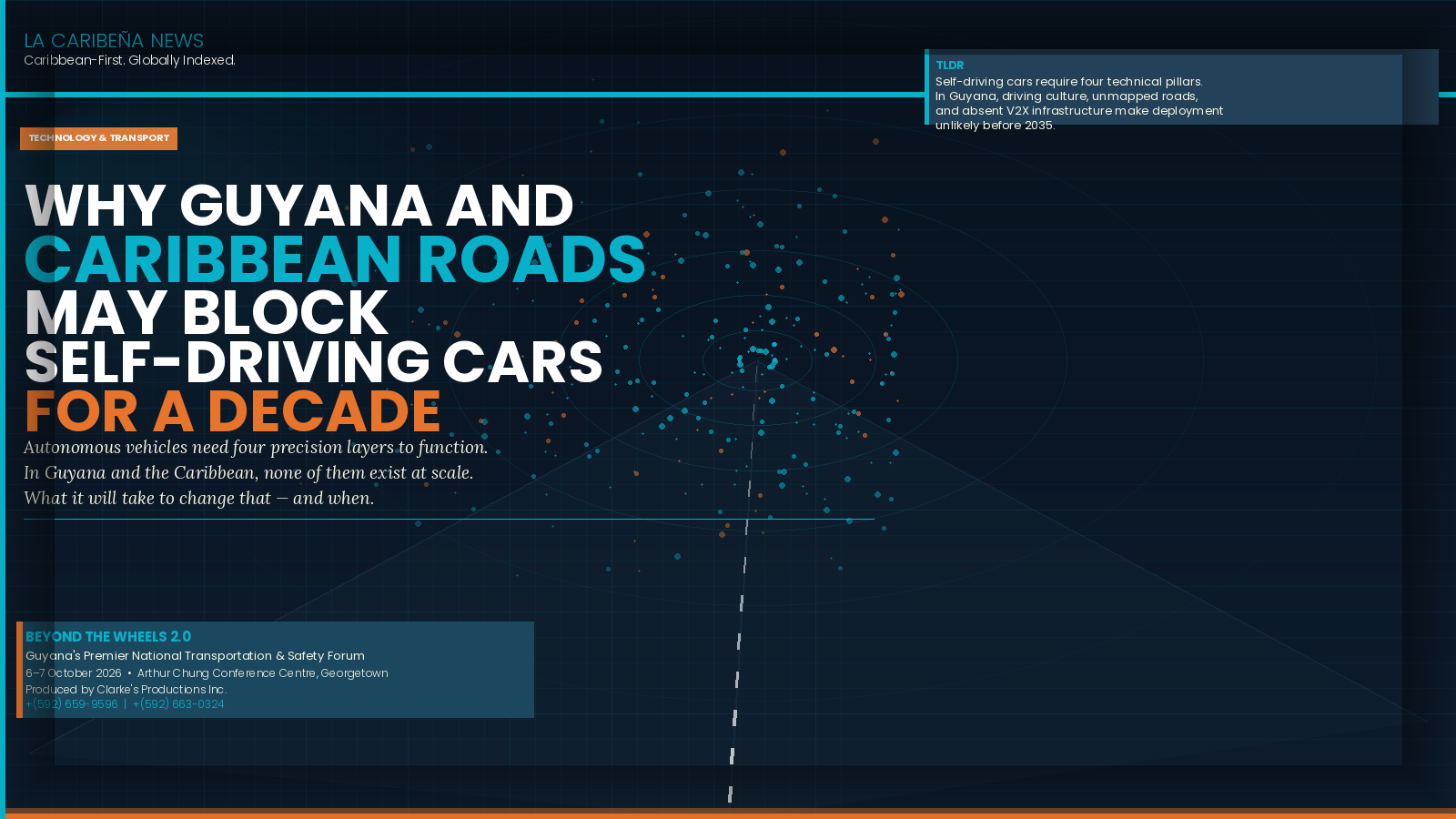
Why Guyana and Caribbean Roads May Block Self-Driving Cars for a Decade
By LCN Newsroom | Georgetown, Guyana | June 2026
Technology | Transport | Caribbean
Self-driving cars require four technical pillars — but in Guyana and the Caribbean, driving culture, unmapped roads, and absent V2X infrastructure make autonomous vehicle deployment unlikely before 2035, experts say.
A self-driving car is not simply a vehicle with a clever computer. It is a system that depends on four precisely engineered layers working simultaneously: perception sensors that see the road, decision-making algorithms that plan a path, mechanical actuators that execute commands, and a digital backbone of high-definition maps and vehicle-to-infrastructure communications. Remove any single layer, and the system fails.
In the Caribbean, all four layers face obstacles that no software patch can resolve. The roads, the culture, and the regulatory environment present conditions that autonomous vehicle manufacturers have not designed for and, in most cases, have not tested. A vehicle built for Phoenix or Singapore will not survive a Wednesday morning on the East Bank Demerara highway, let alone a secondary road in rural Berbice.
That gap is what Beyond the Wheels 2.0, scheduled for October 2026 at the Arthur Chung Conference Centre (ACCC), aims to put squarely on the regional agenda. The conference will bring together transport policymakers, technology firms, and private sector leaders to examine where the Caribbean sits in the autonomous vehicle timeline and what it would actually take to close that distance.
Why can't autonomous vehicles simply be programmed for Caribbean roads?
Autonomous vehicles cannot be simply reprogrammed for Caribbean roads because the physical infrastructure required — HD maps accurate to within 10 centimetres, V2X communication networks, and standardised road markings — does not yet exist across the region.
Autonomous navigation depends first on what the industry calls perception: the continuous collection and processing of environmental data through LiDAR sensors that measure distance with laser pulses, cameras that identify lane markings and traffic lights, and radar arrays that track the precise position of nearby vehicles. These sensors are precise under the conditions they are trained on. They are not trained on a minibus that stops abruptly at an unmarked bus bay to discharge passengers, on livestock crossing a flooded B-road in Essequibo, or on a roundabout in Port of Spain where lane discipline is a suggestion rather than a rule.
According to the Union of Concerned Scientists, fully autonomous vehicles require consistent, machine-readable road features across every kilometre of their operating range. Across CARICOM, that standard remains years away.
How does Caribbean driving behaviour specifically clash with AV systems?
Caribbean driving behaviour clashes with autonomous vehicle systems because AV logic assumes strict adherence to traffic law, predictable pedestrian movement, and consistent following distances — none of which characterise daily road use in Guyana or across the broader region.
Lisa A, writing for Grand Coastal Guyana, documented the improvised nature of driving on Guyanese roads with precision: lane boundaries are treated as approximate, the shoulder functions as a passing lane during congestion, and right-of-way operates on a social contract that no algorithm can read. An AV travelling at a legally correct following distance behind a minibus would create a gap. Another minibus would fill that gap. The AV, detecting the intrusion, would brake. The cycle would repeat until either the AV stopped moving or traffic behind it collapsed.
Minibus culture is the most structurally incompatible feature of the regional transport system with autonomous driving. Public transit minibuses across Guyana stop wherever demand appears. Passengers board and exit mid-block. Drivers negotiate with other drivers through horn patterns and hand gestures. An AV has no interpreter for any of this. Its programming recognises a stationary vehicle as an obstacle, not a bus bay. Its sensors read a pedestrian stepping from a minibus into traffic as an emergency stop event.
The academic literature on AV pedestrian interaction confirms the problem. AV sensor systems predict pedestrian movement from crosswalk positioning and gaze direction. Caribbean pedestrians cross where gaps appear, not where crossings are marked. A 2023 analysis cited by Synopsys in its Vehicle Autonomy technical guide found that unpredictable pedestrian behaviour in high-density urban environments increases AV emergency braking frequency by a factor that creates significant rear-collision risk with following human drivers who do not expect abrupt stops.
What infrastructure gaps make AV deployment impossible in Guyana today?
AV deployment in Guyana is not possible today because HD mapping, V2X communication networks, and standardised road signage — the three non-negotiable infrastructure requirements — are absent across almost all of the country's road network.
High-definition maps used by autonomous vehicles are not the kind found on Google Maps. They are centimetre-accurate models of the road surface, including lane width, camber, kerb height, and the precise three-dimensional location of every sign and signal. Building them requires dedicated mapping vehicles running repeated survey passes. For Guyana's approximately 3,995 kilometres of public roads, most of which are unpaved, that survey has not occurred. The Singapore Land Transport Authority's published framework for AV readiness lists HD mapping as a prerequisite that must exist before any testing begins. Guyana has not reached that prerequisite.
V2X, the communication layer that allows vehicles to receive real-time data from traffic signals, toll gates, and emergency services, requires roadside infrastructure investment at every junction in the operating area. No CARICOM member state has deployed V2X infrastructure at scale.
Then there are the roads themselves. Guyana's coastal highway network is partially paved, but secondary roads are seasonal. Interior routes require high-clearance four-wheel-drive vehicles piloted by experienced human drivers who read conditions that no current AI system can interpret — including the visual difference between a puddle and a metre-deep pothole filled with rainwater.
What is the role of traffic enforcement in AV readiness?
Traffic enforcement shapes AV readiness because autonomous vehicles are programmed to obey the law as written, not as locally applied, and in Guyana the gap between those two versions of road rules is wide enough to halt AV operations entirely.
Autonomous systems are rule-following by design. They do not negotiate. They do not read a traffic officer's wave as permission to pass through a red light. They do not interpret a hand signal from a parked truck driver as the regional equivalent of a yield sign. In a road environment where human flexibility and informal interaction carry significant traffic management weight, a strictly compliant AV becomes a rolling obstacle.
Guyana drives on the left, following British convention, but the practical enforcement of traffic regulations including speed limits, illegal window tinting, and lane usage relies heavily on discretionary human interaction. The gap between statute and practice is not unique to Guyana — it is a regional pattern documented across the Caribbean. Autonomous vehicles close that gap by default. That makes them predictably disruptive to any road system where informal flexibility is load-bearing.
When might autonomous vehicles realistically arrive in the Caribbean?
Autonomous vehicles could realistically operate on limited, designated Caribbean routes by 2035, provided that HD mapping programmes begin within the next two years, V2X pilot infrastructure is funded, and road marking standardisation is legislated and enforced.
The path is not impossible. Singapore, widely cited as the most AV-ready jurisdiction in Asia, spent more than a decade building the regulatory and physical infrastructure before permitting limited public road testing. The Caribbean is a decade behind Singapore's 2015 baseline. That places realistic general deployment somewhere past 2035, assuming consistent policy commitment.
The more proximate opportunity may lie in controlled environments. Port logistics, airport ground operations, and dedicated resort transit corridors represent environments where HD mapping is manageable, pedestrian behaviour is more predictable, and road conditions are maintained to a standard that AV sensors can handle. These are not trivial applications. They are proving grounds that could generate the local data, regulatory familiarity, and workforce capability that eventual broader deployment requires.
Beyond the Wheels 2.0 at the Arthur Chung Conference Centre in Georgetown on 6 and 7 October 2026 is positioned to address exactly that question: not whether self-driving technology will reach the Caribbean, but under what conditions, in what sequence, and who in the region needs to act first. The two-day conference, produced by Clarke's Productions Inc., is Guyana's premier national transportation and safety forum, bringing together transport ministers, private sector investors, and technology developers for a structured examination of the Caribbean's autonomous vehicle readiness gap and the policy interventions that could close it.
Tickets, sponsorship packages, and speaking proposals are available by contacting the organising team at +(592) 659-9596 or +(592) 663-0324.
Frequently Asked Questions
Are self-driving cars legal in Guyana?
No autonomous vehicle legislation exists in Guyana as of June 2026. No testing framework, liability standard, or operational permit has been established, making commercial AV deployment legally undefined.
What are the four requirements for self-driving vehicles?
Autonomous vehicles require perception sensors, decision-making AI, mechanical execution actuators, and digital infrastructure including HD maps and V2X communications. All four must function simultaneously.
Why do minibuses cause problems for autonomous vehicles?
Minibuses stop outside designated zones, block traffic unpredictably, and communicate through informal signals no AV can parse. Their behaviour falls outside every operating scenario AV systems are trained on.
What is Beyond the Wheels 2.0?
Beyond the Wheels 2.0 is Guyana's premier national transportation and safety forum, held on 6 and 7 October 2026 at the Arthur Chung Conference Centre, Georgetown. Produced by Clarke's Productions Inc. For tickets, sponsorship, or speaking proposals: +(592) 659-9596 or +(592) 663-0324.
Could self-driving cars ever work in the Caribbean?
Yes, but not on general roads before 2035 under current conditions. Controlled environments such as ports, airports, and resort corridors represent realistic near-term applications if infrastructure investment begins now.