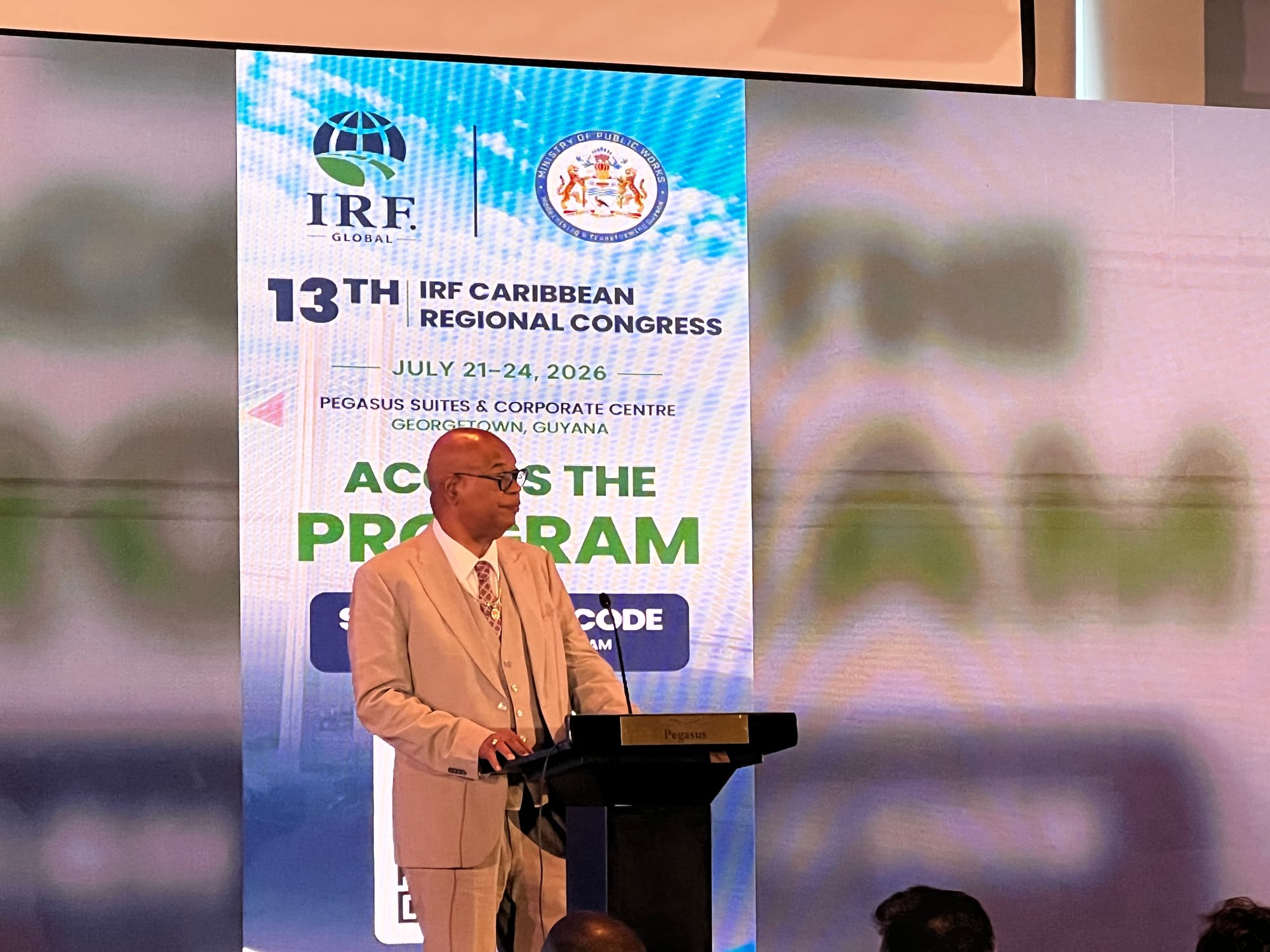
At the 13th IRF Caribbean Congress, the Public Works Minister used the new Bharrat Jagdeo Demerara River Bridge to argue that infrastructure's real return is time given back to families.
BY LCN NEWSROOM · GEORGETOWN, GUYANA · 22 JULY 2026
I N B R I E F At the 13th IRF Caribbean Regional Congress on 22 July 2026, Public Works Minister Bishop Juan Edghill said Guyana has built 40 bridges and 500 kilometres of road, but argued the true measure of infrastructure is hours saved for families. |
GEORGETOWN, Guyana. Bishop Juan Edghill could have read the numbers, and he did. Forty bridges. Five hundred kilometres of road. Thirty kilometres of concrete. Then he set the tally aside.
Guyana's Minister of Public Works used his address to the 13th International Road Federation (IRF) Caribbean Regional Congress to make an argument about how a country should judge what it builds. A ministry can count structures all day, he suggested, and still miss the thing that matters. The real test of a road or a bridge is what it does to an ordinary morning.
What has Guyana built under Edghill's ministry?
Edghill has led the Public Works Ministry for about six years, a stretch that covers much of the country's building boom. He cited 40 bridges, 500 kilometres of road and 30 kilometres of concrete carriageway as evidence of pace. Yet he framed those figures as the least interesting part of the story. Numbers, in his telling, are a starting point for a harder question about value.
How does the new Demerara bridge change a daily commute?
His clearest example was the Bharrat Jagdeo Demerara River Bridge, the four-lane, high-span crossing opened in October 2025 and engineered for a century of use. Edghill said families now save three to four hours a day because of it. He drew the consequences out loud. Parents reach home in time to sit with children over homework. Pupils who once left home at 5:30 for a 9 o'clock class arrive less exhausted. Georgetown breathes easier as traffic thins, and businesses have started crossing into Region Three to expand.
How many projects is the Ministry running at once?
The scale behind those claims is large. Edghill described a standing Monday review with his engineers covering over 12,000 projects currently under the Ministry's watch. That volume, he argued, is why old habits of planning no longer serve. The work has outgrown the assumptions that once guided it. Farmers on islands like Wakenaam already feel the gapbetween what they grow and the transport that can move it.
Why is Guyana building airstrips and roads into remote regions?
Resilience, Edghill said, is not an abstraction. He recalled a flood that cut a farming community off entirely, its fields underwater and its access bridge gone. Food could not reach the people until the water fell. The Ministry rebuilt the crossing and added a new airstrip so the next emergency would not strand anyone. Guyana now operates over 100 aerodromes, part of a push to reach the interior that oil wealth is meant to serve. That same interior loses skilled people faster than almost anywhere in South America, a strain the country is still working to reverse.
How is Guyana paying for this, and will it last beyond oil?
The minister placed the building programme inside a longer bet. Oil and gas revenue, he said, is being spent to stand up sectors that will outlive the wells: agriculture and food security, ecotourism, carbon credits, manufacturing and a digital economy. External financing carries part of the load. The World Bank approved a US$156 million Integrated Transport Corridors Project in 2025 to make Guyana's roads safer and more climate-resilient. The macro backdrop is stark. The IMF put Guyana's average annual growth near 47 per cent between 2022 and 2024, the fastest in the world. The Congress agenda itself frames that growth as the reason the region chose Georgetown to host.
The minister returned to his opening move. A bridge is not a length of cable and concrete, he argued, but a set of returned hours: homework finished, congestion eased, a business that finally crossed the river. Count the structures if you must. Then count what they gave back.
Frequently Asked Questions
How much infrastructure has Guyana built under Minister Edghill?
In his address, Edghill cited 40 bridges, 500 kilometres of road and 30 kilometres of concrete carriageway. He has led the Public Works Ministry for about six years.
What is the Bharrat Jagdeo Demerara River Bridge?
It is Guyana's largest and most advanced crossing, a four-lane, high-span cable-stayed bridge opened in October 2025 and designed for a 100-year lifespan. Edghill said it saves families three to four hours a day.
How many projects is Guyana's Public Works Ministry managing?
Edghill said over 12,000 projects are currently under the Ministry's watch, reviewed in a standing weekly meeting with his engineers.
How is Guyana funding its transport programme?
Funding blends oil and gas revenue with external finance. The World Bank approved a US$156 million Integrated Transport Corridors Project in 2025 to improve road safety and climate resilience.
How fast is Guyana's economy growing?
The IMF estimated average annual growth of about 47 per cent between 2022 and 2024, the fastest rate in the world, driven by offshore oil and heavy infrastructure investment.