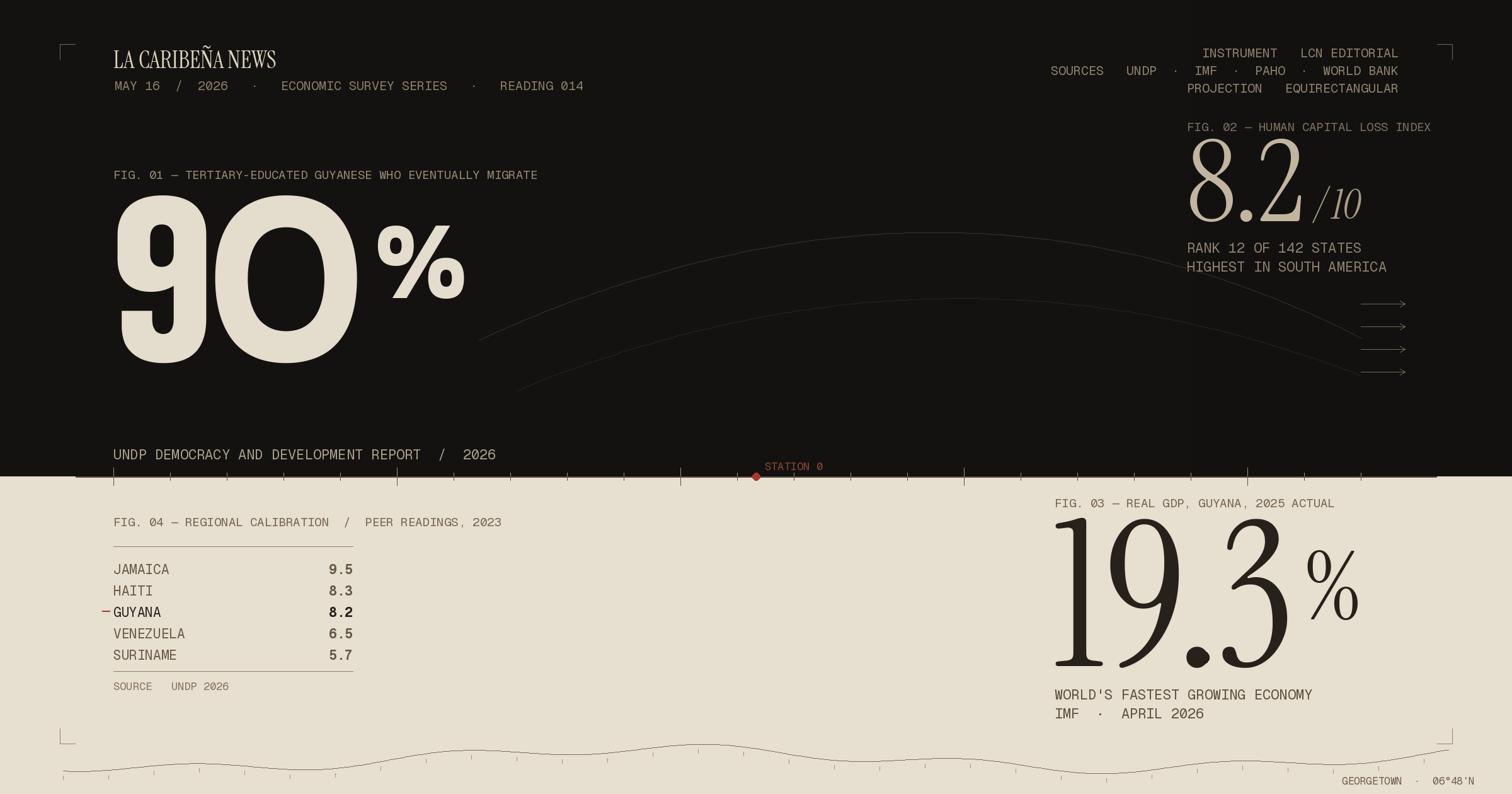
The UN's 2026 Democracy and Development Report puts Guyana 12th in the world for brain drain, raising the question of whether the country can build the institutions it will need to manage the wealth it is generating.
By LCN Newsroom
GEORGETOWN, May 16, 2026
The same Guyana the IMF projects to grow another 16.2 percent in 2026, on top of 19.3 percent last year, is also losing skilled workers faster than almost any other country in the world.
The 2026 Democracy and Development Report from the United Nations Development Programme, released this month, ranks Guyana 12th globally for brain drain. In the Latin America and Caribbean region the country sits in fourth place, behind only Haiti, Jamaica, and one other regional nation, according to reporting by NY Carib News, Kaieteur News, and the Guyana Standard. Guyana's human capital loss score for 2023 came in at 8.2 out of 10. That is the highest in South America, well ahead of Venezuela's 6.5 and Suriname's 5.7.
The figure most likely to land with international readers is the one the UNDP puts at the heart of its case. Nearly 90 percent of Guyanese with tertiary education eventually migrate, the report finds, with North America the most common destination. Earlier reporting in Kaieteur News, citing World Bank data, has long held that about 39 percent of Guyanese citizens already live abroad.
Set those numbers against what the IMF said about Guyana in its 2025 Article IV consultation. Real oil GDP rose nearly 58 percent in 2024. Non-oil GDP grew more than 13 percent. The Natural Resource Fund closed 2024 above US$3.1 billion. Production sat near 645,000 barrels a day at the end of 2024, up from 98,000 barrels a day in its first full year of production. The IMF expects output above 1.3 million barrels a day by 2027.
Two stories run at once. One is a sovereign balance sheet that most finance ministries in the region would trade theirs for. The other is a quiet, steady exit by the people who would normally be running its hospitals, classrooms, regulatory agencies, and ministries.
The UNDP report is careful about why the departures are happening. It does not frame them as flight from conflict. It calls them a rational response to gaps in healthcare, public services, and social protections that have not closed even as oil revenue has filled the treasury. The Pan American Health Organization places Guyana's life expectancy between 66 and 76 years, alongside Haiti's, and below the Caribbean average of 77.8. For a doctor, a nurse, or a teacher weighing whether to stay, that comparison cuts both ways.
That math has been familiar for thirty years, but the offer on the other side has grown sharper. The United States, Canada, and the United Kingdom now actively recruit Caribbean-trained nurses and teachers, sometimes through bilateral agreements. The same English-language education and Commonwealth credentials that make Guyanese professionals employable at home also make them portable abroad. The barrier to leaving is lower than for most countries on the UNDP's list.
Domestic actors have been pointing at the same gap. In June 2024 the Guyana Public Service Union urged the government to “stop the brain drain, put people over profits,” calling for better working conditions and stronger investment in public servants. The UNDP report puts that union appeal in a wider context. The professionals leaving are concentrated in healthcare, education, and the public service. Those are the same sectors the country needs to staff if it wants to translate oil revenue into roads, schools, hospitals, and well-supervised contracts.
There is also a second migration story layered on top of the first. As skilled Guyanese leave, the country has become a destination for Venezuelans fleeing economic collapse next door. The government has used regional frameworks to regularise many of those arrivals. The pressure that creates on schools, clinics, and housing is real, and it adds load to systems already short on the workers who would normally run them.
For compliance and governance audiences, the most consequential line in the UNDP report is the one about oversight. The agency warns that the loss of trained professionals weakens the institutions Guyana needs to manage its oil wealth and protect its democratic governance. Procurement teams, financial intelligence units, audit offices, tax administrators, environmental regulators. These are the functions that turn windfall revenue into long-run development. They are also the functions hardest to staff when the median tertiary-educated Guyanese ultimately settles somewhere else.
That is the through line that connects the brain drain numbers to the oil numbers. Capital can be saved in a sovereign wealth fund. Institutional capacity cannot. Once a generation of mid-career regulators, auditors, and clinicians has emigrated, replacing them takes a decade or more of training, retention pay, and credible career ladders. The UNDP's framing is that Guyana's growth model is, for the moment, outrunning its human-capital model.
The report does not prescribe a single fix. It points to the well-trodden levers governments use to bend brain drain curves. Diaspora engagement programmes that put skilled emigrants back in the country temporarily. Salary scales for technical roles that compete with North American offers. Faster pathways for credentialled professionals to come home. Healthcare and education spending visible enough to change the family conversation at the kitchen table.
Guyana's government has not yet issued a detailed response to the 2026 report. The next budget cycle and the next round of public-service pay negotiations will be the first concrete tests of whether the warning lands.
For now the numbers describe a country running two clocks. One is counting barrels. The other is counting departures.
Sources
• NY Carib News: Guyana – Brain Drain Crisis Despite Booming Oil Economy
• Kaieteur News: Despite oil boom and govt. development claims... Guyana tops brain drain list
• Guyana Standard: Guyana Tops South American Brain Drain Rankings
• IMF: Executive Board Concludes 2025 Article IV Consultation with Guyana
Editor's Note
This article is an original LCN news report written from primary public reporting (NY Carib News, Kaieteur News, Guyana Standard) and primary institutional data (IMF, UNDP, PAHO, World Bank). No copy was reproduced from the source articles. The framing connecting brain drain to institutional capacity is LCN's own.