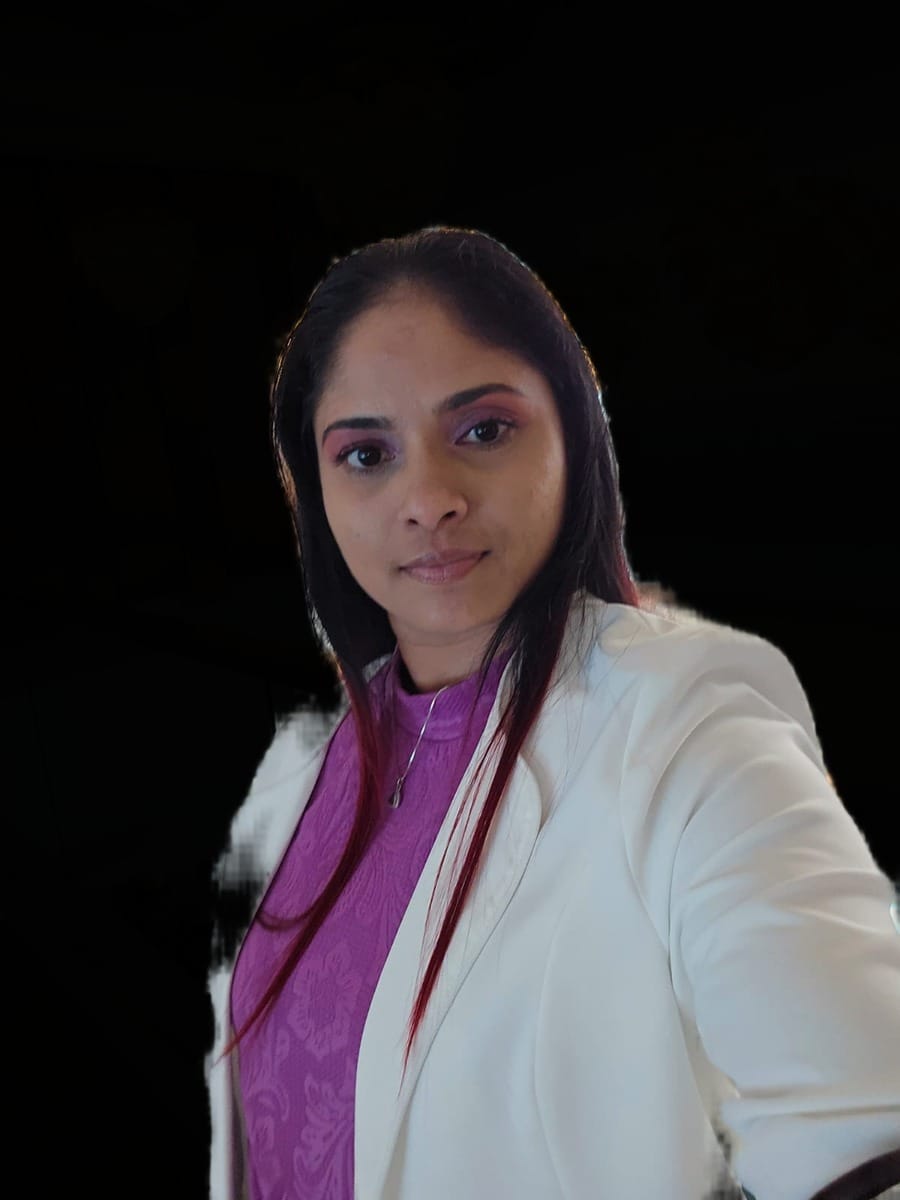
A teacher in West Bank Demerara built a learning app that works without internet. The country needs thousands more like her. The window to train them is closing.
By La Caribeña News Editorial | Education & Economy | May 15, 2026
In a nursery classroom in West Bank Demerara, a four-year-old taps a tablet screen. The picture is a goat. The voice says “goat.” The child says “goat.” The lesson works whether the internet is up that day or not.
The teacher who put that tablet in that child’s hand is Khaimwatie Seenarine. She built the app herself.
That sentence should be the most important one in Guyana’s economic development conversation this year. Because if the country wants to build a knowledge economy on top of its oil economy, it needs an army of teachers who think the way Seenarine thinks. Right now it has a handful. The pipeline to make more of them does not exist at the scale the next ten years demand.
Guyana is planning a future. Oil revenue funds the runway. Construction is everywhere. Roads, ports, hotels, the bridge. The plan assumes that the people who will run the digital economy on the other side of all this construction will somehow appear. They will not appear on their own. They have to be taught. And the teachers who can teach them have to be taught first.
That is the missing pillar.
The Wild Ducks of Industry
Thomas Watson Jr., the man who ran IBM through its biggest growth decades, kept returning to a parable from the Danish philosopher Søren Kierkegaard. A man on a heath fed bread to wild geese flying south every fall. The geese grew fat. The geese grew comfortable. Eventually they could not fly with the migrating flock at all.
Watson wrote it down in 1963: “We are convinced that any business needs its wild ducks. And at IBM we try not to tame them.” He used the parable to argue for room inside a corporation, the room to be eccentric, to chase odd ideas, to refuse the comfortable consensus. He believed innovation came from people who would not sit still. His job, he said, was to protect them from a system that would otherwise feed them bread until they stopped flying.
Guyana has its own wild ducks. Khaimwatie Seenarine is one of them.
A Tablet, a Grant, and an App That Works Offline
Seenarine taught in nursery classrooms before she built anything. She noticed her pupils responded to a tablet. She also noticed that the children who needed reading practice the most lived where the internet was the least reliable. She decided to fix that herself. In January 2021, the Small Business Bureau’s Green Tech Fund awarded her a GYD$1 million grant. She used it to develop an offline-capable mobile app. Download once. Use it anywhere.
The result is the Animal Friends Learning App, an adaptation of the Timehri Reader and Animal Friends workbooks. Children build sight-word recognition and vocabulary through interactive activities. The Ministry of Education received the app in July 2022. By March 2023, it was running in nursery classrooms across several regions.
She also founded Smart Learning Guyana, a retail brand at the West Central Mall in Leonora that sells educational toys and supplies. In April 2026, the Essequibo Islands-West Demerara Chamber of Commerce and Industry voted her onto its executive committee.
This is what a wild duck looks like in a Guyanese classroom. She did not wait for permission. She did not wait for infrastructure. She did not wait for someone in Georgetown to write a curriculum. She solved the problem in front of her with the tools she had.
The North American Mirror
Kayla Delzer teaches third grade in Mapleton, North Dakota, a small farming community west of Fargo. She has been doing what Seenarine did, but with one difference. Her school, her district, and her state government got behind her early.
Delzer paired flexible seating with daily tablet-based and app-based learning. Her third-graders publish to classroom social media accounts under her supervision. The New York Times called her one of the most tech-savvy teachers in the United States. Governor Doug Burgum and the state superintendent named her North Dakota Teacher of the Year in 2019. She was selected for the Global Hundred Award as one of the world’s most innovative educators.
The part that matters for Guyana is what happened after the pilot worked. Her colleagues at Mapleton Elementary applied for a grant to roll the model out across every classroom. The school used her work to plan a new building. The state amplified her platform. Her TEDx talk has crossed 200,000 views. “Students should be using technology as a tool to enhance their understanding of content,” she wrote on Edutopia. “They shouldn’t be using technology just for the sake of using technology.”
The story is not that North Dakota is smarter than Guyana. The story is that North Dakota built the scaffolding that lets a wild duck multiply. Mapleton found one. The state put her on television. The school used her to redesign itself. The country watched.
Guyana found Khaimwatie. The question is what the country does next.
The Capital Is Already Coming
This week, U.S. Under Secretary of State Jacob Helberg flew into Guyana. The trip readout from Washington listed the usual cargo: energy, mining, bauxite, regional security. The line that should have made every educator in the country sit up was about technology. Helberg told reporters Guyana could be “an incredible place for Silicon Valley companies to come test new technologies and potentially set up shop here.” A U.S.-Guyana working group is now being discussed to fast-track tech and mineral investments.
The marquee project Helberg’s visit reinforces is already on the ground. Cerebras Systems, the California AI infrastructure company, is planning a 100-megawatt AI data center at Wales, on the same stretch of the West Bank of Demerara where Khaimwatie Seenarine puts tablets in nursery classrooms. The capital is arriving where the proof of concept already lives.
Who will run the data center? Who will write the code that runs on it? Who will tune the models, audit the outputs, repair the boards, secure the network, and explain to the rest of the country what the machine is doing? Cerebras will bring some of its own people. Some roles will be filled from the diaspora. The rest will be Guyanese, or they will not be Guyanese, because nobody trained them.
The Stakes Are Arithmetic, Not Opinion
A knowledge economy needs knowledge workers. Knowledge workers need teachers. The teachers needed are not generic. They are specifically the kind who can teach what students will not get from a textbook: how to use a tablet to learn, how to use an app to leapfrog a missing library, how to ask a machine the right question, and how to evaluate the answer it gives back.
That is what an IT skills teacher does. That is what an AI skills teacher does. Guyana’s secondary schools currently graduate a small fraction of students with practical software literacy. Its universities produce fewer graduates with applied AI skills than the country’s banks, telcos, mining concerns, and oil-and-gas suppliers will demand within five years. Every pillar of the economic plan, from local content to regional services exports to the digital public infrastructure that government keeps announcing, depends on closing that gap.
The teachers who can close it have to come from somewhere. They will not be imported at scale. They will not be retrained from existing rosters without a pipeline. They have to be built.
Khaimwatie Seenarine is the proof that one teacher, given enough room, can do it. The country needs ten thousand more of her.
What Happens If the System Feeds Them Bread
Watson’s point about wild ducks was not that they were rare. It was that systems killed them. Bureaucracy fed them bread until they could not fly. Schools, when they work badly, do the same to the teachers inside them. The teacher who builds the app, the teacher who tries the unconventional method, the teacher who refuses to wait for the curriculum revision, is also the teacher most likely to be told to sit down and be quiet.
Guyana cannot afford to feed bread to its wild ducks for the next ten years. The country needs the opposite. A program to find them, fund them, give them platforms, and let them train the next cohort.
The tablet in the West Bank Demerara nursery already works. The question is whether the system around it will.
Further Reading on La Caribeña News
- A Trader Made US$250 Million on Russian Oil. Now He Wants Guyana. Who Benefits? — Context on Guyana’s economic transformation and the local-content question.