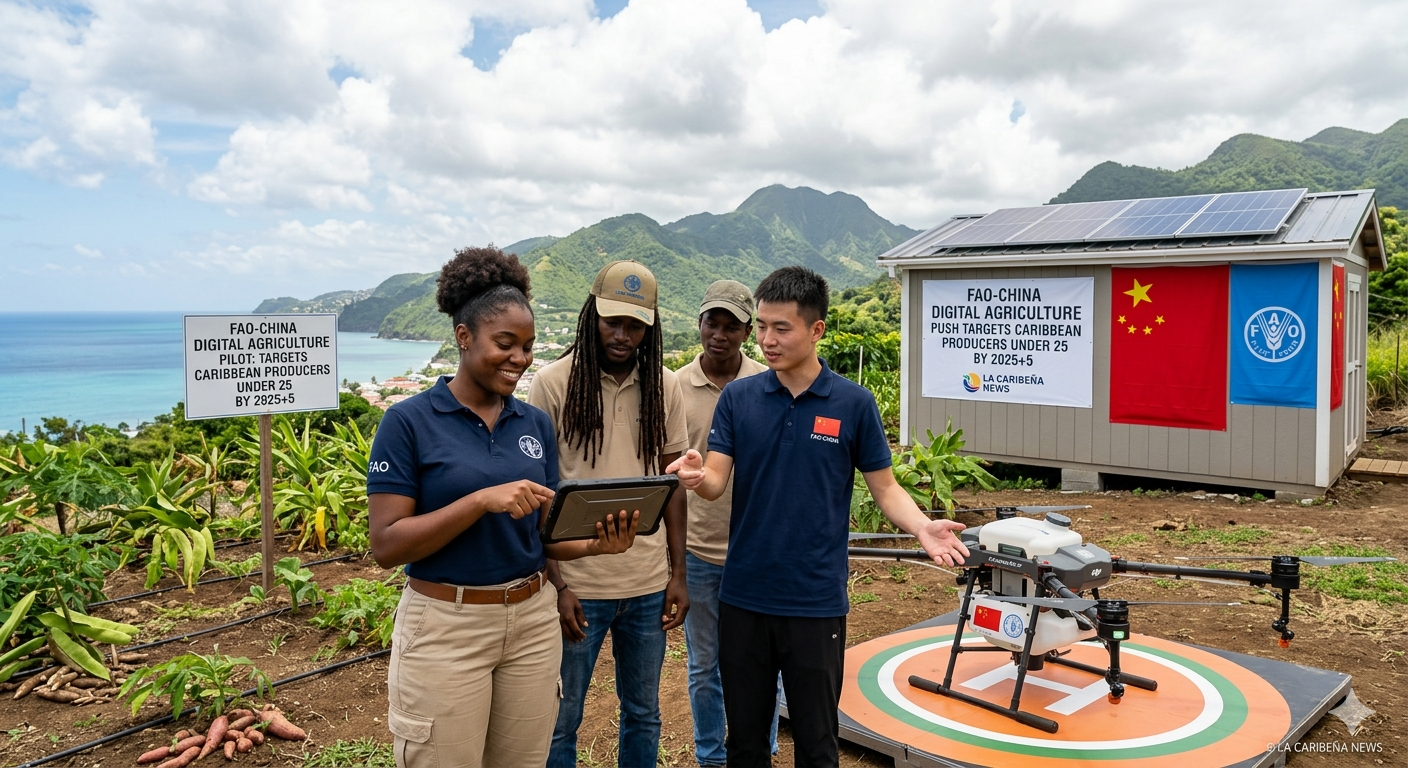
GEORGETOWN, Guyana — The Food and Agriculture Organization of the United Nations and China endorsed six new South-South cooperation projects under a 2025-2026 workplan worth nearly US$68 million, expanding digital agriculture tools to Caribbean and Latin American producers under CARICOM's 25 by 2025+5.
How does digital agriculture connect to 25 by 2025+5?
CARICOM's 25 by 2025+5 framework, extended to 2030 at the 48th Heads of Government meeting in Barbados in February 2025, names digital technology and innovation as a strategic pillar for cutting the region's US$6 billion food import bill. The framework targets improved productivity, traceability, and market access for priority commodities including poultry, small ruminants, root crops, fruits, and vegetables.
The Food and Agriculture Organization and China have already tested that approach in the Caribbean. A South-South cooperation project completed across 12 CELAC countries, including Guyana, Barbados, Jamaica, Suriname, Trinidad and Tobago, and Cuba, delivered more than 70 digital literacy training sessions and distributed over 400 technological devices to rural communities with limited connectivity. The programme directly trained 800 people and benefited more than 4,000 indirectly through strengthened rural associations.
What results did the CELAC digital agriculture project produce?
The programme delivered weather monitoring equipment, digital literacy training, and market access tools that helped small producers in at least four countries improve crop timing, reduce waste, and reach buyers online.
In Costa Rica, producer Juan Carlos Sibaja said the weather station helped farmers track temperature changes and apply fertiliser at the right time. In Argentina, artichoke producer Adriana Ricetti said training sessions helped her group organise, involve younger family members, and market their geographically indicated products online.
Luiz Beduschi, the Food and Agriculture Organization's Senior Policy Officer for Latin America and the Caribbean, said the project proved that digital tools could improve both production processes and quality of life for small-scale farming communities. The programme also created a Facility Platform for Rural and Agricultural Digitalization, a resource hub that remains accessible to producers and policymakers in all 12 participating countries as of May 2026.
For Caribbean producers specifically, these tools address constraints that the region's agro-processors face repeatedly: limited digital infrastructure, weak traceability systems, and the gap between production capacity and export-ready documentation.
What comes next under the FAO-China programme?
The Food and Agriculture Organization and China's Ministry of Agriculture and Rural Affairs endorsed six new project proposals and approved a 2025-2026 workplan at the 13th Annual Consultation Meeting of the FAO-China South-South Cooperation Programme. The programme's cumulative budget now stands at nearly US$68 million across 22 projects spanning digital agriculture, crop and livestock production, aquaculture, plant health, and sustainable water management.
Separately, China and CELAC adopted a Joint Plan for 2025-2027 covering food security projects, green agriculture, and joint programmes on high-tech farming systems and food market data exchange. The FAO-China South-South Cooperation Trust Fund has grown to US$130 million, as confirmed by FAO Director-General QU Dongyu at the World Food Forum Ministerial Dialogue in October 2025.
Whether these expanded programmes reach Caribbean small producers at scale depends on the same structural factors limiting the 25 by 2025+5 initiative itself: trade barriers between CARICOM member states, uneven production capacity, and the distance between pilot-level digital tools and the region-wide systems needed to move food across borders reliably.
Author: LCN Newsroom