EMIGRATION · OIL ECONOMY · BRAIN DRAIN
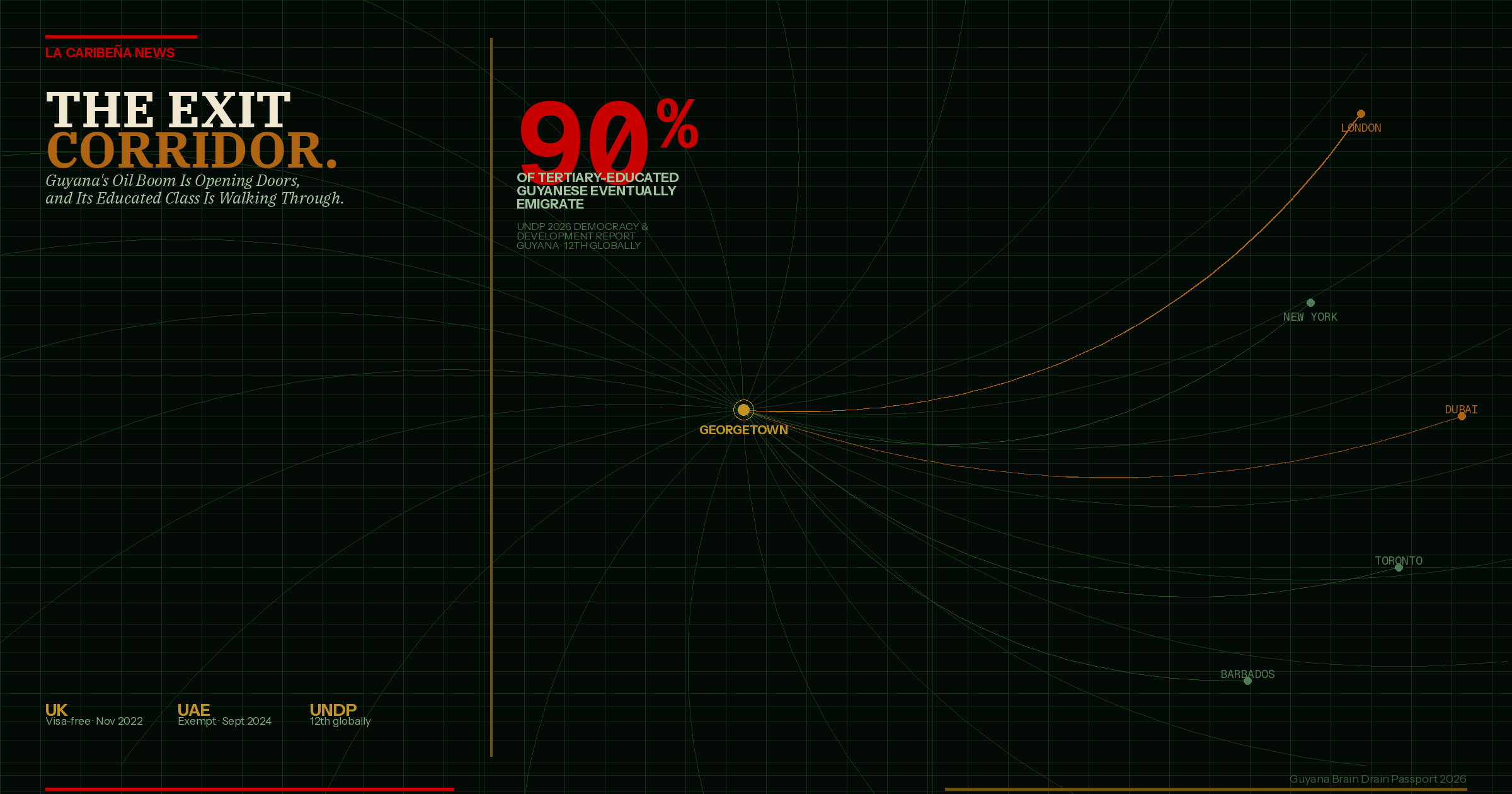
Guyana ranks 12th globally for brain drain. Nearly 90 percent of tertiary-educated Guyanese eventually emigrate. The UK and UAE access wins that made headlines as diplomatic victories have also made it easier to leave permanently.
June 26, 2026 · La Caribeña News
Quick summary:
The UNDP 2026 Democracy and Development Report ranks Guyana 12th globally for brain drain, with nearly 90 percent of tertiary-educated Guyanese eventually emigrating. The three sectors losing the most workers are healthcare, education, and the public service. The UK visa waiver secured in November 2022 and the UAE mutual exemption signed in September 2024 have opened two of the corridors that absorb the most professional talent. The oil boom is generating the GDP. It is not yet generating the conditions that make staying the rational choice.
GEORGETOWN, GUYANA. The same trade relationships that persuaded the United Kingdom to drop its visa requirement for Guyanese passport holders in November 2022 have made the UK one of the most accessible destinations in the world for a Guyanese nurse, teacher, or civil servant who wants to leave. That is not a coincidence. It is the structure of the problem.
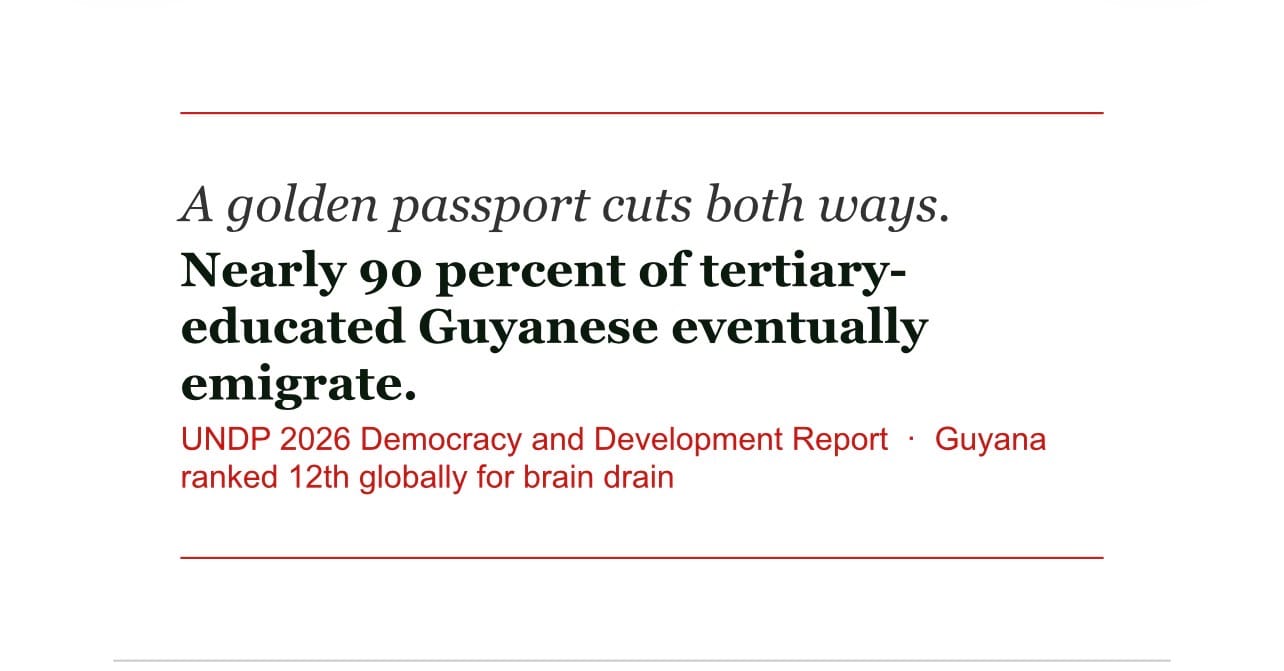
The UNDP 2026 Democracy and Development Report ranks Guyana 12th globally for brain drain. Nearly 90 percent of tertiary-educated Guyanese eventually emigrate. The figure concentrates in three sectors the country can least afford to lose: healthcare, education, and the public service. These are not marginal losses. They are the institutions through which oil wealth is supposed to reach the population that owns it.
Foreign Secretary Robert Persaud was right in April 2025 when he told a diaspora job fair in Toronto that the Guyana passport had become a “golden passport.” He was not wrong about the direction. But a golden passport cuts both ways. A document that once complicated international travel now smooths the path out. La Caribeña News has covered the passport’s rise through the Henley Index and the diplomatic wins behind it. This article is about the other side of that story.
What Does Guyana’s Brain Drain Look Like in 2026?
The UNDP’s ranking of 12th globally is not a new observation dressed in new data. Guyana has ranked among the highest-emigration small states in the world for decades. What is new is the combination of factors shaping it in 2026: the fastest-growing economy on earth, a newly powerful passport, and the persistent absence of wage and institutional conditions that would make staying financially competitive with leaving.
The 90 percent emigration rate for tertiary-educated Guyanese is a long-run figure, not a single-year snapshot. It reflects the cumulative outflow of graduates over time. A university graduate in Georgetown weighing a healthcare career faces a specific calculation: public sector salaries constrained by a government workforce built for a pre-oil budget, private sector options that are expanding but unevenly, and a UK National Health Service or UAE private hospital system that has actively recruited from the Caribbean since well before the 2022 visa waiver.
The visa waiver removed a material barrier. Before November 2022, a Guyanese nurse planning to work in the UK needed a work visa, a sponsor, and a process that took months and cost money. After November 2022, the path shortened substantially. The work visa requirement remains for employment, but the ability to travel without a visa first for interviews, assessments, and registration verification changed the friction of migration in ways that compound over time.
Which Sectors Are Losing the Most Workers?
Healthcare is the most documented and the most acute. Guyana’s public health system has operated at a structural deficit of trained workers for years, a deficit that the oil boom has not yet closed because closing it requires not just money but the years it takes to train a doctor, a specialist, or a nurse at the level the public sector needs. The University of Guyana’s medical and health science programs produce graduates who leave at rates the country has not been able to reverse with compensation adjustments alone.
Education faces the same structural dynamic. Teachers trained through the Cyril Potter College of Education and the University of Guyana enter a salary structure that makes an overseas posting, particularly in the UK or Canada, financially rational almost immediately after graduation. The Caribbean Single Market and Economy provides free movement for certified teachers across CARICOM member states, which means regional migration is also available as an intermediate step, and frequently is one.
The public service loses a different profile of worker: the policy analyst, the economist, the lawyer, the financial administrator. These are the people required to manage a sovereign wealth fund responsibly, to negotiate the terms of ExxonMobil’s production sharing agreements at arm’s length, and to build the regulatory infrastructure an oil state requires. The IMF’s 2025 Article IV Consultation noted institutional capacity as a constraint on Guyana’s ability to translate resource revenue into broad-based development. Brain drain is not incidental to that constraint. It is a primary cause.
Where Are Educated Guyanese Going?
New York has been the primary diaspora destination for the better part of six decades. The Guyanese-American community, concentrated in Brooklyn’s East Flatbush, Richmond Hill in Queens, and parts of the Bronx, is estimated in the hundreds of thousands. It is a community with deep professional networks, established migration pathways, and the infrastructure of a diaspora that has been building for generations. The US still requires a visa for Guyanese nationals, which means the New York corridor runs through the visa application process, but it runs nonetheless, because the network at the destination end is strong enough to absorb the cost of that process.
The UK changed shape in 2022. Before the visa waiver, the UK was a destination that required more preparation. After it, London, Manchester, Birmingham, and the NHS recruitment pipeline became materially more accessible. The practical meaning of “visa-free for 180 days” for a professional is not just leisure travel. It is the ability to attend an interview, complete a registration process with the relevant professional body, and return home with a job offer before committing to the move. That sequence was far harder before November 2022.
Dubai and Abu Dhabi entered the picture at scale after September 2024, when the UAE mutual exemption MOU came into force. The Gulf healthcare market, particularly private hospital systems in Dubai, has recruited Caribbean nursing and paramedical staff aggressively for years. The previous visa requirement was a barrier, not an absolute one, but a barrier. Its removal is too recent to measure precisely in emigration statistics, but the structural conditions are identical to those that drove the post-2022 UK acceleration.
Canada remains a primary destination, particularly for healthcare and technology workers, running through a permanent residency and immigration stream that does not require the same kind of visa-waiver arrangement because it is a longer and more structured pathway. Toronto has the largest Guyanese diaspora outside the United States.
How Has the New Passport Strength Changed the Migration Pattern?
The Guyana passport’s rise to 55th globally with 89 visa-free destinations has changed the geography of optional destinations more than it has changed the primary migration flows. New York, Toronto, and London are driven by networks and opportunity structures that precede the passport improvements. What the passport changes have done is lower the cost of keeping options open.
A Guyanese professional in 2026 who is uncertain about whether to stay or leave can now visit the UK without a visa, travel freely across the Caribbean under the CSME, and access the UAE without advance application. The ability to move around, to compare conditions, to attend professional development events abroad, and to maintain connections with diaspora communities has increased substantially since 2022. Research on emigration consistently shows that the ability to maintain optionality increases the probability of eventual departure. The passport changes have raised Guyana’s optionality ceiling for every professional in the country.
This is not an argument against the passport improvements. It is a description of how economic and diplomatic changes interact with migration decisions in ways that are not always linear or immediately legible in policy terms.
What Is the Government’s Response?
The government has acknowledged the brain drain publicly and repeatedly. The Ministry of Health has run recruitment campaigns targeting the diaspora, particularly in New York, seeking to attract Guyanese-trained or Guyanese-origin professionals back to positions in the public health system. Salary adjustments in the public sector have been made, though the gap between Guyanese public sector compensation and equivalent roles in the UK or Canada remains substantial.
The Natural Resource Fund, established to manage oil revenues for long-term national benefit, has as part of its mandate the financing of infrastructure and human development that would make Guyana a more competitive domestic employer over time. The timeline for that impact is measured in years, not quarters.
The Go-Invest Guyana investment promotion agency has prioritized attracting private sector investment in sectors that would create high-wage employment, which in theory would compete with overseas salary levels. In comparable oil-boom economies, the lag between resource extraction at scale and domestic wage convergence with high-income destination countries has typically run ten to fifteen years.
Is There Any Sign the Trend Is Reversing?
Not yet in aggregate, though there are specific segments where return migration is visible. The oil and gas sector has attracted Guyanese engineers, petroleum economists, and project managers who were working in Houston, Calgary, Aberdeen, and Trinidad and Tobago back to Georgetown, drawn by the scale of the Stabroek Block opportunity and salaries competitive with international energy industry standards. This is the exception, not the rule, and it is concentrated in one sector.
Remittances from the diaspora remain substantial and are, for many Guyanese families, a more immediate form of resource transfer than oil revenue routed through the government budget. The World Bank has tracked remittance inflows to Guyana as a significant percentage of GDP. That flow represents the diaspora’s continuing economic relationship with the country, but it is not the same as the return of the people sending it.
The trajectory through 2026 is an economy growing faster than almost anywhere on earth, a passport getting stronger year by year, and an emigration rate that has not reversed. These things are not contradictory. They reflect the fact that development takes longer than drilling.
Frequently Asked Questions
What is Guyana’s brain drain ranking in 2026?
The UNDP 2026 Democracy and Development Report ranks Guyana 12th globally for brain drain. The report measures the proportion of tertiary-educated nationals who emigrate and do not return. Guyana’s figure of nearly 90 percent is among the highest in the world and reflects decades of cumulative outflow, not a single-year measure.
Which sectors in Guyana are most affected by brain drain?
Healthcare, education, and the public service are the three sectors identified as most affected. Healthcare losses are the most acute in practical terms, as the public hospital system requires trained specialists and nurses who are recruited actively by the UK’s National Health Service, Canadian provincial health authorities, and Gulf private hospital networks. The public service loses the analytical and administrative capacity required to manage oil revenues at the institutional level the economy now demands.
Has the UK visa waiver increased Guyanese emigration to the United Kingdom?
The UK granted visa-free travel to Guyanese passport holders in November 2022. From January 2025, a UK Electronic Travel Authorisation (ETA) of £20 is required before travel. The waiver has reduced the friction of professional migration by enabling Guyanese nationals to attend interviews, complete professional registration processes, and assess the UK labour market before committing to a work visa application. Its full effect on emigration rates will not be visible in data for several years.
Does the UAE visa exemption affect professional migration from Guyana?
The UAE signed a mutual visa exemption MOU with Guyana in September 2024. Gulf private healthcare systems have recruited Caribbean nursing and paramedical staff aggressively for years. The removal of the visa requirement for initial travel reduces one of the barriers in that recruitment pipeline. The effect is most likely to be felt among healthcare workers and hospitality professionals.
Is the oil boom reducing the brain drain?
Not yet in aggregate. The oil boom has created high-wage employment in the petroleum sector that has attracted some diaspora return, particularly among engineers and energy professionals. The broader public sector wage structure and the institutional conditions that determine whether a teacher, nurse, or policy analyst chooses to stay have not yet converged with what comparable professionals can earn in the UK, Canada, or the UAE. The IMF projects this gap will narrow over the medium term as oil revenues flow into public investment and private sector growth, but the timeline extends well beyond 2026.
What does CARICOM free movement mean for Guyanese professionals?
Under the Caribbean Single Market and Economy (CSME), Guyanese nationals in certified professional categories, including university graduates, nurses, teachers, and artistes, can work in other CARICOM member states without a work permit. This means Trinidad and Tobago, Barbados, and other members with higher wage levels within the region are accessible destinations that do not appear in international emigration statistics but represent a regional form of the same brain drain dynamic.
La Caribeña News covers business, economics, and regional affairs across the Caribbean and its diaspora.