PASSPORT · DIPLOMACY · OIL ECONOMY
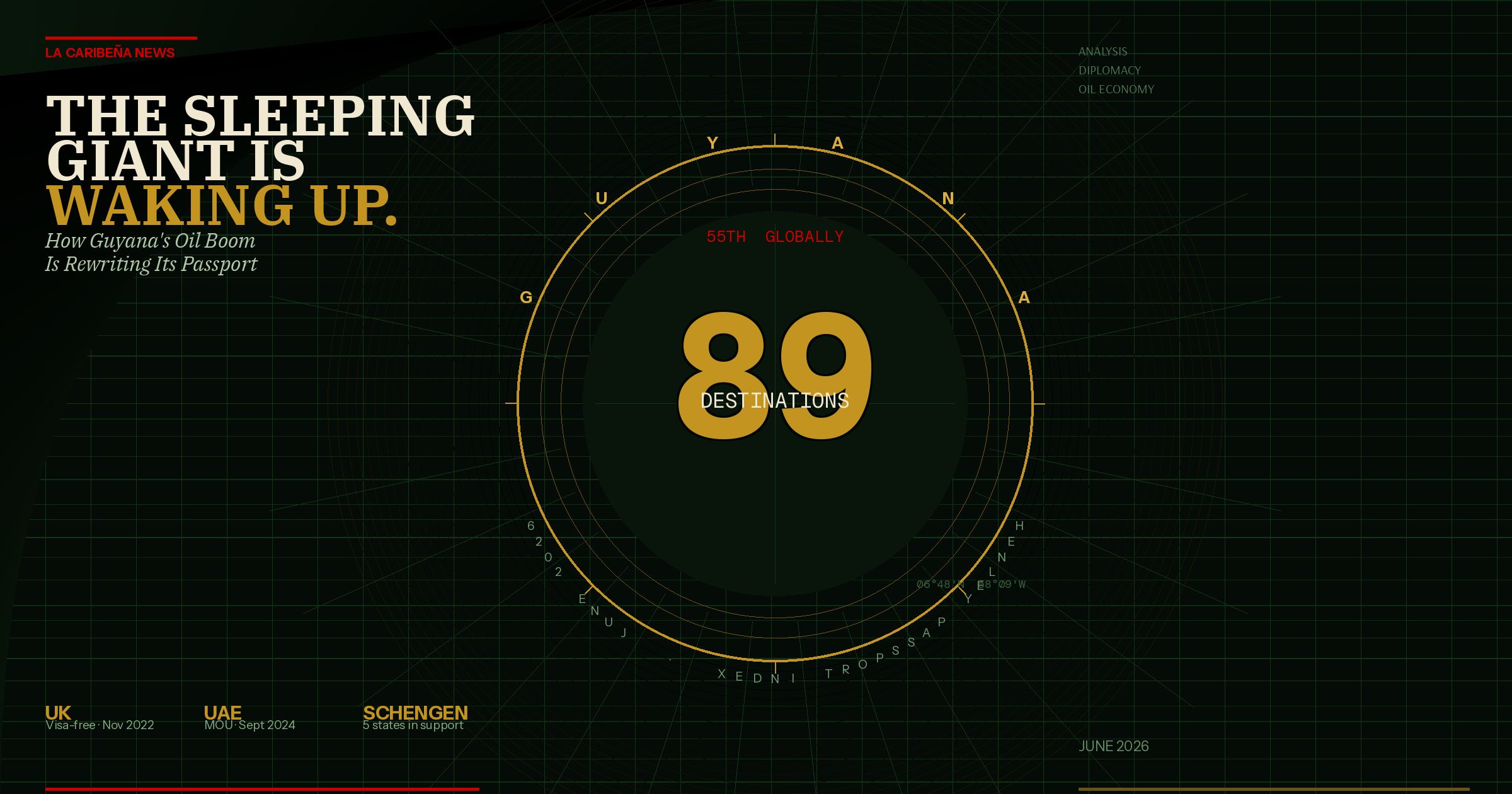
UK visa-free since 2022. UAE added in 2024. Five European countries backing Schengen access. Guyana’s passport sits at 89 countries in 2026 — here’s what changed and what’s still driving it.
June 27, 2026 · La Caribeña News
Quick summary:
The Henley Passport Index June 2026 ranks Guyana’s passport 55th globally with 89 visa-free destinations, down from 91 in 2025. Since 2022, UK and UAE access have been secured through direct bilateral agreements, and Schengen access is in active negotiation. Five European countries have already declared support for Guyana’s bid. The oil money created the leverage. The diplomatic wins are following the leverage.
GEORGETOWN, GUYANA. Green, gold, and red, the colours of the Golden Arrowhead, now mark the cover of a passport the Ministry of Home Affairs calls “a portable celebration of Guyanese identity.” Launched in February 2025, the redesigned 10-year biometric e-passport moves page by page through the Jaguar, Kaieteur Falls, the Hoatzin, and the African, Indian, Chinese, and Indigenous traditions that shape the country. For most of Guyana’s post-independence history, the document beneath that cover moved quietly through the world. Within CARICOM it worked. Beyond the region, it complicated things.
Foreign Secretary Robert Persaud put it plainly at a diaspora job fair in Toronto in April 2025: “There was a time when people used to hide this passport away. Now, this passport is considered a ‘golden passport’ across the world.”
In November 2022, Guyanese passport holders gained visa-free access to the United Kingdom for up to 180 days, following a joint announcement by President Dr. Irfaan Ali and British High Commissioner Jane Miller. The context: by 2021, Guyana was already the UK’s largest Caribbean trading partner, with bilateral trade at £516 million, 21.6% of all UK-Caribbean commerce. The visa waiver followed the trade.
In September 2024, the UAE signed a mutual visa exemption MOU with Guyana on the sidelines of the UN General Assembly. By July 2023, President Ali had already disclosed that five European countries had declared support for Guyana’s Schengen Area bid, the 26-country bloc where Guyanese nationals still require an advance visa.
Where does 89 destinations sit in the world?
Above Jamaica. Above China. Above India.
Henley Passport Index · June 2026 · 55th globally · 89 destinations
A country that spent most of its post-independence history locked out of high-value travel corridors now outranks some of the most populous nations on earth. The gap to CARICOM’s leaders is real: Barbados holds 163 destinations (20th globally), The Bahamas 158 (21st). That distance takes years of sustained diplomacy to close, not a few good trade deals.
Why Does the Guyana Passport Still Rank Below Most of Its Caribbean Neighbours?
The Henley Passport Index, published by Henley & Partners using data from the International Air Transport Association (IATA), measures how many destinations a passport holder can enter without a visa in advance, counting visa-free access and visa-on-arrival arrangements together. It is the data source behind every ranking figure in this article.
Passport strength is not a function of current GDP. It reflects decades of bilateral visa agreements, built on mutual trust, tourism volumes, immigration risk profiles, and diplomatic relationships cultivated over time. An economy can double in three years. A passport’s reach builds across generations of diplomatic engagement.
Guyana’s oil wealth arrived at scale in December 2019, when the ExxonMobil-led consortium reached commercial production at the Stabroek Block. The UK visa waiver came three years later. The UAE mutual exemption five years later. That sequencing is not accidental. Economic weight opens doors that decades of diplomatic courtship could not.
The corridors still requiring advance visas for Guyanese nationals are the Schengen Area (26 countries), the United States, and Canada. These three are where the active diplomatic work is now concentrated.
How Does the Guyana Passport Compare to Other CARICOM Members in 2026?
CARICOM Passport Rankings by Visa-Free Destinations — Henley Passport Index 2025 vs. June 2026
Data source: Henley & Partners, Henley Passport Index. Underlying data: International Air Transport Association (IATA). 2025 figures reflect the annual 2025 index; 2026 figures reflect the June 2026 monthly edition published 17 June 2026.
Text equivalent: In 2025, Barbados led CARICOM at 165 destinations (21st globally), followed by The Bahamas (161, 22nd), St. Kitts and Nevis and St. Vincent and the Grenadines (both 157, joint 24th), Antigua and Barbuda (148, 29th), Trinidad and Tobago (144, 34th), Guyana (91, 54th), and Jamaica (89, 56th). By June 2026, Antigua and Barbuda gained the most ground in the region (+6 destinations), while Jamaica lost the most (-4). Guyana moved from 54th to 55th, losing two destinations in the period.
Antigua and Barbuda gained six destinations, the largest movement in the region year over year. Trinidad and Tobago added one. Most CARICOM members held position or saw minor reductions, consistent with the routine recalibration of the IATA dataset each cycle. Guyana and Jamaica both contracted, but Guyana holds the edge: 89 destinations to Jamaica’s 85, a lead that did not exist before 2022. Oil money reversed that gap. It continues to hold it open.
What Destinations Can Guyanese Citizens Access Without a Visa?
Within CARICOM, Guyanese nationals move freely under the Caribbean Single Market and Economy (CSME), established through the Revised Treaty of Chaguaramas. All 14 member states are open without a visa or advance application.
Beyond the region, the sharpest change has come since 2022. The United Kingdom grants entry for up to 180 days for leisure and business, visa-free since November 9, 2022. From January 2025, a UK Electronic Travel Authorisation (ETA) is required before boarding. At £20, obtainable in minutes through the UK ETA app, it is not a visa, but it must be secured before travel. The UAE requires no visa since the mutual exemption MOU signed in September 2024. The British Virgin Islands added a mutual waiver in November 2024.
Further afield, Singapore, Hong Kong SAR, Malaysia, Indonesia, Kenya, and Mercosur member states in South America are all accessible without advance visas. The Schengen Area, the United States, and Canada remain the significant gaps.
How Has Guyana’s Oil Economy Reshaped Its Diplomatic Standing?
The ExxonMobil-led consortium at the Stabroek Block reached commercial production in December 2019 with the Liza Phase 1 development. By 2024, Guyana’s crude output averaged approximately 617,000 barrels per day, a 58 percent increase over 2023, according to the U.S. Energy Information Administration. Production is expected to exceed 1 million barrels per day by 2027. The Stabroek Block holds estimated recoverable resources of more than 11 billion barrels of oil equivalent, per ExxonMobil’s published estimates.
Guyana’s GDP grew 43.8% in 2024. Real oil GDP rose nearly 58%; non-oil GDP expanded by over 13%. The IMF projects 19.3% growth for 2025. Average annual growth since 2022 has run approximately 47%, according to the IMF’s 2025 Article IV Consultation, which placed Guyana on a trajectory toward high-income status.
Go-Invest Guyana, the government’s investment promotion agency, reports a substantial rise in signed investment commitments since 2019, drawing companies from the United States, Canada, China, the United Kingdom, and Brazil. IMF data from April 2026 puts Guyana’s GDP per capita above $27,000 in 2025, already above that of several countries whose passports outrank Guyana by 40 or more destinations.
The UK visa waiver. The UAE mutual exemption. Five European states backing a Schengen bid. Countries that matter to the global energy market find that doors open. Guyana is learning that at speed.
What Is the CARICOM Single Market and Economy and What Does It Mean for Guyanese Travellers?
The CSME covers more than entry rights. Under the Revised Treaty of Chaguaramas, progressively implemented since 2006, it provides for the free movement of skilled persons across specific categories: university graduates, media workers, artistes, musicians, sportspersons, and certified professionals. Work-permit requirements between CARICOM member states are eliminated for these categories.
Beyond the region, CARICOM has also pursued collective visa facilitation agreements with third-party blocs. The CARICOM Secretariat has identified Schengen area facilitation as a regional diplomatic priority, a track that all member states benefit from. For Guyana, the UK was secured bilaterally. The Schengen bid may follow the same logic. La Caribeña News has previously reported on how Guyana’s oil boom is reshaping the choices available to its professional class, a dynamic with direct implications for who uses these new travel arrangements and for what purpose.
Is the Guyana Passport Getting Stronger? What Critics Are Saying.
The passport is getting stronger. The politics around it are getting messier.
When the government launched its redesigned biometric e-passport in February 2025, the launch attracted commentary that had nothing to do with visa-free destinations. The new design includes the PPP’s political slogan “One Guyana” printed inside the document. Opposition MP Amanza Walton Desir characterised this as a partisan overreach into a sovereign national document and raised questions about compliance with International Civil Aviation Organisation (ICAO) Document 9303, which sets standards for passport neutrality and interoperability. The criticism was reported by Stabroek News in March 2025.
The controversy does not change the passport’s functional strength. It does clarify the tension running through Guyana’s current moment: a government collecting diplomatic wins at speed while generating political conflict in parallel.
The metrics for June 2026 are mixed, not alarming. Two destinations lost, from 91 to 89, puts Guyana back to its 2024 score. Jamaica dropped four in the same period. Neither move signals a reversal of diplomatic momentum. Both reflect the routine recalibration of the IATA dataset each cycle. The UK breakthrough in 2022 arguably did more for the Guyanese travel experience than anything in a generation, and it drew far less international attention than comparable events in the region.
The question is whether Schengen access follows, and whether Guyana can extend its count before the oil revenues that created this leverage begin to moderate.
The Schengen bid has backing from five European states. The biometric passport satisfies the technical requirements most Schengen negotiations need. None of that guarantees access. But Guyana is, for the first time in its history, in a position to ask.
Frequently Asked Questions
How many countries can Guyanese citizens visit without a visa in 2026?
According to the Henley Passport Index June 2026 edition, Guyanese passport holders can access 89 destinations visa-free or via visa on arrival, down from 91 in the 2025 index. This includes all 14 CARICOM member states under the Caribbean Single Market and Economy (CSME), the United Kingdom (visa-free since November 2022 for up to 180 days, with a £20 ETA required from January 2025), the UAE (visa-free MOU September 2024), and select destinations across Asia, Africa, and South America.
What is the Henley Passport Index?
The Henley Passport Index is a global ranking of passports by the number of destinations their holders can access without obtaining a visa in advance. Published by Henley & Partners using official data from the International Air Transport Association (IATA), it is the most widely cited measure of passport strength globally.
When did Guyanese citizens gain visa-free access to the United Kingdom?
The UK announced visa-free travel for Guyanese passport holders on October 18, 2022, effective November 9, 2022. Guyanese nationals can enter for up to 180 days for leisure or business without a visa. Since January 2025, a UK Electronic Travel Authorisation (ETA) of £20 is required before travel. It is not a visa and is typically approved in minutes, but must be obtained before boarding. The arrangement followed Guyana becoming the UK’s largest Caribbean trading partner, with bilateral trade at £516 million in 2021.
Why does the Guyana passport still rank below most CARICOM neighbours?
Passport strength reflects decades of bilateral visa agreements, not a country’s current GDP. Barbados, Trinidad and Tobago, and The Bahamas have maintained diplomatic and tourism relationships with high-value destinations over a much longer period than Guyana, which only became a significant oil producer after December 2019. Guyana’s passport is gaining ground, but diplomatic leverage built over generations cannot be replicated in a few years.
Is Guyana close to gaining Schengen visa-free access?
As of July 2023, President Dr. Mohamed Irfaan Ali had disclosed that at least five European countries had agreed to support Guyana’s bid for visa-free Schengen Area access. No formal timeline has been announced. The February 2025 launch of Guyana’s biometric 10-year e-passport meets ICAO technical standards, satisfying a key compliance requirement that Schengen negotiations typically need. The bid remains active as of June 2026.
Is Guyana’s stronger passport contributing to the brain drain?
The United Nations Development Programme ranked Guyana 12th globally for brain drain in its 2026 Democracy and Development Report, with nearly 90 percent of tertiary-educated Guyanese eventually migrating, concentrated in healthcare, education, and the public service. The UK and UAE access wins have removed barriers that once slowed professional migration to those destinations. La Caribeña News has investigated this question in depth: read our full coverage of where Guyana’s professional class is going.
La Caribeña News covers business, economics, and regional affairs across the Caribbean and its diaspora.