NEWS STORY | LCN NEWSROOM GEORGETOWN, June 2026
New data from the New York City Department of City Planning shows that Guyanese admissions to the United States most established Caribbean gateway collapsed by nearly 54 percent between the 1980s and the 2010s. Read alongside LCN’s earlier reporting on Guyana’s brain drain, the numbers raise a pointed question: if the exodus has not eased, where is it going?
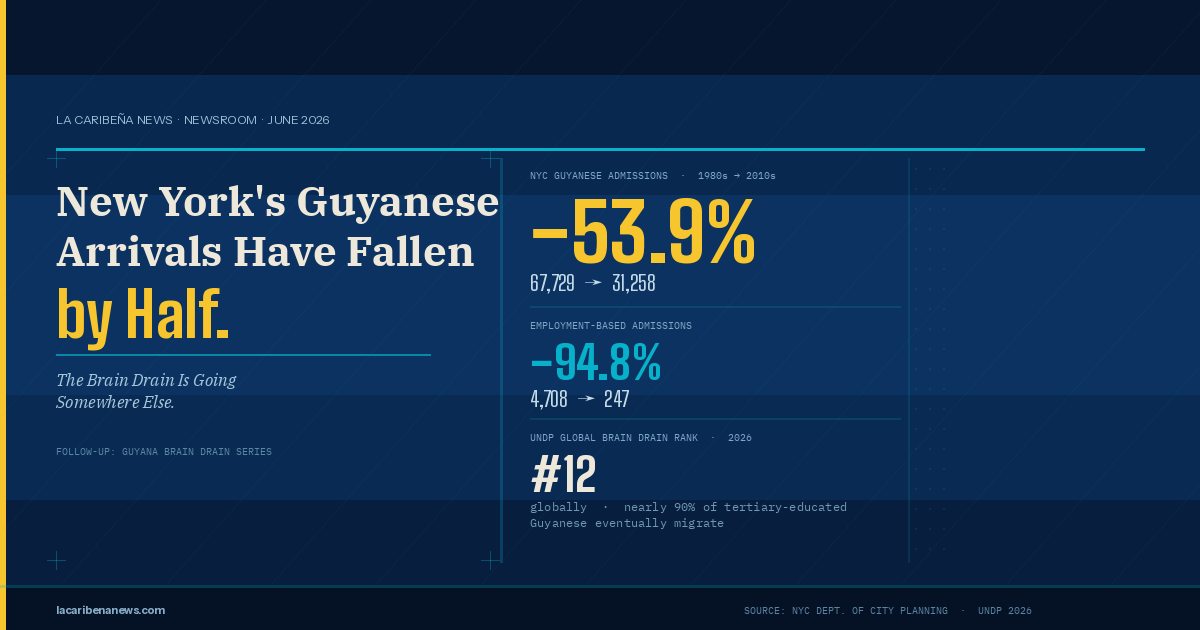
New York City received 67,729 Guyanese immigrants in the 1980s and 31,258 in the 2010s, a 54 percent drop, while employment-based admissions fell 95 percent. The diaspora is redirecting toward Canada and the United Kingdom, not disappearing.
New York City built its Guyanese community borough by borough across four decades. Richmond Hill and South Ozone Park in Queens became so densely settled that the corridor acquired its own name, Little Guyana. By 2020, the city held roughly 140,000 people of Guyanese origin, the fifth-largest immigrant group in the five boroughs. The community did not arrive all at once. It was built on a chain of family-preference visas that stretched from the late 1960s well into the 1990s, each admission creating the paperwork foundation for the next.
That chain has shortened considerably. New data from the New York City Department of City Planning, drawn from federal immigration records covering 1982 to 2021, shows that total Guyanese admissions to New York fell from 67,729 in the 1980s to 31,258 in the 2010s, a decline of 53.9 percent. The contraction in employment-based admissions was steeper still, dropping 94.8 percent from 4,708 in the 1980s to just 247 in the 2010s.
Read in isolation, those numbers might suggest that Guyanese emigration has slowed. It has not. LCN reported in May 2026that the United Nations Development Programme ranked Guyana 12th globally for brain drain in its 2026 Democracy and Development Report, with nearly 90 percent of tertiary-educated Guyanese eventually migrating. The UNDP noted that departures are concentrated in healthcare, education, and the public service. The New York data does not contradict that finding. It complicates it.
What the data suggests is that the route has shifted more than the volume. New York was for decades the overwhelmingly dominant destination for Guyanese migrants, particularly those leaving under family-preference categories. The second-preference category alone, which covers spouses and unmarried adult children of permanent residents, accounted for nearly 30,000 Guyanese admissions in the 1980s and fell to just over 5,000 in the 2010s, an 83 percent drop in a single visa class.
The Undocumented Layer
The formal admission figures do not capture the full picture. Guyanese migrants arriving in the United States without current legal status represent a population that is, by definition, difficult to count precisely. No major research organisation publishes a current Guyana-specific estimate. What Pew Research Center and the Center for Migration Studies do document is the mechanism that applies most directly to Caribbean migrants: visa overstay rather than illegal border crossing.
Pew has found that nationals from countries outside Mexico and Central America generate nearly nine in ten US visa overstays, at a ratio of more than thirty overstays for every person apprehended at the border. Guyanese nationals travel to the United States on tourist and visitor visas and are not apprehended at the southern border in any significant numbers. For that population, overstaying a visa is the established, low-profile route to irregular status in a city where family networks, informal employment, and a large established diaspora make settlement viable.
The International Organization for Migration noted as early as 2005 that irregular Guyanese migrants in the United States were estimated to exceed 250,000 at that time, a figure that predates two decades of policy change and is not independently verified by current methodology. It is cited here only as historical context. What is not in dispute is that formal admission data undercounts the Guyanese presence in New York considerably, and that the undocumented layer is concentrated in the same outer-borough neighbourhoods, the same families, and often the same households as the documented community.
Canada and the United Kingdom Hold the Professional Stream
The International Organization for Migration has documented where the most qualified Guyanese migrants tend to go: the United Kingdom, North America broadly, and nearby Caribbean countries including Barbados, Antigua, and Trinidad and Tobago. The IOM specifically identifies teachers and nurses as the professional classes most likely to leave and least likely to return.
Canada holds an established Guyanese-born community of roughly 85,000 to 97,000, concentrated in Ontario. New permanent resident admissions from Guyana to Canada have remained small in absolute terms, with 2,290 Guyanese admitted across the full 2020 to 2025 period according to Immigration, Refugees and Citizenship Canada. The UK census counted approximately 21,000 Guyanese-born residents in 2011, with an Office for National Statistics estimate of 24,000 by 2009.
Those communities are not growing at the same pace New York's grew in the 1980s. But they represent a qualitatively different kind of migration. Canada's Express Entry system and the UK's points-based immigration system both select explicitly for credentials, language proficiency, and work experience. Guyanese professionals with degrees in nursing, engineering, or education are well positioned to qualify. The pathway is narrower than New York's family-preference chain, but the bar to entry rewards exactly the skills the UNDP report says Guyana cannot afford to lose.
What the New York Numbers Reveal About the Diaspora's Age
The 2020 Census found that over 44 percent of the Guyanese-alone population in the United States was over 45 years old. That demographic profile tells its own story. The New York Guyanese community, built primarily in the 1970s and 1980s, has aged in place. The family-preference pipeline that created it has wound down not because Guyana’s emigration pressure has eased but because the founding generation’s sponsorship capacity has been exhausted.
Remittances from that community still flow. The Inter-American Development Bank has put US-to-Guyana remittances at approximately US38 million. That figure represents real household income inside Guyana and real political leverage for the diaspora. But it also reflects a settled community that is not being replenished at the rate it was in the 1980s.
Oil Revenue Has Not Changed the Calculus
Guyana’s oil economy is, by any measure, performing. The IMF recorded real oil GDP growth of nearly 58 percent in 2024, with the Natural Resource Fund closing the year above US.1 billion. Production near 645,000 barrels a day at the end of 2024 is expected to exceed 1.3 million by 2027. The government’s fiscal position is stronger than at any point in the country’s history.
The UNDP report is direct about why that has not reversed the brain drain. Departure decisions are driven by gaps in healthcare, public services, and social protections, not by macroeconomic aggregates. A nurse in Georgetown weighs life expectancy figures, clinic conditions, and salary scales against what the NHS or a Canadian health authority is offering. The gap remains wide. The Pan American Health Organization places Guyana’s life expectancy at 66 to 76 years, below the Caribbean average of 77.8.
The UNDP warns specifically about institutional capacity. The professionals who are leaving are exactly the ones needed to staff the oversight functions that come with managing a windfall: procurement regulators, financial intelligence analysts, audit officers, tax administrators, environmental compliance officers. Capital can accumulate in a sovereign wealth fund. The institutional knowledge to manage it responsibly cannot be deposited there.
Two Communities, Two Conversations
The New York data points to a structural reality. One conversation about Guyana's diaspora is happening in Queens and the Bronx, among a community that arrived decades ago, has naturalised at high rates, remits reliably, and votes. Another is happening in Ontario and in British cities, among a smaller, more recently arrived, more credentialled cohort that moved through skills-based immigration systems rather than family chains.
Neither community is going home at scale. The UNDP lists the standard interventions: diaspora engagement programmes that bring skilled expatriates back temporarily, salary scales that compete with North American offers, faster credentialling pathways for professionals who want to return. Guyana's government has not yet responded in detail to the 2026 report. The next budget cycle and the next round of public-service pay negotiations will be the first concrete test of whether the warning registers.
In the meantime, the flow continues. New York receives fewer Guyanese than it did a generation ago. Canada and the United Kingdom hold the professionals who left more recently. And Guyana runs its oil fields short-staffed in the agencies that would ordinarily be watching.
Tags: News Story, Guyana, Caribbean Diaspora, Migration