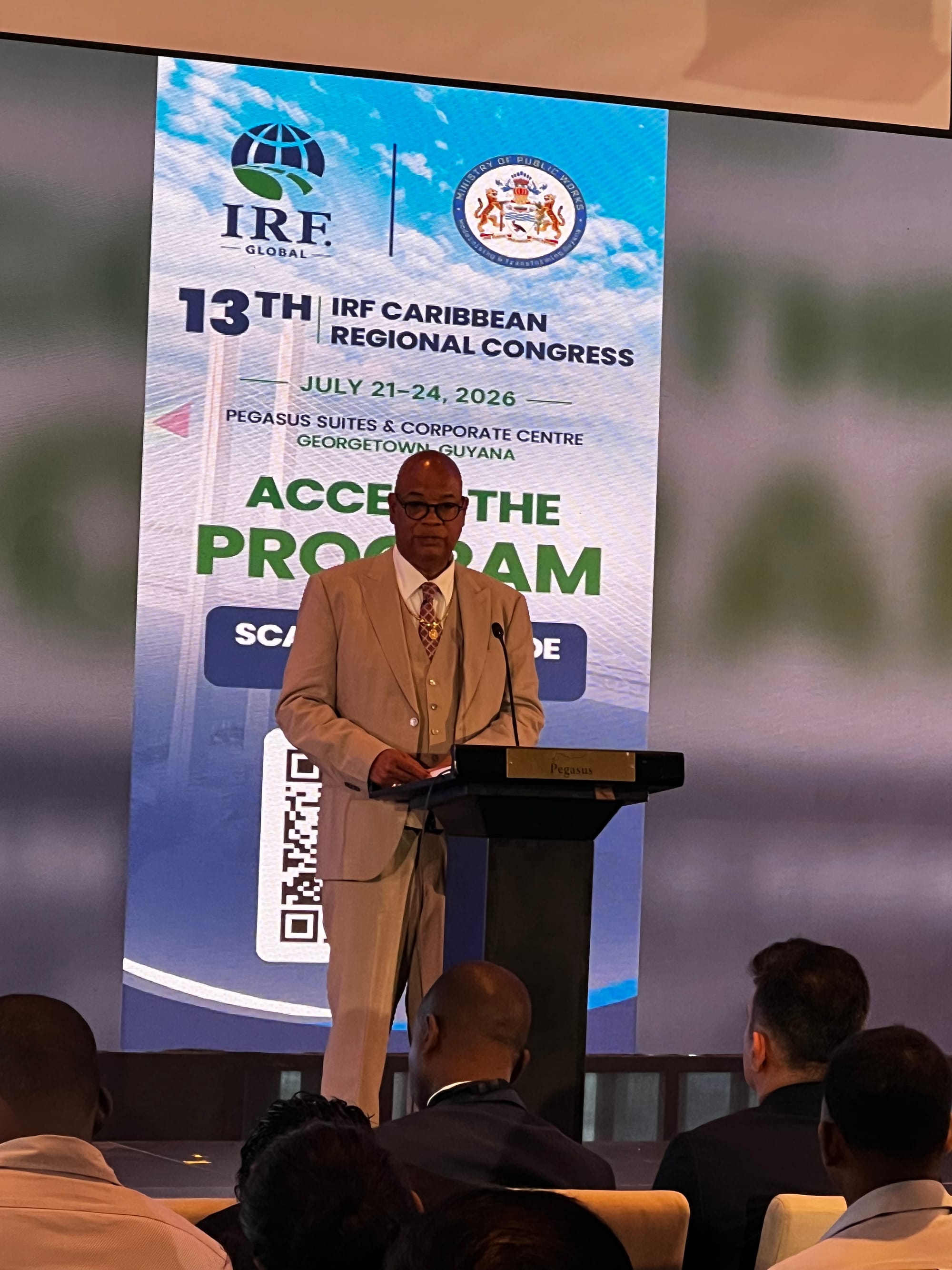
Smart traffic lights, cameras studied in Shenzhen, and climate-proofed design. At the IRF Caribbean Congress, the Public Works Minister said tomorrow's roads need engineers who think past asphalt.
BY LCN NEWSROOM · GEORGETOWN, GUYANA · 22 JULY 2026
I N B R I E F At the 13th IRF Caribbean Regional Congress on 22 July 2026, Public Works Minister Bishop Juan Edghill said Guyana needs engineers who combine artificial intelligence, smart traffic systems and climate-resilient design to build roads for the decades ahead. |
GEORGETOWN, Guyana. Bishop Juan Edghill wants engineers who can read a traffic camera as fluently as they read a load calculation.
In his address to the 13th International Road Federation (IRF) Caribbean Regional Congress, Guyana's Minister of Public Works argued that the profession which built the country's roads must change to keep them useful. Tomorrow's engineer, he said, has to work with data, with artificial intelligence, and with a climate that no longer behaves like the one the old design manuals assumed.
What did Edghill mean by a new kind of engineer?
His point was that technical skill is no longer enough on its own. The engineer of the coming decade, he argued, must also think like a planner and a policymaker, weighing budgets, behaviour and long horizons alongside stress loads. He pressed the same expectation onto financiers and ministries of finance, who he said must fund plans that reach past a single electoral term. Guyana has already flagged how thin its pipeline of technical talent runs, from classrooms that need thousands more IT and AI teachers to trade programmes racing to graduate electricians.
How is Guyana using AI and smart traffic technology?
Edghill described concrete steps, not slogans. The Ministry is piloting smart traffic lights with a technology provider to manage flow rather than simply cycle on a timer. He recounted a visit to Shenzhen, where he watched camera systems track traffic along a three-kilometre stretch, and said Guyana is weighing how to fold that kind of monitoring into its own traffic management and safety. Talks with a Chinese intelligent-transport team are underway. The through-line is artificial intelligence applied to how people and goods actually move.
Why is Edghill questioning old engineering standards?
Guyana grew up trusting greenheart, the local hardwood that could hold a pile or a landing for a hundred years. Edghill honoured that inheritance, then said it is no longer sufficient on its own. The volume and speed of modern transport have outrun the old assumptions. New materials, new technology and a fresh look at long-settled practice are needed, he argued, because the conditions the standards were written for have changed.
What makes climate resilience an engineering problem now?
Climate change, in Edghill's framing, is a present design constraint rather than a future worry. Extreme weather is testing infrastructure that was never built for it. He said resilience has to enter a project at the earliest stage of design, not as a repair after the flood, and that digital technology belongs inside the structure rather than bolted on later. The stakes are measured in lives. The World Bank records a road death rate of 15 per 100,000 people in Guyana, with 642 road deaths between 2020 and 2024, and the country aims to cut annual fatalities below 50 by 2030.
What can small Caribbean states teach the world about resilient roads?
Edghill closed on the region's paradox. Small island developing states carry real disadvantages: limited finance, scarce land, exposure to hurricanes, flooding and coastal erosion, and a heavy dependence on imported materials. Those same pressures, he argued, force invention. Necessity has made the Caribbean a laboratory for resilient infrastructure, and its experience deserves a hearing in the global debate. He borrowed a proverb to make the timing plain: the best time to plant a tree was 20 years ago, and the second best time is now. The IRF's 2026 agenda, built around electrification and resilience, gives the argument a stage. The habits Guyana teaches its drivers and engineers will decide whether the lesson holds.
The old engineer designed a road to carry weight. The new one, in Edghill's account, has to design it to carry a future that keeps changing its mind. That is a larger job, and he made clear he expects the profession to grow into it.
Frequently Asked Questions
What did Edghill say the future engineer must be able to do?
He said tomorrow's engineer must combine technical skill with the instincts of a planner and policymaker, working with data, artificial intelligence and climate-resilient design rather than structural calculation alone.
Is Guyana actually using AI in its road network?
Edghill said the Ministry is piloting smart traffic lights and studying camera-based traffic monitoring observed in Shenzhen, with talks underway with a Chinese intelligent-transport team.
Why does Edghill say old engineering standards need revisiting?
He argued that the volume and speed of modern transport have outrun assumptions built around traditional materials like greenheart, and that new materials and methods are needed for today's conditions.
How serious is road safety in Guyana?
The World Bank records about 15 road deaths per 100,000 people and 642 road deaths between 2020 and 2024. Guyana aims to cut annual fatalities below 50 by 2030.
What does Edghill say small Caribbean states offer the world?
He argued that the constraints facing small island developing states force innovation, making the Caribbean a valuable source of ideas on resilient infrastructure for the wider world.