ANALYSIS
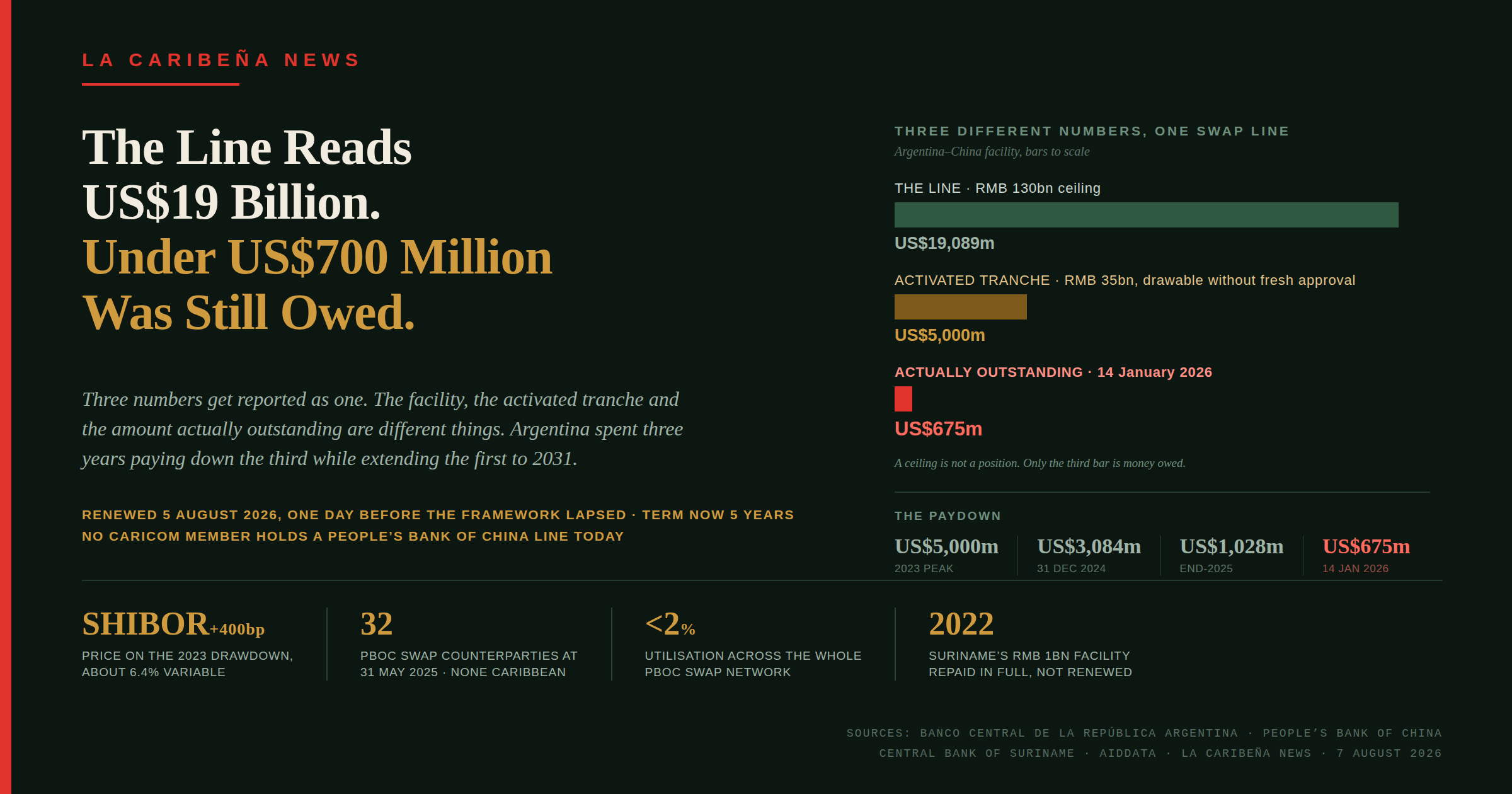
Three numbers matter and most reporting carries one. The line, the activated tranche, and the amount actually outstanding are different things. Argentina spent three years paying down the third while extending the first to 2031.
BY LCN NEWSROOM · GEORGETOWN, GUYANA
Quick summary: Argentina's central bank extended its currency swap with the People's Bank of China to 2031 on 5 August 2026. The line reads US$19 billion, but only US$5 billion was ever activated and under US$700 million remained owed in January. Suriname, the only Caribbean state ever to hold such a line, lost it in 2022.
What the title card shows
Every data point on the article's title card, in text.
- RMB 130 billion. The size of the Argentina-China swap line, about US$19.1 billion. Source: Banco Central de la República Argentina (BCRA), 5 August 2026.
- RMB 35 billion. The activated tranche, about US$5 billion, meaning drawable without fresh approval from the People's Bank of China. Source: BCRA.
- US$675 million. The amount actually outstanding at 14 January 2026, down from a US$5 billion peak. Source: BCRA balance sheet, as reported in the Argentine financial press.
- The paydown, four points. US$5,000 million at the 2023 peak, US$3,084 million at 31 December 2024, US$1,028 million at end-2025, US$675 million at 14 January 2026. Source: BCRA balance sheet reporting.
- SHIBOR plus 400 basis points. The reported pricing on the 2023 drawdown, about 6.4 per cent variable. Source: AidData record of the drawdown.
- RMB 1 billion. The size of the Central Bank of Suriname's facility with the People's Bank of China, signed 18 March 2015 and lapsed in 2022. Source: Central Bank of Suriname; PBoC counterparty table.
- 32 counterparties, none Caribbean. The People's Bank of China's published swap counterparties as at 31 May 2025. Source: People's Bank of China.
- Under 2 per cent. Utilisation across the PBoC's swap network, RMB 81.8 billion drawn against roughly RMB 4.5 trillion committed. Source: People's Bank of China.
What did Argentina actually renew?
The line, not the borrowing. Those are different things, and only one of them is money Argentina owed.
The Banco Central de la República Argentina (BCRA) and the People's Bank of China renewed their bilateral currency swap on 5 August 2026, extending the term from three years to five and carrying it to 2031. The existing framework agreement was due to expire on 6 August. The renewal was signed the day before it lapsed. The facility is RMB 130 billion, which Central Banking puts at about US$19.3 billion and the BCRA's own accounts put at US$19,089 million.
The BCRA's statement then says the activation of "CNY35 billion (USD5 billion), initiated at the beginning of 2023, remains in effect."
Activated does not mean borrowed. It means that tranche is drawable without going back to Beijing for fresh approval. It is a standing authorisation.
What Argentina actually owed is a third number, and it has been falling hard.
| Amount | What it is | |
|---|---|---|
| The line | RMB 130 billion, about US$19.1 billion | The ceiling, now running to 2031 |
| The activated tranche | RMB 35 billion, about US$5 billion | Drawable without fresh PBoC approval |
| Outstanding at 31 December 2024 | About US$3,084 million | Actually owed |
| Outstanding at end-2025 | About US$1,028 million | Actually owed |
| Outstanding at 14 January 2026 | About US$675 million | Actually owed |
Sources: BCRA statement of 5 August 2026 for the line and the activated tranche; BCRA balance sheet figures as reported in the Argentine financial press for the outstanding amounts.
Argentina drew about US$5 billion at the peak and has repaid roughly nine tenths of it. In an earlier statement the BCRA said it would reduce the activated amount gradually and that the tranche would be "completely deactivated by the middle of 2026."
So the country paid down the position and, three weeks before that deactivation date, extended the line to 2031. It gave up the borrowing and kept the option.
A facility is not money. An activation is not a drawing. And the only one of the three that costs anything is the one nobody puts in a headline.
What did it cost to hold?
More than the alternative, and the price is rarely reported.
AidData's record of the 2023 drawdown puts the pricing at SHIBOR plus 400 basis points, about 6.4 per cent variable at the time. A drawing on a United States Federal Reserve swap line is reported at roughly 25 basis points over the relevant reference rate.
That gap is the part a finance ministry needs before anything else. This is not an emergency facility of the kind the Federal Reserve extends to selected central banks on standing terms. It is a commercial-rate credit line, and at Argentine scale the interest on it is a real budget line.
What is a currency swap line, and what is it not?
It is a credit facility in another country's currency. It is not reserves in the ordinary sense.
Two central banks agree to exchange currencies at an agreed rate for an agreed period, with a commitment to reverse the exchange later. The drawing party receives the counterparty's currency and hands over its own. Nothing is given away. Something is borrowed.
For a small state the consequence is specific. A central bank can print its own currency. It cannot print renminbi. So a drawn swap is a foreign-currency liability with a date on it, serviced from the same scarce pool of foreign earnings as everything else.
How does the International Monetary Fund treat it?
It nets it out, which removes most of the reserve benefit.
This is the question that decides whether a swap line helps a country under a Fund programme, and it has an answer. Under Argentina's Extended Fund Facility, the technical memorandum defines net international reserves as gross reserves net of swap lines, so a drawn swap is deducted as a reserve liability. The non-activated portion is not counted as a reserve asset at all. Fund staff reports on Suriname carry a footnote recording official reserve assets as excluding the PBoC swap.
The practical consequence is one sentence. Drawing it raises your gross reserves and does nothing for the number the Fund actually assesses you on.
These are secondary descriptions of the Fund's documents rather than the documents themselves. The wording should be read as reported, not quoted.
Has any Caribbean state done this?
One did, for seven years, and it no longer has the line.
The Central Bank of Suriname signed a facility of RMB 1 billion with the People's Bank of China on 18 March 2015, for a three-year term. It was renewed once, on 11 February 2019, for a further three years. It was not renewed again and lapsed in 2022.
Suriname did not touch it once. It lived on it. There were at least five drawdowns between 2015 and 2021, including the RMB 800 million drawdown recorded by AidData in May 2017, and the country carried an outstanding position of roughly RMB 982 million continuously from end-2019 through end-2021, rolled year after year. That is close to the whole line, held for three years.
Then the sequence.
| Date | Event |
|---|---|
| 18 March 2015 | RMB 1 billion facility signed |
| May 2017 | RMB 800 million drawdown |
| 31 March 2021 | Suriname in default on its Eurobonds |
| February 2022 | PBoC swap repaid in full, about US$155 million, during the default |
| 31 December 2022 | Outstanding balance RMB 0 |
| 6 December 2023 | Bondholder restructuring completed, with a haircut |
Sources: Central Bank of Suriname; People's Bank of China counterparty table; sovereign debt restructuring record.
Suriname repaid its central bank swap in full while it was in default to its bondholders, and those bondholders later took a reduction in what they were owed. La Caribeña News has found no document stating that the swap was expressly excluded from the restructuring perimeter, so this is a description of conduct and sequence rather than of a legal carve-out. But the sequence is the sequence.
That is the fact a Caribbean finance ministry should sit with. A drawn swap is not merely debt. On the region's only worked example, it is debt that got paid first.
Is this instrument common in the Caribbean?
No, and that can now be stated flatly rather than hedged.
The People's Bank of China's published status table lists 32 swap counterparties as at 31 May 2025. It contains no member of the Caribbean Community (CARICOM) and no Caribbean state. Five of CARICOM's fifteen full members recognise Taiwan and are structurally ineligible. Four more share the Eastern Caribbean Central Bank, which is also absent.
Suriname was the only CARICOM state ever to hold such a line. It does not hold one now.
The network is also far less used than its headline suggests. Against roughly RMB 4.5 trillion committed across those 32 agreements, total outstanding drawings stood at RMB 81.8 billion at 31 May 2025. That is utilisation under 2 per cent. These lines are routine to sign and rare to draw.
Among regional peers the pattern is thin: Brazil at RMB 190 billion, Argentina at RMB 130 billion, Chile at RMB 50 billion, Suriname at RMB 1 billion and lapsed, and nothing else.
Does holding one buy leverage?
On the available record, no, and the point cuts against the case for these lines rather than for it.
The argument for diversifying a small state's financial relationships is intuitive. Concentration is exposure. But the evidence for a renminbi swap line delivering negotiating room is not there.
Argentina is the test. Washington pressed Buenos Aires to wind the line down, and Buenos Aires substantially did, repaying roughly nine tenths of the drawn position across three years.
Then Washington offered its own. In October 2025 the United States Treasury Secretary, Scott Bessent, announced financial support for Argentina that included a currency swap of US$20 billion through the Exchange Stabilization Fund, as recorded by the Congressional Research Service. The order of events matters and should not be overstated. The paydown was already well advanced before the American facility was announced, so this is not a case of one line being swapped for the other on a given date. But the destination is not in doubt. Argentina now has a larger dollar line from the United States Treasury and a yuan line it had run down to under US$700 million.
That is the opposite of the leverage story. The People's Bank of China facility did not win Argentina better terms from Washington. Washington outbid it. This newspaper has found no case in which holding a People's Bank of China line improved a state's terms with Washington or with the International Monetary Fund.
That does not make the instrument worthless. It makes the claim about it narrower than it is usually stated. What Argentina bought was an option it could use in a payments crisis, at commercial rates, which it then spent three years unwinding under pressure. That is a real thing. It is not a seat at a table.
Why does any of this matter to the Caribbean?
Because the region's trading terms were changed by someone else this year, and the process was contestable.
On 12 March 2026 the United States Trade Representative initiated investigations under section 301 of the Trade Act of 1974 into 60 economies, examining whether each failed to prohibit, or to effectively enforce a prohibition on, the importation of goods produced with forced labour. On 2 June the Trade Representative determined that all 60 had failed. On 23 July the President directed the resulting duties, 10 per cent for the seventeen economies that had enacted such a ban or committed to one and 12.5 per cent for every other economy, with effect from 24 July 2026. Guyana was placed at 12.5 per cent, alongside The Bahamas and Colombia.
The uncomfortable part, and the part that changes the argument, is that this was not imposed in silence. There were government-to-government consultations, more than 1,600 written comments and a three-day public hearing in July at which governments testified.
And one Caribbean state used it. Trinidad and Tobago adopted a forced-labour import prohibition after the June determination and moved from 12.5 per cent to 10 per cent as a result.
So the lesson is not that the region was ignored. It is narrower and harder. The process was open, the capability to engage it was unevenly distributed, and the state that had the capability paid less. Most of the region did not contest its band. One did, and it worked.
That points toward diversification, but not for the reason usually given. Not because another partner is kinder. Because a state that can only respond to terms, rather than shape them, will keep receiving terms. The instrument is secondary. The capability is the thing.
What would a Caribbean official need to know before signing one?
Four things, and the last is arithmetic rather than judgment.
The price is the first question, not the size. A line at SHIBOR plus 400 basis points is commercial borrowing, and it should be compared with what else the country can borrow at, not with zero.
The Fund nets it out. Drawing raises gross reserves and leaves net international reserves where they were, so a facility taken to improve a programme metric will not improve it.
Suriname's sequence is the regional precedent, and it shows a swap being serviced in full during a default that private creditors were later dragged into.
And there is a test an official can actually run, drawn from the Fund's own reported approach. Is the facility under 1 per cent of gross domestic product, and would repaying it push gross reserves below 60 per cent of the Fund's reserve adequacy metric? Those two numbers determine how the borrowing is treated. They can be worked out in an afternoon from figures a central bank already publishes.
On Guyana's own position, one correction to the way this is usually described. The country holds the highest gross reserves on record, reported at US$1,356.2 million at end-2025, but that is not the same as the strongest reserve position it has ever had. Import cover was around 0.85 months in 2023, against three to five months through 2004 to 2017. The larger buffer is the Natural Resource Fund, reported at about US$3.96 billion at end-May 2026, which is a sovereign fund and not central bank reserves, and the two should not be added together.
Frequently Asked Questions
What did Argentina and China agree on 5 August 2026?
The Banco Central de la República Argentina and the People's Bank of China renewed their bilateral swap line of RMB 130 billion, about US$19.1 billion, and extended the term from three years to five, carrying it to 2031.
Is the whole US$19 billion borrowed money?
No. The line is the ceiling. The activated tranche of RMB 35 billion, about US$5 billion, is the portion drawable without fresh approval. The amount actually outstanding had fallen to about US$675 million by 14 January 2026, from a peak of about US$5 billion.
What does a drawn swap cost?
The 2023 Argentine drawdown is recorded at SHIBOR plus 400 basis points, about 6.4 per cent variable. A drawing on a United States Federal Reserve line is reported at roughly 25 basis points over the reference rate.
Has a Caribbean country used one?
Suriname held a RMB 1 billion facility from March 2015, drew on it at least five times, carried roughly RMB 982 million outstanding from end-2019 to end-2021, repaid it in full in February 2022 while in default to its bondholders, and did not renew. No Caribbean Community member holds a People's Bank of China line today.
Does a yuan swap line reduce dependence on the dollar?
Not materially. Caribbean trade, tourism receipts, energy contracts and correspondent banking remain dollar-denominated, and the International Monetary Fund nets a drawn swap out of the reserve measure it assesses. It adds an instrument; it does not change the currency the region earns and owes in.
---
Disclosure. La Caribeña News is owned by Theon Alleyne, who is a Director of the Guyana Manufacturing and Services Association and Chair of its Services Sub-Sector, and Vice President and Public Relations Officer of the Essequibo Islands-West Demerara Chamber of Commerce and Industry. This article is analysis. It is not policy advice, and neither the publication nor its owner holds a position in any instrument discussed.