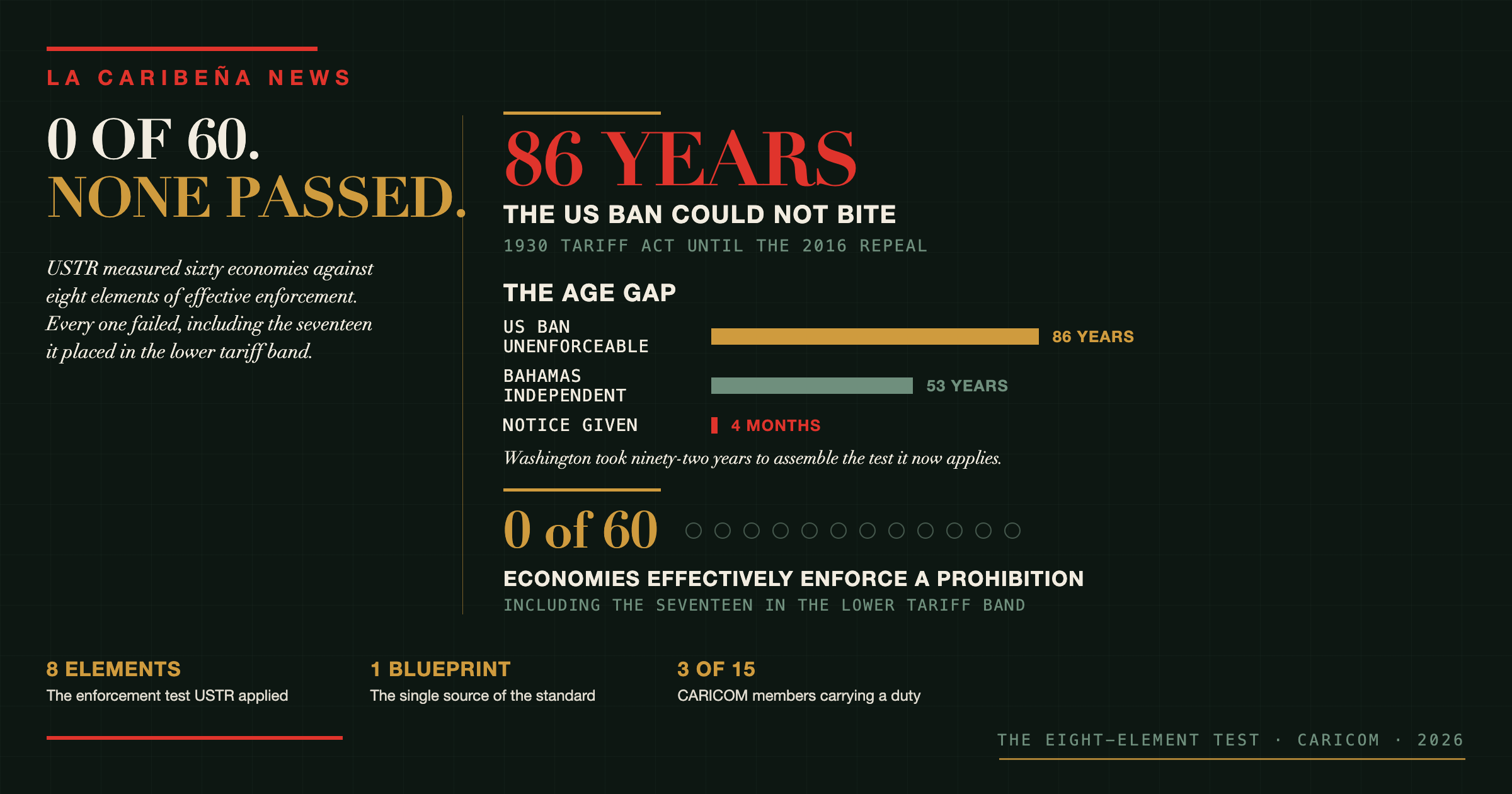
Washington now measures whether a country can enforce a forced-labour import ban. Its own ban could not bite for eighty-six years, longer than any of the three CARICOM states it penalised has been independent.
BY THEON ALLEYNE
Quick summary: The United States Trade Representative judged 60 economies on 2 June 2026 against eight elements of effective enforcement. Every one failed, including the seventeen placed in the lower 10 per cent tariff band. For CARICOM, the eight elements did not set this year's rate. They set the next test, and the region has no plan for it.
What are the eight elements?
USTR ran a two-limb test. The first limb asks whether an economy has imposed a prohibition on importing goods made with forced labour. The second asks whether it effectively enforces one. For the second limb, the report sets out eight elements that "inform whether a forced labor import prohibition will be effective":
- A statutory definition of forced labour grounded in international law
- Designated enforcement authority
- A public entity list
- A rebuttable presumption where forced labour is established for a particular good
- Clear evidentiary standards, ideally based on "reasonable cause"
- A remediation requirement
- An accessible reporting and allegations mechanism
- Transparency and public disclosure
What the title card shows
Every data point on the article's title card, in text.
- 0 of 60. No investigated economy effectively enforces a forced-labour import prohibition, on USTR's own finding. Source: USTR Section 301 report, 2 June 2026.
- 8 elements. The indicators USTR treats as showing a prohibition can be effectively enforced, cited to Laura Murphy, Forced Labor Import Blueprint, at 8-9.
- 86 years. The period from the 1930 US prohibition to the 2016 repeal of the consumptive demand exception, during which the American ban could not meaningfully bite. Longer than Trinidad and Tobago, Guyana or The Bahamas has been independent. Haiti, independent since 1804, is the regional exception and was not investigated.
- 4 years. How long the United States has held a public entity list and a rebuttable presumption, under the Uyghur Forced Labor Prevention Act, effective 21 June 2022.
- 4 months. The notice the 60 investigated economies were given.
- 3 of 15. CARICOM members carrying an additional US duty. Source: La Caribeña News.
- 52. Withhold Release Orders or Findings issued by US Customs and Border Protection since 2016. Source: USTR Section 301 report.
Did the eight elements decide this year's tariff rates?
No, and any reading that says otherwise is wrong.
The 10 versus 12.5 per cent split was decided on the first limb alone. Ten per cent went to economies that had imposed a prohibition, committed to one by trade agreement, or ran a partial regime, per USTR's final action. Everyone else paid 12.5.
On the second limb the report is unambiguous: "none of the 60 economies whose acts, policies, and practices are the subject of these investigations effectively enforce a forced labor import prohibition." That includes Trinidad and Tobago, Canada, the United Kingdom, Japan and every other economy in the lower band.
The eight elements therefore carry a nil pass rate. They cost nobody a tariff point this year. They are the standard being built for the next round, and that is precisely why the region should be reading them now rather than in 2027.
Where does the standard come from?
Not from a treaty. Not from an International Labour Organization convention. Not from anything CARICOM negotiated or acceded to.
Footnote 102 of the report cites the eight elements to a single source: Laura Murphy, Forced Labor Import Blueprint, at pages 8 to 9. USTR describes it as independent research, which it is. It is also one academic blueprint, from one centre, now functioning as the yardstick against which sixty sovereign states are measured in a unilateral trade proceeding.
That is worth stating without outrage. The blueprint may well be correct about what makes a prohibition work. The question for a small state is different: whether a standard it had no part in setting, and no notice of, is one it can be expected to meet.
Is it reasonable to require this of CARICOM states?
The honest answer splits in two, and the split is the whole story.
The first limb is entirely reasonable. Imposing a prohibition is a drafting exercise, and a cheap one. Trinidad and Tobago did it on 12 June with a single amendment to section 45 of its Customs Act, and moved into the lower band. The Bahamas passed a power to prohibit by Order in the same month and did not, a distinction this publication has examined. Any CARICOM member can close that gap this year with one bill. Nothing about small size or limited budget prevents it.
The second limb is a different order of demand. A public entity list requires investigative reach into foreign supply chains a Caribbean customs department does not have and has never needed. A rebuttable presumption requires adjudicative machinery to hear rebuttals. A remediation requirement requires monitoring capacity abroad. An accessible allegations mechanism requires staff to receive and triage allegations. These are not drafting problems. They are institutional ones, and they are expensive.
How old is the American standard?
Consider the comparison the report itself invites.
The United States prohibited forced-labour imports in 1930, under Section 307 of the Tariff Act. For most of the next century the ban did very little, because of the consumptive demand exception, which let forced-labour goods enter whenever American domestic production could not meet demand. Congress repealed that exception in the Trade Facilitation and Trade Enforcement Act of 2016. That repeal is why the report counts enforcement only "since 2016," and why the 52 Withhold Release Orders and Findings it cites all fall inside the last decade.
The public entity list and the rebuttable presumption, two of the eight elements, arrived later still, with the Uyghur Forced Labor Prevention Act, signed on 23 December 2021 and effective on 21 June 2022.
Set that against the age of the states now being measured.
| Milestone | Year | Elapsed |
|---|---|---|
| US forced-labour import prohibition enacted | 1930 | 96 years |
| Consumptive demand exception repealed, ban becomes enforceable | 2016 | 10 years |
| US acquires entity list and rebuttable presumption | 2022 | 4 years |
| Haiti independent | 1804 | 222 years |
| Trinidad and Tobago independent | 1962 | 64 years |
| Guyana independent | 1966 | 60 years |
| The Bahamas independent | 1973 | 53 years |
The United States ran a forced-labour import prohibition that could not bite for eighty-six years. That is longer than Trinidad and Tobago, Guyana or The Bahamas has existed as an independent country, and each of those three is now paying for a gap the United States itself carried for most of a century.
Haiti is the region's exception, and worth naming precisely because it complicates the point. It has been independent since 1804, longer than the American prohibition has existed at all, and it was not among the sixty economies investigated. The bloc that Washington is measuring contains both the oldest Black republic in the world and states that were British colonies within living memory. A single compliance deadline treats all of them as one.
The United States has held two of the eight elements for four years. It then found sixty economies deficient for not having what it acquired in 2022, and gave them four months' notice.
None of that makes the standard wrong. A ban that works is better than a ban that does not, and the Caribbean has no interest in being a soft route for goods made by forced labour. But it does answer the question of reasonableness with something firmer than sentiment. The country setting the test took ninety-two years to assemble it, and gave the economies it measured four months to do the same.
Scale matters too. Twelve of the fifteen CARICOM members were never investigated at all. They have no prohibition, no entity list and no rebuttable presumption, because nothing until now gave them a reason to build one. They are not manufacturing hubs and they are not significant transshipment routes for the goods this proceeding is aimed at. Writing in the Jamaica Gleaner, the regional trade analyst Elizabeth Morgan set out what the new measures mean for CARICOM states as a bloc. If the eight elements become the gate rather than the guidance, the region does not face a drafting exercise. It faces building an enforcement apparatus from nothing.
Was help offered before the tariffs?
It was requested, and the record shows it. The report notes at page 7 that some comments "suggested that the Trade Representative increase coordination with trading partners, including by providing technical assistance related to import prohibitions prior to taking tariff action," citing a submission from Transparentem.
USTR proceeded to tariffs without sequencing technical assistance first. That is a policy choice the United States was entitled to make. It is also the single most consequential fact for any CARICOM state planning its response, because it establishes that the region should not assume assistance will arrive ahead of the next standard.
What should the region do now?
Three things follow, and they are separable.
The cheap fix costs one bill. Every CARICOM member without an express statutory prohibition on importing forced-labour goods should enact one, in the operative form Trinidad and Tobago used rather than the enabling form the Bahamas used. Trinidad amended a single section of its Customs Act on 12 June and moved into the lower band. Nothing about small size, limited budget or thin customs capacity prevents any of the other twelve members from doing the same this year.
The strategic one is limb two. The eight elements are a capacity programme, not a statute, and the sensible unit for building them is regional rather than national. A shared entity list, a common evidentiary standard and a single regional allegations mechanism are affordable across fifteen states in a way they are not affordable for one.
The diplomatic one is sequencing. The request for technical assistance before tariff action was made by others and declined. If the region wants a different answer in the next round, that case has to be made by the region, in the proceeding, on the record, and early.
Frequently Asked Questions
What are the eight elements USTR uses?
A statutory definition of forced labour grounded in international law, a designated enforcement authority, a public entity list, a rebuttable presumption, clear evidentiary standards based on reasonable cause, a remediation requirement, an accessible reporting and allegations mechanism, and transparency and public disclosure.
Did any economy pass the eight-element test?
No. USTR found that none of the 60 investigated economies effectively enforce a forced-labour import prohibition, including the seventeen assigned the lower 10 per cent tariff band.
Did the eight elements determine the 10 or 12.5 per cent rate?
No. The rate turned on the first limb, whether an economy had imposed a prohibition, committed to one by trade agreement, or operated a partial regime. The eight elements relate to the enforcement limb, which no economy satisfied.
Where do the eight elements come from?
From Laura Murphy's Forced Labor Import Blueprint, cited at footnote 102 of the USTR report. They are not drawn from a treaty or an International Labour Organization convention.
How long did the United States take to meet its own standard?
Its import prohibition dates to Section 307 of the Tariff Act of 1930, but the consumptive demand exception left it largely unenforceable until Congress repealed that exception in 2016, a span of 86 years. The public entity list and rebuttable presumption arrived with the Uyghur Forced Labor Prevention Act, effective 21 June 2022, four years ago. The 60 investigated economies were given four months.
Which CARICOM members are affected?
Three of fifteen. Trinidad and Tobago at 10 per cent, the Bahamas and Guyana at 12.5 per cent. The remaining twelve were never investigated.