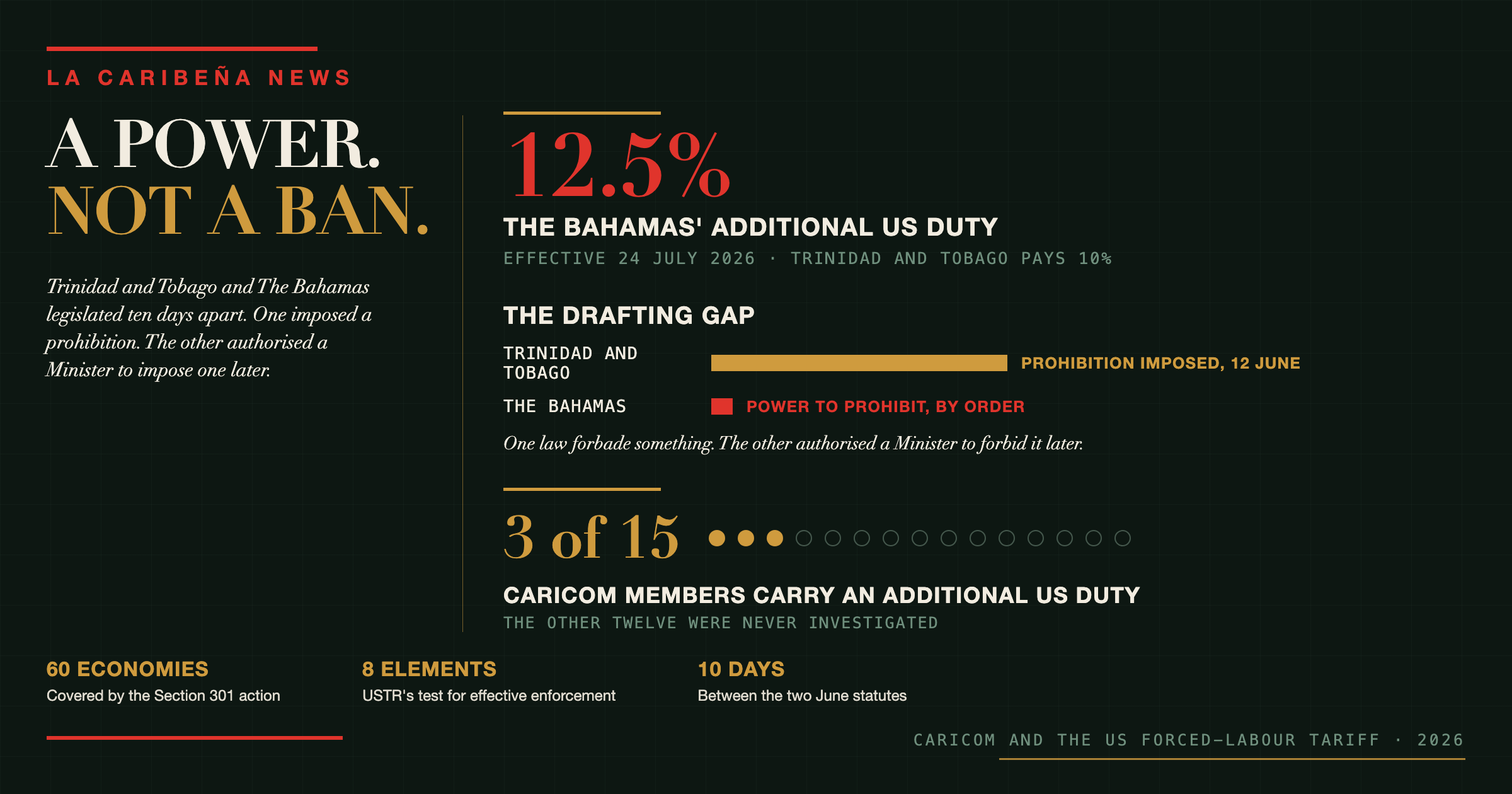
Both legislated in June, ten days apart. Trinidad wrote a prohibition. The Bahamas wrote a power to make one.
BY THEON ALLEYNE
Quick summary: The United States imposed additional forced-labour tariffs on 60 economies on 24 July 2026. Trinidad and Tobago pays 10 per cent and The Bahamas pays 12.5. Both legislated in June, ten days apart. Trinidad imposed a prohibition. The Bahamas granted a Minister the power to impose one later, and USTR had already ruled that distinction material.
What did the Bahamas argue in Washington?
The Bahamas was the only CARICOM member to appear at the first round of hearings. The United States Trade Representative published its panel schedule for the two-day hearing at the US International Trade Commission on 28 and 29 April, and Day 1, Panel 7 lists "Sen. Hon. L. Ryan Pinder KC, The Office of the Attorney General of the Commonwealth of The Bahamas." No other Caribbean Community state appears anywhere on that schedule.
Danya Wallace, Director of Legal Affairs, appeared in Pinder's place. Asked whether the Bahamas had anything addressing forced-labour goods, she answered plainly, The Tribune reported:
"The Customs Management Act is the domestic law responsible for that, and that provides authority for the regulation and control of imported goods, and empowers the Customs Department to prohibit or restrict goods, but there is nothing presently in place to address goods that are as a result of forced labour."
She asked the panel for a negative determination. The Bahamas engaged earliest of any CARICOM state, at the most senior level, and conceded the deficiency on the record.
What did USTR decide?
On 2 June, USTR published its findings across all 60 investigations. The proposed action set two bands. Ten per cent applied to economies that had imposed a prohibition, committed to one through a trade agreement, or operated a partial regime. Twelve and a half per cent applied to every other investigated economy. The Bahamas is not analysed individually anywhere in that report. Its entry reads exactly as Algeria's, Angola's and Bahrain's do, that it "has failed to impose and effectively enforce a prohibition on the importation of goods produced with forced labor."
The Bahamas was disposed of in a section headed "All Other Economies," and named only in a footnote listing 55 states. Some economies did get individual assessments, and one of them won. Of Pakistan, USTR wrote that it "does not find that Pakistan has failed to impose a forced labor import prohibition."
The report also answered the argument Wallace had made in April, as a class:
"the mere existence of an authority that could be used to disallow the importation of forced labor goods is materially distinct from a measure that legally forbids the importation of goods produced with forced labor."
That sentence is the whole case. A power to prohibit is not a prohibition.
What did each country then pass?
Trinidad and Tobago, 12 June. Act No. 16 of 2026 amended section 45 of the Customs Act to impose an outright prohibition on importing goods produced with forced labour, piloted by Finance Minister Davendranath Tancoo.
The Bahamas, before end-June. The Customs Management (Amendment) Bill 2026 passed alongside the 2026-2027 Budget, inserting section 208A: the Minister "may, by Order, prohibit the importation of any goods, wholly or partially produced or manufactured, from any supplier, country or territory if there are reasonable grounds to believe that the goods are a result of forced labour."
Read the two together. Trinidad forbade something. The Bahamas authorised a Minister to forbid something later, by Order. Ten days apart, and ten days after Washington had put in writing that the distinction was material.
Was it a question of timing?
No, and this is the part that removes the Bahamian government's strongest defence.
Trinidad and Tobago appears in the same footnote as the Bahamas. As of 2 June, USTR found that Trinidad had no prohibition either. Act No. 16 passed ten days after the report was published, and Trinidad was still assigned the lower band. Washington did take account of an instrument enacted after its own findings.
The Bahamas legislated inside the same window and was not credited. Timing cannot explain the split, because both instruments post-date the report.
Nor can attendance. Trinidad never sent a hearing witness at all, as this publication reported when the rates were set. It worked the file directly instead. Its Ministry of Foreign and CARICOM Affairs said it held technical discussions with USTR between May and July, including in-person visits to the Washington office on 14 May and 16 July, and credited that engagement with the reduced rate. The Bahamas testified and did not move. Guyana appeared at the second round of hearings on 7 July, brought no instrument, and stayed at 12.5 per cent.
How did the region finish?
| Economy | Instrument | Engagement | Rate |
|---|---|---|---|
| Trinidad and Tobago | Outright prohibition, 12 June | Technical talks at USTR, 14 May and 16 July | 10% |
| The Bahamas | Power to prohibit by Order, June | Hearing panellist, 28 April | 12.5% |
| Guyana | None | Hearing witness, 7 July | 12.5% |
| Dominican Republic | Decree 502-26, 23 July | Not on the April schedule | 12.5% |
What the title card shows
Every data point on the article's title card, in text.
- 12.5 per cent. The Bahamas' additional US duty, effective 24 July 2026. Trinidad and Tobago pays 10 per cent. Source: USTR final action.
- The drafting gap. Trinidad and Tobago imposed a prohibition on 12 June through Act No. 16 of 2026, amending section 45 of the Customs Act. The Bahamas enacted a power to prohibit by Order through section 208A of the Customs Management (Amendment) Bill 2026. Source: The Tribune.
- 3 of 15. Three CARICOM members carry an additional US duty. The other twelve were never investigated. Source: La Caribeña News.
- 60 economies. The number covered by the Section 301 forced-labour action. Source: USTR findings, 2 June 2026.
- 8 elements. The indicators USTR treats as showing a forced-labour import prohibition can be effectively enforced. Source: USTR Section 301 report, 2 June 2026.
- 10 days. The interval between Trinidad's Act No. 16 on 12 June and the Bahamian amendment passed with the 2026-2027 Budget before end-June.
The Dominican Republic issued Decree 502-26 the day before the duties took effect, empowering its customs agency to seize and prohibit forced-labour goods, DR1 reported. Twelve of the fifteen CARICOM members were never investigated and carry no additional duty, as this publication set out when the regime began.
What does the Bahamas say now?
The Office of the Prime Minister has asked Washington to look again. In its update, it said the government is "engaging our United States counterparts to seek clarification and to ensure that recent legislative measures taken by The Bahamas are fully considered," adding that the country "values its longstanding economic relationship with the United States, and we will continue working constructively toward a fair resolution."
Whether the measures were considered may be the wrong question. On the reasoning USTR published on 2 June, section 208A would not qualify even if it were read closely, because it confers an authority rather than imposing a prohibition. USTR has published no assessment of section 208A specifically, so that conclusion is its stated test applied to the Bahamian text, not Washington speaking about Nassau.
There is a second hurdle behind the first. USTR set out eight elements it treats as indicators that a prohibition can be effectively enforced, including a statutory definition of forced labour grounded in international law, a designated enforcement authority, a public entity list, a rebuttable presumption, clear evidentiary standards, a remediation requirement, a reporting mechanism, and public disclosure. Section 208A is a single sentence conferring a discretion. Imposing a prohibition is only the first limb of the test.
The practical question for Nassau is now narrow and answerable. Section 208A gives the Minister everything needed to make an Order. Whether one has been made, and when, is the most consequential detail in the file, and it is not on the public record.
Frequently Asked Questions
Why does the Bahamas pay 12.5 per cent when Trinidad and Tobago pays 10?
USTR placed economies that had imposed a prohibition, committed to one by trade agreement, or operated a partial regime in the 10 per cent band, and all others at 12.5. Trinidad's Act No. 16 of 2026 imposed an outright prohibition. The Bahamian amendment created a power for a Minister to prohibit by Order.
Did the Bahamas appear before USTR?
Yes. USTR's published panel schedule places the Office of the Attorney General of the Commonwealth of The Bahamas on Day 1, Panel 7 of the hearing held on 28 and 29 April. Danya Wallace, Director of Legal Affairs, appeared. It was the only CARICOM member on that schedule.
Was the Bahamian law passed too late to count?
Timing alone does not explain the outcome. Trinidad and Tobago passed its prohibition on 12 June, after USTR's 2 June findings, and still received the lower rate.
What did USTR say about the Bahamas specifically?
Nothing specific. The Bahamas received the same boilerplate finding as every other economy in the residual group and appears only in a footnote listing 55 states.
Which CARICOM members were affected?
Three of fifteen. Trinidad and Tobago at 10 per cent, the Bahamas and Guyana at 12.5 per cent. The other twelve were never investigated.