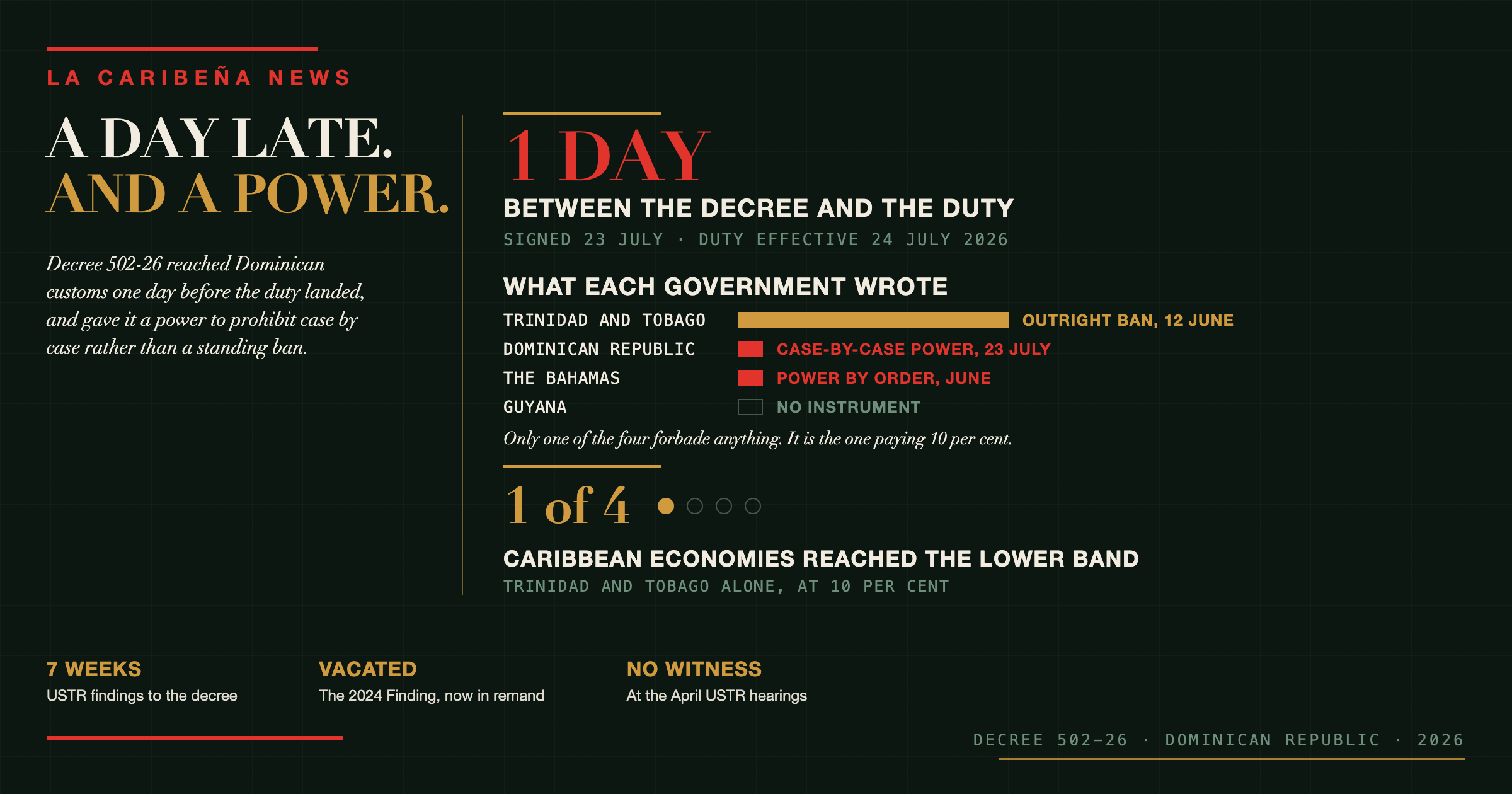
Decree 502-26 gives Dominican customs a case-by-case power, not the prohibition Washington was grading. Trinidad and Tobago wrote a ban and pays 10.
BY THEON ALLEYNE
Quick summary: President Luis Abinader signed Decree 502-26 against forced-labour imports on 23 July 2026, one day before an additional US duty of 12.5 per cent hit Dominican goods. The decree lets customs prohibit shipments case by case. Washington was grading whether a prohibition existed, and had ruled seven weeks earlier that a power is not one.
What does Decree 502-26 actually do?
The Presidency describes the decree as establishing the procedural framework to prevent, identify and restrict the importation of merchandise produced wholly or partly through forced labour. It was signed on 23 July 2026.
The operative power sits with the Dirección General de Aduanas. The decree allows the DGA, by reasoned decision, to prohibit the importation of goods when it is determined that they were produced through forced labour. It reaches shipments that have already sailed, that sit in port, or that are under any prior customs regime, and it lets the DGA order re-export, destruction, or other lawful measures. Enforcement is shared with the Ministry of Labour, the Ministry of Industry, Commerce and MSMEs, the Ministry of Foreign Relations and the Public Ministry.
Diario Libre and Acento both carried the measure as a prohibition on importing goods made with forced labour.
Read the instrument closely, though, and it is a power exercised case by case, not a standing ban. Nothing is prohibited until the DGA issues a reasoned decision about a particular consignment.
What the title card shows
Every data point on the article's title card, in text.
- 12.5 per cent. The additional US duty on Dominican goods, effective 24 July 2026. Source: USTR final action.
- 1 day. The interval between Decree 502-26 on 23 July and the duty taking effect on 24 July. Source: Presidencia de la República Dominicana.
- 7 weeks. Between USTR's findings of 2 June and the decree of 23 July.
- What each government wrote. Trinidad and Tobago, an outright ban by amending section 45 of its Customs Act on 12 June, and it pays 10 per cent. The Dominican Republic, a case-by-case power for customs on 23 July. The Bahamas, a power for a Minister to prohibit by Order in June. Guyana, no instrument at all. The last three all pay 12.5 per cent. Sources: La Caribeña News and Presidencia de la República Dominicana.
- 1 of 4. Caribbean economies caught by the action that reached the lower band. Trinidad and Tobago alone.
- Vacated. The US Court of International Trade vacated a CBP forced-labour Finding covering Dominican aluminium products on 23 September 2025. The matter is in remand.
Why did the decree not move the Dominican Republic into the lower band?
For the same reason the Bahamian amendment did not.
USTR sorted economies on one question: had a prohibition been imposed. Ten per cent went to economies that had imposed one, committed to one by trade agreement, or ran a partial regime. Everyone else paid 12.5. In its findings of 2 June, USTR addressed the argument directly:
"the mere existence of an authority that could be used to disallow the importation of forced labor goods is materially distinct from a measure that legally forbids the importation of goods produced with forced labor."
The Dominican Republic appears in the report's footnote listing the economies that had not imposed a prohibition at all. So does the Bahamas. So does Trinidad and Tobago, which then went and enacted one.
Two Caribbean governments have now made the same drafting choice independently. The Bahamas legislated a power for a Minister to prohibit by Order, which this publication examined this week. The Dominican Republic decreed a power for customs to prohibit by reasoned decision. Both pay 12.5 per cent. Trinidad and Tobago wrote a ban and pays 10, and never sent a witness to Washington to argue for it. Guyana brought a witness and no instrument, and entered the regime at 12.5.
What happened to the enforcement action that put the sector in the frame?
A US court threw it out.
In December 2024, US Customs and Border Protection announced a forced-labour Finding covering aluminium extrusion and profile products from a Dominican producer, and said it would seize those goods at all US ports of entry. The action followed a petition from an American industry body and a labour union.
It was unusual procedurally. CBP issued a Finding directly, without first issuing a Withhold Release Order, which is the lower evidentiary threshold it normally uses to open such a case.
Then it came apart. On 23 September 2025 the US Court of International Trade vacated and remanded the Finding, holding that CBP's determination was arbitrary and capricious because it lacked a satisfactory explanation and did not draw a rational connection between the facts found and the decision reached. The government sought reconsideration and was opposed. The matter remains in remand and is unresolved.
The point here is about the agency, not the producer. The court made no finding about whether forced labour occurred. It found that CBP had not adequately explained its own determination. La Caribeña News takes no position on the underlying conduct, which has not been adjudicated.
Who was in the room in Washington?
Not the Dominican Republic.
USTR's published panel schedule for the hearings of 28 and 29 April 2026 lists the American aluminium extrusion industry's trade body among the witnesses on Day 1, the same sector whose petition produced the 2024 Finding. The only Caribbean government on that schedule is the Bahamas, through its Office of the Attorney General.
So the industry that brought the original complaint was in the room. The Dominican government was not.
What does this mean for Dominican exporters?
The duty falls on agricultural and free-zone exports. USTR published no economy-specific analysis of the Dominican Republic, so there is no official statement of what drove the rate beyond the finding that applied to all fifty-five economies in the residual group.
The practical consequence is uncomfortable. Dominican growers and free-zone manufacturers carry a national duty, while the one forced-labour enforcement action the sector is known for sits vacated and unresolved in a US court.
Diario Libre reported on 26 July that the private sector had raised concerns while the government worked out how the measure would apply.
What would move the Dominican Republic into the lower band?
On the reasoning USTR published, one thing above all: an express statutory prohibition, in force, that forbids the importation of forced-labour goods rather than authorising an official to forbid it later. Trinidad's amendment shows the form, and it took a single section.
Beyond that sits the harder test. USTR also set out eight elements it treats as indicating that a prohibition can be effectively enforced, and no economy of the sixty passed that limb, including those in the 10 per cent band. Decree 502-26 does establish an inter-agency mechanism and a registry, which is more institutional machinery than a bare prohibition provides. It is not nothing. It is simply not the thing that was being graded in July.
The wider regional picture has not changed. Twelve of fifteen CARICOM members were never investigated, the tariff spares Guyana's biggest export while taxing nearly all its exporters, and the bloc continues to argue market access from a position of structural weakness.
Frequently Asked Questions
What is Decree 502-26?
A Dominican decree signed by President Luis Abinader on 23 July 2026 establishing a framework to prevent and restrict imports of goods produced wholly or partly through forced labour, and empowering the Dirección General de Aduanas to prohibit such imports by reasoned decision.
Why does the Dominican Republic still pay 12.5 per cent?
USTR assigned the lower 10 per cent band to economies that had imposed a prohibition, committed to one by trade agreement, or operated a partial regime. The Dominican Republic had none of these when the determination was made, and the decree that followed confers a case-by-case power rather than imposing a standing prohibition.
What happened to the 2024 CBP forced-labour Finding?
CBP issued a Finding in December 2024 covering aluminium products from a Dominican producer and began seizing them at US ports. The US Court of International Trade vacated and remanded that Finding on 23 September 2025, holding it arbitrary and capricious for want of adequate explanation. The court made no finding about whether forced labour occurred, and the matter is unresolved.
Did the Dominican Republic appear at the USTR hearings?
It does not appear on USTR's published panel schedule for the hearings of 28 and 29 April 2026. The only Caribbean government listed is the Bahamas.
Which Caribbean economies were affected?
Trinidad and Tobago at 10 per cent, and the Bahamas, Guyana and the Dominican Republic at 12.5 per cent.