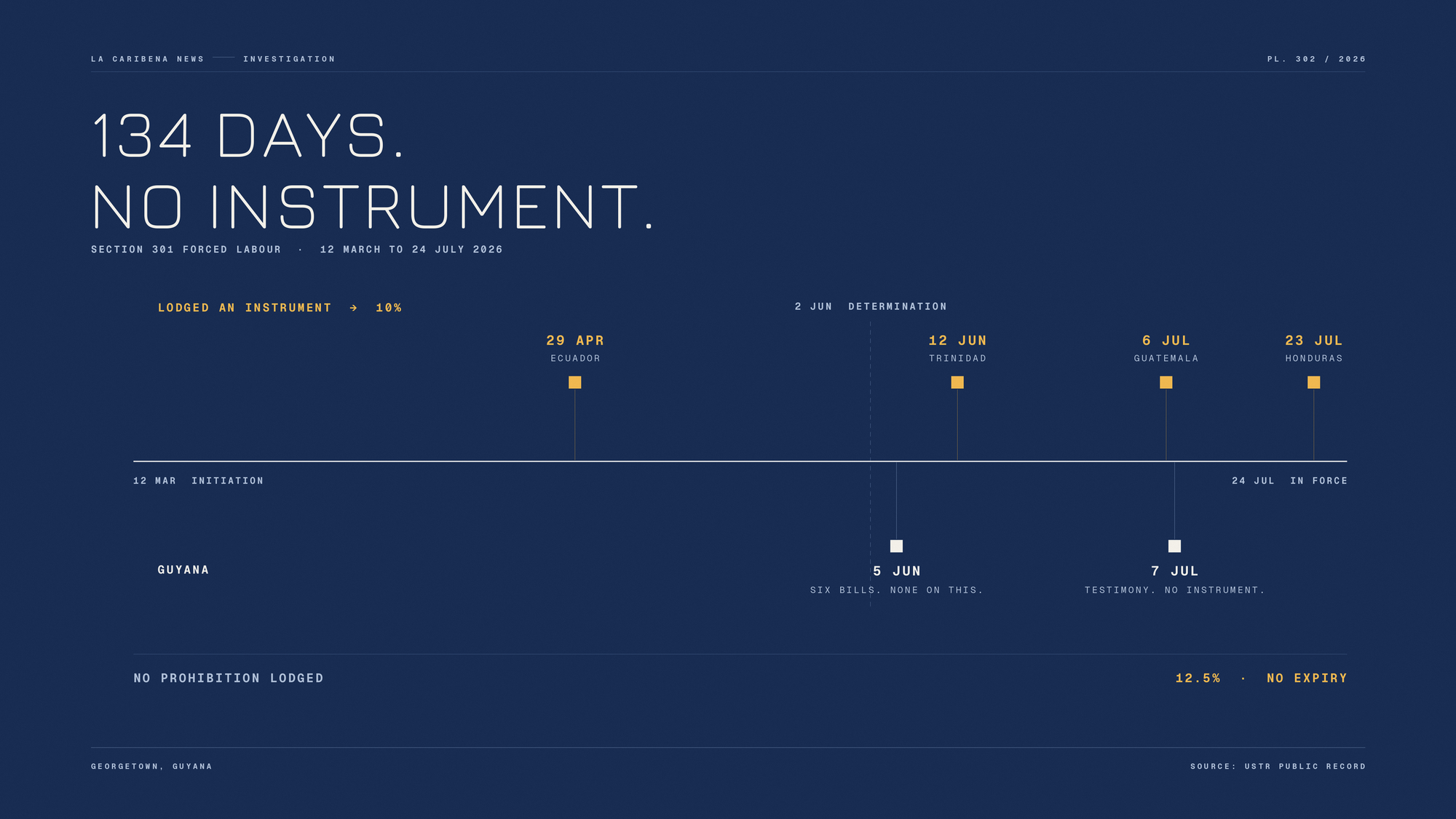
Washington gave sixty economies four months' notice and a written route to the lower tariff band. Five took it and were moved down on Thursday. Trinidad and Tobago never sent a witness to Washington; its trade minister announced a prohibition in his own Senate instead. Guyana sent a witness and no instrument. The public record of what happened in the hearing room is not comfortable reading.
From midnight tonight, Guyanese exports to the United States carry an additional 12.5 per cent duty with no expiry date. Twelve of fifteen CARICOM members carry nothing extra at all, and Trinidad and Tobago carries 10 per cent. Trinidad and Tobago moved into the 10 per cent band while Guyana did not. This report addresses a narrower question. Guyana had the same notice as everyone else, the same invitation to file, and a seat at the same table. Why did it end up in the higher band?
A note on the record
Everything that follows comes from documents any reader can open. The United States Trade Representative publishes the full transcript of every hearing day, the panel schedule naming every witness, the country-by-country findings report, and the final determination. They sit on a government website and cost nothing.
This is worth stating plainly, because the proceeding that set Guyana's tariff rate for the foreseeable future was conducted in public in Washington and reported almost nowhere in Georgetown. La Caribeña News has linked the primary documents at the foot of this report. Where this account and the transcript differ, the transcript governs, and readers are invited to check it.
The clock started in March
The US Trade Representative opened investigations into 60 economies on 12 March 2026 and named Guyana in the initiating notice. Written comments were invited. Hearings were scheduled. On 2 June the determination landed, placing Guyana in the 12.5 per cent group and setting out precisely what separated that group from the 10 per cent group. A second comment window ran to 6 July, with hearings from 7 to 9 July.
That is more than four months of public, documented warning, with the remedy stated in the notice itself. The lower rate was available to economies that imposed a prohibition on importing goods made with forced labour, or committed to one through a trade agreement, or operated a partial regime. The higher rate applied to everyone else. Nothing about the test was hidden.
What Georgetown said it would do
None of this was hidden from Guyanese readers. Demerara Waves reported the threat on 18 June and the government's response on 24 June, and the second of those pieces states the intended posture in the government's own words.
Foreign Secretary Robert Persaud told the outlet that Guyana was preparing to defend its trade policy, and that at the public hearing it would present information on efforts being made to prevent and prohibit forced labour, including forced labour imports. The request to appear had been submitted through the Ministry of Labour and Manpower Planning. He added that the government remained committed to addressing trade barriers with the United States through meaningful dialogue.
Set that against what Trinidad's trade minister was saying in the same fortnight and the difference is a verb. Port of Spain was going to prohibit. Georgetown was going to present information.
A week earlier, on 17 June, the former head of the US Foreign Commercial Service, Arun Venkataraman, had told a World Trade Centre Georgetown luncheon that the aggregate effect on Guyana's exports would probably stay limited because petroleum and bauxite are exempt, but that the real harm would fall on suppressing new categories of export, agriculture in particular. That warning was delivered to a room of Guyanese business people five weeks before the deadline.
What the neighbours carried into the room
Guyana appeared on the Western Hemisphere panel on 7 July alongside Chile, Ecuador, Guatemala, Honduras, Mexico and Peru. The transcript is public. Read in sequence, it reads like a competition nobody in Georgetown appears to have known was running.
Ecuador arrived with a prohibition already in force. Its foreign trade committee adopted the measure on 29 April and it took effect on 4 May, creating an inter-institutional body with power to investigate on its own initiative, maintain a register of high-risk origins and sectors, and coordinate with foreign authorities. Ecuador's complaint to the committee was not that it had been treated unfairly. It was that 10 per cent was too high a reward for having actually legislated.
Guatemala's delegate told the panel her country's ministerial agreement had been published the previous day, with implementation running thirty business days from adoption, and a statutory bill behind it. She asked for a rate of zero.
Honduras was the most instructive. Its representative described a decree in full draft, prepared jointly by the labour ministry, customs and the presidential trade office, and told the committee he expected it signed and in force before 24 July. That date is tonight. He named three mechanisms: a sworn supply-chain declaration required of every importer as a condition of customs clearance, a risk list built on international forced-labour indicators, and a binding technical opinion from the labour ministry that customs is legally obliged to enforce. He then cited the provision of the Trade Act that permits USTR to withhold action where a country is already taking satisfactory steps, and asked for a bridge rate of 10 per cent. He got it. Honduras appears on the 10 per cent list in Thursday's final action.
Peru's bill was already before Congress with approval expected within a fortnight. Chile produced a declaration signed in late June by four under-secretaries committing to a mechanism. Mexico pointed to an investigative protocol operating since 2023, amended in 2025, with two live investigations and an information-sharing arrangement with US Customs.
What Guyana carried
Guyana's representative presented on behalf of the Government. The statement was competent and, on its own terms, accurate. Forced labour is prohibited under the constitution and under the Combating of Trafficking in Persons Act. Guyana has ratified the relevant ILO conventions. The Ministry of Labour had completed more than 2,000 inspections by June without substantiated findings. The Guyana Revenue Authority was not aware of forced-labour goods entering the country. Where credible evidence exists, the Customs Act allows the responsible minister to prohibit importation once it is conclusively determined that goods were produced with forced labour.
She made the case that allegations of forced labour must be addressed through lawful, evidence-based investigation, and told the committee that the Government of Guyana was not aware of evidence that goods produced through forced labour were being manufactured in, imported into, or exported from Guyana. She noted that the United States remains one of Guyana's largest trading partners, that the relationship has deepened in recent years, that American firms maintain a significant presence across the economy and particularly in energy, and that US commerce is therefore neither restricted nor burdened in the Guyanese market.
She added that Guyana and the United States were in discussions towards an Agreement on Reciprocal Trade covering forced labour, and argued that imposing tariff penalties before those talks concluded would be premature and counterproductive. She closed by inviting the committee to consider Guyana's detailed written submission, and offered cooperation on any specific and verified case, together with a request for capacity building, information sharing and best practice to strengthen detection and enforcement.
That is the full shape of Guyana's case, presented here as it was presented there. It is a reasonable statement of a reasonable position. It was also, on the test USTR had published seven weeks earlier, an answer to a different question.
Asked directly for a timeline, she offered three things: the existing Customs Act power, the ongoing trade talks, and a review of Guyana's labour laws that had commenced. Every other delegation on that panel answered the same question with a date, a resolution number or a document already signed.
The exchange that decided it
Kayla Savage of the Commerce Department put the question that mattered. Guyana had asserted a power to prohibit such imports. Would its law actually prohibit the good if Guyana found one? And what had Guyana done with that authority in sectors where forced-labour risks are known to exist?
The answer was that as of that morning, Guyana had received no complaints about goods being imported using forced labour.
That reply is the whole case against Guyana in a sentence, and it was Guyana's own. The question asked what the state had done. The answer described what nobody had asked the state to do. Honduras's proposed system requires a declaration from every importer at the border whether or not anyone complains. Ecuador's body can open an investigation on its own initiative. Both are engines that run by default. Guyana's Customs Act provision only starts when someone else pushes it and a determination has already been reached, which is a remedy rather than a prohibition. USTR's entire finding is that a dormant power is not a régime. Guyana confirmed the power was dormant.
The arguments that were always going to fail
Two of Guyana's three arguments were not tailored to the proceeding.
The first was the relationship argument, that the United States is a major trading partner, that American firms are heavily present in the energy sector, and that US commerce is neither restricted nor burdened in Guyana. Peru made a more forensic version of the same point, with figures showing a cumulative American surplus of some thirty-four billion dollars. Chile made it too. Both are in the same tariff band as Guyana. Under Section 301 the burden being tested is not the bilateral balance. It is whether the absence of a forced-labour import ban distorts American commerce globally. Warm relations are not a defence to that charge, and the record now shows they were not treated as one.
The second was that tariffs were premature while reciprocal trade talks continued. The difficulty is that El Salvador and Guatemala received the lower rate precisely because they had already concluded such agreements. An unsigned negotiation is not a commitment, and Honduras understood this well enough to say plainly that it was close to concluding its own agreement while simultaneously drafting a decree that would not depend on it.
Only the third argument, the inspections record, engaged the actual test, and it engaged the wrong half of it. Two thousand domestic inspections speak to whether Guyana produces goods with forced labour. Nobody alleged that it does. The finding concerns what Guyana permits to come in.
The argument nobody made
There is a defence available to Guyana that its own delegation did not raise, and it deserves examining because most readers here will think of it immediately.
The National Assembly did not sit between 14 February 2026, when the budget passed, and the resumption the government announced for 5 June. By late May the American, British, Canadian and European missions had publicly called for Parliament to be reconvened, the Prime Minister said he could not say when it would meet, and the Clerk confirmed no date had been set because the date is fixed by the government. The USTR investigation opened on 12 March and closed on 9 July. Most of it ran inside that silence.
A country cannot legislate without a legislature, and that is a real constraint. It is not, however, an answer to this proceeding, for three reasons that are all on the record.
The first is that almost nobody who succeeded used a legislature. Ecuador acted by resolution of its foreign trade committee. Guatemala acted by ministerial agreement. Honduras acted by executive decree drafted jointly by three agencies. Chile acted by declaration signed by four under-secretaries. Every one of those instruments is executive. The only country on that panel that chose the parliamentary route was Peru, whose bill was still before Congress on 7 July, and Peru is paying 12.5 per cent tonight alongside Guyana.
The second is that Guyana already holds the executive power. Its own delegation told the committee that the Customs Act empowers the responsible minister to prohibit importation. No sitting of the National Assembly is required to exercise a power a minister already has, and the delegation confirmed under questioning that it had never been exercised.
The third is the hardest. The National Assembly did sit, on 5 June, seven weeks before the deadline. Attorney General Anil Nandlall announced in advance that six pieces of legislation would be tabled and read for the first time, and six were: the Guyana Development Bank Bill, measures on hire purchase, sexual offences law, benefits for former presidents and others. USTR had published its determination placing Guyana in the higher band three days earlier, on 2 June. Not one of the six responded to it.
The parliamentary calendar was therefore not the obstacle. When the House returned, the government had a legislative agenda ready and this was not on it.
So the parliamentary shutdown does not explain the outcome. What it does is describe the conditions in which the outcome became likely. A state that has not convened its legislature in nearly four months, whose international partners are publicly asking it to, is not a state with officials reading foreign trade registers and answering them on schedule. The tariff is not a consequence of the closure. Both are symptoms of the same thing.
The country that did not turn up
Trinidad and Tobago is not on the witness list for any of the three hearing days. The published schedule names every witness across twenty panels and Port of Spain appears on none of them. Guyana was the only CARICOM government in the room.
Trinidad and Tobago is now in the 10 per cent band. Guyana is not.
What Port of Spain has been doing instead is a matter of record. Four ministers, covering foreign affairs, energy, finance and trade, met Ambassador Greer, Ambassador Daniel Watson and Under Secretary William Kimmitt in August 2025. Prime Minister Kamla Persad-Bissessar travelled to Washington the following month at Secretary Rubio's invitation, with her foreign minister and the head of the foreign service engaging USTR directly. That campaign produced a result in November 2025, when a presidential executive order zeroed tariffs on Trinidadian ammonia, urea and urea-ammonium nitrate.
It also did the one thing USTR had asked for. On 12 June, the state broadcaster TTT reported that Trade, Investment and Tourism Minister Satyakama Maharaj had gone to the Senate and outlined a measure to prohibit the importation of goods produced through forced labour. He described it as keeping the national marketplace from becoming a dumping ground for goods produced through coercion, trafficking, debt bondage or child labour, and tied it to protecting the 20,000 to 25,000 small enterprises that make up most of the country's registered businesses.
That was ten days after USTR published the determination placing Trinidad and Tobago and Guyana in the same band. Port of Spain did not send anyone to Washington in July because it did not need to. Its trade minister had already stood up in his own parliament and said the words USTR was waiting to hear.
The two countries can now be set side by side, week by week. On 2 June both were placed in the higher band. On 5 June Guyana's National Assembly sat for the first time since February and tabled six bills, none addressing forced-labour imports. On 12 June Trinidad's trade minister went to his Senate and announced the prohibition. On 24 June Guyana's foreign secretary said the country would go to Washington and present information. On 7 July it did. On 23 July Trinidad was moved to 10 per cent and Guyana was not.
Trinidad's Parliament was sitting. So, by 5 June, was Guyana's.
The six weeks that decided it
Until Thursday this was an argument about what Guyana might have done. It is no longer hypothetical. USTR's final action moved five economies out of the higher band after the June proposal: Honduras, Trinidad and Tobago, India, Sri Lanka and Jordan. Ambassador Jamieson Greer said in the accompanying statement that he was encouraged by the trading partners who had moved quickly to adopt forced-labour import prohibitions.
That is the American trade representative confirming, in writing, that the window between 2 June and 23 July was open and that walking through it worked. Honduras walked through it with a decree drafted by three agencies in a matter of weeks. So, by some route this newsroom has not yet established, did Trinidad and Tobago.
Guyana, the Bahamas, Chile and Peru stayed where they were. Peru's case is instructive in a way that bears directly on Georgetown. Peru chose the legislative route, sent a bill to its Congress, and ran out of time. Guyana did not attempt either route, legislative or executive, despite its own delegation confirming that the responsible minister already holds an executive power under the Customs Act that has never been exercised.
The comparison that will matter most in the region is the nearest one. Guyana and Trinidad and Tobago are CARICOM's two energy exporters and the only members that sell the United States more than they buy. Six weeks ago they were in the same band. Tonight they are 2.5 percentage points apart on every non-exempt export, indefinitely.
What it costs, and who owns it
The gap between the two bands is 2.5 percentage points on every non-exempt export to the United States, applied indefinitely. Crude and gas are exempt, so the burden falls on rum, seafood, processed food and light manufacturing, which is the diversification economy the state has spent a decade financing. It lands on the same firms that are already carrying the cost of certification and standards compliance to reach American shelves at all, and it narrows a window this newsroom has argued closes around 2029.
The failure is not the delegation's. Guyana's representative defended the position she was given, with the instruments that existed. The question is why, between 12 March and 7 July, nobody produced a better instrument for her to carry. Drafting an import prohibition is not a diplomatic undertaking. It is a legal one, sitting across the Attorney General's Chambers, the Ministry of Labour, the Revenue Authority and the ministry responsible for trade. Honduras assembled the same thing from three agencies inside a few weeks under the same deadline.
This is the argument for treating compliance as an operating function rather than an annual filing exercise, which LCN has made before about Guyanese firms. It applies with more force to the state. A country whose exports depend on preferential access to one dominant market needs somebody whose job is to read foreign trade registers and answer them on time. On the evidence of the transcript, that function either does not exist or was not activated.
What remains open
The lower band has not closed. Section 301 rates carry no expiry and no ceiling, but they are reviewable, and USTR has now demonstrated twice that it will move a country that produces an instrument. Five economies proved it between June and July. Nothing in Thursday's action suggests the door has been locked behind them.
Two live questions remain unanswered as this is published, and both belong to Georgetown rather than Washington. Whether the labour law review that had commenced in July has produced anything. And whether an import prohibition has been drafted since the hearing. La Caribeña News has put those questions, together with the status of the reciprocal trade negotiations, to the relevant authorities and will publish the responses received.
Frequently Asked Questions
Is Guyana accused of using forced labour?
No. The finding concerns the absence of a prohibition on importing goods produced with forced labour elsewhere, and the failure to enforce one.
How much notice did Guyana have?
Investigations opened on 12 March 2026 and the determination followed on 2 June, with hearings in early July and duties effective 24 July.
What would have secured the lower rate?
Imposing a forced-labour import prohibition, or committing to one through a reciprocal trade agreement, or operating a partial régime.
Did any country get relief by arguing the relationship was good?
No. Peru, Chile and Guyana each made a version of that argument and all three remain at 12.5 per cent. The economies that moved down produced legal instruments.
Can Guyana still move down?
Five economies moved from the higher band to the lower one between the June proposal and the July final action. The distinction USTR draws is between economies that produce an instrument and economies that do not.
Read the record yourself
The primary documents are open to anyone. Guyana's testimony begins at page 29 of the Day 1 transcript.
Day 1 hearing transcript, 7 July 2026
Day 2 hearing transcript, 8 July 2026
Day 3 hearing transcript, 9 July 2026
Panel schedule naming every witness, 7 to 9 July 2026
Country-by-country findings report, 2 June 2026 (Guyana at section 17)
Final action and rate bands, 23 July 2026