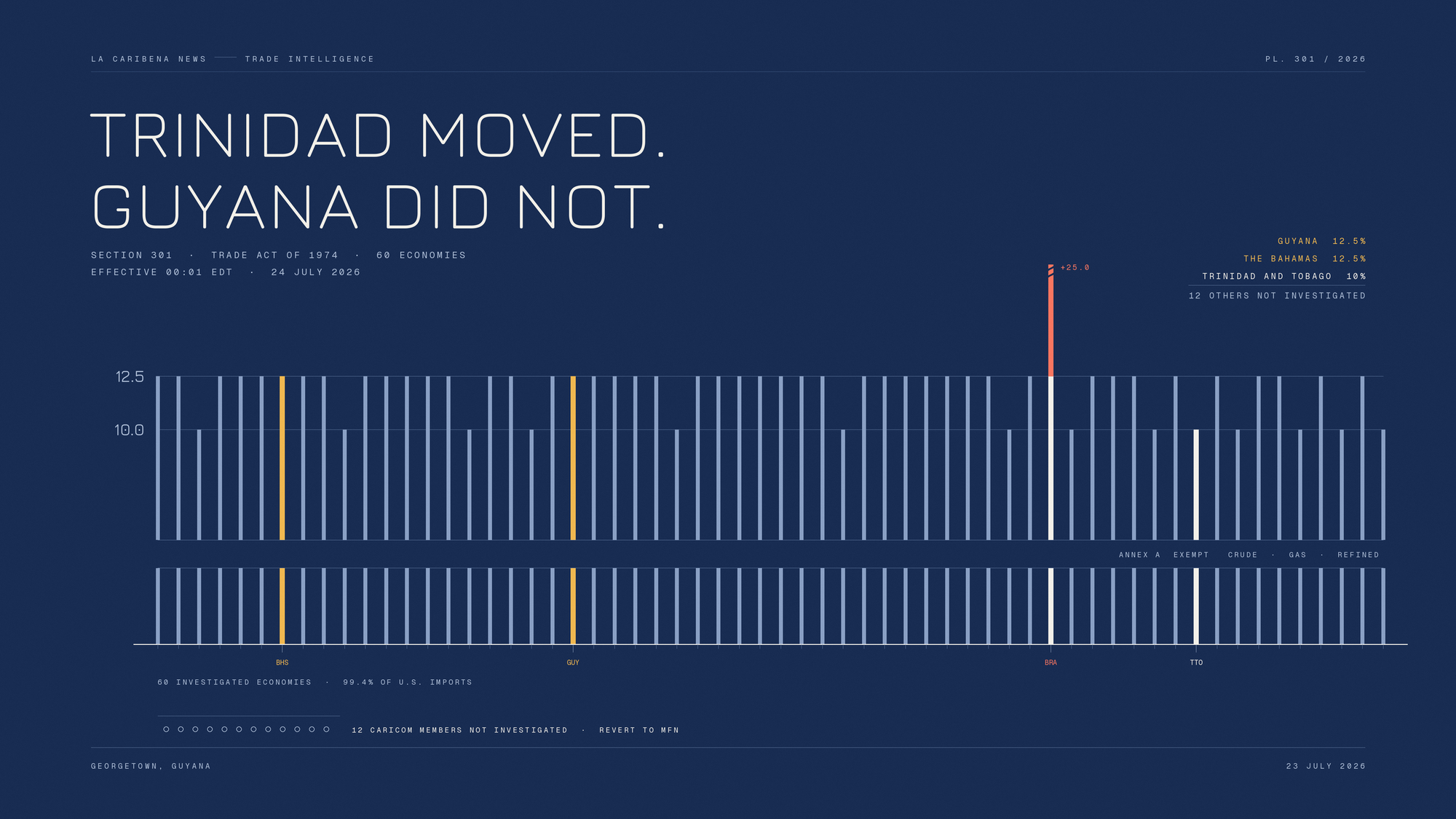
USTR's final action places Trinidad and Tobago at 10 per cent and leaves Guyana and the Bahamas at 12.5. Twelve other CARICOM members were never investigated and revert to ordinary duty tonight.
Guyana pays an additional US tariff of 12.5 per cent from 12:01 a.m. on 24 July 2026. Trinidad and Tobago pays 10 per cent and the Bahamas pays 12.5 per cent. The other twelve CARICOM members were not investigated and carry no additional duty. Crude oil, natural gas and refined products are exempt.
What takes effect tonight?
New American duties of 10 to 12.5 per cent begin at 12:01 a.m. Eastern on Friday, covering 60 trading partners and about 99.4 per cent of what the United States imports. They start at the precise moment the temporary 10 per cent surcharge expires. There is no gap between the two.
The legal ground has shifted, and that matters more than the rate. The old duty rested first on emergency powers the Supreme Court rejected in February, then on a temporary surcharge with a 150-day life that runs out today. The replacement uses Section 301 of the Trade Act of 1974, which carries no rate ceiling and no sunset. Section 301 duties have survived court challenge before. They can sit in place indefinitely. This follows earlier signals that dozens of countries were under review.
The stated grounds are forced labour. The US Trade Representative spent months examining whether trading partners prohibit and enforce against the importation of goods made with forced labour, and concluded in June that all 60 economies had failed on one count or both. Fifty-four, Guyana among them, were found to have neither imposed such a prohibition nor enforced one. Those countries were placed in the 12.5 per cent band.
Which Caribbean countries are affected?
Three were investigated: Guyana, Trinidad and Tobago and the Bahamas. In June all three were placed in the higher band. In the final action published on Thursday, Trinidad and Tobago appears on the 10 per cent list. Guyana and the Bahamas do not.
Five economies moved down between the June proposal and Thursday's determination. Honduras, Trinidad and Tobago, India, Sri Lanka and Jordan all left the higher band. Ambassador Jamieson Greer said in the accompanying statement that he was encouraged by partners who had moved quickly to adopt forced-labour import prohibitions, which is an unusually direct confirmation that the six weeks after the proposal were the six weeks that counted.
The other twelve CARICOM members were never on the list. Barbados, Jamaica, Belize, Suriname, Haiti and the OECS states are not covered by this action at all. When the temporary surcharge lapses their goods return to ordinary most-favoured-nation duty, which averages a little over three per cent and is zero on a great many lines. Section 232 duties on steel, aluminium, copper and vehicles still apply to everyone, and new pharmaceutical measures are arriving on their own schedule.
The Community therefore ends tonight in three positions. Twelve members carry no additional duty. Trinidad and Tobago carries 10 per cent. Guyana and the Bahamas carry 12.5 per cent with no expiry date. Guyana and Trinidad are the region's two energy exporters and the only CARICOM states that sell the United States more than they buy from it. They are now 2.5 points apart, permanently, and the difference was decided in the weeks after 2 June.
What does 12.5 per cent actually hit?
Not the oil. Crude petroleum, refined products, natural gas and natural gas liquids sit in the exemption annex, along with bananas, coffee, cocoa, spices and several tropical fruits. Guyana's largest export by value passes through untouched. So does Trinidad's gas trade.
What remains inside the fence is the part of the economy the country has spent a decade trying to build. Rum. Seafood. Processed food. Light manufacturing. The extractive sector is exempt and the diversification sector carries the duty. Read that either as Washington protecting its own energy supply or as a tax falling precisely where Guyana can least afford it. Both readings describe the same annex.
Twelve and a half per cent will not close a shrimp exporter. It will decide whether a Georgetown agro-processor with a thin margin and one American buyer keeps the account. That damage is quiet and slow, and it lands first on the firms already fighting for the certification and quality standards that get them onto US shelves at all.
Is this better or worse than what Guyana had?
Worse, and the comparison being made elsewhere is misleading. The 38 per cent rate imposed on Guyana in April 2025 died with the Supreme Court ruling in February. It is not the baseline. Since then Guyana has been paying the flat temporary surcharge, and in April the World Trade Centre Georgetown put Guyana's effective rate at 15 per cent against 10 for the rest of CARICOM.
Measured against that, tonight is not relief. It is a comparable burden made permanent, at the moment most of the region stops paying anything extra.
What about CBERA?
Still law. The Caribbean Basin Economic Recovery Act has no expiration date and the Caribbean Basin Trade Partnership Act runs to September 2030. Neither has been repealed. What has happened is that successive tariff actions stack on top of duty-free entry, so the preference survives on paper and is cancelled at the border.
That is the substance of the case the World Trade Centre Georgetown took to Philadelphia. Executive Director Wesley Kirton was not asking Congress to renew a lapsed statute. He was asking Washington to stop overwriting one it never repealed. Haiti is the exception worth watching, since its HOPE and HELP preferences did expire in September 2025 and renewal bills are still sitting in the Senate Finance Committee.
Did Guyana make its case?
It did. Guyana's representative appeared for the Government at the USTR hearing on 7 July, on a panel with Chile, Ecuador, Guatemala, Honduras, Mexico and Peru. She told the committee that Guyana is committed to eliminating forced labour, that the Ministry of Labour had completed more than 2,000 inspections by June without substantiated findings, and that American commerce is neither restricted nor burdened in the Guyanese market. She argued that penalising Guyana while reciprocal trade talks were still running would be premature.
It did not work, and the reason is uncomfortable. Guyana's neighbours arrived at that same table carrying legal instruments. Ecuador had a prohibition already in force since May. Guatemala's ministerial agreement had been published the previous day. Honduras told the committee its decree would be signed before 24 July, meaning tonight. Peru's bill was in Congress. Guyana pointed to an existing provision of the Customs Act and to a review of its labour laws that had begun.
Honduras was moved to the lower band on Thursday, having done what it told the committee it would do. Trinidad and Tobago was moved as well. Guyana was not.
One distinction deserves emphasis, because it will be blurred. Guyana is not accused of using forced labour. The finding concerns the absence of a law prohibiting the import of goods made with forced labour elsewhere. The gap is administrative, which is precisely why others closed theirs in a matter of weeks. LCN will examine how Guyana came to be in the higher band, and who was responsible for closing that gap, in a separate report.
Why does Brazil matter here?
Brazil carries the 12.5 per cent forced-labour duty plus a separate 25 per cent action of its own, putting combined exposure near 37.5 per cent. It has threatened reciprocal tariffs and moved to shelter exporters with a credit package. Retaliate publicly, subsidise quietly. How hard Brasília pushes each track sets the ceiling for what smaller CELAC economies believe they can attempt.
The effect that will reach Caribbean shelves first is not diplomatic. Brazilian goods priced out of the American market will look for somewhere nearer to go. That may mean cheaper protein in Georgetown. It may also mean regional producers undercut at home in the same quarter their US margin thins. Brazilian export decisions already move regional food pricing, as they did when Brazil moved to fill China's beef quota. A wall that high in the north redirects a great deal more than beef.
What should exporters do now?
Find your tariff code and check it against the exclusion annex before the next shipment clears. The annex runs to dozens of pages and the wording moved through two rounds of comment. An exporter who assumes the duty applies when the annex exempts the product will price itself out of a market it never lost.
Then read the contract. Whoever drafted the incoterms already decided who absorbs this, and most Caribbean exporters have never had reason to look closely at that clause. Litigation is expected and Section 301 has historically withstood it, so planning around a court reversal is not a plan.
The governmental move is a drafting exercise, and the region has just watched four countries demonstrate it. Guyana's placement rests on the absence of an import prohibition. That is legislation, not diplomacy, and firms with capital tied up in the sectors the Guyana Development Bank has prioritised have a direct interest in how quickly it is drafted.
Frequently Asked Questions
When do the new duties begin?
12:01 a.m. Eastern on Friday 24 July 2026, as the previous surcharge expires.
Which CARICOM states are covered?
Guyana, Trinidad and Tobago and the Bahamas were investigated. In the final action Trinidad and Tobago is at 10 per cent, Guyana and the Bahamas at 12.5. The remaining twelve members were not investigated.
Do the other twelve now pay nothing?
No. They pay ordinary MFN duty, plus any Section 232 exposure. They simply carry no additional duty from this action.
Is Guyana's oil taxed?
No. Crude, refined products and natural gas are within the exemption annex. Non-energy exports carry the duty.
Is Guyana accused of using forced labour?
No. The finding concerns the absence of a legal prohibition on importing goods produced with forced labour, and the failure to enforce one.
Can the rate come down?
Yes. Five economies moved from the higher band to the lower one between the June proposal and the final action, including Trinidad and Tobago and Honduras. The route remains open.
Is CBERA still in force?
Yes. CBERA has no expiry and CBTPA runs to 2030. The additional duties apply on top of preferential entry.