By La Caribeña News · 30 August 2026
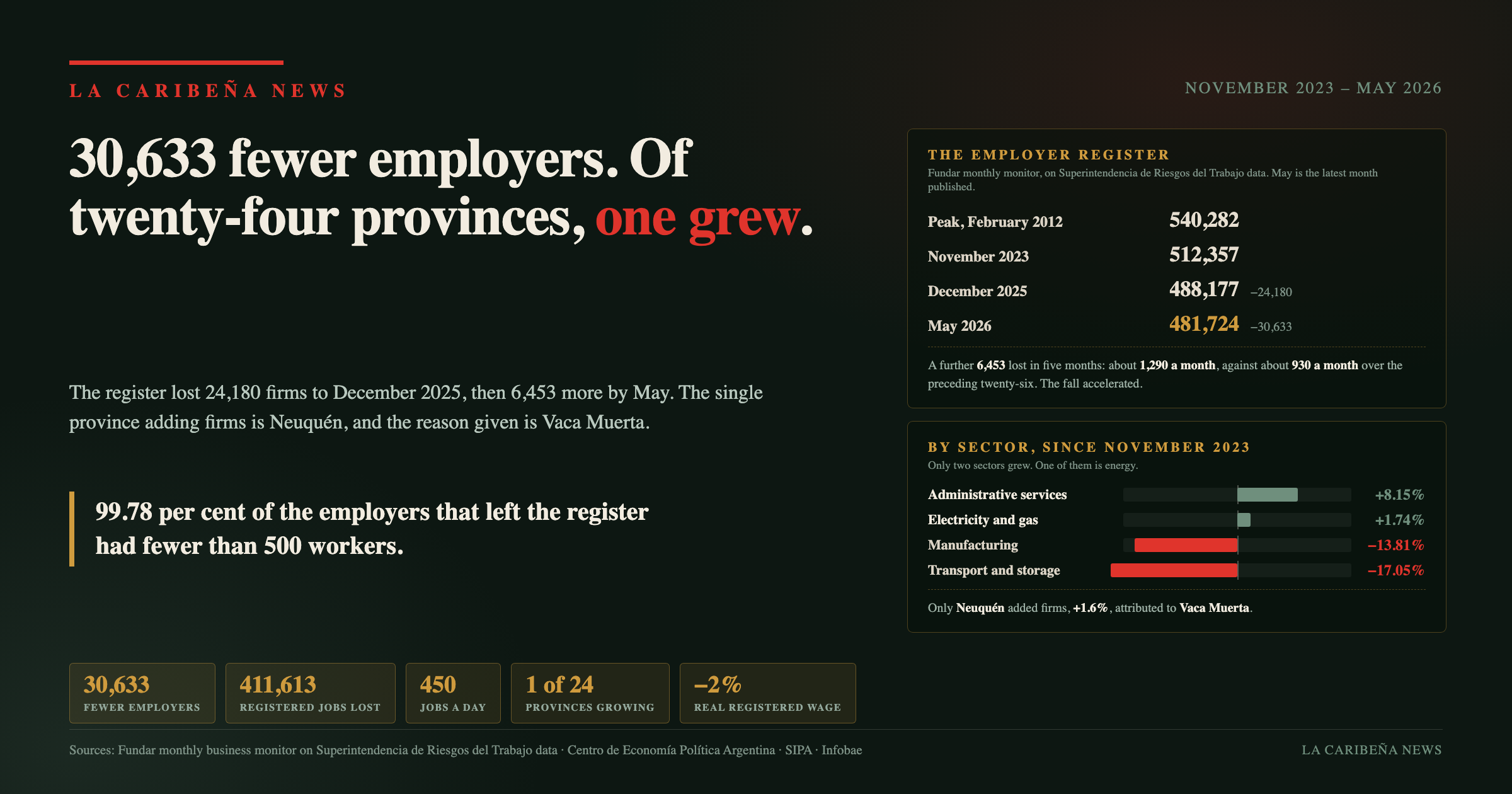
Argentina's register of employers lost 24,180 firms across the first twenty-six months of Javier Milei's government, to December 2025. It lost a further 6,453 in the five months to May 2026.
That is roughly 930 firms a month, and then roughly 1,290. The contraction did not level off this year. It sped up.
The figures were published in mid-August. Of twenty-four provinces, one has been adding firms, and the reason given for it is Vaca Muerta.
How many employers has Argentina lost?
Thirty thousand six hundred and thirty-three, against a November 2023 base.
Fundar's monthly business monitor, built on data from the Superintendencia de Riesgos del Trabajo, the workplace-risk regulator with which employers must register, puts the registry at 481,724 firms in May 2026 against 512,357 in November 2023.
The difference is 30,633, about 6 per cent of the base. The registry is at its lowest in nearly two decades and below its 2021 level, after the pandemic. Its peak was 540,282, in February 2012.
The decline is continuous rather than sudden. Infobae, reporting the monitor, records May 2026 at 2,371 firms below April. Against May 2025 it was 16,560 fewer, a fall of 3.3 per cent.
An earlier edition of the same monitor, reported in April, put the register at 488,177 firms at December 2025, a loss of 24,180 since November 2023. Between that reading and May the register lost another 6,453.
The first twenty-six months averaged about 930 firms a month. The next five averaged about 1,290.
How current are these figures?
May is the most recent month the series covers, and the reason is publication lag.
The Superintendencia de Riesgos del Trabajo compiles the register from employers' own filings, and Fundar's monitor follows. The May reading was reported in mid-August, a gap of roughly ten weeks. On the published record this newspaper can find, no June or July reading has been issued.
So May 2026 is not a stale month chosen over a newer one. It is the current state of the series, and the ten-week gap is a property of the data rather than of the story.
What does the registry actually count?
Employers, not businesses, and the distinction matters.
The figure counts firms registered with the workplace-risk regulator as employers. A business that sheds its last employee leaves that registry. So does one that moves into informality. Neither has necessarily stopped trading.
Spanish-language reporting of the data describes the period as producing the closure or the deformalisation of thousands of enterprises. Both are in the number, and the published data does not separate them.
So the precise statement is that Argentina has 30,633 fewer registered employers than it had in November 2023. How many of those firms no longer exist, and how many exist without formal employees, is not established by this series.
Which sectors carried it?
Transport and manufacturing proportionally, commerce by volume.
Measured cumulatively since November 2023, transport and storage is down 17.05 per cent and manufacturing down 13.81 per cent. In May alone the steepest monthly fall was accommodation and gastronomy, at 1.38 per cent.
The Centro de Economía Política Argentina, which reaches the same total, gives the counts. Commerce lost 8,408 productive units, transport and storage 6,733, real estate services 4,098 and manufacturing 4,020.
Two sectors grew. Administrative services rose 8.15 per cent, the largest increase of any surveyed. Electricity and gas rose 1.74 per cent.
| Sector | Change since November 2023 |
|---|---|
| Administrative services | +8.15% |
| Electricity and gas | +1.74% |
| Accommodation and gastronomy | falling, steepest single month in May |
| Manufacturing | -13.81% |
| Transport and storage | -17.05% |
What happened to employment?
411,613 registered jobs, and almost all of it in smaller firms.
CEPA puts the destruction of registered posts in productive units at 411,613, a fall of 4.18 per cent in total payroll. That is roughly 450 jobs a day across the period, against roughly 33 employers a day leaving the registry.
99.78 per cent of the employers that disappeared had up to 500 workers. This is a contraction of small and medium firms, not of large ones.
Real wages did not absorb it. The registered real wage measured through the Sistema Integrado Previsional Argentino sat about 2 per cent below its November 2023 level.
The distress shows in the credit data as well. This newspaper reported yesterday that household loan delinquency reached 12.8 per cent in June, against 5.2 per cent a year earlier, with personal loans at 16.4 per cent, and that part of the first pause in nineteen months came from moving bad debtors off balance sheet.
Industriales Pymes Argentinos recorded 190 preventive bankruptcy filings in Buenos Aires in 2025, an increase of 131.7 per cent.
What grew, and where?
Energy, in one province.
Of twenty-four provinces, Neuquén alone increased its count of registered firms, by 1.6 per cent, and the growth is attributed to Vaca Muerta, the shale formation that has become Argentina's principal hydrocarbon development.
Set that beside the sector table. The two activities that grew nationally are administrative services and electricity and gas. The one province that grew is the one where the gas is.
Neuquén has appeared in this newspaper before for a different reason. Its power cooperative CALF chose Huawei equipment, and Washington issued visa warnings to the directors who took the decision.
Why does this read in the Caribbean?
Because it is the shape of an extractive expansion, measured.
Argentina is not a small state and its politics are its own. What its registry shows is something the Caribbean's oil and gas producers can measure themselves against: over thirty months, an economy in which the hydrocarbon province added firms while the other twenty-three lost them, and in which the sectors that grew were energy and the services that administer it.
Guyana is running the same experiment with a shorter history and a larger discovery. Its share of Stabroek production reached 39.8 per cent this month because a cost bank was recovered, not because terms changed. Trinidad is running it in reverse, with gas short enough that an LNG train has stood idle since 2020.
Argentina also demonstrates that the financing arrangements around such an economy are not what they appear. Its currency swap with China reads at US$19 billion, and under US$700 million was ever actually drawn.
Ninety-nine point seven eight per cent of the employers that left the registry had fewer than 500 workers. Whatever grew in Neuquén did not hold them.
Text equivalent of the title card
Every data point shown on the title image, with its source.
- Employer registry: 512,357 in November 2023, 481,724 in May 2026. Net loss 30,633, about 6 per cent. Source: Fundar monthly business monitor, on Superintendencia de Riesgos del Trabajo data, reported by Infobae, 14 August 2026.
- Historical peak 540,282, February 2012.
- December 2025 reading: 488,177 firms, a loss of 24,180. May 2026 reading: 481,724, a loss of 30,633. A further 6,453 in five months, about 1,290 a month against about 930 a month over the preceding twenty-six. May 2026 was 16,560 below May 2025, a fall of 3.3 per cent. Source: Fundar monthly business monitor, editions reported 16 April and 14 August 2026.
- All 24 provinces fell in May 2026. 23 fell year on year. Only Neuquén grew, by 1.6 per cent, attributed to Vaca Muerta.
- Sector change since November 2023: administrative services +8.15%, electricity and gas +1.74%, manufacturing -13.81%, transport and storage -17.05%.
- CEPA unit counts: commerce -8,408, transport and storage -6,733, real estate services -4,098, manufacturing -4,020.
- 411,613 registered jobs lost, payroll down 4.18 per cent, about 450 jobs and 33 employers a day. Source: CEPA.
- 99.78 per cent of employers that left the registry had up to 500 workers.
- Registered real wage about 2 per cent below the November 2023 level. Source: SIPA, via CEPA.
- 190 preventive bankruptcy filings in Buenos Aires in 2025, up 131.7 per cent. Source: Industriales Pymes Argentinos.
The registry, end to end
| Firms | |
|---|---|
| Peak, February 2012 | 540,282 |
| November 2023 | 512,357 |
| December 2025 | 488,177 |
| May 2026 | 481,724 |
| Net change since November 2023 | -30,633 |
| Change May 2025 to May 2026 | -16,560 (-3.3%) |
Frequently Asked Questions
How many companies have closed in Argentina under Milei?
The registry of employers fell by 30,633 between November 2023 and May 2026, from 512,357 to 481,724, on Superintendencia de Riesgos del Trabajo data compiled by Fundar. That is about 6 per cent. The figure counts employers registered with the workplace-risk regulator, so it includes firms that shed all employees or moved into informality as well as those that closed.
Over what period were the losses measured, and how current are they?
November 2023 to May 2026, roughly thirty months. May is the most recent month the series covers: the Superintendencia de Riesgos del Trabajo data reached publication in mid-August, a lag of about ten weeks, and no June or July reading has been issued on the public record. The employment figures compiled by CEPA over the same period give about 450 registered jobs lost a day, which is consistent with that window and not with any shorter one.
Which sectors were worst affected?
Transport and storage fell 17.05 per cent and manufacturing 13.81 per cent cumulatively since November 2023. By unit count CEPA records commerce down 8,408, transport and storage 6,733, real estate services 4,098 and manufacturing 4,020. Administrative services and electricity and gas were the only sectors to grow.
Did any part of Argentina add firms?
One province. Of twenty-four, only Neuquén increased its count of registered firms, by 1.6 per cent, growth attributed to the Vaca Muerta shale development. All twenty-four fell in May 2026 and twenty-three were down year on year.
How many jobs were lost?
CEPA puts the figure at 411,613 registered posts in productive units, a fall of 4.18 per cent in total payroll, at roughly 450 a day. Of the employers that left the registry, 99.78 per cent had up to 500 workers.