ANALYSIS
The target was not a government and not a telecoms giant. It was an electricity co-operative with 9,000 fibre customers, and the consequence being weighed lands on named individuals. Caribbean boards sitting over Huawei equipment should read the file.
BY LCN NEWSROOM · GEORGETOWN, GUYANA
Quick summary: The United States warned directors of Neuquén electricity co-operative CALF that their visas could be restricted over a Huawei fibre contract, Argentine outlets reported in August 2026. The instrument, section 212(a)(3)(C) of the Immigration and Nationality Act, has been used against Huawei employees since 2020. This extends it to a customer.
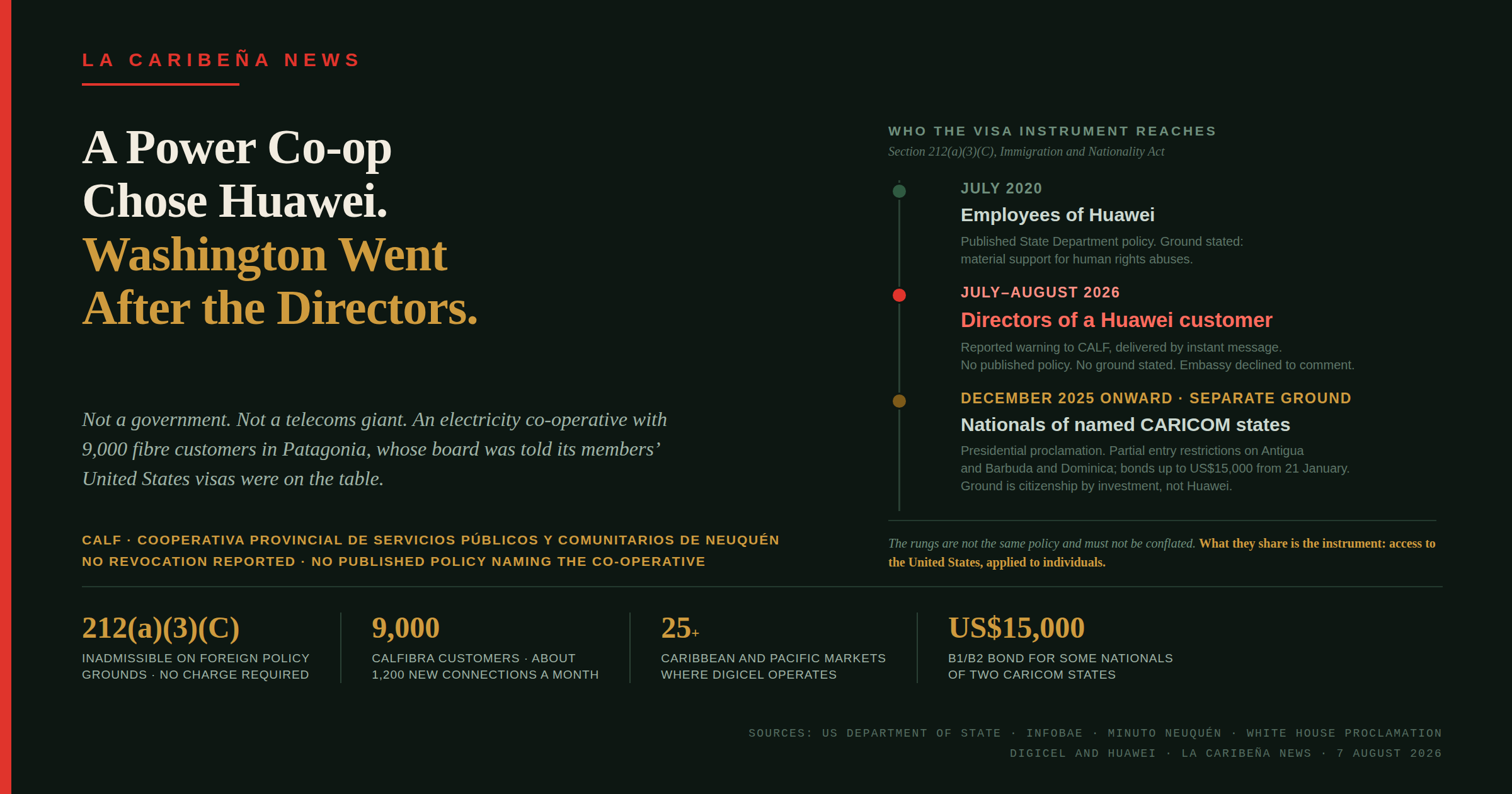
What the title card shows
Every data point on the article's title card, in text.
- 12 July 2026. Date a CALF manager began receiving messages referencing a United States policy to restrict visas of executives linked to Huawei's expansion in Argentina. Source: Argentine press reporting.
- 9,000 customers. Subscribers on CALF's Calfibra fibre network, growing by about 1,200 connections a month. Source: Argentine press reporting.
- Section 212(a)(3)(C). The Immigration and Nationality Act provision making a person inadmissible where the Secretary of State has reason to believe entry would have potentially serious adverse foreign policy consequences. Source: United States Department of State.
- July 2020. When the State Department first imposed visa restrictions on certain employees of Chinese technology companies including Huawei. Source: United States Department of State.
- 25+ markets. Caribbean and Pacific territories in which Digicel operates, including Jamaica, Trinidad and Tobago, Barbados, Guyana, Haiti and Suriname. Source: company and industry reporting.
- 16 December 2025. Date of the United States presidential proclamation placing partial entry restrictions on Antigua and Barbuda and Dominica, effective 1 January 2026. Source: White House proclamation as reported.
- US$15,000. The bond some nationals of those two states may be required to post for a B1/B2 visa from 21 January 2026. Source: as reported.
What happened at CALF?
A fibre contract became a personal problem for the people who signed it.
The Cooperativa Provincial de Servicios Públicos y Comunitarios de Neuquén, known as CALF, distributes electricity in the Argentine province of Neuquén. It also runs Calfibra, a fibre-optic network built with Huawei technology, which Argentine outlets report has around 9,000 customers and is adding roughly 1,200 connections a month. The co-operative had also been in talks over a regional data centre and further Huawei equipment.
On 12 July 2026, a manager at the co-operative began receiving messages through an instant messaging service referring to a United States policy that would restrict or revoke visas for executives linked to the expansion of Huawei's operations in Argentina, Infobae reported. Reporting indicates other companies considered strategic could face the same treatment.
CALF's response was institutional rather than defensive. It sent a formal note to the United States Ambassador in Buenos Aires, Peter Lamelas, copied to Argentina's foreign ministry, asking two questions: whether those messages represented an official position of the United States Government, and what the technical or legal grounds for the objections were.
The co-operative publicly defended the network and confirmed it will continue with all its projects, Calfibra included. The United States Embassy declined to comment.
What is the legal instrument?
An old and very broad one.
Under section 212(a)(3)(C) of the Immigration and Nationality Act, a person is inadmissible to the United States where the Secretary of State has reason to believe their entry "would have potentially serious adverse foreign policy consequences for the United States." It requires no conviction, no charge and no public finding. It is a determination, not a proceeding.
The State Department has applied it to this sector before. In July 2020 it imposed visa restrictions on certain employees of Chinese technology companies, naming Huawei among them, on the basis that those employees provided material support to a regime committing human rights abuses. The Department has separately used visa restriction policies against executives of foreign private companies in unrelated contexts, including travel firms said to facilitate irregular migration.
So the mechanism is established, the sector is already named, and the practice of reaching foreign private-sector executives is not new.
What is actually new here?
The target moved down the supply chain.
The 2020 policy reached employees of Huawei. What Argentine reporting describes at CALF reaches directors of a Huawei customer, a provincial electricity co-operative whose business is distributing power and selling broadband in Patagonia.
That is a different proposition. A vendor's staff can be said to be part of the vendor. A utility's board is being asked to weigh a procurement decision against its own members' ability to enter the United States.
A procurement decision has been converted into a personal travel consequence for the people who take it. That is the part Caribbean directors should read twice.
How much of this is confirmed?
Less than the headlines suggest, and the piece should say so.
No visa has been reported as revoked. What has been reported is a warning, delivered initially over an instant messaging service rather than by note verbale, followed by silence when the recipient asked for the official basis. The Embassy declined to comment, and on the public record this newspaper can find, the United States has not published a policy naming CALF, Argentina's co-operatives or Huawei customers generally.
CALF's own letter is the sharpest document in the story precisely because of what it asks: is this official, and what is the legal ground? Both questions remain unanswered in public.
Reported pressure is not sanction. But a board cannot plan on the difference, which is the point of the exercise.
Why does this reach the Caribbean?
Because the equipment is already installed, and the region did not install it by accident.
Huawei has been a long-standing supplier into Caribbean networks. Digicel, which operates in more than 25 Caribbean and Pacific markets including Jamaica, Trinidad and Tobago, Barbados, Guyana, Haiti and Suriname, has publicly partnered with Huawei alongside ZTE and Ericsson to deploy mobile and broadband infrastructure. The two companies jointly demonstrated 10 Gbps fibre-to-the-home in Jamaica and ran the Caribbean's first 4K broadcast test together.
This newspaper is not asserting which vendor supplies any current Caribbean 5G core, and operators do not generally publish that. The relevant fact is narrower and sufficient: Huawei equipment has been deployed across Caribbean networks for a decade, procurement decisions were taken by identifiable boards, and those boards are still sitting.
The exposure is not confined to telecoms. CALF is an electricity co-operative that moved into fibre. Across the Caribbean, utilities, port authorities, development banks and state enterprises have made similar adjacent-infrastructure choices, and the people who approved them are named in board minutes.
Is the visa instrument already pointed at CARICOM?
Yes, though on entirely different grounds, and the distinction matters.
A United States presidential proclamation of 16 December 2025, effective 1 January 2026, placed Haiti under full entry restrictions and Antigua and Barbuda and Dominica under partial restrictions. From 21 January 2026, nationals of those two states found otherwise eligible for a B1/B2 visa may be required to post a bond of up to US$15,000. Five CARICOM states with citizenship by investment programmes, Antigua and Barbuda, Dominica, Grenada, Saint Kitts and Nevis and Saint Lucia, face immigrant visa suspensions. CARICOM has urged a quick resolution.
Those measures rest on citizenship by investment and information-sharing concerns. They have nothing to do with Huawei, and conflating the two would be wrong.
What they share is the instrument. Visa access is being used as a routine lever of United States policy toward the region, on more than one ground at once. A Caribbean director is therefore already operating inside a tightening travel architecture before any technology question arises.
| The 2020 policy | Neuquén, 2026 | CARICOM, 2025 to 2026 | |
|---|---|---|---|
| Who is reached | Huawei employees | Directors of a Huawei customer | Nationals of named states |
| Stated ground | Human rights, material support | Not stated publicly | CBI and information sharing |
| Instrument | Visa restriction | Visa restriction, reported | Entry restriction, bonds, suspensions |
| Published policy | Yes | None found | Yes, presidential proclamation |
Sources: United States Department of State; Argentine press reporting; White House proclamation as reported.
What should a Caribbean board do about it?
Five things, and none of them is to rip anything out.
1. Establish what is actually installed. Vendor by network layer, with contract dates. A board cannot assess an exposure it has not inventoried.
2. Find out who signed. The reported instrument attaches to individuals. Directors should know which of them are named on the relevant approvals.
3. Ask for the policy in writing. CALF's letter is the model. A request for the official position and legal basis, in writing, to the embassy, copied to the foreign ministry, costs nothing and creates a record.
4. Do not act on an instant message. A communication that will not identify itself as official policy should not move a procurement decision. Verify the channel before conceding anything to it.
5. Put it on the risk register as a director exposure, not just a vendor risk. Boards routinely record supplier concentration. Very few record the possibility that a supplier choice becomes a personal travel restriction for the people who approved it.
The wider point is one this newspaper has made in a different sector this week: a state or a firm that can only respond to terms will keep receiving them. CALF's response, asking for the rule in writing, is what capability looks like at board level. It may not change the outcome. It puts the question where it belongs.
Frequently Asked Questions
What is CALF and what did it do?
The Cooperativa Provincial de Servicios Públicos y Comunitarios de Neuquén distributes electricity in the Argentine province of Neuquén and runs Calfibra, a fibre network built with Huawei technology serving around 9,000 customers.
What did the United States warn about?
Argentine outlets reported that from 12 July 2026 a CALF manager received messages referencing a United States policy to restrict or revoke visas of executives linked to Huawei's expansion in Argentina. CALF wrote to Ambassador Peter Lamelas asking whether this was official and on what legal basis. The Embassy declined to comment.
What is the legal basis for restricting a foreign executive's visa?
Section 212(a)(3)(C) of the Immigration and Nationality Act makes a person inadmissible where the Secretary of State has reason to believe their entry would have potentially serious adverse foreign policy consequences for the United States. No charge or conviction is required.
Has any visa actually been revoked?
No revocation has been reported. What has been reported is a warning and the possibility of restrictions, with no published policy naming the co-operative.
Does Huawei equipment operate in Caribbean networks?
Huawei has supplied Caribbean networks for years, including a long-standing partnership with Digicel alongside ZTE and Ericsson across markets such as Jamaica, Trinidad and Tobago, Guyana and Suriname. Operators do not generally publish current vendor composition by network layer.